
Beneath the deceptively simple surface of a steaming cup of black coffee lies an astonishingly complex chemical universe, a meticulously orchestrated symphony of hundreds, if not thousands, of distinct molecular compounds. Far from being a mere infusion of roasted beans, this ubiquitous beverage is primarily water—over 98.5% of its volume—yet it is the remaining 1.2% to 1.5% of total dissolved solids (TDS) that bestows upon it its iconic color, captivating aroma, and multifaceted flavor profile. This minute fraction, typically 12-15 grams of extracted solids from about 60 grams of ground coffee per liter, represents a frontier of ongoing scientific exploration, challenging analytical chemists and delighting connoisseurs alike. The quest to fully understand what constitutes "the perfect cup" transcends simple brewing parameters, delving deep into the molecular architecture that defines this beloved drink.
The Invisible Symphony: Unpacking Coffee’s Chemical Complexity
The journey to understand coffee’s chemical composition began centuries ago, but it is only with the advent of sophisticated analytical techniques in the latter half of the 20th century that the true depth of its complexity has started to unravel. Early analyses focused on major components like caffeine and sugars, but modern chromatographic methods, such as Gas Chromatography-Mass Spectrometry (GC-MS) and High-Performance Liquid Chromatography (HPLC), have allowed scientists to identify and quantify an ever-growing number of compounds. These techniques are capable of separating individual chemical components, revealing a staggering array of molecules, many of which are known and characterized, while a significant portion continues to elude full identification. A notable aroma extract dilution analysis (AEDA) conducted in 2002, for instance, starkly illustrated this challenge by revealing that 13 of the 40 key odorants in coffee remained unknown [1]. This analytical enigma often stems from compounds being present in exceedingly low concentrations, making structural elucidation difficult, or due to their large and intricate molecular structures.
The pursuit of replicating coffee’s flavor synthetically offers a compelling testament to its complexity. A 1996 study attempted to create "model" coffees mimicking Arabica and Robusta varieties using a selection of 22 key volatile compounds [2]. While assessors described these synthetic brews as "clearly coffee-like," the nuanced depth and full spectrum of natural coffee were undeniably absent. This suggests that even a carefully curated selection of two dozen compounds falls far short of capturing the complete aromatic signature, reinforcing the notion that a truly "synthetic" coffee capable of rivaling its natural counterpart remains a distant prospect.
A Journey Through Time: Unveiling Coffee’s Secrets
The scientific exploration into coffee’s composition has evolved alongside advancements in analytical chemistry.
- Early 20th Century: Initial chemical investigations largely focused on identifying major components like caffeine, organic acids, and simple sugars, primarily for understanding its stimulant properties and basic nutritional profile.
- Mid-20th Century: The development of more refined separation techniques began to reveal the presence of volatile compounds, but comprehensive analysis was still limited. The emphasis was often on broad classifications rather than individual molecules.
- 1960s: The discovery of "rose ketones," including beta-damascenone, in rose oil by Firmenich marked a significant milestone in flavor chemistry. While not directly related to coffee at the time, this work laid foundational knowledge for understanding potent odorants present in trace amounts, which would later prove crucial for coffee.
- 1990s: A pivotal period saw a surge in research utilizing advanced gas chromatography and mass spectrometry. The 1996 study by Semmelroch and Grosch [2], which identified 22 key volatile compounds and attempted synthetic coffee models, highlighted both the progress and the remaining challenges in recreating coffee’s intricate aroma. This era also saw a growing appreciation for the non-volatile compounds contributing to taste and body.
- Early 2000s: The 2002 AEDA study by Sanz, Czerny, Cid, and Schieberle [1] further deepened understanding by identifying key odorants and, crucially, pointing out the significant number of still-unknown aroma contributors. This underscored the fact that even with advanced tools, the full picture of coffee’s flavor was far from complete. The publication of comprehensive food chemistry texts, like Belitz, Grosch, and Schieberle’s "Food Chemistry" in 2004 [3], began to consolidate this expanding knowledge.
- 2010s and Beyond: Contemporary research continues to refine the understanding of coffee extraction and composition. Studies like Amanpour and Selli’s work in 2016 [4] on specific volatile compounds, and Batali et al.’s 2020 research [5] on sensory attributes and chemical components, reflect an ongoing, interdisciplinary effort. This period also correlates with the "third wave" coffee movement, where an emphasis on origin, processing, and precise brewing techniques has driven demand for deeper scientific insight into how these factors influence the final cup’s chemistry. This chronological progression illustrates a shift from broad identification to highly specific molecular characterization, driven by ever-improving analytical technologies.
The Microscopic World of Taste and Aroma: Volatiles and Non-Volatiles
The compounds within coffee are broadly categorized into volatile and non-volatile components, each playing a distinct yet interconnected role in the sensory experience. Volatile compounds are those with low boiling points that readily evaporate, making their way to the olfactory receptors in the nose, thus contributing to the coffee’s aroma. This category includes a vast array of molecules such as pyrazines (responsible for roasted, nutty notes), aldehydes (fruity, grassy), ketones (caramel, sweet), esters (fruity, floral), and furans (caramel, sweet, savory). The interplay of these hundreds of volatile molecules creates the rich, complex bouquet that coffee aficionados cherish.
Conversely, non-volatile compounds remain in the liquid and interact with taste receptors on the tongue, influencing the primary tastes of bitterness, sweetness, acidity, and astringency. This group encompasses:
- Carbohydrates: Sugars (e.g., sucrose, fructose, glucose) contribute sweetness, while soluble oligosaccharides and polysaccharides influence body and mouthfeel.
- Acids: Chlorogenic acids are abundant in green coffee and break down during roasting into quinic and caffeic acids, contributing to acidity and bitterness. Citric, malic, and acetic acids also contribute to the coffee’s bright and fruity notes.
- Minerals/Salts: Trace minerals extracted from the bean and contributed by brewing water (e.g., potassium, magnesium) affect taste perception and interact with other compounds.
- Proteins and Amino Acids: While most proteins denature during roasting, some amino acids remain, contributing to taste and forming melanoidins during the Maillard reaction, which are responsible for coffee’s brown color and some bitter notes.
- Lipids: Coffee oils contribute to body, mouthfeel, and can carry fat-soluble aroma compounds.
- Caffeine: The most famous alkaloid, caffeine, is a significant contributor to bitterness and, of course, the stimulant effect.
- Unidentified Compounds: A substantial portion remains structurally uncharacterized, many of which are believed to contribute to the complex color and bitterness of the beverage.
Furthermore, non-volatile components, along with insoluble fine particles (fines) that pass through filters, contribute significantly to the "body" and "texture" of coffee—the viscous, tactile sensations perceived in the mouth. This intricate balance between volatile aroma compounds and non-volatile taste and texture components defines the holistic coffee experience.
Beyond the Brew: The Enigma of Potent Odorants
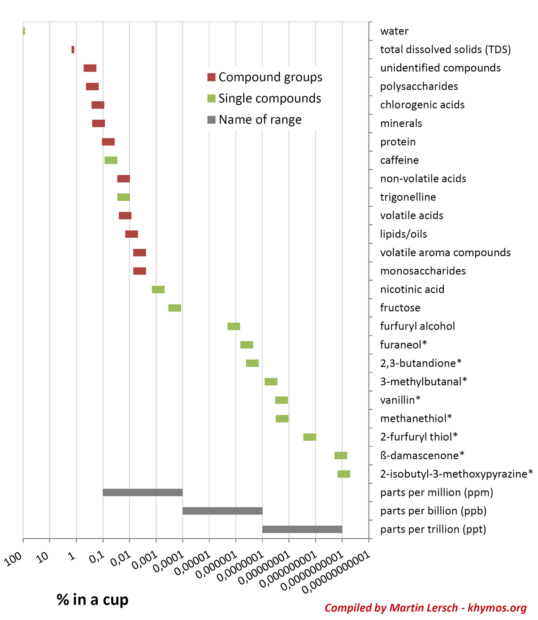
The relationship between a compound’s concentration and its impact on flavor is not linear; instead, it is governed by a concept known as the Odor Activity Value (OAV). OAV is calculated by dividing a compound’s concentration by its odor threshold—the minimum concentration detectable by the human nose. This means that a compound present at an astonishingly low concentration, say 0.0000000001%, can be just as critical to the overall flavor as another compound present at 0.01%, if our nose is exceptionally sensitive to the former. This phenomenon highlights the remarkable analytical prowess of the human olfactory system.
Beta-damascenone stands as a prime example of such a potent odorant. Despite being present in coffee at concentrations as low as 1 part per trillion (ppt), it exerts a significant influence on the overall flavor profile and is considered one of the top five key odorants in coffee [1]. This remarkable compound belongs to a class known as rose ketones, first identified in rose oil in the 1960s. Its name, damascenone, is derived from the Damask rose (Rosa × damascena), a flower renowned for its exquisite fragrance. The pioneering work by Firmenich, a leading flavor and fragrance company, led to the strategic use of beta-damascenone and other rose ketones in iconic perfumes, most notably Dior’s "Poison." The Good Scents Company, a comprehensive resource for flavor and fragrance professionals, describes beta-damascenone’s multifaceted sensory attributes as floral (rose), fruity (blackcurrant, apple), sweet, woody, and even tobacco-like, showcasing its capacity to contribute a broad spectrum of notes to coffee. The sheer challenge of accurately measuring odor thresholds and quantifying compounds at such minuscule concentrations underscores the ongoing scientific endeavor, suggesting that further key odorants in coffee undoubtedly await discovery.
The Science of Solubility: Polar, Non-Polar, and Extraction Dynamics
The differential solubility of various coffee compounds in water is a critical factor influencing extraction. Compounds can be broadly classified as polar or non-polar. Polar compounds, which include acids, minerals, proteins, and carbohydrates (sugars and soluble oligosaccharides), share a common characteristic: high solubility in water. As water itself is a highly polar solvent, it efficiently extracts these components, typically dissolving more than 75% of the polar compounds present in the coffee grounds [2]. These compounds contribute significantly to coffee’s taste, body, and acidity.
In contrast, non-polar compounds, which primarily encompass volatile aroma compounds and lipids (oils), exhibit low solubility in water. Consequently, when brewing coffee with water, only a fraction—typically 10-30%—of these non-polar compounds are extracted. This selective extraction has profound implications for the final cup. Brewing methods, grind size, water temperature, and contact time all influence the balance of polar versus non-polar extraction. For instance, cold brewing, with its longer extraction times and lower temperatures, tends to yield a different chemical profile compared to hot brewing, often resulting in a beverage with lower acidity and bitterness, indicative of a shift in the ratio of extracted polar to non-polar compounds. The theoretical exploration of less polar solvents, such as ethanol, offers an intriguing avenue for alternative coffee extraction, potentially unlocking different flavor dimensions by selectively extracting a higher proportion of non-polar compounds that remain largely untouched by water. Such approaches are already employed in decaffeination processes, which often utilize organic solvents to target caffeine, a moderately polar alkaloid, more efficiently.
Limitations of Measurement: Why TDS Tells Only Part of the Story
Total Dissolved Solids (TDS) is a widely used metric in the coffee industry, serving as a convenient measure of coffee strength. It quantifies the total mass of solids dissolved in the brew, typically ranging from 1.2% to 1.5% for normal black coffee. While useful for quality control and ensuring consistency in brewing, a closer examination of the concentration ranges of individual compounds reveals that only a few major compound groups are present in sufficient concentrations to significantly influence the TDS reading. These usually include larger amounts of carbohydrates, organic acids, and some mineral salts.
The fundamental limitation of TDS measurements lies in the absence of a direct correlation between the rate of extraction of minute, yet potent, flavor compounds and the bulk of compounds that determine TDS. The stark difference in extraction yields between polar (high solubility) and non-polar (low solubility) compounds highlights this discrepancy. A high TDS might indicate a strong brew, but it provides little to no information about the nuanced balance of aroma compounds, the delicate interplay of acids, or the subtle presence of powerful odorants like beta-damascenone. Consequently, relying solely on TDS to predict the aroma and flavor quality of a cup of coffee is a flawed approach.
For most coffee professionals and enthusiasts, the human nose and palate remain the gold standard analytical detectors. The ability to discern subtle differences in fragrance, taste, and mouthfeel, integrating the complex interplay of hundreds of molecules, far surpasses the capabilities of current singular chemical measurements for holistic flavor assessment. This experiential approach continues to drive the exploration and appreciation of coffee’s wonders, acknowledging that while science can dissect and explain, the ultimate arbiter of a truly great cup resides in human perception.
Looking Ahead: The Future of Coffee Science and Consumption
The ongoing scientific endeavor to unravel coffee’s chemical secrets has profound implications for consumers, industry, and the scientific community. For consumers, this deepening understanding translates into an enhanced appreciation for the beverage, empowering them to make more informed choices about beans, brewing methods, and desired flavor profiles. It demystifies why a single-origin Ethiopian Yirgacheffe tastes distinctly different from a Sumatran Mandheling, or why a pour-over differs from an espresso.
For the coffee industry, these insights are invaluable. They drive innovation in every segment, from sustainable farming practices and targeted breeding of coffee varietals for specific flavor characteristics, to advanced roasting techniques that precisely control chemical reactions. Furthermore, understanding the chemical components allows for the development of new coffee products, such as specialized extracts, natural flavor enhancers for food and beverage applications, and more efficient decaffeination methods. Quality control processes are also becoming increasingly sophisticated, moving beyond basic parameters to incorporate more detailed chemical profiling. The design of brewing equipment benefits directly, as manufacturers can optimize parameters like temperature stability, pressure, and flow rate to selectively extract desired compounds.
From a scientific perspective, coffee research pushes the boundaries of analytical chemistry, particularly in the challenging realm of trace compound detection and identification. It also contributes significantly to our understanding of human olfaction and gustation, providing a complex, real-world matrix for studying how different molecules interact with our sensory systems. The potential for creating truly synthetic coffee, while still far off, is gradually being explored, even if its primary use might be in understanding flavor rather than replacing natural beans.
As research continues, the coffee world will undoubtedly uncover more of its hidden chemical treasures. This continuous exploration promises to elevate the coffee experience, refining brewing practices, inspiring new product innovations, and fostering an even deeper appreciation for this extraordinary, chemically complex beverage. The ultimate goal remains a testament to both science and artistry: to unlock the full potential of every single bean, one molecule at a time.
References
[1] Sanz, C.; Czerny, M.; Cid, C.; Schieberle, P. Eur. Food. Res. Technol., 2002, 214, 299 (DOI: 10.1007/s00217-001-0459-9)
[2] Semmelroch, P.; Grosch, W. J. Agric. Food Chem. 1996, 44, 537 (DOI: 10.1021/jf9505988)
[3] Belitz, H.-D.; Grosch, W.; Schieberle, P. (ed.), 2004, Food Chemistry (3rd edition) Springer.
[4] Amanpour, A.; Selli, S. J. Food Proc. Pres. 2016, 40, 1116 (DOI: 10.1111/jfpp.12692)
[5] Batali, M. E.; Frost, S. C.; Lebrilla, C. B.; Ristenpart, W. D.; Guinard, J.-X. J. Sci. Food Agric. 2020, 7, 2953 (DOI: 10.1002/jsfa.10323)