
Today, a burgeoning industry of wearable technology empowers individuals to meticulously monitor their physiological states and behavioral patterns, often through a single, sophisticated device. Metrics such as heart rate, step count, exercise intensity, and sleep quality are now readily accessible, offering an unprecedented window into personal health. In its most effective application, this technology acts as a crucial bridge, connecting an individual’s subjective perception of their well-being with objectively measurable data. This integration of qualitative feeling and quantitative evidence represents a significant leap forward in personal health management.
Humans, by nature, are not inherently precise instruments for self-quantification. Our subjective feelings, while vital, are prone to biases and inaccuracies. We often struggle to precisely measure our experiences and behaviors. Consider the common scenario of dietary estimation: a colleague, convinced he adhered to a strict caloric intake, discovered through diligent tracking that an additional 500 calories were unknowingly consumed daily, primarily from barbecue sauce. This highlights a fundamental human limitation in consistently and accurately perceiving internal states and habits. While some individuals possess extraordinary self-awareness—such as Canadian sprinter Ben Johnson, who reportedly could predict his 100-meter sprint time within a tenth of a second—such precision is an extreme outlier. For the vast majority, the question remains: how accurately do we assess ourselves, and how can intelligent application of technology, like fitness trackers, enhance this accuracy to foster better health decisions?
The Evolution of Personal Data Tracking: From Logs to Luminescence
The concept of self-tracking is not entirely new; historical figures have kept meticulous diaries of health and habits for centuries. However, the advent of modern computing and sensor technology has dramatically transformed this practice. The early 2000s saw the rise of the "Quantified Self" movement, a community dedicated to self-knowledge through numbers, often relying on manual data entry and basic devices. This laid the groundwork for the explosion of wearable technology.
The past decade has witnessed a rapid acceleration in the sophistication and accessibility of personal health trackers. Miniaturization of sensors, advancements in battery life, and the ubiquitous presence of smartphones capable of processing vast amounts of data have converged to create a diverse ecosystem of devices. From simple pedometers of yesteryear to today’s multi-functional smartwatches, sleek ring trackers, and even continuous glucose monitors (CGMs), the journey has been one of increasing integration, accuracy, and user-friendliness. This technological chronology underscores a societal shift towards proactive health management, driven by the desire for actionable insights into one’s own body.
Navigating the Modern Tracking Ecosystem: Device Capabilities and Market Trends
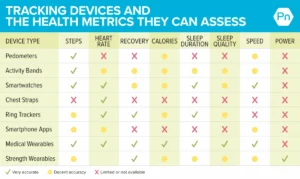
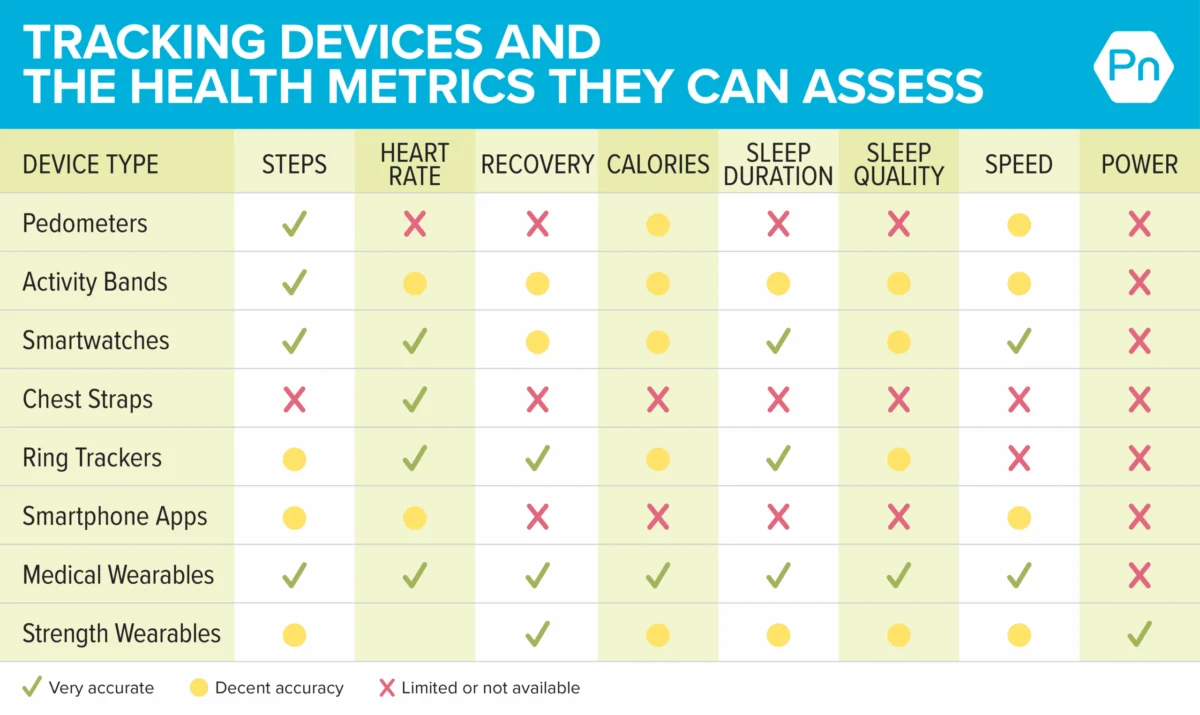
The market for wearable health technology has experienced exponential growth, with projections indicating continued expansion. Smartwatches, fitness bands, and smart rings lead the charge, offering a spectrum of features from basic activity tracking to advanced physiological monitoring. These devices typically incorporate accelerometers for step counting, photoplethysmography (PPG) sensors for heart rate detection, and increasingly sophisticated algorithms for sleep stage analysis and recovery metrics.
Beyond these common devices, specialized trackers are emerging. Medical wearables offer clinical-grade data for specific conditions, while strength wearables aim to quantify aspects like movement velocity and power output during exercise. Smartphone applications, often integrated with these devices, serve as central hubs for data visualization, analysis, and goal setting. According to market research, global wearable technology shipments are expected to exceed half a billion units annually in the coming years, reflecting widespread consumer adoption and a growing demand for personalized health data. This robust ecosystem provides an unprecedented amount of information, but it also necessitates a critical understanding of the data’s reliability.
The Imperative of Accuracy: What the Data Reveals
Not all data generated by these trackers is created equal. The accuracy of a device is a function of both its hardware—the quality of its sensors—and its software, which includes the algorithms used to interpret raw data and the datasets against which these algorithms are validated. Consequently, some brands consistently produce more reliable products than others.
Furthermore, the nature of the metric itself dictates its ease of quantification. Data such as heart rate and step count are generally considered highly reliable across many devices. Heart rate monitoring, particularly via chest straps (which use electrocardiography, or ECG, principles), offers near-medical grade accuracy, while optical sensors in wrist-worn devices have improved significantly, showing strong correlations with ECG during steady-state activities. Step counts, derived from accelerometers, are also largely accurate, especially during continuous walking or running.

However, other outputs present substantial margins for error. Calorie expenditure, for instance, is notoriously difficult to measure accurately by consumer-grade wearables. Algorithms often rely on generalized formulas based on age, sex, weight, and heart rate, which may not account for individual metabolic differences, exercise efficiency, or varying activity types. Studies have shown discrepancies of 20-40% or more when comparing wearable calorie estimates to gold-standard methods like indirect calorimetry. Similarly, metrics like movement velocity, recovery scores, and detailed sleep stage analysis can have varying degrees of accuracy depending on the device, sensor placement, and the complexity of the underlying algorithms. While devices can detect sleep duration with reasonable accuracy, distinguishing between specific sleep stages (REM, deep, light) remains a challenge, often relying on heart rate variability and movement patterns rather than direct brain activity. Understanding these limitations is crucial for interpreting data effectively and making informed decisions.
The Paradox of Information: Navigating Data Overload
The proliferation of tracking devices presents a double-edged sword. While they offer an abundance of data, this very abundance can become a hindrance. As computer scientist Samantha Kleinberg notes, even a tiny amount of surplus information can negatively impact decision-making. This highlights the "paradox of tracking": too little detail makes it difficult to make informed choices, but too much can lead to analysis paralysis.
This phenomenon is often visualized as an inverted U-shaped curve, where the ability to make decisions improves with increasing relevant information up to an optimal "sweet spot," after which it declines sharply due to cognitive overload. In a world saturated with data, it’s surprisingly easy to overshoot this sweet spot. Consider the overwhelming experience of sifting through hundreds of online reviews for a simple item – what began as a quest for a good recommendation quickly devolves into indecision.
In the health and fitness sphere, where countless apps and devices promise more science, more customization, and more complexity, finding this optimal amount of information is an art. When the deluge of data blurs into an unclear path forward, a fundamental question emerges: Does tracking genuinely enhance my well-being and performance? A clear "yes" or "no" provides immediate guidance. For those in a gray area, several signs can help clarify the utility of tracking.
Expert Insights: Balancing Objective Data with Subjective Experience
Health professionals and behavioral scientists emphasize the nuanced relationship between data and human psychology. The objective of tracking should always be empowerment, not enslavement to numbers.
When Tracking Builds Confidence and Reduces Stress:
Tracking can be immensely beneficial when it validates an individual’s efforts and reduces anxiety. Take Zak, a high-performing individual who struggled to trust that "Zone 2 cardio"—an exercise intensity that feels easy—could be effective. His heart rate monitor provided objective proof: consistent Zone 2 training led to a lower resting heart rate and faster recovery times. This data-driven reassurance allowed Zak to relax into the process, further enhancing his physiological response. For coaches, this means tracking can be a powerful tool to build client confidence, particularly for those who constantly feel "not good enough." It shines a spotlight on existing, often unseen, progress. Similarly, the initial use of continuous glucose monitors (CGMs) by individuals without diabetes can offer valuable insights into how specific foods affect their blood sugar, helping validate healthier dietary choices.
However, the opposite can also occur. Tracking can be counterproductive if it generates undue stress without a tangible benefit. A new parent, already sleep-deprived by a newborn, receiving a "poor sleep quality" score from a tracker, experiences unnecessary stress over something largely beyond their immediate control. In such scenarios, when circumstances or priorities lie elsewhere, tracking should be temporarily suspended.
When Data Enhances Motivation and Ability:
According to the Fogg Behavior Model, for a behavior to occur, three elements are needed: motivation, ability, and a prompt. Fitness trackers excel at providing the "prompt" when motivation and ability are already present. Margaret, for instance, believed her nightly glass of wine aided sleep. Her sleep tracker, however, revealed a significant drop in sleep quality on nights she consumed alcohol. This clear, objective prompt led her to adjust her behavior, improving her sleep. By highlighting crucial data, trackers can make the right choices undeniably clear. Once a piece of data is "seen," it often cannot be "unseen," driving powerful behavioral shifts. This was exemplified by Precision Nutrition’s CEO, Tim Jones, who leveraged feedback from various lifestyle trackers to reduce his genetically high cholesterol levels, transforming his health and life.
Conversely, an over-reliance on data can diminish intrinsic motivation and enjoyment. Jan, an avid cyclist, initially found joy in breaking local trail records using his device. Yet, his singular focus on speed and numbers eventually led to under-recovery and burnout. When workouts become solely about metrics rather than technique, experience, or the sheer joy of movement, tracking loses its helpfulness.

When Tracking Fosters Self-Understanding:
The common adage "the harder you work, the better your results" is not always true. Many "grinders" inadvertently inhibit their progress and recovery by constantly pushing too hard, failing to understand their body’s need for rest and smart training. Conversely, others chronically underestimate their capacity, needing data to reveal their true potential. For example, in high-intensity interval training (HIIT), recovery periods are often fixed. However, heart rate data can personalize these, revealing whether an individual recovers faster or slower than a generic estimate. This allows for truly individualized training, preventing "junk volume"—effort that accumulates fatigue without improving performance.
However, an excessive reliance on data risks disconnecting individuals from their own sensory experiences. The "Great MyFitnessPal Blackout" of 2019, when the popular calorie-tracking app went offline, caused significant anxiety for users who had become entirely dependent on it to dictate their daily food intake. This scenario underscored how over-reliance on external metrics can erode one’s ability to tune into internal hunger/fullness cues, energy levels, or other vital bodily signals. The goal is to calibrate internal wisdom with external data, not replace it.
Strategic Integration: Three Pillars for Empowered Self-Assessment
True mastery of self-assessment and health management lies in harmonizing objective data with subjective experience. While objective data provides invaluable feedback, the enduring benefits of any health practice—including sustained enjoyment and resilience during plateaus—stem from a connection to one’s "felt experience," encompassing mindfulness, mastery, meaning, and success. Fitness trackers, far from alienating us from our bodies, can actually be used to refine and improve our internal sensory accuracy.
1. Check in with Yourself Before You Check the Data:
Before consulting any device, pause and tune into your body’s signals. How do you feel? Estimate the metric in question: How far do you think you biked? How many calories do you estimate you consumed? How fast was your heart beating? This deliberate act engages your brain’s powerful, though often imperfect, prediction-making capabilities. Only after this internal assessment should you consult your tracker. By consistently comparing your subjective feeling with the objective data, you begin to calibrate your internal sensors, gradually narrowing the gap between perception and reality. Regular app updates are also crucial, as algorithms are continuously refined for better predictive accuracy.
2. Develop Mental Shortcuts Calibrated by Objective Measures:
Coaches frequently ask clients to estimate their physical limits, such as how many more repetitions they could perform at a given weight until failure. Novices are often significantly inaccurate. However, with occasional calibration against objective data (like actual performance, or even a coach’s objective assessment), individuals can dramatically reduce their margin of error. The "rate of perceived exertion" (RPE), a subjective scale of how hard one feels they are working, is a scientifically validated sensory-driven approach. While not everyone is naturally adept at estimating RPE, consistent practice, coupled with periodic checks against objective measures like heart rate or lifting velocity, can greatly enhance this skill. These mental shortcuts allow for intuitive, yet increasingly accurate, self-assessment even without constant data reference.
3. Continuously Develop Your Innate Sensory Abilities:
While trackers employ accelerometers, GPS, and gyroscopes to sense movement and location, the human body possesses an infinitely richer network of sensory information. This includes:
- Proprioception: The sense of body position and movement.
- Interoception: The sense of the internal state of the body (e.g., hunger, thirst, pain, energy levels).
- Vestibular sense: Balance and spatial orientation.
- Touch, Vision, Hearing, Smell, Taste: Our five primary external senses.
This vast array of information is constantly fed into our nervous system, forming complex patterns that inform our perception of well-being. To leverage this powerful, innate system, make it a regular practice to consciously check in with how you are feeling across these sensory dimensions. By learning to calibrate your rich internal sensory data with the precise, objective feedback from technology, you unlock a holistic approach to health. This approach allows you to harness the impressive advancements in wearable tech while ensuring your personal experience and intuition remain central to your journey.
The Future of Self-Tracking: Towards a Holistic View
The trajectory of wearable technology suggests an increasingly sophisticated and integrated future. Devices will likely become even more accurate, unobtrusive, and capable of analyzing complex biomarkers. However, the ultimate value will always lie in how this technology empowers individuals to make better decisions, not in the sheer volume of data itself.
The broader implications extend to healthcare, where remote monitoring and personalized interventions could become standard. Yet, this also brings ethical considerations regarding data privacy, security, and the potential for digital health disparities. For individuals, the ongoing challenge will be to cultivate a balanced relationship with their trackers—one that leverages objective insights without sacrificing subjective wisdom. The goal is not to become a robot optimized by algorithms, but a more informed, self-aware human, capable of both feeling and quantifying their way to optimal health.