
The pursuit of the perfect cup of coffee has evolved significantly, moving beyond mere habit to embrace a rigorous, scientific approach. What began for many as a simple means to fuel a demanding schedule, such as a post-PhD commute, has blossomed into a profound appreciation for the intricate flavors and complex chemistry of specialty coffee. This shift aligns with the "third wave of coffee," a global movement emphasizing high-quality, single-origin beans, lighter roasts, and meticulous brewing methods designed to highlight the unique characteristics of each coffee. Scandinavia, in particular, has emerged as a vibrant hub for this scene, fostering innovation and a deep-seated commitment to coffee excellence.
The Catalyst for Precision: A Case Study in Personal Discovery
The extraordinary circumstances of 2020, marked by reduced social interaction and an abundance of contemplative time, inadvertently provided the ideal environment for a deeper dive into coffee science. A significant turning point was the experience of a Coffee Advent Calendar, offering 24 days of blind tasting. This immersive exercise underscored the nuanced differences between origins and processing methods, revealing how profoundly these factors impact flavor. It highlighted the joy of correctly identifying a bean’s provenance or processing type, but more importantly, it exposed the subtle complexities that make some coffees challenging to distinguish, emphasizing the critical role of processing in shaping the final cup.
Concurrently, experimentation with various coffee hand grinders, alongside a trusty old Rancilio Rocky, introduced a degree of variability into the daily brewing routine. This initial frustration, characterized by an inability to consistently produce high-quality pour-over coffee, served as a potent catalyst for learning. The realization of a lack of reproducible and controlled brewing techniques ignited an extensive research endeavor, leading to an unexpected and profound exploration of coffee extraction science. This journey into the microscopic world of coffee particles and dissolved solids has revealed a vast and rapidly expanding body of knowledge, particularly in the last decade, with significant advancements in understanding pour-over and drip coffee methodologies.

The Unseen Journey: From Bean to Brew
The journey of a coffee bean, from its origin as a fruit on a Coffea arabica shrub to the final brewed beverage, is a testament to a complex interplay of human skill and natural processes. Countless individuals and processing steps exert influence on the quality of the final product. While many of these factors, such as cultivation, harvesting, and initial processing at the farm level, remain outside the direct control of the consumer, the conscious choice to procure high-quality, ethically sourced beans — cultivated by dedicated farmers, processed by skilled craftspeople, and roasted by passionate enthusiasts — lays the essential groundwork. The true opportunity for influence begins when roasted coffee beans arrive in the consumer’s kitchen, presenting a myriad of parameters that can be precisely controlled and optimized for an exceptional brewing experience.
Decoding the Brew: Core Scientific Parameters and Their Impact
Modern coffee science has identified several critical parameters that, when understood and managed, can elevate brewing from an art to a precise science.
Brew Ratio: The Blueprint for Consistency
The brew ratio (BR) is a fundamental metric defined as the mass of water relative to the mass of ground coffee. Typically expressed as a ratio of water to coffee (e.g., 16.7:1), a common starting point is 60 grams of coffee for 1000 grams of water, yielding a BR of 16.7. This simple ratio serves as the bedrock of any coffee "recipe," analogous to the baker’s percentage in baking, providing a straightforward method for remembering and scaling brewing parameters. Black coffee recipes generally fall within a brew ratio range of 15 to 25. The precise control offered by the brew ratio is indispensable for ensuring consistency and reproducibility across different brewing sessions and volumes.
Total Dissolved Solids: Measuring the Essence
The perception of coffee strength is often subjective, leading to inconsistent results. Many coffee drinkers experience a common frustration: coffee that is perceived as "too strong and bitter." The addition of a small amount of hot water can, surprisingly, transform such a brew, revealing latent fruity flavors. This anecdotal observation underscores the importance of precisely quantifying coffee strength, a task for which Total Dissolved Solids (TDS) is invaluable. TDS measures the total concentration of soluble matter extracted from the coffee grounds and dissolved into the water. While TDS does not directly quantify taste quality, it provides an objective measure of strength, allowing brewers to identify when a brew falls outside an optimal range.
The Science of Refractometry
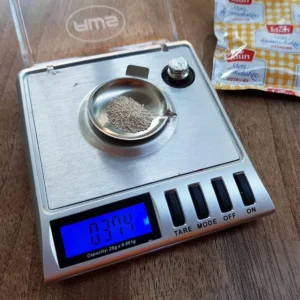
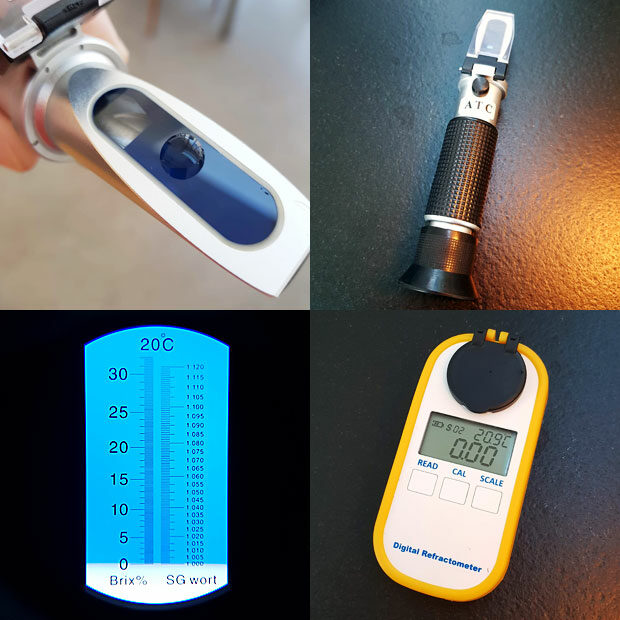
Traditionally, TDS could be measured gravimetrically by evaporating the water from a coffee sample and weighing the residual solids. However, this method is impractical for home or café use, requiring highly accurate laboratory balances for the minute amounts of solids (1.2-1.5%, or 12-15 grams per liter, in a typical cup). A more accessible and widely adopted method utilizes refractometry, which measures the change in the refractive index of light as it passes through the coffee beverage. Dissolved solids alter the speed of light, and this alteration correlates directly with concentration.
Analog handheld refractometers, often equipped with a %Brix scale, offer an economical entry point. %Brix values can be converted to %TDS by multiplying by a factor of 0.85. While these devices provide sufficient resolution (0.0-0.2 %Brix) to confirm if a brew is within a typical strength range (1.4-1.8 %Brix for normal coffee), they lack the precision for fine-tuning. Digital refractometers, on the other hand, offer superior accuracy (e.g., 0.01 °B readout) and often include automatic TDS conversion, though at a higher cost. These devices are increasingly adopted in specialty coffee shops for quality control.
Practical Application and Limitations
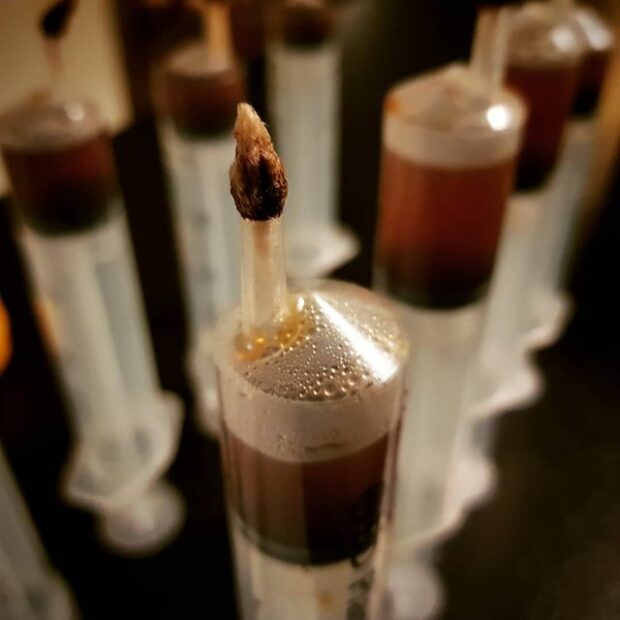
Beyond coffee, handheld refractometers are versatile kitchen tools, useful for applications like calibrating sugar content for sorbets or monitoring specific gravity in homebrewing. For accurate coffee TDS measurements, samples must be hot-filtered to halt extraction and then cooled completely to minimize evaporation and ensure stable readings. A simple DIY method involves using plastic syringes with a cotton plug for hot filtering and cooling, effectively minimizing waste and cost associated with laboratory-grade equipment. It is important to note that a typical cup of black coffee is over 98% water, a fact often hard to reconcile with its rich flavor profile. The Specialty Coffee Association (SCA) advocates for specific TDS and EY ranges, often visualized on a "coffee brewing control chart," to guide brewers towards optimal extraction.
Extraction Yield: Efficiency and Flavor
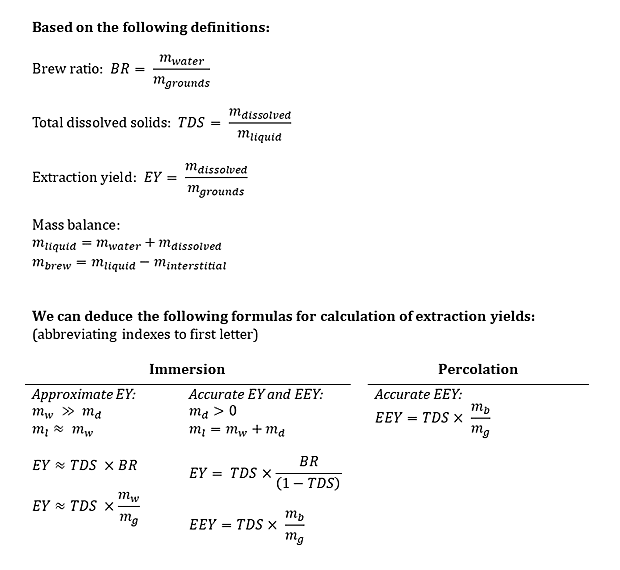
Once TDS is measured, calculating the extraction yield (EY) becomes possible. EY represents the percentage of soluble material extracted from the dry coffee grounds. The calculation becomes nuanced when distinguishing between immersion and percolation brewing methods due to the "interstitial liquid" — the water retained within the coffee grounds after brewing.
Immersion vs. Percolation: A Chemical Distinction
For immersion brews (e.g., French press), the entire liquid mass is considered homogeneous, making the calculation of EY relatively straightforward. The dissolved solids are distributed throughout the total water used. However, in percolation brews (e.g., pour-over), a significant portion of the water flows through the coffee bed and into the cup, leaving some liquid trapped within the grounds. Leading coffee scientists like Scott Rao and Jonathan Gagné have extensively discussed these complexities. To simplify, two types of extraction yields can be defined:
- Extraction Yield (EY): Focuses on the total solids extracted from the grounds into the entire liquid mass (including interstitial liquid).
- Effective Extraction Yield (EEY): Focuses on the solids delivered to the cup, which is more relevant from an economic and consumption perspective.
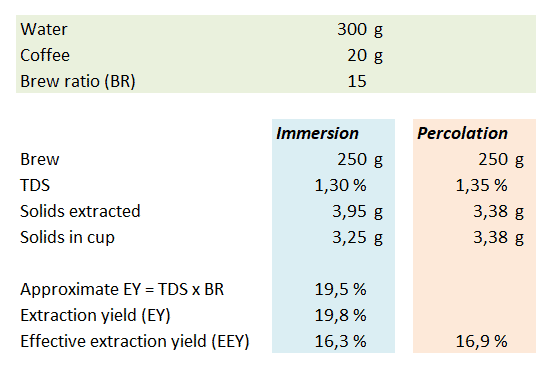
In percolation, EY often equals EEY by definition because the interstitial liquid does not contribute to the final beverage. However, detailed calculations, factoring in the mass of dissolved solids affecting the liquid mass, demonstrate that immersion methods can extract more total solids from the grounds into the liquid mass, even if not all of it makes it into the final cup. Conversely, percolation methods are often more efficient at delivering extracted solids to the cup. For example, using 20g of coffee and 300g of water to yield 250g of brew, an immersion brew might show a 19.8% EY (total extracted from grounds) but only a 16.3% EEY (delivered to cup), while a percolation brew might show a 16.9% EEY. This difference in extracted mass (e.g., 3.95g vs. 3.38g in the example) directly influences the sensory profile, as a different composition of chemical compounds is present in each.
Economic and Sensory Implications
Understanding EY and EEY is crucial. EEY has direct economic implications, as it quantifies how much of the expensive coffee bean material is actually enjoyed. EY, on the other hand, provides insight into the efficiency of the extraction process from the grounds themselves, influencing flavor development. Accurate calculations must also consider factors like evaporation during brewing and the inherent water content (1-4%) in roasted beans, although these are often disregarded for practical reasons. The precision of yield calculations is highly dependent on the accuracy of coffee ground weight and TDS measurements, highlighting the need for calibrated scales and refractometers.
Particle Dynamics: Grind Size and Distribution
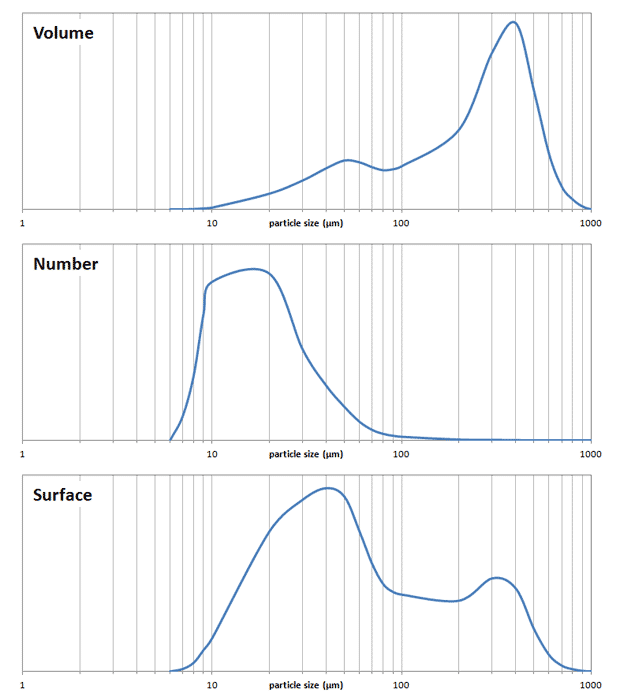
The grinding of roasted coffee beans is a critical step, as it determines the surface area available for extraction. However, grinding is not a uniform process. A bean shatters into a range of sizes, from larger "boulders" to microscopic "fines" (generally defined as particles smaller than 100 µm). The resulting particle size distribution (PSD) significantly impacts extraction kinetics and flow dynamics.
The Physics of Grinding
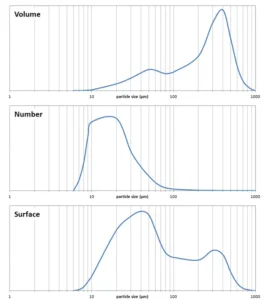
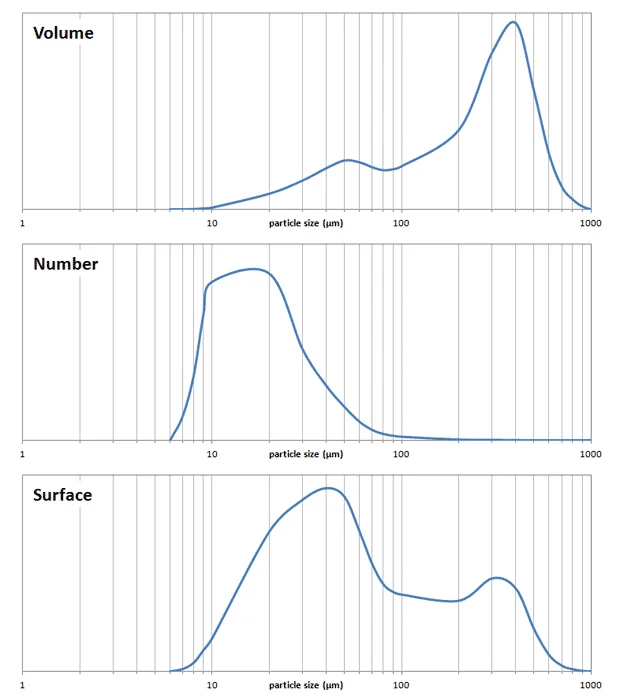
The method of visualizing PSD is crucial. While volume distribution (the most common) might show fines as a small percentage, examining the number of particles reveals an overwhelmingly high count of fines. Even more telling is the surface area distribution, which often demonstrates that over half of the total extraction surface comes from particles smaller than 100 µm. This is significant given preliminary research by Matt Perger of Barista Hustle, suggesting that coffee particles are extracted only to a depth of approximately 100 µm. This implies that the core of larger particles may remain unextracted, representing "wasted" coffee. Nonetheless, larger particles are essential for forming a permeable filter bed, preventing clogging, and maintaining adequate flow rates in percolation brewing.
The choice of grinder profoundly affects PSD. Inexpensive blade grinders, which chop rather than mill, produce an extremely wide and inconsistent PSD with a high proportion of undesirable fines. Burr grinders, the standard for quality home and commercial use, utilize two abrasive surfaces to crush beans. These come in various designs (conical or flat burrs), materials, and sizes. Flat burrs, often found in higher-end commercial machines, can offer superior consistency, with specific geometries designed for espresso (where some fines are desired for body) versus pour-over (where fines are generally avoided). Conical burrs are prevalent in hand grinders due to their compact design. Industrial grinders, such as cylindrical mills, achieve exceptionally narrow PSDs, leading some to suggest that professionally pre-ground coffee, if immediately sealed in an inert atmosphere, could offer a more uniform grind than most home setups.
The Grinder’s Role
Optimizing grind size for pour-over coffee typically involves finding the finest grind possible that still allows for sufficient flow rate without clogging the filter. The Aeropress, with its pressure-assisted filtration, offers a workaround by allowing extraction to be stopped at a desired time, regardless of grind-induced flow issues. Research into double grinding (coarse then fine) or utilizing grain mills for pre-crushing is exploring methods to achieve narrower PSDs and potentially enhance extraction uniformity. However, accurately measuring PSD at home remains a challenge, often requiring specialized sieves (like those from Kruve) or image analysis software.
The Essence of Freshness: Oxidation and Degassing
Freshness is paramount. Roasted coffee beans continuously undergo degassing, releasing carbon dioxide, which influences brewing dynamics (e.g., bloom). More critically, upon exposure to oxygen, the delicate aromatic compounds and oils within the beans begin to oxidize. This chemical degradation leads to the development of "stale" flavors and rancidity. Consequently, beans should be stored in airtight containers, ideally with minimal air, and preferably in a cool environment (freezer or refrigerator for longer storage) to slow oxidation kinetics. Crucially, coffee should only be ground immediately before brewing. Grinding dramatically increases the surface area exposed to oxygen, accelerating oxidation and flavor degradation, typically reducing the optimal flavor window from days (for whole beans) to mere minutes or hours (for ground coffee).
Water Chemistry: The Unsung Hero
Often overlooked, water is the primary component of coffee, and its chemical composition profoundly influences extraction and flavor. Minerals present in water, such as magnesium, calcium, and bicarbonate, play critical roles. Magnesium and calcium ions can bind to certain flavor compounds, enhancing their extraction and perception. Bicarbonates, on the other hand, act as buffers, influencing the pH of the brew and affecting the perception of acidity and bitterness.
Mineral Influence on Flavor
Regions with naturally soft water, like Norway, may benefit from mineral additions to optimize brewing. Conversely, areas with hard water often require filtration or distillation followed by controlled mineral reconstitution. The Specialty Coffee Association (SCA) provides detailed guidelines for optimal brewing water, recommending specific ranges for total hardness, alkalinity, and pH. Resources like Jonathan Gagné’s Coffee Ad Astra blog offer recipes for creating ideal brewing water from distilled water. A detailed spreadsheet or calculator that allows users to adjust their local tap water composition by adding specific mineral salts (e.g., magnesium sulfate, calcium chloride, sodium bicarbonate) can significantly enhance the brewing process, tailoring the water to specific coffee profiles.
Customizing Water for Optimal Brews
The complex interaction between water chemistry and coffee compounds is a burgeoning area of research. For instance, different mineral profiles can selectively extract different flavor precursors from the coffee grounds, leading to variations in perceived sweetness, acidity, body, and bitterness. The ability to precisely control water composition represents a significant advancement in achieving truly customized and optimized coffee extractions.
Temperature Control: Kinetics of Extraction
Temperature is a fundamental driver of chemical extraction. Generally, the solubility of compounds and the rate of diffusion increase with higher temperatures. In coffee brewing, elevated temperatures (close to 100 °C, or 212 °F) maximize the extraction of various molecules from the grounds into the water. However, maximum extraction does not necessarily equate to the "best possible cup," as certain desirable flavor compounds are extracted optimally within specific temperature windows, while excessively high temperatures can lead to the extraction of undesirable bitter or astringent compounds.
Cold brewing exemplifies the temperature effect; by intentionally lowering the temperature, extraction slows considerably, necessitating extended brew times (often overnight). The resulting cold brew has a distinctly different flavor profile compared to hot-brewed coffee, due to the altered solubility and extraction kinetics of various compounds at lower temperatures. Furthermore, the perceived taste of a beverage is temperature-dependent; sweetness and bitterness are often diminished as coffee cools, while sourness and saltiness tend to remain more stable. Therefore, for accurate sensory comparison, coffees should ideally be tasted at similar temperatures.
Filter Mediums: Shaping Clarity and Body
The choice of filter material significantly influences the final sensory experience, impacting both the clarity and mouthfeel of the coffee. Paper filters are the most common and are highly effective at retaining fine particles. The human palate is remarkably sensitive, capable of discerning microscopic particle sizes, with a "just notable difference" for particles in chocolate around 5 µm. This explains why a French press, which uses a coarse metal mesh, often yields a "muddy" or full-bodied coffee with visible sediment, while a Chemex, known for its thick paper filter, produces a remarkably "clean" and bright cup.
Material Science of Filtration
Beyond particle retention, paper filters also retain certain oils that contribute to mouthfeel and flavor in unfiltered brews (like espresso or French press). Experimenting with metal filters in drippers like a V60 or Aeropress can provide a benchmark for understanding the sensory impact of these oils.
Within paper filters, choices abound, including bleached and unbleached varieties. While some prefer unbleached filters for environmental reasons, they may contain more residues (lignin, hemicellulose) that can impart unwanted flavors to the coffee. Modern bleaching processes largely employ oxygen-based oxidizing agents, effectively eliminating concerns about chlorine. From a chemical perspective, bleached filters, being purer cellulose, are often favored for their neutrality. The filtration science is complex, involving pore size, wet strength, and the swelling of cellulose fibers when wet, which can significantly alter filtration performance from its dry state. Research, such as detailed analyses found on blogs like Coffee Ad Astra, uses microscopy and calculations to compare various filter papers, revealing the intricate structures that influence flow rate and particle retention.
Bleached vs. Unbleached: Beyond Aesthetics
The environmental impact of paper filters, while a valid concern, is often dwarfed by other dietary or lifestyle choices. Focusing on the fundamental chemical and physical properties of the filter, such as pore size, flow rate, and inertness, is key to optimizing flavor.
Synthesizing the Science: A Hierarchical Approach to Brewing Mastery
Mastering coffee extraction requires a systematic, hierarchical approach, building from foundational principles to more nuanced refinements. The following parameters are generally considered in order of their impact and ease of control:
- Brew Ratio, Total Dissolved Solids, and Extraction Yield: These interconnected parameters form the bedrock of reproducible brewing. Without proper control over the coffee-to-water ratio and a basic understanding of extraction efficiency, even the finest beans will yield inconsistent results. Utilizing tools like the Barista Hustle Coffee Compass can help diagnose common brewing issues related to strength and extraction.
- Grind Size and Particle Size Distribution: The uniformity and fineness of the grind critically influence both extraction rate and flow dynamics. Investing in a quality burr grinder and understanding how to adjust it is essential.
- Freshness of Beans: While fundamental, optimal freshness cannot compensate for poor brewing technique. Once the primary brewing parameters are controlled, using freshly roasted and ground beans becomes crucial for accessing the full spectrum of volatile aromatics.
- Temperature: Consistent and appropriate water temperature ensures optimal extraction kinetics for desired compounds.
- Filter Material: The choice of filter impacts clarity, body, and the presence of oils, allowing for fine-tuning of the sensory profile.
- Water Composition: This is often the final frontier for optimization. Once all other variables are tightly controlled, adjusting water chemistry can unlock subtle flavor nuances and elevate the coffee experience to an even higher level. However, for those still grappling with the earlier parameters, diving into water chemistry may introduce unnecessary complexity.
Industry Insights and Future Directions
The scientific rigor applied to coffee brewing reflects a broader trend in the food and beverage industry towards data-driven quality control and consumer education. Leading figures and organizations, such as the Specialty Coffee Association (SCA), actively promote scientific standards and research, empowering both professional baristas and home enthusiasts with the knowledge and tools to consistently achieve exceptional results. The proliferation of digital refractometers, advanced grinders with precise particle size control, and online resources from experts like Scott Rao, Jonathan Gagné, and Matt Perger, signifies a democratization of advanced brewing techniques.
This scientific revolution in coffee promises not only a more consistently delicious cup but also a deeper understanding of the complex interactions between bean, water, and brewing process. As research continues to uncover new insights into coffee chemistry and physics, the future of precision brewing will likely involve even more sophisticated tools, AI-driven brewing profiles, and an ever-expanding appreciation for the nuanced artistry and science behind every cup. The journey from a simple caffeine fix to a meticulously crafted sensory experience is ongoing, driven by curiosity, experimentation, and a commitment to unlocking coffee’s boundless potential.