
The contemporary wellness landscape has undergone a seismic shift as high-profile figures, including biohacker Bryan Johnson and medical influencers like Dr. Peter Attia and Dr. Andrew Huberman, have popularized the pursuit of extreme longevity. This cultural movement suggests that through rigorous, data-driven protocols—ranging from complex supplementation regimens to advanced physiological monitoring—individuals can effectively "hack" their biology to extend their healthspan and lifespan significantly. However, a growing body of evidence from clinical nutritionists and behavioral scientists indicates that this pursuit of the "optimal" often obscures a fundamental truth: the most significant improvements in human health are achieved through consistent adherence to foundational habits, not through the adoption of fringe, high-cost protocols.

The history of this optimization culture can be traced back to the rise of personal health technology and the democratization of medical data. Over the past decade, the proliferation of wearable devices, at-home blood testing kits, and personalized genomic analysis has transformed health from a passive medical concern into an active, performance-based endeavor. This transition has been accelerated by the "quantified self" movement, which encourages individuals to track every metric—from heart rate variability to glucose levels—to identify areas for improvement. While this granular approach has empowered many to take control of their health, it has also created an industry of "optimization," where the complexity of a routine is often mistaken for its efficacy.

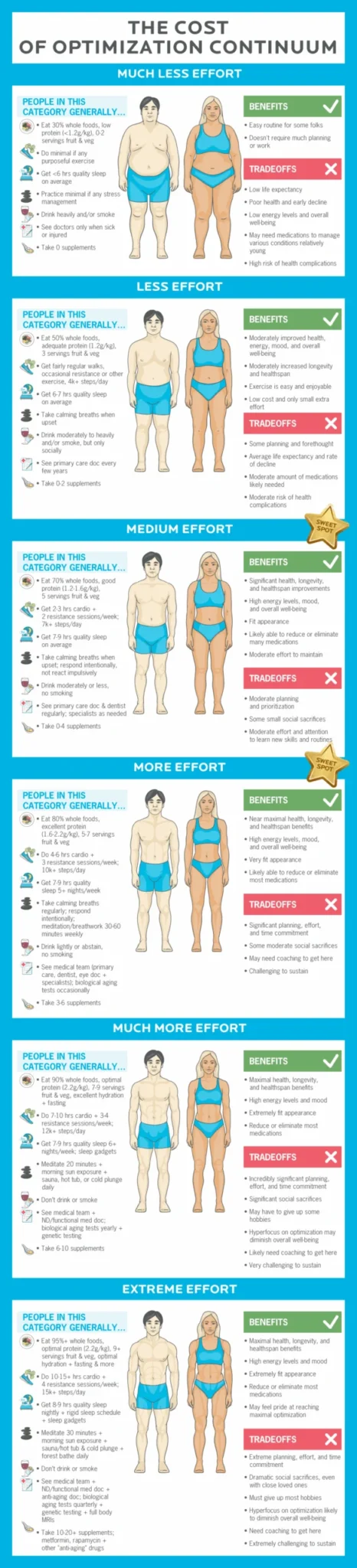
Clinical data suggests that the return on investment for health efforts follows a distinct law of diminishing returns. Research into longevity indicates that while initial lifestyle changes produce dramatic health benefits, the incremental gains from increasingly complex interventions are often negligible. For instance, data from long-term studies on physical activity reveals that the steepest reduction in all-cause mortality occurs when individuals transition from a sedentary lifestyle to achieving 7.5 to 15 MET-hours of activity per week. Beyond this threshold, health benefits continue to accrue but at a significantly slower rate. This "U-shaped" curve of health suggests that while exercise is indeed medicine, there is a point of over-prescription where extreme physical exertion may lead to cardiac issues, such as atrial fibrillation or coronary artery calcification, rather than longevity.

A similar pattern emerges in nutrition. The modern preoccupation with restrictive diets and proprietary supplements often distracts from the established efficacy of basic nutritional principles. Large-scale observational studies, encompassing millions of participants, consistently demonstrate that the most significant health outcomes are linked to simple habits: consuming at least five servings of fruits and vegetables daily, prioritizing whole foods over ultra-processed options, and ensuring adequate protein intake to prevent sarcopenia. While the wellness industry aggressively markets exotic supplements—ranging from NAD+ boosters to complex herbal extracts—the scientific consensus remains that these interventions often lack rigorous human trials. In contrast, protein intake, particularly for older adults, has been shown through decades of clinical observation to be a critical lever for maintaining bone density, muscle mass, and metabolic function.

The psychological implications of this optimization culture are perhaps the most concerning. When health becomes an exercise in perfectionism, the barrier to entry rises, causing many individuals to abandon healthy habits entirely if they cannot meet an "optimal" standard. Data from coaching programs involving hundreds of thousands of participants shows that consistency is the primary driver of success, even when that consistency is practiced at levels as low as 40 to 50 percent. When individuals believe that "all or nothing" is the only path to health, they miss out on the measurable benefits of partial adherence. Furthermore, the financial burden of a "fully optimized" lifestyle is prohibitive for the majority of the population, often requiring thousands of dollars annually in testing, specialized food, and supplemental products.

From an institutional perspective, health experts argue that the focus should remain on social determinants of health and foundational behaviors. According to the Study of Adult Development at Harvard Medical School—a longitudinal study spanning over 87 years—the strongest predictor of both life satisfaction and longevity is the quality of an individual’s social relationships. This finding stands in stark contrast to the modern focus on individual biohacking. Social isolation is now recognized by medical professionals as a risk factor for mortality equivalent to smoking 15 cigarettes per day. Consequently, the time and financial resources currently directed toward fringe health protocols might be more effectively invested in cultivating community, securing stable housing, and ensuring access to primary preventative healthcare.

The implications for public health are clear: the democratization of "health" should prioritize accessibility and simplicity over exclusivity and complexity. The "optimal" is rarely realistic for the average person juggling the demands of modern work, family, and social life. Instead, a shift toward "sustainable health" offers a more pragmatic path. This involves a commitment to four core pillars: consistent physical movement, a diet centered on whole foods, adequate restorative sleep, and the management of chronic stress. These are not exciting or "hackable" behaviors, but they are the bedrock of human physiology.

As the field of longevity science matures, it is likely that the focus will return to these basics. Future research is expected to continue clarifying the exact thresholds of efficacy for these behaviors, but the evidence currently supports a model of moderation. For the individual navigating this space, the advice is simple: evaluate your goals, assess your available time and financial resources, and ignore the noise of the "optimizer" industry. True health optimization is not found in the latest trending supplement or the most expensive recovery device; it is found in the mundane, daily choices that, when repeated over a lifetime, build a robust and resilient body. By lowering the threshold of entry for health-promoting behaviors, society can potentially see a greater collective increase in healthspan and longevity than any high-cost, experimental protocol could ever achieve.