
Dr. Gabrielle Fundaro, a highly credentialed expert in human nutrition with a PhD, over a decade of coaching experience, and six powerlifting competitions to her name, found herself in a deeply relatable paradox. Despite her profound understanding of dietary science and practical application, she harbored a significant fear: abandoning the meticulous macro tracking that had governed her eating for years might compromise her hard-earned physique. This internal conflict highlights a pervasive issue within the fitness and nutrition communities: the transition from rigid, external tracking methods to more intuitive, self-guided approaches.
The Macro Tracking Dilemma: When Precision Becomes a Prison
Macro tracking, the practice of monitoring macronutrient intake (proteins, carbohydrates, and fats) to achieve specific health or physique goals, surged in popularity in the early 21st century. Touted for its precision and effectiveness, it offered a seemingly foolproof method for managing diet. For many, including Dr. Fundaro, it initially delivered results, providing a structured pathway to understanding nutritional composition and achieving desired body compositions. However, for a growing number of individuals, this very precision eventually morphed into a restrictive burden.
Dr. Fundaro’s journey mirrored this trajectory. What began as a tool for "staying on track" gradually became an exhausting regimen. The constant need to balance macros, the inability to spontaneously enjoy meals without calculation, and the pervasive anxiety about "going sideways" on her health and physique took a significant toll. This sentiment resonates with countless individuals who, after prolonged periods of tracking, experience burnout, a diminished enjoyment of food, and an erosion of their natural hunger and fullness cues. Research indicates that while tracking can offer initial benefits, its long-term application can be associated with increased stress, anxiety around food, and in some cases, a higher risk of developing disordered eating patterns. The mental load alone—constantly logging, calculating, and planning—can be unsustainable.
The fear of cessation was palpable for Dr. Fundaro. Her internal monologue echoed common anxieties: "What if I don’t eat enough protein, and lose all my muscle?" "What if I overeat and gain fat?" "What if I have no idea how to fuel myself without tracking macros? And what does that say about me as an expert in the field of nutrition?" These questions underscore the deep psychological dependence that can develop when external metrics entirely supplant internal bodily wisdom. The identity of an expert, or simply a disciplined individual, can become intertwined with the practice of tracking, making the thought of letting go incredibly daunting.
Seeking an Alternative: A Quest for Freedom and Peace with Food
Recognizing the unsustainability of her current approach, Dr. Fundaro embarked on a quest for an alternative that would support her nutritional goals while fostering a sense of freedom and peace around food. Traditional calorie counting was immediately dismissed as equally, if not more, restrictive. Intuitive eating, which emphasizes tuning into internal hunger and fullness cues, also presented a challenge. Years of relying on external macro targets had dulled her ability to trust her own instincts, leaving her craving a framework that offered more structure than pure intuition. This highlights a critical gap for many transitioning from highly structured diets: the need for a bridge between rigid rules and complete liberation.
The inspiration for this bridge came from an unexpected quarter: her powerlifting training. Dr. Fundaro had begun incorporating the Rate of Perceived Exertion (RPE) scale into her workouts. Developed by Gunnar Borg in the 1960s, RPE is a psychophysical scale used to measure an individual’s perceived level of effort or exertion during physical activity. It allows lifters to quantify how hard a set feels on a scale, typically 0-10 or 6-20, enabling them to adjust their training based on daily readiness rather than predetermined loads. This autoregulatory approach allowed Dr. Fundaro to train more effectively, getting stronger while also recovering better. The synergy of structure and intuition inherent in RPE-training proved remarkably effective.
It was this experience that sparked a profound realization for Dr. Fundaro, akin to Sir Isaac Newton’s legendary apple moment: if RPE could optimize physical training, could a similar framework be applied to eating? This pivotal insight led to the birth of the RPE-Eating Scale.
The RPE-Eating Scale: Merging Structure with Self-Awareness
The RPE-Eating Scale, adapted by Dr. Fundaro from the well-established fitness RPE model, offers a novel approach to nutrition that prioritizes self-trust and internal awareness. While the original Borg RPE scale ranged from 6 to 20, Dr. Fundaro’s RPE-Eating utilizes a more intuitive 0 to 10 scale, mirroring modern fitness adaptations.
In fitness, the RPE scale allows an exerciser to subjectively judge their effort: 0 for no exertion, 1 for very light, 2-3 for light, 4-5 for moderate, 6-7 for vigorous, 8-9 for very hard, and 10 for maximum effort. This subjective assessment empowers individuals to train safely and effectively, adapting to their body’s daily capacity rather than adhering rigidly to a pre-set plan. This autonomy, combined with a guiding structure, was precisely what Dr. Fundaro sought to replicate in the realm of nutrition.
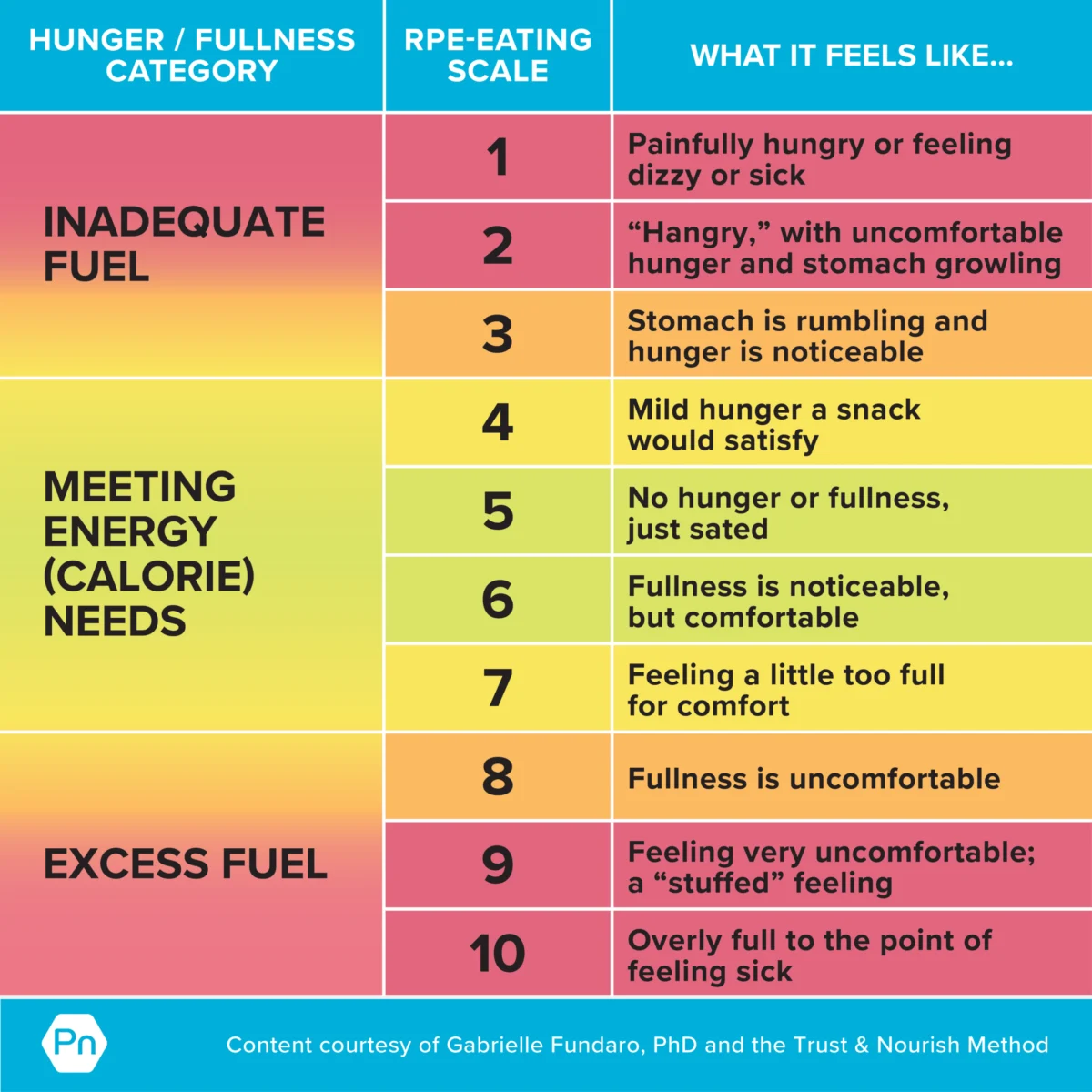
The RPE-Eating Scale translates these principles to hunger and fullness:
- 1: Painfully hungry, dizzy, or sick.
- 2: "Hangry," uncomfortable hunger, stomach growling.
- 3: Hunger noticeable, stomach rumbling.
- 4: Mild hunger, a snack would satisfy.
- 5: No hunger or fullness, just sated.
- 6: Noticeable fullness, but comfortable.
- 7: A little too full for comfort.
- 8: Uncomfortable fullness.
- 9: Very uncomfortable or "stuffed."
- 10: Overly full to the point of feeling sick.
The overarching goal of RPE-Eating is to cultivate the skills necessary to determine adequate nourishment for oneself, without reliance on external metrics like apps or trackers. This method aims to empower individuals to regain confidence and self-trust around food, improve nutritional awareness and competence, and ultimately free themselves from the shackles of constant tracking. Dr. Fundaro, through this system, has indeed found her own trust in her eating choices, with no macro tracker in sight.
Practical Implementation: Mastering RPE-Eating
Adopting RPE-Eating, much like RPE-training, requires practice and patience. It’s a skill-building process, especially for those accustomed to ignoring internal cues. Dr. Fundaro outlines four key steps for effective practice:
1. Get Clear on Your Goals: Beyond Body Modification
RPE-Eating fundamentally shifts the focus from body transformation to building inner trust and confidence. While it can be adapted for physique goals like muscle gain or fat loss, it is not primarily designed as the most efficient tool for extreme body modification. Its core purpose is about "sensing into what your body needs and giving yourself appropriate nourishment—while building inner trust and confidence along the way." This requires letting go of the expectation of hitting "optimal" macros at every meal and accepting potential changes in one’s body, fostering a healthier, more sustainable relationship with food.

2. Practice Identifying Your Hunger Cues: Differentiating Hunger from Appetite
A crucial aspect of RPE-Eating is distinguishing between true physiological hunger and psychological appetite. Hunger arises from physical cues indicating a need for energy, while appetite is the desire to eat, which can persist even after hunger is satisfied, often driven by sensory pleasure or emotional triggers.
The practice involves:
- Before a meal, using the RPE-Eating scale to identify and record your current hunger level.
- Eating mindfully, limiting distractions, and focusing on the sensory experience of the food.
- Checking in halfway through the meal and again upon finishing, recording your RPE-Eating score.
- Internalizing the feeling of comfortable fullness.
Consistent practice helps recalibrate internal hunger cues, strengthening the body’s internal compass over external directives. This process enhances interoceptive awareness, the conscious perception of internal bodily states, which is fundamental to self-regulation.
3. Get to Know Your Non-Hunger Triggers: The Emotional Landscape of Eating
Life is rarely a mindful, perfectly rated eating experience. Stress, emotions, and external situations frequently trigger eating beyond physical hunger. Dr. Fundaro advocates for "Notice and Name" – observing these triggers without judgment. This involves identifying feelings (anxiety, sadness), situations (a stressful email, an argument), and then exploring the actual underlying need or desire. Eating for comfort is normal, but if it becomes the sole coping mechanism, it can be detrimental. Expanding one’s repertoire of self-soothing methods—a walk, deep breathing, connecting with a friend—provides alternatives to compulsive eating, fostering more intentional food choices. This step addresses the psychological complexities often overlooked by purely quantitative tracking methods.
4. Eat for Satiety AND Satisfaction: The Holistic Experience
RPE-Eating emphasizes that eating should fulfill two criteria:
- Satiety: The physical sensation of fullness, indicating caloric and fuel needs are met.
- Satisfaction: A holistic feeling of being nourished, where the meal is also pleasurable.
If only satiety is met, an individual might still feel unsatisfied, especially if they are restricting certain desired foods. This often leads to a "restrict-binge" cycle. Satisfaction acknowledges that humans eat for pleasure, tradition, community, and novelty, not just nutrients. Dr. Fundaro encourages practicing RPE-Eating with genuinely enjoyable foods, including those previously deemed "off-limits." This helps integrate all foods into a healthy relationship, breaking the cycle of restriction and promoting a more flexible, spontaneous, and enjoyable eating experience.
Who Benefits from RPE-Eating? Addressing the Right Audience
RPE-Eating is a powerful tool, but like any tool, it’s not universally applicable. It’s particularly well-suited for individuals who:
- Feel dependent on food tracking but wish to break free.
- Experience anxiety or fear when contemplating stopping tracking.
- Desire a structured system or guidance as they transition away from tracking.
- Are currently tracking or considering it, but possess elevated risk factors for developing an eating disorder (e.g., high body dissatisfaction, history of yo-yo dieting, disordered eating patterns, participation in weight-class sports).
It is crucial to note that RPE-Eating does not replace professional support for individuals struggling with clinical eating disorders. In such cases, specialized care from therapists, doctors, or registered dietitians is paramount. For coaches, Dr. Fundaro’s resources offer guidance on flexible application, emphasizing client-centered adaptation.
RPE-Eating for Weight Management: A Nuanced Approach
While Dr. Fundaro primarily advocates for RPE-Eating in a weight-neutral context, acknowledging its potential for fostering a healthier relationship with food independent of body size, she also provides guidance for those who wish to use it for weight modification. She likens intentional weight modification to contact sports, acknowledging inherent risks that can be mitigated through best practices. RPE-Eating, by removing macro-tracking (a potential risk factor for disordered eating in some) and emphasizing biofeedback and non-hunger triggers, offers a safety net that macro-tracking alone may lack.
For those aiming for weight gain, the recommendation is to generally eat within the 7 to 8 range on the RPE-Eating scale (noticeable fullness to a little too full). For weight loss, the target range would typically be 4 to 5 (mild hunger to sated). However, Dr. Fundaro cautions against using RPE-Eating for extreme weight modification, such as for a bodybuilding competition, emphasizing that it’s not the right tool for such intense, precise, and often temporary dietary interventions.
Beyond "Feelings Over Facts": The Science of Interoceptive Awareness
Skeptics might dismiss RPE-Eating as merely "eating based on feelings," contrasting it with the perceived objectivity of macro tracking. However, this skepticism echoes the initial resistance RPE faced in the fitness world. Today, RPE and autoregulation are widely accepted and scientifically validated methods for guiding training. RPE, while subjective, has demonstrated accuracy and convenience, often surpassing more complex tracking methods in practical application.
The scientific underpinning of RPE-Eating lies in interoceptive awareness, the conscious perception of internal bodily sensations. This skill, honed through practices like RPE-Eating, allows individuals to make informed decisions based on their body’s signals. Just as a slowing barbell indicates fatigue in lifting, the absence of hunger at the end of a meal signals fullness. Instead of relying on external tools like glucose monitors, RPE-Eating leverages internal cues that correlate with physiological states, such as stomach rumbling coinciding with lowered blood sugar and hunger. This internal calibration is not only scientifically sound but also far more convenient and accessible for daily life. While initial attempts may involve some over or undereating, consistent practice strengthens this vital skill.
Challenges and Considerations: When RPE-Eating Isn’t the Perfect Fit
Despite its benefits, RPE-Eating is not without its challenges. It demands a significant investment of attention and reflection on both physical and emotional feelings, which can be laborious. For individuals with demanding schedules—parents of young children, shift workers, or those with jobs requiring on-the-go eating—the luxury of a leisurely, mindful meal may be rare.
In such scenarios, Dr. Fundaro suggests flexibility. RPE-Eating can be applied selectively during quieter meals or moments. Alternatively, individuals can isolate specific steps, such as focusing solely on developing hunger and fullness awareness without attempting to integrate all aspects of the framework. It’s a tool, not a dogma, and its utility depends on the specific context and needs of the individual.
The Off-Ramp from Macro Tracking: A Path to Lasting Freedom
Macro tracking, while initially educational, is rarely a lifelong endeavor for most. The transition away from it, however, can be fraught with fear and a perceived loss of control. RPE-Eating offers a vital "off-ramp," a structured transition away from rigid, restrictive macro tracking. It helps dismantle the reliance on external cues—whether macro targets or the arbitrary directive to "finish your plate"—and re-establishes trust in internal signals.
While RPE-Eating won’t instantly eliminate all anxieties associated with changing ingrained eating habits, it provides a valuable framework and language to navigate this process. By fostering less fear, less stress, and greater confidence around food, it aligns with Dr. Fundaro’s ultimate goal: "to know that you’re nourishing yourself—and you don’t need a food tracker to do that." This innovative approach holds promise for cultivating a more intuitive, sustainable, and peaceful relationship with food for a broad spectrum of individuals.