
This sentiment resonates deeply with many seeking to navigate the complexities of modern health advice. The desire to maximize healthspan and lifespan, to outlive peers and defy age expectancies, to remain fit, lean, and youthful well into advanced years, is a compelling vision. It promises a future where disease is fended off and vitality endures. Yet, the pursuit of this ideal often appears daunting, demanding extraordinary investments of effort, time, money, and an intricate understanding of complex protocols. The pertinent questions then arise: Is all this intense effort truly necessary? Is it worth the investment, and will it even deliver the promised results?

The Rise of the Longevity Optimization Movement
The landscape of health and longevity has been dramatically reshaped by a burgeoning movement advocating for "optimization" and "biohacking." Influential figures, from popular podcasters and health experts like Dr. Peter Attia, Dr. Andrew Huberman, and Dr. Rhonda Patrick, to biohacker Bryan Johnson, have brought unprecedented attention to this space. Their often highly personalized and rigorous routines, frequently involving advanced diagnostics, experimental therapies, and a vast array of supplements, project an image of ultimate control over the aging process. The appeal is undeniable: the promise of a longer, healthier life, coupled with a comforting sense of agency over one’s biological destiny.

This trend is not without historical precedent. Humanity has long sought elixirs for youth and longevity, from ancient alchemists to modern wellness gurus. However, the current iteration is amplified by technological advancements, sophisticated marketing, and the pervasive reach of social media, creating an environment where complex, cutting-edge solutions often overshadow simpler, time-tested wisdom. Public health organizations and traditional medical communities, while supportive of preventive care, generally advocate for evidence-based interventions, often differing from the more speculative approaches promoted within the optimization sphere.
Debunking the Myths: The Overlooked Power of the Fundamentals

For organizations deeply embedded in coaching hundreds of thousands of individuals with diverse lives and resources, such as Precision Nutrition, the concept of "optimal" health is rarely realistic. More importantly, it’s often not necessary. Experience suggests that modest, consistent efforts toward established health and well-being practices typically yield superior and more sustainable results than an intense, highly "optimized" protocol. This perspective challenges several prevailing myths:
Myth 1: The "Basics" Aren’t Enough for True Longevity
There’s a pervasive notion that achieving exceptional health and extending life beyond average expectancies demands complex, "cutting-edge" strategies. However, robust scientific evidence consistently demonstrates the profound efficacy of fundamental health behaviors. These include regular exercise, a nutrient-rich diet, adequate sleep, effective stress management, and strong social connections. The challenge isn’t that these basics don’t work; it’s that very few individuals adhere to them consistently. Data from various health surveys consistently show low adherence rates for recommended fruit and vegetable intake, physical activity, and sleep duration across populations. The primary barrier to a longer, healthier life for most people is not the absence of advanced biohacks but the inconsistent application of these relatively simple, yet powerful, daily habits. For example, only 10% of Americans consume the recommended five servings of fruits and vegetables daily, and fewer than 25% meet both aerobic and resistance exercise guidelines. These figures highlight a fundamental gap that precedes any need for complex interventions.

Myth 2: More Effort Always Equates to Better Health Outcomes
The logical extension of "if some is good, more must be better" often falls flat in the realm of health and fitness. A fundamental principle of biology and training is the law of diminishing returns. Initial efforts in adopting healthy habits yield substantial benefits, but as efforts increase, the incremental gains become progressively smaller. Beyond a certain point, excessive intensity or volume can introduce new risks. Overtraining, for instance, can lead to hormonal imbalances, sleep disturbances, chronic fatigue, increased injury risk, and even detrimental effects on cardiovascular health, as posited by the "Extreme Exercise Hypothesis." This phenomenon illustrates a U-shaped curve where both very low and extremely high levels of exercise can increase health risks, with the sweet spot lying in moderate to high activity levels. Furthermore, an overly complex or demanding health regimen can detract from other vital aspects of life, such as social engagement, career, or personal enjoyment, ultimately compromising overall well-being.
Myth 3: Cutting-Edge Strategies Offer Significant, Proven Benefits
The allure of novel "longevity supplements" and "biohacks" is powerful, but their scientific validation often lags far behind their marketing. Much of the research supporting these advanced, complex strategies is still in its nascent stages, frequently conducted on animal models, or involves small observational studies over short durations. For example, compounds like resveratrol, NAD+, and NAC, touted for their potential anti-aging effects, largely lack conclusive human trials demonstrating significant, long-term benefits or safety. Moreover, the supplement industry is less regulated than pharmaceuticals, meaning many products lack rigorous testing for purity, potency, or efficacy. Some fringe methods not only remain unproven but also carry potential risks, including adverse interactions with medications or unforeseen side effects. Prioritizing foundational health behaviors, which have decades of robust evidence supporting their benefits, is a far more prudent and effective strategy than investing in speculative interventions.

Myth 4: Health Optimization is an All-or-Nothing Proposition
The perception that achieving health goals requires perfect adherence or an extreme lifestyle can be paralyzing. Many individuals, feeling overwhelmed by the idealized standards presented by "optimizers," conclude that if they cannot achieve perfection, they might as well do nothing. However, this "all or nothing" mindset is counterproductive. Data from extensive coaching programs, such as Precision Nutrition’s year-long program, demonstrates that even clients who practiced basic health habits with less than 50% consistency still achieved measurable and meaningful results, including significant weight loss and improved body composition. This highlights the substantial impact of incremental improvements and the forgiving nature of the human body when even moderate efforts are applied. The journey to better health is a continuum, and every small, consistent step contributes positively.
The Seven Pillars of Sustainable Longevity: An Evidence-Based Approach

For individuals seeking to genuinely enhance their healthspan and lifespan, focusing on a set of well-established, foundational behaviors offers the most reliable and sustainable path.
-
Exercise Regularly: Physical activity is a cornerstone of health, reducing the risk of chronic diseases and extending lifespan regardless of other factors. Studies, including those on Harvard alumni, show that any amount of physical activity decreases mortality risk. Specifically, accumulating 7.5 to 15 MET-hours of activity per week provides substantial benefits, with diminishing returns beyond this range. This translates to the standard recommendation of 150-300 minutes of moderate-intensity aerobic activity or 75-150 minutes of vigorous-intensity aerobic activity per week, coupled with two or more days of resistance training. Resistance training is particularly crucial for preserving muscle mass, maintaining cognitive function, and preventing falls, a leading cause of death in older adults. Despite these clear benefits, only 24% of adults meet both aerobic and resistance exercise guidelines, underscoring a significant public health challenge.

-
Eat a Nourishing, Nutrient-Rich Diet: A healthy diet doesn’t require extreme restrictions or exotic ingredients. The focus should be on three key nutritional fundamentals:
- Prioritize Whole and Minimally-Processed Foods: These foods are naturally rich in fiber, healthy fats, vitamins, minerals, and phytochemicals, while being less calorie-dense and lower in harmful additives (sugar, sodium, trans fats) than ultra-processed foods (UPFs). Diets high in whole foods are linked to lower rates of depression, heart disease, type 2 diabetes, and cancer. Conversely, UPFs are associated with 32 harmful health outcomes. A realistic target is to derive 70-80% of calories from whole or minimally-processed foods. Current US data indicates that Americans derive only about 28.5% of their calories from these foods, with 56% coming from UPFs.
- Consume Five Servings of Fruits and Vegetables Daily: Extensive research, including a meta-analysis of over 1.8 million people, shows that consuming five fist-sized servings (typically three vegetables, two fruits) daily is associated with a 13% lower risk of death from any cause, with benefits plateauing at this intake level. Despite this, only about 10% of Americans achieve this recommendation.
- Ensure Adequate Protein Intake: Protein is critical for maintaining muscle mass, especially as we age (to combat sarcopenia), supporting immunity, and promoting satiety. The recommended minimum intake is 1.2 grams per kilogram of body weight for most adults, increasing to 1.6-2.2 g/kg for those engaging in resistance training or taking GLP-1 medications. While most adults meet the lower 0.8 g/kg recommendation, many, especially older adults and young women, fall short of the ideal.
-
Get Adequate and Quality Sleep: Sleep is not merely rest; it’s an active process vital for physical and mental restoration. Research indicates that 7 to 9 hours of sleep per night is ideal for most adults, significantly impacting heart health, cognitive function, and reducing the risk of conditions like dementia (deep sleep helps clear brain toxins). Compared to 7 hours, even a 1-hour decrease in sleep duration is linked to an 11% increased risk of cardiovascular disease. Approximately one-third of US adults do not meet the recommended sleep duration, facing higher risks for various health issues. Interestingly, consistently sleeping more than 9 hours can also be associated with increased health risks, though this often points to underlying health problems rather than being a direct cause.

-
Manage Stress Effectively: Chronic, unmanaged stress elevates heart rate, blood pressure, and inflammation, increasing the risk of cardiovascular disease, anxiety, and depression. However, stress itself is a natural and even beneficial part of life (eustress), providing motivation and engagement. The goal is not to eliminate stress but to develop resilience and effective coping mechanisms. Simple strategies like self-compassion, a growth mindset, and basic self-regulation skills (e.g., deep breathing, journaling, spending time in nature) can significantly mitigate its negative impacts. Given that over a quarter of people in the US and Canada report being too stressed to function most days, mastering stress management is a critical, yet often neglected, health behavior.
-
Stay Socially Connected: Social connection is a powerful determinant of health and longevity. Strong social relationships are associated with a 50% increased likelihood of survival and are a better predictor of life satisfaction and longevity than wealth or IQ, as demonstrated by the 87-year-long Harvard Study of Adult Development. Conversely, social isolation and loneliness dramatically increase the risk of heart disease, stroke, type 2 diabetes, dementia, and premature death, with an impact comparable to smoking 15 cigarettes a day. Research suggests that maintaining three to five close friends with regular interaction (1-3 times per week) provides optimal benefits. Yet, approximately one in three adults reports feeling lonely, highlighting a growing public health concern.

-
Minimize Known Harms: Avoiding clearly detrimental behaviors is foundational to longevity.
- Don’t Smoke: Tobacco use remains a leading cause of preventable death, accounting for over 8 million premature deaths globally each year and significantly increasing the risk of numerous chronic diseases, including cancer, heart disease, and emphysema. Despite widespread awareness, 11.5% of US adults still smoke.
- Limit Alcohol: The evidence is increasingly clear that alcohol has negative health implications, particularly with regular, heavy use. It contributes to over 200 diseases, including liver disease, cardiovascular disease, and at least seven types of cancer. For individuals aged 15-49, alcohol is the leading risk factor for death. US guidelines suggest moderate intake (up to one drink per day for women, two for men), but average consumption often exceeds this, and underreporting is common. The WHO has stated that no amount of alcohol is "safe," emphasizing that risks rise exponentially with increased intake. The decision to drink involves a personal assessment of risk versus perceived benefits, with abstinence offering the lowest health risk.
-
Practice Basic Preventive Health Measures: These "boring but important" habits form a critical line of defense for long-term health. They include regular check-ups, vaccinations, appropriate screenings (e.g., cancer screenings), maintaining good hygiene (e.g., brushing and flossing daily), wearing safety gear (e.g., seatbelts, helmets), protecting hearing and vision, and promptly addressing health concerns. While seatbelt usage is high, adherence to other simple measures, like daily flossing (only 32% of Americans), is much lower. These consistent, low-effort practices are immeasurably more impactful than any optimization fad for preventing illness and injury.

Bonus: Foster a Sense of Purpose and Meaning
Beyond physiological factors, a strong sense of purpose and meaning in life is consistently linked to improved health, well-being, and longevity. This "existential health" component makes individuals more likely to engage in health-promoting behaviors, improves mental health (e.g., 43% reduced risk of depression), and potentially simply makes one want to live longer to fulfill that purpose. Purpose can manifest in various forms, from career goals to nurturing relationships or contributing to community.
The Overlooked Tradeoffs: When Optimization Becomes Detrimental

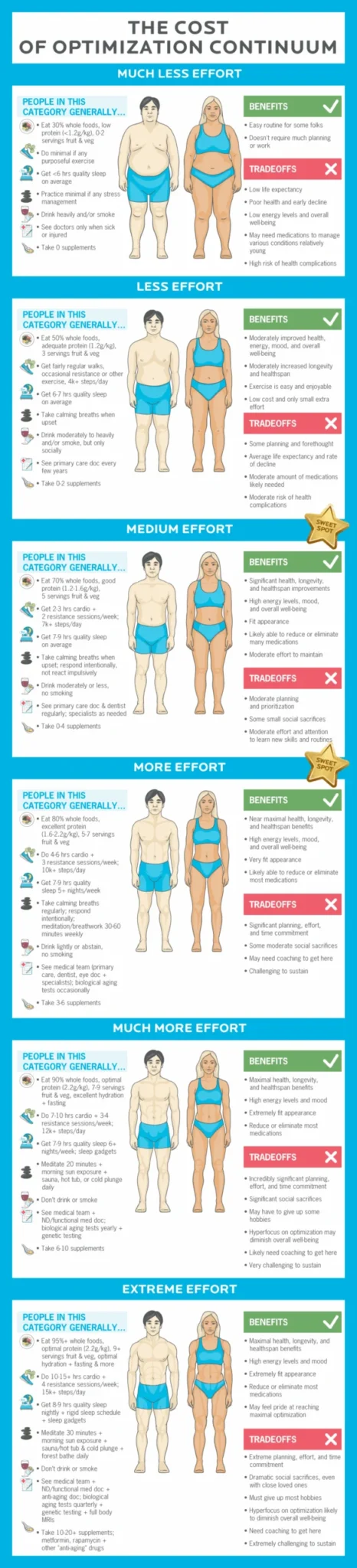
While the foundational behaviors offer significant returns, the pursuit of extreme optimization often comes with substantial, often unacknowledged, tradeoffs. An "optimizer" lifestyle demands exponentially more time, effort, and financial resources—potentially three to four times that of a consistently "healthy" individual. This involves not just maximizing exercise and nutrition but also integrating costly supplements, advanced diagnostics, and niche therapies. A weekly tally of an "optimizer" might include hours of specialized training, meticulous meal prep, advanced recovery protocols, and substantial spending on everything from genetic testing to cryotherapy, easily adding $10,000+ per year and many hours per week.
Beyond the monetary cost, the most significant tradeoff can be the erosion of overall well-being and quality of life. An obsessive focus on physical health can lead to burnout, making it harder to sustain even basic habits. More critically, it can compromise other vital aspects of "deep health," including social, emotional, mental, and existential well-being. The constant monitoring, restrictive diets, and rigid schedules can foster anxiety, orthorexia (an unhealthy obsession with healthy eating), and social isolation. The ultimate goal of health is not merely to extend life but to live it fully and joyfully. When the pursuit of longevity begins to diminish the joy of living, the balance has been lost.

Making Informed Choices for Your Health Journey
In conclusion, while the allure of extreme health optimization is strong, true and sustainable longevity is built upon the consistent application of foundational health behaviors. The noise of the optimization culture should not overshadow the profound impact of these accessible, evidence-based practices.

- Clarify Your Goals: Take a moment to genuinely reflect on what a "healthy life" means to you. How important is maximizing healthspan and lifespan in the context of your other life priorities, values, and resources?
- Consider the Tradeoffs: Honestly assess how much time, money, and effort you are realistically willing to invest. What aspects of your life are you prepared to adjust, and what are non-negotiables?
- Prioritize the Basics: Review the seven foundational health behaviors outlined here. Identify areas where you can improve consistency. These are the interventions with the highest return on investment. Once these are solidly in place, and only if desired, consider minor, evidence-supported enhancements.
- Tune Out the Noise: Remember that you are the ultimate expert on your own life. Filter out the overwhelming information from influencers and media. Make choices that align with your personal values and circumstances, rather than conforming to an idealized, often unrealistic, standard of "perfection."
Your health journey is deeply personal. By focusing on consistent, sustainable habits, you can build a robust foundation for a long, healthy, and genuinely enjoyable life, free from the pressure of chasing ever-elusive "optimal" extremes.
References
Click here to view the information sources referenced in this article.