
The realization that macro counting was no longer serving her well-being arrived after years of rigid adherence. Despite her credentials—a PhD in Human Nutrition—Dr. Fundaro found herself trapped in a cycle of dependency where the inability to track a meal triggered fears of muscle atrophy, fat gain, and professional inadequacy. This phenomenon, often termed "tracking fatigue," is increasingly being identified by nutritionists as a barrier to long-term sustainable health. It represents a pivot from data-driven eating to a more nuanced, internal-cue-based methodology.
The Chronology of a Shift in Nutritional Philosophy
The transition from external tracking to internal regulation is not merely a personal anecdote; it mirrors a broader trend within exercise science. In the mid-20th century, specifically the 1960s, physiologist Gunnar Borg introduced the Rate of Perceived Exertion (RPE) scale. Initially designed for clinical settings to help patients gauge physical effort, the scale was later adopted by strength athletes to autoregulate their training.
For decades, the fitness world relied on rigid percentages of one-rep maximums (1RM) to dictate workout intensity. However, as sports science matured, researchers and coaches began to recognize that an individual’s readiness to perform fluctuates daily due to sleep, stress, and recovery. By adopting the RPE scale, athletes learned to listen to their bodies, adjusting load based on how they felt in the moment rather than what a spreadsheet dictated.
Dr. Fundaro’s epiphany was the realization that this same framework of autoregulation could be applied to nutrition. If an athlete could safely and effectively train by gauging their effort on a scale of 1 to 10, then a person could theoretically nourish themselves by gauging their hunger and fullness on a similar scale. This conceptual leap—from physical exertion to nutritional consumption—marks the birth of the RPE-Eating framework.
Understanding the RPE-Eating Framework
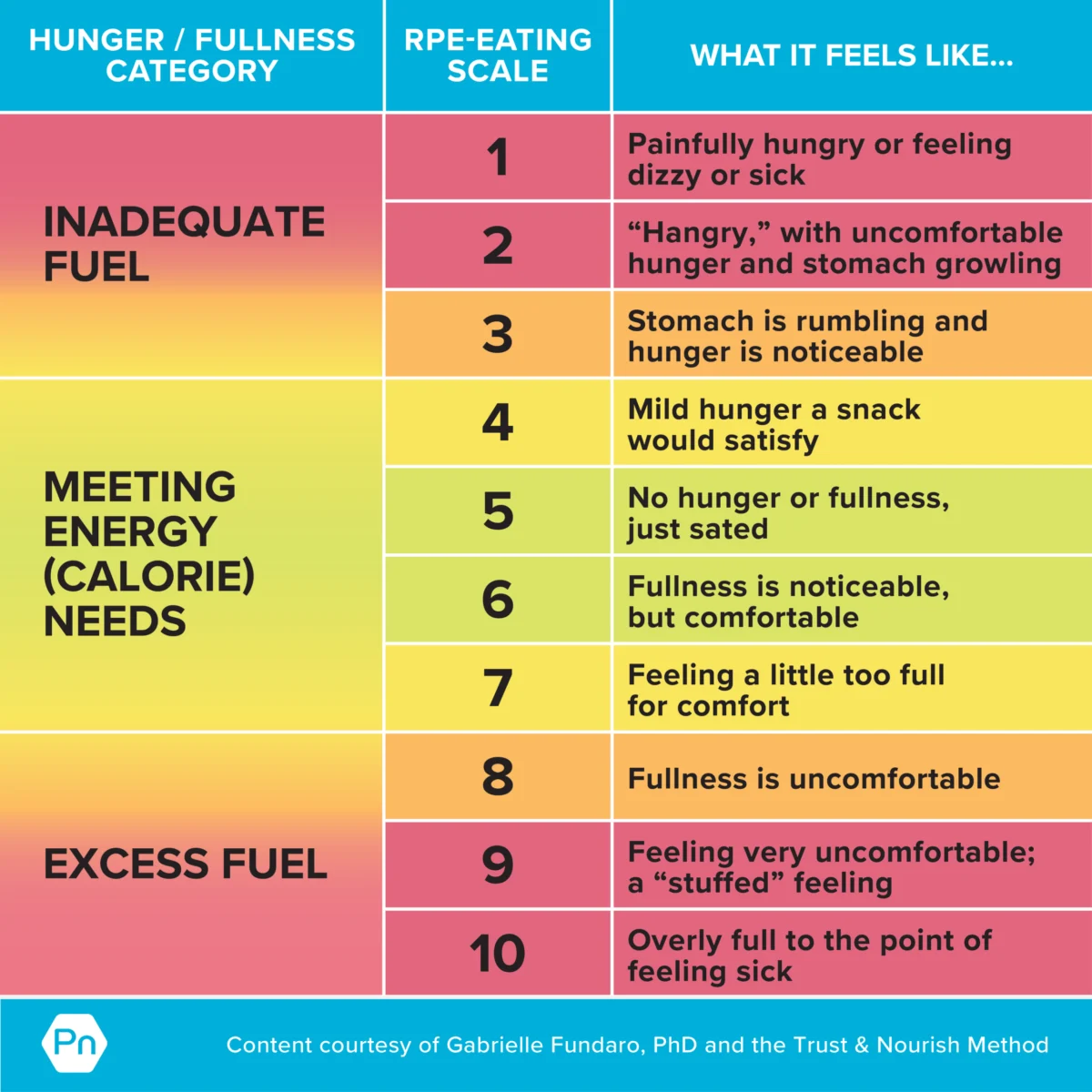
The RPE-Eating model operates on a scale of 1 to 10, categorizing physiological states ranging from "painfully hungry" at the bottom to "overly full/sick" at the top. Unlike calorie counting, which provides a rigid ceiling or floor, RPE-Eating is a qualitative tool that emphasizes interoceptive awareness—the body’s ability to sense its own internal states.
The scale is structured as follows:
- Levels 1–3: Inadequate fuel (physical signs of distress such as dizziness, lightheadedness, or severe stomach rumbling).
- Levels 4–7: Adequate fuel (a spectrum of comfort ranging from mild satisfaction to noticeable, comfortable fullness).
- Levels 8–10: Excess fuel (moving from a state of being slightly over-full to physical discomfort or "stuffed" sensations).
The core objective is not to hit a precise numerical target but to cultivate the competence to stop eating when "adequate" is reached, thereby bypassing the need for external verification through apps or scales.
Supporting Data and Scientific Context
The psychological impact of tracking is well-documented in clinical literature. Research into restrictive eating patterns suggests that when individuals rely exclusively on external trackers, they often experience a disconnect from their internal satiety hormones, specifically ghrelin (the hunger hormone) and leptin (the fullness hormone). A 2021 meta-analysis on the long-term outcomes of calorie-counting applications suggested that while these tools are effective for short-term weight loss, they are frequently associated with increased levels of body dissatisfaction and disordered eating behaviors in vulnerable populations.
By shifting the focus to RPE-Eating, practitioners are attempting to retrain the brain to recognize the physiological signals that have been suppressed by years of data-driven eating. This is supported by studies on mindful eating, which indicate that individuals who pay closer attention to hunger cues often report higher levels of satisfaction and lower rates of binge eating episodes.

Implications for Coaches and Athletes
The implications of this method are substantial, particularly for the coaching industry. Traditional nutrition coaching has historically focused on prescriptive meal plans. The RPE-Eating model, however, requires a more collaborative approach. It demands that the client take an active role in their own nutrition by recording their hunger levels before, during, and after meals.
Critics of this approach, particularly those in the "evidence-based" fitness community, often argue that "feelings" are unreliable metrics for body composition goals. However, proponents point out that the RPE-Eating framework is not about discarding science, but about acknowledging the limits of human consistency. Just as a powerlifter uses RPE to ensure they don’t over-train, an individual can use RPE to ensure they don’t over-eat or under-eat during periods of high stress or life transitions.
Furthermore, Dr. Fundaro emphasizes that this is not an invitation to abandon all structure. For individuals with specific body composition goals, such as weight loss or muscle gain, RPE-Eating can be used as a "safety net." For instance, someone aiming for weight loss might aim to stay within the 4–5 range, while someone in a muscle-building phase might lean toward the 7–8 range. The difference lies in the reliance on internal feedback rather than a rigid calorie count that may fail to account for daily metabolic variance.
Addressing Non-Hunger Triggers
A critical component of the RPE-Eating system is the identification of "non-hunger triggers." In a modern environment saturated with high-palatability foods, eating is often driven by emotional states—stress, boredom, or anxiety—rather than genuine biological need.
The "Notice and Name" technique, popularized by various coaching organizations, is central here. By identifying the emotional catalyst before reaching for food, individuals can differentiate between hunger and appetite. Appetite, which is often stimulated by the sight, smell, or emotional association of food, can lead to overconsumption even when the body is biologically sated. By learning to distinguish between these two, practitioners of the RPE-Eating method gain a layer of psychological resilience that traditional macro-tracking does not provide.
The Role of Satisfaction
Perhaps the most counterintuitive part of the system is the emphasis on satisfaction. Many diets fail because they are purely functional, ignoring the human desire for pleasure, community, and cultural tradition in food. Dr. Fundaro’s framework explicitly includes "satisfaction" as a key metric of success. If a meal meets the caloric requirements but lacks satisfaction, it often leads to a cycle of restriction and subsequent binging. By allowing for the inclusion of preferred foods, the RPE-Eating method aims to reduce the "forbidden fruit" effect, which is a major contributor to long-term diet failure.
Broader Impact and Future Directions
As the fitness industry continues to grapple with the mental health repercussions of aesthetic-focused training, the adoption of RPE-based nutritional models is likely to grow. This shift represents a move toward autonomy. For the average person, the goal is not to reach a specific, unsustainable leanness, but to achieve a state where they can trust their own body to regulate its needs.
However, it is vital to note that this tool is not a panacea. For individuals with a history of clinical eating disorders, RPE-Eating should only be practiced under the guidance of a registered dietitian or licensed therapist. The removal of external guardrails can be a source of profound anxiety for those who have spent years using tracking as a primary coping mechanism.
The transition from a calculator-based approach to an intuition-based one is not instantaneous. It requires patience, repeated practice, and a willingness to accept that the body’s needs may vary significantly from day to day. As Dr. Fundaro concludes, the goal is not to achieve the "perfect" diet, but to build a sustainable relationship with food that is grounded in self-trust rather than data. In a world of infinite tracking devices, the most sophisticated instrument remains the human body itself. Whether this trend will fundamentally alter the landscape of the fitness industry remains to be seen, but the increasing discourse suggests that for many, the era of absolute nutritional measurement is being challenged by the quiet, internal power of awareness.