
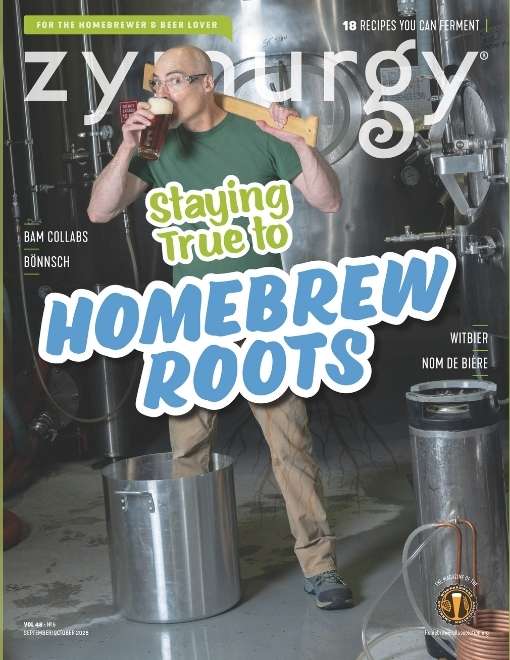
The American Homebrewers Association (AHA) has released the September/October 2025 edition of Zymurgy magazine, a publication that has served as the preeminent resource for the homebrewing community since its inception in 1978. This latest issue centers on a theme that has become increasingly relevant in the modern craft beer landscape: the fluid intersection between amateur enthusiasts and professional industry leaders. Featuring 18 new recipes and in-depth technical profiles, the issue serves as both a practical manual for brewers and a historical record of the community’s ongoing evolution.
At the heart of this edition is a comprehensive cover story detailing the career trajectory of Gary Glass. Glass, who served for years as the director of the American Homebrewers Association, has successfully transitioned from a leadership role in advocacy to achieving top-tier recognition as a professional brewer. The feature, authored by Gabe Toth, explores Glass’s journey from overseeing national homebrewing initiatives to securing medals at the Great American Beer Festival (GABF). This narrative underscores a broader industry trend where the rigorous technical standards of high-level homebrewing serve as a primary pipeline for professional innovation and quality control.
The Synergy of Amateur and Professional Brewing Traditions
The September/October 2025 issue arrives at a pivotal moment for the American craft beer movement. While the industry has matured significantly over the last four decades, the link between homebrew clubs and commercial breweries remains a vital component of its ecosystem. This relationship is exemplified in a featured report on the collaboration between the Bay Area Mashers and the Maltose Falcons.
The Maltose Falcons, based in Los Angeles, hold the distinction of being the oldest homebrew club in the United States, founded in 1974. Their collaboration with the Bay Area Mashers, along with regional maltsters and professional breweries, highlights a sophisticated network of knowledge-sharing. These partnerships are not merely social; they are experimental labs where professional brewers can test small-batch concepts and where homebrewers gain access to commercial-grade raw materials and technical insights. Such collaborations often result in the refinement of specific styles and the introduction of rare ingredients into the wider market.
Technical Spotlights: Bönnsch and Belgian Witbier
Zymurgy continues its tradition of providing deep technical dives into specific beer styles, offering readers the opportunity to master complex brewing processes. In this issue, brewer Gunnar Martens provides an exploration of Bönnsch naturtrüb. Bönnsch is a localized specialty from Bonn, Germany, often described as a hazy, unfiltered version of the more famous Kölsch from nearby Cologne. Because it is rarely exported, Martens’s insights into the yeast management and fermentation temperatures required for this style are invaluable for brewers looking to recreate authentic European regional specialties.

The issue also features a masterclass on the Belgian Witbier style, led by Charlie Gottenkieny and Jason Perkins. Perkins, the Brewmaster at Allagash Brewing Company, is widely regarded as one of the world’s foremost experts on Belgian-style ales. His contribution, alongside Gottenkieny, provides a comparative look at how a world-class professional approach to Witbier—utilizing unmalted wheat, coriander, and orange peel—can be scaled down to the homebrew level without sacrificing the delicate balance of phenols and esters that define the style.
The Art of Competition: Naming and Presentation
Beyond the chemistry and physics of brewing, the September/October 2025 issue addresses the cultural and psychological aspects of the craft. Ron Minkoff contributes an irreverent guide to naming beers for competition. While often overlooked, the naming of a brew can play a subtle role in the perception of a beer during the judging process. Minkoff’s guide provides a framework for selecting names that are memorable and professional, reflecting the high stakes of modern homebrew competitions, which often see thousands of entries across hundreds of categories defined by the Beer Judge Certification Program (BJCP).
The editorial direction of this issue is led by Dave Carpenter, a veteran beer writer and brewer who has served as Editor-in-Chief since 2019. Carpenter’s vision for the magazine focuses on "geeking out" on the technicalities of the craft while maintaining accessibility for newcomers. His leadership reflects the AHA’s broader mission to promote the community of homebrewers and protect the right to brew at home.

Historical Context and the Economic Impact of Homebrewing
To understand the significance of the September/October 2025 issue, one must look at the historical trajectory of the American Homebrewers Association. Founded by Charlie Papazian in Boulder, Colorado, the AHA was instrumental in the 1978 federal legalization of homebrewing. Since then, the hobby has grown into a significant economic driver.
According to data from the Brewers Association (the parent organization of the AHA), more than 1.1 million people in the United States brew their own beer at home. These enthusiasts contribute an estimated $700 million annually to the economy through the purchase of ingredients, equipment, and educational materials. Furthermore, the AHA reports that approximately 90% of professional craft brewers began their careers as homebrewers. The "Pro-Am" theme of the current Zymurgy issue is a direct reflection of this statistic, acknowledging that today’s amateur in a garage is often tomorrow’s award-winning professional.
Chronology of Homebrewing Milestones
The evolution of the content within Zymurgy tracks the advancement of the hobby over the decades:

- 1978: President Jimmy Carter signs H.R. 1337, legalizing homebrewing at the federal level. The AHA is founded.
- 1980s: Zymurgy focuses on basic sanitation and the transition from hopped malt extracts to all-grain brewing.
- 1990s: The magazine begins featuring more professional-level chemistry, including water profile adjustments and yeast propagation.
- 2000s: The rise of extreme brewing and high-gravity ales is documented, alongside the birth of the "hazy" IPA movement.
- 2020-2025: A return to "heritage" styles and technical precision, as seen in the current issue’s focus on Bönnsch and Witbier.
Implications for the Craft Brewing Industry
The publication of this issue has implications that extend beyond the individual brewer’s kitchen or basement. The inclusion of 18 validated recipes provides a benchmark for quality that influences the entire craft sector. When homebrewers master difficult styles like the Bönnsch naturtrüb, they raise the collective palate of the consumer base. This, in turn, pressures commercial breweries to maintain high standards and continue innovating.
Furthermore, the focus on Gary Glass’s transition to professional success serves as a powerful recruitment tool for the AHA. By demonstrating that the path from hobbyist to GABF medalist is viable, the association reinforces its value proposition. Membership in the AHA, which includes access to Zymurgy, is presented not just as a subscription, but as an investment in a professional-grade education.
The AHA continues to advocate for legislative changes that benefit brewers, such as the ability to transport homebrew to competitions and festivals in states where restrictions still exist. The September/October 2025 issue serves as a reminder of the association’s dual role: a provider of technical education and a guardian of brewing rights.
Conclusion and Future Outlook
As the craft beer industry faces new challenges, including shifting consumer preferences and rising ingredient costs, the role of Zymurgy remains steadfast. It provides a platform for the rigorous exchange of ideas that keeps the industry vibrant. The September/October 2025 issue, with its blend of historical perspective, technical mastery, and professional success stories, reaffirms that the boundary between the amateur and the professional is not a wall, but a permeable membrane through which the best ideas in brewing continue to flow.
For the members of the American Homebrewers Association, this issue is a call to action to continue refining their craft. For the broader beer world, it is a testament to the enduring influence of the homebrewing community on the global stage. As Editor-in-Chief Dave Carpenter and his team look toward the future, the magazine remains dedicated to the "gerunds" of the craft—hiking, traveling, and, most importantly, brewing.