
For years, macro counting served as Dr. Fundaro’s primary method for maintaining dietary control and achieving her physique goals. This approach, which involves precisely measuring and balancing macronutrients (proteins, carbohydrates, and fats), is widely adopted in fitness and bodybuilding communities. It offers a structured framework that can yield significant results in body composition and performance, and for a time, it worked for Dr. Fundaro. However, the relentless pursuit of "perfectly balanced macros" eventually led to burnout. The constant mental arithmetic, the inability to spontaneously enjoy meals, and the pervasive fear that her health and physique would suffer without external metrics became overwhelming. This experience is not uncommon, as many individuals who engage in long-term, rigid dietary tracking report increased stress, anxiety, and a diminished enjoyment of food.
The psychological burden of constant tracking became untenable. Dr. Fundaro articulated a series of anxieties that plagued her whenever she contemplated abandoning the method: "What if I don’t eat enough protein, and lose all my muscle?", "What if I overeat and gain fat?", and critically, "What if I have no idea how to fuel myself without tracking macros? And what does that say about me as an expert in the field of nutrition?" These questions reveal a deep-seated dependency on external validation and a loss of internal trust, a common side effect of prolonged restrictive eating patterns.
The Quest for a Sustainable Alternative
Driven by a desire for both nutritional efficacy and mental freedom, Dr. Fundaro began seeking a viable alternative to macro tracking. Traditional calorie counting was immediately dismissed, as it presented an equally, if not more, restrictive framework. Intuitive eating, an approach that emphasizes listening to internal hunger and fullness cues, also seemed ill-suited at first. Years of relying on external metrics had dulled her ability to trust her body’s natural signals, leaving her craving a system that offered more structure than pure intuition. This highlights a critical gap for many transitioning away from strict diets: the need for a bridge between rigid rules and complete freedom.
A breakthrough emerged from an unexpected quarter: her powerlifting training. Dr. Fundaro had been incorporating the Rate of Perceived Exertion (RPE) scale into her workouts. Developed by Swedish psychologist Gunnar Borg in the 1960s, the RPE scale provides a subjective measure of exercise intensity, typically ranging from 0 (no exertion) to 10 (maximal effort). It allows athletes to auto-regulate their training based on how they feel on a given day, rather than strictly adhering to predetermined loads or repetitions. Dr. Fundaro observed that by using RPE, she was not only getting stronger but also recovering more effectively. This blend of structured guidance and personal intuition resonated deeply.
The realization struck her with the clarity of "the apple hitting Sir Isaac Newton on the head": if RPE could optimize her physical training, couldn’t a similar framework be applied to her eating? This pivotal insight led to the birth of the RPE-Eating Scale.
Introducing the RPE-Eating Scale
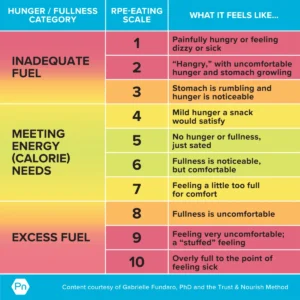
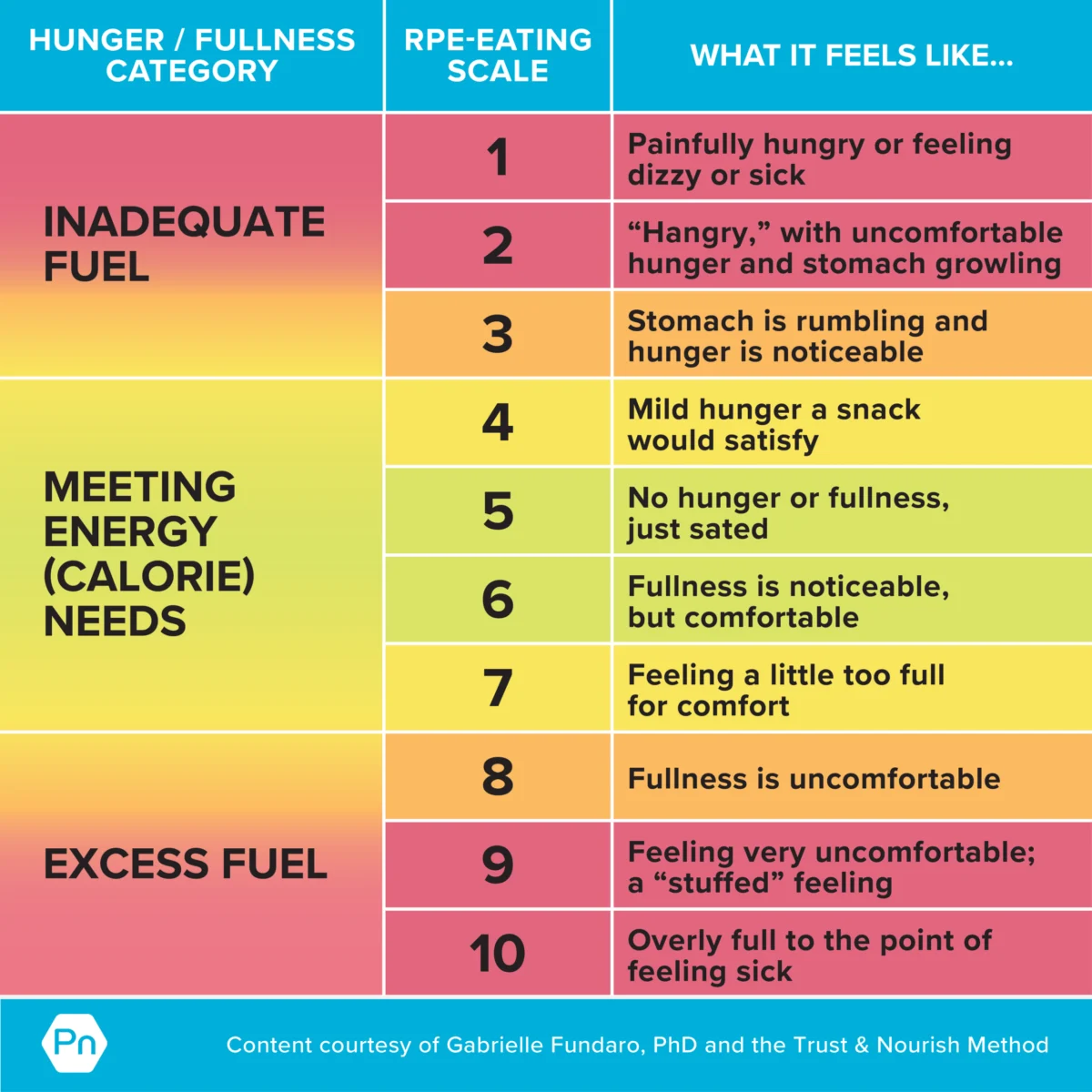
The RPE-Eating Scale adapts the principles of the exercise RPE scale to nutritional intake, offering a structured yet flexible method for reconnecting with internal hunger and fullness cues. The goal is to cultivate self-trust and nutritional awareness without the need for constant external tracking.
The RPE-Eating Scale: A Framework for Mindful Nourishment
| Rating | Perceived Hunger/Fullness Level |
|---|---|
| 1 | Painfully hungry, dizzy, or sick (Inadequate Fuel) |
| 2 | "Hangry," uncomfortable hunger, stomach growling (Inadequate Fuel) |
| 3 | Hunger noticeable, stomach rumbling (Inadequate Fuel) |
| 4 | Mild hunger, a snack would satisfy (Adequate Fuel) |
| 5 | No hunger or fullness, just sated (Adequate Fuel) |
| 6 | Noticeable fullness, but comfortable (Adequate Fuel) |
| 7 | A little too full for comfort (Adequate Fuel) |
| 8 | Uncomfortable fullness (Excess Fuel) |
| 9 | Very uncomfortable, "stuffed" (Excess Fuel) |
| 10 | Overly full to the point of feeling sick (Excess Fuel) |
The original Borg RPE scale (6-20) has evolved, with many modern fitness applications adopting a more intuitive 0-10 range, which Dr. Fundaro wisely chose for her eating adaptation. In fitness, RPE allows an individual to gauge their effort, enabling them to adjust workouts based on their current physical state, ensuring both safety and effectiveness. Similarly, the RPE-Eating scale empowers individuals to judge their own hunger and fullness, fostering autonomy while still providing a guiding structure.
Dr. Fundaro’s system has since been instrumental in helping herself and her clients achieve significant breakthroughs: regaining confidence and self-trust around food, improving nutritional awareness and competence, and ultimately, freeing themselves from the shackles of food tracking. This liberation from external validation represents a profound shift towards a more intuitive and sustainable relationship with eating.
Practical Application of RPE-Eating
Embracing RPE-Eating, like its fitness counterpart, requires practice and patience. It acknowledges that after years of ignoring internal cues, immediate mastery is unrealistic. The process is designed to gradually re-sensitize individuals to their body’s signals.
Step 1: Clarify Your Goals
RPE-Eating is not presented as another diet designed for rapid body transformation. Dr. Fundaro emphasizes that its core purpose is to foster self-trust and appropriate nourishment. While it can be adapted for body composition goals (muscle gain or fat loss), it is not the most efficient tool for extreme modifications. The primary objective is to build an inner compass for eating, accepting that the body’s composition may naturally fluctuate within a healthy range. This shift in perspective is crucial for individuals accustomed to rigid, outcome-driven dietary regimens. It challenges the prevailing diet culture that often prioritizes external appearance over internal well-being.
Step 2: Practice Identifying Hunger Cues
A fundamental aspect of RPE-Eating involves distinguishing between physiological hunger and psychological appetite. Hunger is driven by physical sensations (stomach rumbling, lightheadedness) signaling a need for energy. Appetite, conversely, is the desire to eat, often influenced by sensory appeal, emotional states, or social cues, and can persist even after physical hunger is satisfied.
To practice this distinction, individuals are encouraged to:
- Before a meal, rate their hunger using the RPE-Eating scale.
- Eat mindfully, minimizing distractions and focusing on the sensory experience of food.
- Midway through the meal, re-evaluate their hunger level.
- Upon completion, record their final fullness rating and internalize the physical sensations of satiety.
This repeated practice helps recalibrate the body’s internal feedback loop, allowing individuals to become more attuned to genuine hunger and fullness signals, rather than relying on external portion guides or arbitrary calorie targets.
Step 3: Recognize Non-Hunger Triggers
Life’s stresses often lead to eating beyond physical hunger. Emotional eating, or eating triggered by stress, boredom, or habit, is a common coping mechanism. RPE-Eating encourages awareness of these non-hunger triggers. The "Notice and Name" technique, borrowed from mindfulness practices, involves:

- Observing when compulsive or mindless eating occurs.
- Identifying the underlying emotions (e.g., anxiety, sadness) or situational triggers (e.g., a difficult conversation, work pressure).
- Reflecting on the true need or desire behind the eating impulse.
The goal is not to eliminate emotional eating entirely, which is a normal human response, but to expand the repertoire of coping mechanisms. This might involve engaging in non-food activities like deep breathing, a short walk, or connecting with a friend. By addressing the root cause of non-hunger eating, individuals can develop a more intentional and less reactive relationship with food.
Step 4: Prioritize Satiety and Satisfaction
RPE-Eating distinguishes between two crucial components of a fulfilling meal: satiety and satisfaction.
- Satiety refers to the physical state of being full, where caloric and fuel needs are met.
- Satisfaction encompasses a broader, more holistic sense of nourishment, where the meal is not only physically adequate but also emotionally pleasurable.
The concept of satisfaction is particularly important for those who have historically restricted certain foods. A meal that is merely "satiating" but lacks elements of pleasure can leave an individual feeling deprived, potentially leading to compensatory overeating or binging later. This aligns with research indicating that restrictive diets often backfire, leading to increased cravings and disordered eating patterns.
Dr. Fundaro advocates for incorporating genuinely enjoyed foods into the RPE-Eating framework, even those previously deemed "off-limits." By practicing the scale with a diverse range of meals, including indulgent ones, individuals can learn what it feels like to be adequately fueled and satisfied without guilt or fear. This approach helps dismantle the "good food/bad food" dichotomy that often fuels disordered eating and fosters a more balanced and flexible eating pattern.
Broader Implications and Expert Perspectives
The RPE-Eating scale is more than just a personal anecdote; it represents a thoughtful response to a growing public health concern: the widespread prevalence of diet culture, body dissatisfaction, and disordered eating tendencies. Supporting data indicates that a significant percentage of adults engage in dieting behaviors, often leading to a cycle of weight loss and regain, and sometimes escalating to more severe eating disorders. Macro tracking, while effective for some, can exacerbate these issues for vulnerable individuals.
The scientific basis for RPE, particularly its reliance on interoceptive awareness—the conscious perception of internal bodily sensations—lends credibility to its application in eating. Just as an athlete learns to gauge their exertion by sensing muscle fatigue or breathlessness, an individual can learn to gauge hunger and fullness by noticing stomach sensations, energy levels, or mood shifts. This skill, when developed, allows for informed decision-making based on internal biofeedback, rather than external rules. Studies have shown that enhanced interoceptive awareness is linked to improved emotional regulation and overall well-being.
Is RPE-Eating for Everyone?
RPE-Eating is particularly well-suited for individuals who:
- Feel overly dependent on food tracking but wish to break free.
- Experience anxiety or a loss of control when attempting to stop tracking.
- Desire a structured guidance system to transition away from tracking.
- Have elevated risk factors for developing an eating disorder (e.g., high body dissatisfaction, history of yo-yo dieting, disordered eating patterns, participation in weight-class sports), as it provides a safety net that rigid tracking often lacks.
It is crucial to note that RPE-Eating is a tool for developing self-awareness and a healthier relationship with food; it is not a substitute for professional treatment for eating disorders. For individuals struggling with severe disordered eating, consultation with a specialized health professional (therapist, doctor, registered dietitian) remains paramount.
RPE-Eating for Weight Modification
While primarily intended for a weight-neutral approach, RPE-Eating can be adapted for weight modification, though Dr. Fundaro advises against treating it as a direct replacement for precise macro tracking in extreme scenarios (e.g., bodybuilding competitions). She likens using RPE-Eating for extreme weight cutting to using "physio exercises to prepare for a powerlifting competition"—it’s not the right tool for the job.
For modest weight gain, individuals might aim to consistently eat to a 7-8 on the scale (noticeable fullness, a little too full for comfort). For gradual weight loss, the target might be a 4-5 (mild hunger satisfied, sated without excess). This approach allows for gentle adjustments based on internal cues, prioritizing sustainable habits over rapid, potentially unhealthy, changes. Dr. Fundaro emphasizes that RPE-Eating, by removing the rigidity of macro-tracking and fostering biofeedback, offers a safer pathway for weight modification than methods that can increase the risk of disordered eating.
Addressing Skepticism: Feelings Over Facts?
Skeptics might dismiss RPE-Eating as merely "eating based on feelings," contrasting it with "hard data" from tracking. However, this mirrors the initial resistance RPE faced in the fitness world. Today, RPE and autoregulation are widely accepted in exercise science as valid, accurate, and convenient methods for guiding training. The perception of "feelings" in RPE-Eating is actually the cultivation of interoceptive awareness—a scientifically recognized skill. Sensing internal cues like stomach grumbling or energy levels provides actionable "data" that is often more accessible and sustainable than continuous glucose monitoring or meticulous food logging. While not perfect, this method, through consistent practice, builds robust internal skills for lifelong nourishment.
The Nuances and Limitations
Like any tool, RPE-Eating has its limitations. It demands genuine attention to both physical and emotional feelings, and requires reflection—a luxury not always afforded by modern life. Parents of young children, individuals with demanding work schedules, or those who frequently eat on-the-go may find it challenging to consistently engage in mindful eating practices.
In such cases, flexibility is key. Individuals can choose to apply RPE-Eating during opportune moments, like a quiet lunch break, or focus on integrating specific aspects, such as simply becoming more aware of initial hunger cues without trying to change anything else. The goal is progress, not perfection.
Ultimately, RPE-Eating offers a vital "off-ramp" for those seeking to transition away from rigid and potentially psychologically damaging food tracking. It addresses the pervasive fear of losing control that often drives individuals back to restrictive habits. By providing a structured language and framework, it helps cultivate confidence and reduce stress around eating. Dr. Fundaro’s journey and the RPE-Eating Scale represent a significant step towards a more intuitive, self-trusting, and ultimately healthier relationship with food, proving that true nourishment comes from within, not from an app.
References
Click here to view the information sources referenced in this article. (Note: Original article did not provide clickable links, so this is a placeholder based on the prompt’s reference to it.)