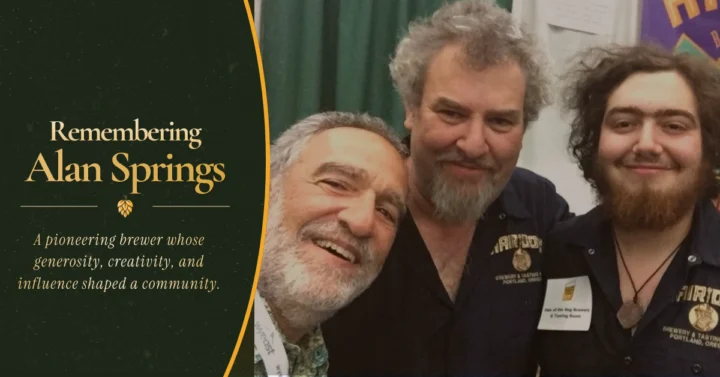

The craft brewing industry is mourning the loss of Alan Sprints, the visionary founder of Portland’s Hair of the Dog Brewing Company, who passed away following a battle with metastatic stage 4 bladder cancer. Sprints, a figure widely regarded as a foundational pillar of the American craft beer movement, was instrumental in transitioning brewing from a localized hobby into a sophisticated culinary art form. His work in the early 1990s introduced American palates to high-gravity, barrel-aged, and historically inspired ales, effectively creating the "cult beer" phenomenon that defines much of the modern enthusiast market.
Early Life and the Transition to Professional Brewing
Originally hailing from the Los Angeles area, Alan Sprints did not begin his professional journey in a brewhouse. His early career spanned diverse sectors, including the aerospace industry and the music world. However, his burgeoning passion for homebrewing eventually led him to the Pacific Northwest, a region that was just beginning to establish itself as the epicenter of the American beer revolution.
Before founding his own enterprise, Sprints refined his palate and technical skills within the culinary world. He trained as a chef, a background that would later inform his complex, flavor-forward approach to recipe formulation. In 1991, he secured a position with Widmer Brothers Brewing in Portland, one of the early titans of the industry. During this period, Sprints became a central figure in the Oregon Brew Crew, one of the oldest and most influential homebrew clubs in the United States. His leadership as the club’s president allowed him to foster a community of experimentation, bridging the gap between amateur enthusiasm and professional execution.
By 1993, after three years in the kitchen and two years on a professional brew deck, Sprints felt prepared to launch his own venture. He established Hair of the Dog Brewing Company in an industrial sector of Southeast Portland, a location that reflected the gritty, hands-on nature of the early craft movement.
Defining the "White Whale": The Four-Letter Ales
Sprints gained international acclaim for a series of potent, high-alcohol beers typically identified by simple, four-letter names. At a time when the American market was dominated by light lagers and the emerging "Pacific Northwest IPA," Sprints looked backward to historical European styles that had largely been forgotten.
In 1994, he released "Adam," a beer that would become the cornerstone of his legacy. Inspired by "Adambier," a historical strong ale from Dortmund, Germany, described by the late beer historian Michael Jackson, Adam was a revelation. Clocking in at 10% ABV with a robust 60 International Bitterness Units (IBUs), the beer was dark, smoky, and designed for longevity. It was a beer that defied contemporary categories, offering a complexity that improved with years of cellar aging.
In 1997, Sprints followed this success with "Fred," named in honor of the legendary Portland-based beer historian and author Fred Eckhardt. While Adam drew from German roots, Fred was inspired by the Belgian Golden Strong Ale tradition. Also reaching 10% ABV, Fred featured a distinct hop profile and a deep golden hue. These releases pioneered the concept of the "white whale"—extremely limited, high-quality beers that enthusiasts would travel great distances to acquire and trade.
Innovations in Barrel Aging and Technical Mastery
While barrel-aged beers are now a staple of the craft industry, Alan Sprints was one of the earliest practitioners of the craft in the United States. His approach was not merely about infusing beer with spirit flavors; it was about the careful curation of wood, oxygen, and time. Sprints utilized a variety of vessels, including Sherry, Bourbon, and Pinot Noir barrels, to create layers of oxidation and tannin that complemented his high-gravity ales.
His technical setup was famously idiosyncratic. For years, Sprints utilized a four-barrel, steam-jacketed kettle that had originally been used by the Campbell’s Soup Company to process vegetables. This small-scale, repurposed equipment allowed for a level of artisanal control that larger, more modern breweries often lacked. The juxtaposition of his massive, high-gravity beers and his relatively diminutive brewing equipment became a point of lore within the industry.
The pinnacle of his barrel-aging program was perhaps "Dave," a barleywine-style ale based on the Adam recipe. Dave was subjected to a process of freezing and aging that resulted in a staggering 29% ABV. For years, bottles of Dave were considered some of the rarest and most expensive beers in the world, occasionally fetching thousands of dollars at charity auctions and on the secondary market.
A Chronology of Influence and the "Hair of the Dog" Ethos
The timeline of Hair of the Dog is marked by a steadfast refusal to follow industry trends. While other breweries focused on rapid expansion and the "IPA craze," Sprints remained committed to his niche.
- 1991–1993: Sprints transitions from the culinary arts to professional brewing at Widmer Brothers.
- 1993: Hair of the Dog is founded in a warehouse along the Willamette River in Portland.
- 1994: The release of Adam marks the birth of the "cult beer" in the Pacific Northwest.
- Late 1990s: Sprints begins experimenting with barrel aging, winning early accolades from Beer Advocate and Whiskey Advocate.
- 2010: The brewery moves to a more modern facility and tasting room on SE Yamhill Street, allowing for expanded food service that integrated Sprints’ culinary roots.
- 2022: After nearly three decades of operation, Sprints announces his retirement and the closure of the brewery’s production and tasting room, citing a desire to move on to a new chapter of life.
Throughout this timeline, Sprints remained a "brewer’s brewer." He was known for hosting private gatherings during the Oregon Brewers Festival, where he would open his extensive cellar to newcomers and veterans alike. His generosity was legendary; he frequently shared rare vintages and magnums of his "Doggie Claws" barleywine with homebrew clubs and industry peers.
Industry Reactions and Professional Tributes
The impact of Sprints’ passing has resonated throughout the global brewing community. Tributes have poured in from fellow pioneers and historians who noted his role as both an innovator and an educator.
Matt Simpson, founder of The Beer Sommelier, noted that Sprints did not merely participate in the barleywine and barrel-aged categories but "perfected" and "curated" them in a way that few others could. Drew Beechum, an author and founding board member of the American Homebrewers Association (AHA), emphasized Sprints’ enduring connection to his homebrewing roots. Beechum recalled Sprints as a "mischievously grinning Santa Claus," always ready to provide magnums of beer to celebrate the successes of others.
Industry analysts point out that Sprints’ influence can be seen in the business models of modern "hype" breweries. His focus on limited releases, bottle conditioning, and vertical tastings (sampling different years of the same beer) provided the blueprint for the premium craft beer market.
Broader Impact and Implications for the Craft Sector
The passing of Alan Sprints marks the end of an era for the "first wave" of American craft brewing pioneers. His work demonstrated that beer could possess the same prestige, aging potential, and complexity as fine wine or aged spirits. By reviving styles like Adambier, he ensured that brewing history remained a living, breathing part of the modern industry.
Furthermore, Sprints’ career serves as a case study in the importance of the homebrewing community as a pipeline for professional innovation. His transition from the Oregon Brew Crew to the international stage highlighted the symbiotic relationship between amateur experimentation and commercial success.
As the craft beer industry continues to navigate a landscape of changing consumer preferences and economic pressures, the legacy of Hair of the Dog remains a testament to the power of a singular, uncompromising vision. Alan Sprints did not just brew beer; he created a culture of appreciation that elevated the entire industry. He is survived by his family, including his son Isaac, and a global network of brewers who continue to be inspired by his "large" beers and even larger spirit. His contributions to the art of fermentation will be studied and enjoyed by enthusiasts for decades to come, as the many bottles he carefully aged in his Portland cellar continue to mature, much like the industry he helped build.