
The annual culinary transition from dense winter comforts to vibrant spring flavors is officially marked by the return of seasonal baking traditions, most notably the production of traditional spiced buns. As the weather gradually warms and the Easter holiday approaches, professional bakers and home culinary enthusiasts alike turn their attention toward perfecting time-honored recipes. Among the most popular seasonal items are hot cross buns, traditionally consumed on Good Friday to signify the end of Lent. Modern iterations of this classic pastry have evolved significantly from commercial-yeast shortcuts, with contemporary bakers increasingly turning to natural fermentation methods to elevate both flavor and texture.
This comprehensive guide examines an advanced, meticulously calculated formula for sourdough hot cross buns. Adapted from established artisanal baking literature and refined through the incorporation of traditional Asian baking techniques, this updated recipe addresses common textural challenges associated with enriched doughs. By combining wild yeast fermentation with precise thermal chemistry, this approach yields a pastry that bridges the gap between traditional heritage baking and modern culinary science.
The Evolution of Hot Cross Buns: From Tradition to Modern Sourdough
Historically, hot cross buns were spiced, sweet yeast-leavened rolls marked with a cross on top, baked specifically for consumption on Good Friday across the United Kingdom, Ireland, Australia, and various Commonwealth nations. While commercial bakeries have long relied on rapid-action industrial yeasts to accelerate production schedules, this shortcut frequently sacrifices structural integrity and aromatic complexity.
The integration of wild sourdough fermentation into enriched dough formulas introduces significant structural and chemical shifts. Unlike commercial yeast, which merely produces carbon dioxide for leavening, wild sourdough cultures comprise a symbiotic colony of wild yeasts and lactic acid bacteria. This microbial activity breaks down complex carbohydrates and proteins over extended fermentation windows, developing a nuanced flavor profile characterized by a mild, pleasant acidity. When balanced against the inherent sweetness of dried fruits, refined sugars, and a post-bake simple syrup glaze, this subtle sourdough tang prevents the pastry from becoming cloying, resulting in a more sophisticated sensory experience.
Furthermore, commercial hot cross buns often stale rapidly due to the high fat and sugar content inherent in enriched doughs. To combat this limitation, contemporary artisanal bakers have successfully adopted the Asian tangzhong method, a technique involving the pre-cooking of a portion of the flour and liquid into a hydrated paste.
The Science of Tangzhong in Enriched Doughs
The defining technological advancement in this updated sourdough formula is the integration of a tangzhong—a cooked flour and milk paste heated to approximately 65°C (149°F) prior to mixing. This thermal process gelatinizes the starches within the flour, enabling them to absorb and retain significantly more moisture than untreated flour can manage.
When incorporated into the main dough, gelatinized starch molecules form a stable matrix that locks in free water throughout the mixing, bulk fermentation, and baking stages. This moisture retention accomplishes two critical objectives:
- It drastically improves the oven spring and internal crumb structure, generating an exceptionally soft, pillowy, and pull-apart texture.
- It acts as a natural humectant, extending the shelf-life of the baked goods and keeping the crumb remarkably tender for days after baking without the use of chemical preservatives or commercial softeners.
Given that enriched doughs contain substantial quantities of dairy, butter, eggs, and sugar—ingredients that naturally weigh down the gluten network and retard microbial activity—the addition of a tangzhong provides crucial structural support, ensuring the dough can successfully rise despite the heavy load of fats and inclusions.
Comprehensive Baking Schedule and Chronology
Executing a natural sourdough enriched dough requires careful time management, as the heavy proportion of butter and sugar slows microbial fermentation compared to lean artisan bread doughs. Bakers preparing these buns for a specific morning timeline, such as Easter Sunday, must follow a structured schedule to optimize flavor development while maintaining physical convenience.
The Two-Day Production Timeline
- Friday, 9:00 p.m. (Levain Preparation): The process begins the night before main mixing by preparing a sweet levain. By introducing superfine sugar directly into the levain feed alongside a ripe sourdough starter, high-protein white flour, and water, bakers encourage the yeast to operate efficiently while suppressing excessive acetic acid production. This ensures the final dough maintains a gentle, rounded flavor rather than an aggressive sourness. The levain is covered and left to ferment at ambient room temperature for approximately 12 hours.
- Saturday, 8:00 a.m. (Tangzhong and Butter Preparation): Unsalted butter is portioned into uniform pats and brought to room temperature. Simultaneously, high-protein white flour and whole milk are whisked continuously in a saucepan over medium-low heat until the mixture thickens into a smooth, cohesive paste. The paste is removed from the heat and spread onto a plate to accelerate cooling.
- Saturday, 8:30 a.m. (Dough Mixing): The active, highly aerated sweet levain is combined with the cooled tangzhong, high-protein flour, beaten egg, sugar, spices, citrus zests, water, and sea salt. Utilizing a mechanical stand mixer or spiral mixer is strongly recommended for this stage to develop the necessary gluten network. Butter is incorporated gradually once the primary gluten structure is established, followed by the gentle folding of soaked dried fruits and currants at the lowest mixing speed.
- Saturday, 9:00 a.m. to 1:00 p.m. (Bulk Fermentation): The dough undergoes a four-hour bulk fermentation phase at a controlled warm room temperature of 74°F to 76°F (23°C to 24°C). Two strategic sets of stretches and folds are administered at 30-minute intervals during the initial phase to build mechanical strength and evenly distribute the fruit inclusions.
- Saturday, 1:00 p.m. (Division and Shaping): The fully proofed dough is gently emptied onto a clean work surface and portioned into uniform pieces weighing precisely 115 grams each. Each piece is rounded into a tight, smooth ball to ensure optimal surface tension and placed into a buttered 9-inch square non-stick baking pan in a 3-by-3 grid. At this juncture, bakers may opt for an overnight cold retard in a refrigerator to further streamline the baking schedule.
- Saturday, 1:30 p.m. to 5:30 p.m. (Final Proof): The shaped rolls undergo a secondary fermentation phase lasting roughly four to five hours in a warm environment. The proof is complete when the dough feels exceptionally soft, highly aerated, and rises to just beneath the rim of the baking pan.
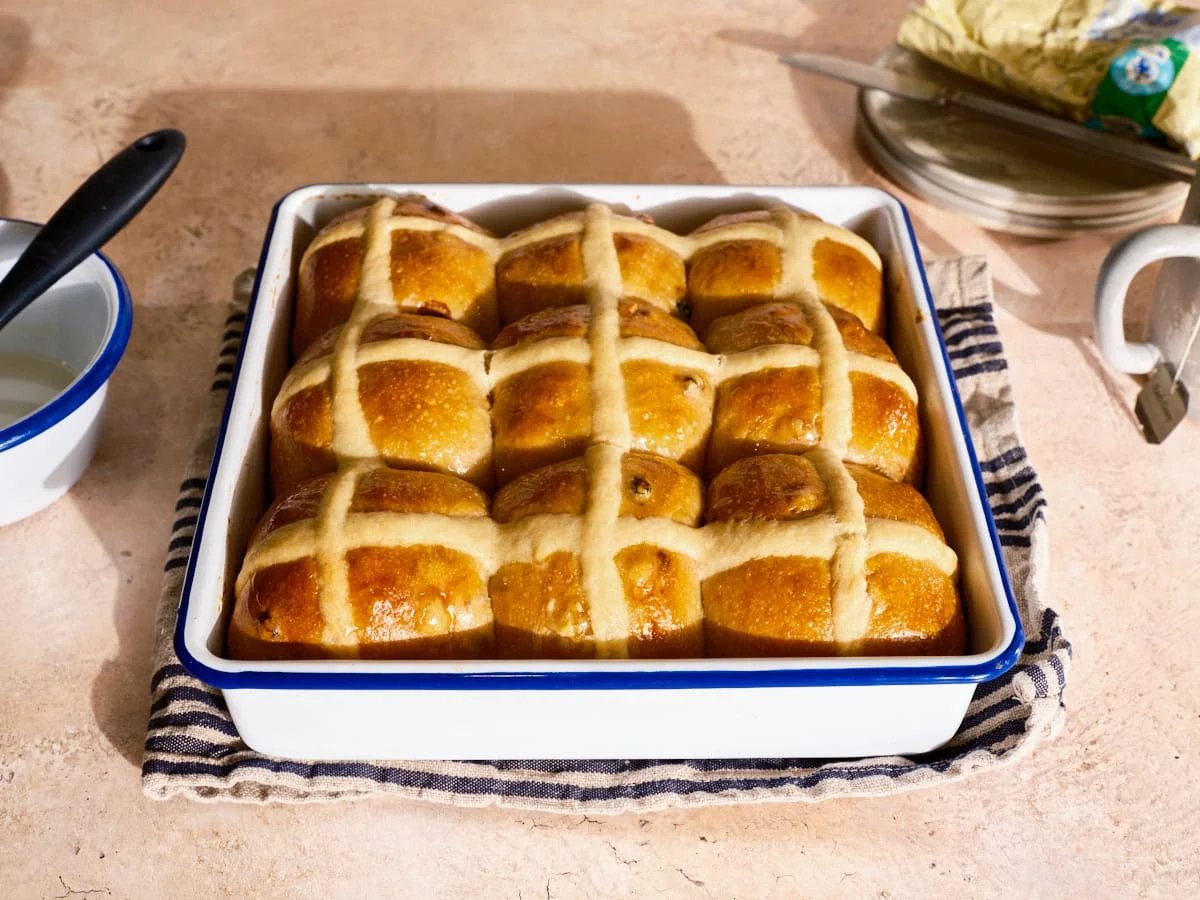
- Saturday, 5:30 p.m. (Finishing and Baking): The buns are brushed with an egg-and-milk wash, piped with traditional flour-and-water crosses, and baked at an initial temperature of 400°F (200°C) before being lowered to 350°F (175°C). Upon removal from the oven, a hot simple syrup glaze is brushed directly over the crust to seal in moisture and impart a glossy sheen.
Quantitative Formula and Ingredient Breakdown
Professional execution relies on standardized baker’s percentages, ensuring scalability and consistency across different batch sizes. The following measurements outline the complete formula for a standard yield of nine uniform hot cross buns.
Total System Metrics
- Total Dough Weight: 1,150 grams
- Pre-fermented Flour: 15.5%
- Levain in Final Dough: 48.6%
- Hydration (excluding milk): 31.0%
- Target Yield: Nine 115-gram buns
Main Dough Formula
- High-Protein White Flour (12–14% protein): 454g (92.0%)
- Tangzhong Flour: 39g (8.0%)
- Tangzhong Whole Milk: 178g (36.0%)
- Beaten Egg (approx. 1 medium): 49g (10.0%)
- Unsalted Butter (room temperature): 69g (14.0%)
- Superfine Sugar: 39g (8.0%)
- Thompson Raisins or Candied Orange Peel: 74g (15.0%)
- Dried Currants or Chocolate Chips: 49g (10.0%)
- Ground Cinnamon: 3g (1 tsp) (0.6%)
- Ground Allspice: 1g (½ tsp) (0.2%)
- Freshly Ground Nutmeg: 1g (½ tsp) (0.2%)
- Lemon Zest: Zest of 1 lemon
- Orange Zest: Zest of 1 orange
- Water: 153g (31.0%)
- Fine Sea Salt: 9g (1.9%)
- Ripe Sourdough Starter (100% hydration): 31g (6.2%)
Ancillary Components
- Cross Mixture: 50g white flour, 35g water, 15g orange juice, 15g vegetable oil, and a pinch of salt.
- Simple Syrup Glaze: 50g water combined with 50g granulated sugar, brought to a boil until clear.
- Egg Wash: 1 whole egg whisked thoroughly with 1 tablespoon of whole milk.
Analysis of Implications and Culinary Impact
The widespread adoption of natural leavening methods in enriched pastry production highlights a broader consumer shift toward foods that offer both superior flavor and enhanced digestibility. While commercial additives and fast-acting yeasts prioritize manufacturing speed and extended retail shelf-life, artisanal sourdough processes reintroduce biological fermentation as a primary culinary tool.
From a nutritional and gastronomic standpoint, the extended fermentation of a sweet levain breaks down complex starches and proteins more thoroughly than commercial baking methods. This biological degradation can render rich holiday pastries easier on the digestive system for many consumers. Furthermore, the combination of organic citrus zests, aromatic baking spices, and natural wild yeasts creates a multi-layered flavor profile that industrial alternatives cannot replicate.
As home baking continues to evolve, recipes that merge classical artisan techniques—such as wild fermentation and precise dough temperature control—with modern innovations like the tangzhong method represent the pinnacle of contemporary baking practice. Whether prepared as a cherished Easter morning centerpiece or integrated into regular spring baking routines, these sourdough hot cross buns demonstrate that patience and chemical understanding remain the ultimate ingredients for superior breadcraft.