
The culinary landscape of artisan baking continues to evolve as traditional techniques meet modern scientific understanding of dough development. Among the seasonal products receiving significant attention from both professional bakers and home enthusiasts are hot cross buns, a historically significant spiced sweet roll traditionally consumed on Good Friday to mark the culmination of Lent. Recent formula updates by master bakers have introduced Japanese baking innovations—specifically the tangzhong method—to natural sourdough fermentation, resulting in a product that bridges historical culinary traditions with contemporary texture preferences.
Background and Historical Context of Hot Cross Buns
Hot cross buns carry a rich history deeply embedded in European folklore, religious tradition, and agricultural cycles. Long before commercial bakeries standardized the product, spiced breads marked the end of the strict fasting periods associated with Lent. Historical records indicate that Queen Elizabeth I even passed a decree limiting the sale of spiced breads, including hot cross buns, to burials, Good Friday, and Christmas, acknowledging their special status in society.
Traditionally, these buns relied on commercial bakeries utilizing active dry or instant yeast to achieve a rapid rise, followed by standard enrichment ingredients such as butter, eggs, milk, sugar, and dried fruit. While efficient for commercial production, standard commercial yeast approaches often sacrifice complex flavor profiles in favor of speed. The introduction of natural sourdough fermentation to enriched doughs represents a major shift in craft baking, offering a nuanced, lower-acidity profile—often achieved via a sweet levain—that complements the heavy sugar load and warm spices without overpowering the palate.
The Science of Tangzhong in Sourdough Enriched Doughs
The primary technical advancement in contemporary sourdough hot cross bun formulations is the integration of the tangzhong method. Originally popularized in Asian breadmaking, tangzhong involves cooking a small portion of flour and liquid (water or milk) over low heat until it forms a viscous paste or gelatinized slurry.
From a food science perspective, cooking the starch molecules in this manner allows them to absorb significantly more moisture than traditional mixing methods. When incorporated into the final dough matrix, this pre-gelatinized starch traps water molecules throughout the baking process. Consequently, the finished crumb achieves an exceptionally pillowy, pull-apart texture that resists staling, maintaining its moisture and softness significantly longer than conventional enriched loaves.
When paired with a slow-fermenting sourdough culture, the dough requires extended proving times due to the weight of dairy, fats, and sugars. Professional bakers note that the inclusion of a sweet levain—where sugar is introduced directly into the starter feeding—accelerates yeast activity in heavy environments while dampening the sharp acetic acid notes typical of traditional artisan sourdough breads.
Step-by-Step Baking Schedule and Chronology
Executing a successful batch of artisan sourdough hot cross buns requires meticulous timing, particularly given the sluggish nature of enriched doughs during bulk fermentation and proofing stages. A typical professional or advanced home-baking schedule spans a 24-hour period to optimize flavor development and structural integrity:
- Night Prior (9:00 PM): Preparation of the sweet levain and optional fruit soakers. The levain combines high-protein flour, superfine sugar, water, and mature sourdough starter, fermenting loosely covered at ambient room temperature for approximately 12 hours. Meanwhile, dried fruits such as Thompson raisins and currants may be submerged in water to plump.
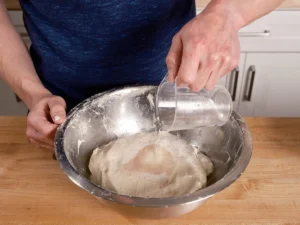
- Morning Mixing (8:00 AM): Preparation of the tangzhong paste by whisking high-protein flour and whole milk over medium-low heat until cohesive, followed by rapid cooling. Butter is brought to room temperature in preparation for incorporation.
- Dough Development (8:30 AM): The final dough is mixed using mechanical assistance, such as a standard stand mixer or a spiral mixer, to build gluten strength. Ingredients include high-protein white flour (12% to 14% protein content), the prepared tangzhong, eggs, sugar, spices (cinnamon, allspice, nutmeg), citrus zests, water, salt, and the mature sweet levain. Butter is added incrementally once initial gluten networks form, followed by the inclusion of fruits and peels.
- Bulk Fermentation (9:00 AM to 1:00 PM): The dough undergoes a 4-hour bulk fermentation phase at a controlled temperature of roughly 74°F to 76°F (23°C to 24°C), reinforced by periodic stretches and folds to build internal structure.
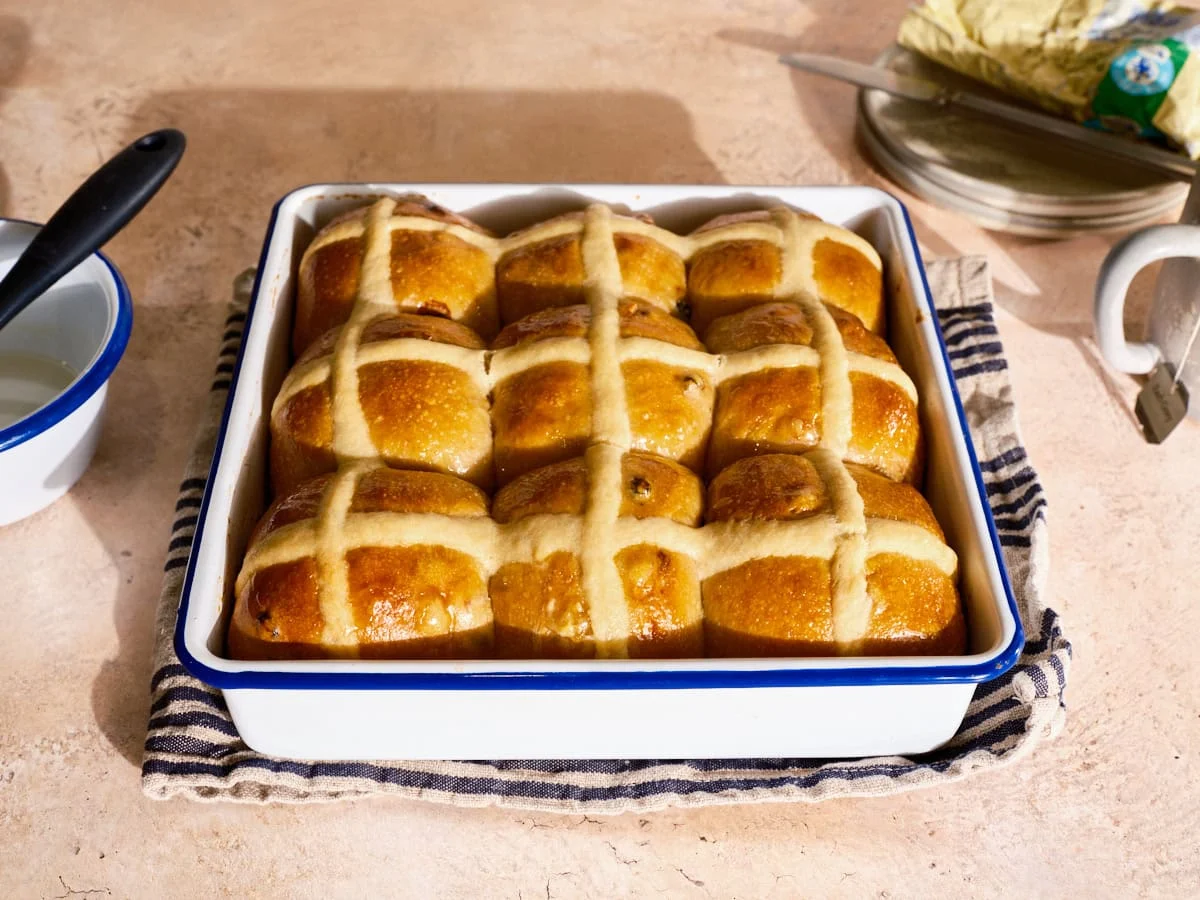
- Division and Shaping (1:00 PM): The dough is weighed and divided into uniform portions—typically 115-gram units—then shaped into tight spherical rounds and arranged in a buttered baking pan to promote a unified, pull-apart structure. Alternatively, spacing them on a sheet pan creates a firmer, caramelized crust across all exterior surfaces.
- Final Proofing (1:30 PM to 5:30 PM): A prolonged secondary fermentation phase lasting 4 to 5 hours allows the enriched dough to expand fully until light, puffy, and responsive to the touch. (An overnight refrigeration option is frequently utilized by commercial bakeries to streamline morning workflows).
- Decoration and Baking (5:30 PM): Buns are brushed with an egg-and-milk wash, piped with a flour-and-oil cross mixture, and baked at initial high temperatures before being reduced to finish internal cooking to a target temperature of 195°F (90°C). A post-bake simple syrup glaze locks in moisture and delivers a glossy, professional finish.
Technical Formula and Ingredient Proportions
Precision remains a cornerstone of successful artisan baking, with professional recipes evaluated through baker’s percentages relative to total flour weight. A standard batch yielding nine uniform 115-gram hot cross buns relies on a balanced formulation designed to maximize structural elasticity and flavor depth:
- Total Dough Weight: Approximately 1,150 grams
- High-Protein White Flour (Main Dough): 454g (92% baker’s percentage)
- Tangzhong Flour: 39g (8%)
- Tangzhong Whole Milk: 178g (36%)
- Whole Egg (Beaten): 49g (10%)
- Unsalted Butter: 69g (14%)
- Superfine Sugar: 39g total across components (8%)
- Fruit Inclusions (Raisins and Currants): ~123g combined (25%)
- Spices (Cinnamon, Allspice, Nutmeg) & Citrus Zests: Balanced for aromatic complexity
- Water: 153g (31%)
- Fine Sea Salt: 9g (1.9%)
- Ripe Sourdough Starter (100% Hydration): 31g (6.2%)
The distinct cross mixture, piped onto the buns immediately prior to baking, utilizes a precise blend of white flour, water, orange juice, vegetable oil, and salt to ensure the paste bakes into a visible, stable indicator without becoming overly brittle. A post-bake simple syrup glaze, created by boiling equal parts water and sugar, provides the final characteristic sheen.
Broader Industry Impact and Consumer Implications
The rising popularity of hybrid baking techniques—such as combining the ancient art of wild fermentation with modern hydrocolloid and starch-gelatinization principles like tangzhong—signals a broader shift in consumer demand. Modern food consumers increasingly prioritize artisanal authenticity paired with superior sensory attributes, rejecting dry, overly commercialized seasonal products in favor of nutrient-dense, slow-fermented baked goods that offer both gut-health associations and elevated gastronomic experiences.
As artisan bakeries continue to refine traditional holiday offerings, the incorporation of technical adjustments ensures that classic staples remain relevant, appealing to a demographic that values both historical continuity and cutting-edge culinary science.