
Despite its apparent simplicity, a cup of black coffee represents a profoundly complex chemical solution, a testament to intricate natural processes and precise extraction. While it may appear as little more than flavored water, with over 98.5% of its volume being H2O, the remaining 1.2% to 1.5% of total dissolved solids (TDS) harbors a staggering array of compounds responsible for coffee’s distinctive color, taste, and aroma. This seemingly small percentage translates to 12-15 grams of extracted solids per liter of brewed coffee, typically derived from approximately 60 grams of ground beans, making it one of the most chemically diverse beverages consumed globally.
The Elusive Aroma: A Frontier of Discovery
The sensory experience of coffee is primarily driven by its volatile compounds—molecules that readily evaporate and interact with our olfactory receptors. Modern analytical chemistry, particularly advanced chromatographic techniques such as Gas Chromatography-Mass Spectrometry (GC-MS) combined with Aroma Extract Dilution Analysis (AEDA), has revealed that coffee contains not merely hundreds, but potentially thousands of different chemical entities. This vast molecular landscape is what gives coffee its nuanced and captivating scent profile.
Yet, even with sophisticated instrumentation, the complete picture remains elusive. A landmark AEDA study from 2002 by Sanz, Czerny, Cid, and Schieberle [1] highlighted this ongoing challenge, identifying 13 of the 40 key odorants in coffee as entirely unknown. The difficulty in characterizing these compounds stems from several factors: their presence in incredibly low concentrations, often at parts per billion (ppb) or even parts per trillion (ppt) levels, making isolation for structural elucidation arduous; and the potential for large, complex molecular structures that defy straightforward analysis. This continuous discovery underscores that coffee chemistry is a vibrant and active field of research.
The complexity is further illustrated by attempts to replicate coffee’s essence synthetically. A 1996 study by Semmelroch and Grosch [2] successfully created "model" coffees mimicking Arabica and Robusta varieties using just 22 key volatile compounds. While sensory assessors described these models as "clearly coffee-like," they fell short of perfectly replicating the authentic aroma. This suggests that the full spectrum of coffee’s aromatic profile requires far more than two dozen compounds, highlighting the synergistic interplay of numerous molecules, many of which may contribute subtle but critical notes. The pursuit of a truly "synthetic" coffee that can stand shoulder-to-shoulder with a naturally brewed cup remains a significant challenge, reinforcing the unparalleled artistry of nature’s blend.
Taste and Texture: The Non-Volatile Contributors
Beyond aroma, coffee’s appeal lies in its multifaceted taste and mouthfeel, primarily influenced by non-volatile compounds. These molecules, which do not readily evaporate, interact directly with taste receptors on the tongue, contributing to the characteristic bitterness, sweetness, acidity, and astringency.
A diverse array of soluble components makes up this non-volatile fraction. Carbohydrates, including various sugars and soluble oligosaccharides, contribute to sweetness and body. Acids, such as quinic, citric, malic, and chlorogenic acids, are crucial for coffee’s characteristic acidity and brightness, which varies significantly by bean origin and roast level. Minerals and salts, extracted from the beans and influenced by water composition, also play a role in modulating taste perception. Proteins and lipids (oils), though present in smaller quantities, contribute significantly to the coffee’s body, viscosity, and crema formation. Caffeine, the most famous alkaloid in coffee, is a key non-volatile compound responsible for its stimulating effects and a significant portion of its perceived bitterness. Additionally, a substantial "unidentified" fraction of non-volatile compounds contributes to coffee’s color and bitterness, hinting at further discoveries awaiting scientific exploration. The interplay of these non-volatile elements, alongside insoluble particles (fines) and oils, defines the overall body and texture, from the light crispness of a filter brew to the rich creaminess of an espresso.

A Dance of Potency: Concentration vs. Impact
One of the most fascinating aspects of coffee’s chemical composition is the disjunction between a compound’s concentration and its sensory impact. While it might seem intuitive that higher concentrations equate to greater influence, this is not always the case in the realm of flavor. The human olfactory system possesses an extraordinary sensitivity to certain molecules, quantified by their odor threshold. This leads to the concept of the Odor Activity Value (OAV), calculated as the ratio of a compound’s concentration to its odor threshold. A high OAV indicates a potent odorant, regardless of its minuscule concentration.
To illustrate this, consider the logarithmic scale used to depict coffee’s chemical composition, spanning more than nine orders of magnitude. This vast range means a compound present at an astonishingly low 0.0000000001% (parts per trillion) can contribute as significantly to the overall flavor as a compound present at 0.01% (parts per hundred). This phenomenon is vividly exemplified by beta-damascenone.
Beta-damascenone is an incredibly potent odorant, often cited as one of the top five key aroma compounds in coffee [1]. Despite its presence in concentrations as low as 1 part per trillion (ppt), its impact on flavor is profound. This compound belongs to a family known as rose ketones, first identified in rose oil in the 1960s. Its name is derived from the Damask rose (Rosa × damascena), a flower renowned for its exquisite fragrance. The flavor and fragrance company Firmenich pioneered the use of rose ketones, and beta-damascenone, alongside its relatives, famously became a cornerstone in Dior’s iconic perfume, Poison. Its sensory descriptors are remarkably diverse, ranging from fruity notes like blackcurrant and plum to floral, woody, sweet, and even tobacco-like nuances, showcasing its versatility and complexity in contributing to coffee’s overall profile. The ability of such minute quantities to exert such a significant influence underscores the remarkable sophistication of natural flavor chemistry and the unparalleled sensitivity of the human nose.
The Extraction Equation: Polar, Non-Polar, and the Limits of Water
The brewing process itself is a selective extraction, dictated by the solvent properties of water and the chemical nature of the coffee compounds. Compounds in coffee can be broadly categorized as polar or non-polar. Polar compounds, including acids, minerals, proteins, and carbohydrates, share a common characteristic: they are highly soluble in water, a polar solvent. Consequently, water efficiently extracts over 75% of these compounds during brewing. This contributes to the foundational taste elements of acidity, sweetness, and mineral notes.
Conversely, non-polar compounds, which encompass many volatile aroma molecules and lipids (oils), exhibit low solubility in water. As a result, typically only 10-30% of these non-polar compounds are extracted during a standard water-based brew. This differential extraction efficiency is crucial for understanding why varying brewing parameters yield distinct flavor profiles. Longer extraction times, for instance, might extract more of certain polar compounds, potentially leading to over-extraction of bitter notes, while still struggling to fully release the non-polar aromatics.
This inherent limitation of water as a solvent presents intriguing possibilities for exploring "additional dimensions" of coffee extraction. The use of less polar solvents, such as ethanol, could theoretically unlock a different spectrum of non-polar compounds, yielding novel flavor profiles and potentially enhancing specific aromatic notes that are otherwise difficult to capture with water alone. While not practical for everyday brewing, such experimental approaches in food science could lead to new insights into coffee’s full chemical potential and inform future innovations in coffee processing.
Beyond TDS: The Nuance of Flavor Measurement
Total Dissolved Solids (TDS) is a widely accepted metric in the coffee industry, primarily used to gauge the strength or concentration of a brewed coffee. It provides a useful, objective measure for consistency and quality control. However, relying solely on TDS measurements to predict the full aroma and flavor profile of a cup of coffee is fundamentally flawed.
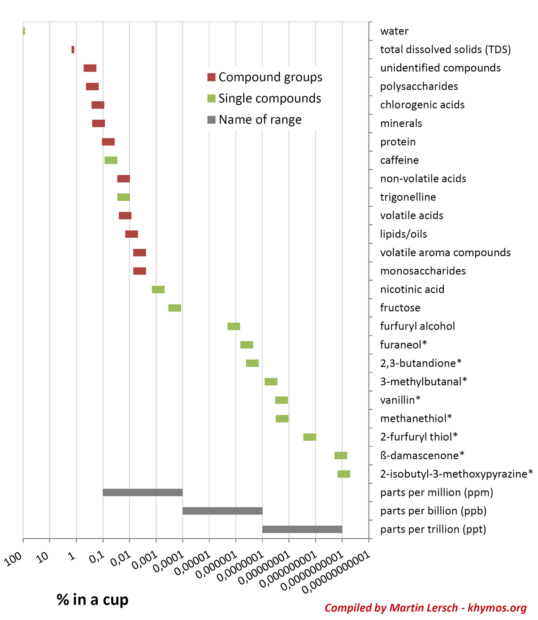
The primary reason for this limitation lies in the fact that only a select few compound groups in coffee are present in concentrations high enough to significantly influence the overall TDS reading. These tend to be the more abundant polar compounds. The critical problem is that there is no direct correlation between the extraction rate of these TDS-influencing compounds and the myriad of minute-quantity aroma compounds that define coffee’s true character. As highlighted by the differential extraction of polar and non-polar compounds, different classes of molecules extract at different rates and to different extents. A high TDS reading might indicate strong coffee, but it offers little insight into the balance of acidity, the presence of delicate floral notes, or the complexity of its finish.
Therefore, while TDS remains an invaluable tool for ensuring consistent strength, it is a poor predictor of the nuanced aroma and intricate flavor that coffee enthusiasts cherish. For the vast majority of consumers and even professional cuppers, the human nose and palate remain the "superb analytical detectors." The subjective, yet highly trained, sensory evaluation provides a holistic assessment that no single chemical metric can replicate. This blend of scientific rigor and sensory artistry is at the heart of coffee appreciation.
The Journey of Discovery: A Chronology of Coffee Science
The scientific quest to understand coffee’s chemical makeup has evolved significantly over time, mirroring advancements in analytical chemistry. Early inquiries in the 18th and 19th centuries focused on identifying major components, notably caffeine, recognizing its stimulating properties. The mid-20th century saw a significant leap forward with the development of techniques like gas chromatography (GC), allowing scientists to begin separating and identifying volatile compounds. This paved the way for more detailed investigations into coffee’s aroma.
The 1990s marked a particularly fruitful period, with studies like Semmelroch and Grosch’s 1996 work [2] demonstrating the potential to model coffee aroma using a limited set of key volatiles. This was followed by the groundbreaking 2002 AEDA study by Sanz et al. [1], which not only quantified known odorants but also courageously highlighted the existence of numerous unknown, yet critical, aroma compounds. These studies were pivotal in shifting the understanding of coffee from a simple beverage to a marvel of natural chemistry. More recent research, such as that by Amanpour and Selli in 2016 [4] and Batali et al. in 2020 [5], continues to refine our understanding of coffee’s composition, exploring the impact of processing methods and unraveling the intricate interactions between its many molecules. This chronological progression underscores a continuous journey of discovery, where each new analytical tool or methodology opens another window into coffee’s profound chemical depths.
Implications for Industry and Consumer
The deep understanding of coffee’s chemical composition carries profound implications for both the global coffee industry and the individual consumer. For the industry, this scientific insight is invaluable for optimizing every stage of the coffee value chain. Roasters can fine-tune profiles to enhance desired flavor precursors, knowing how heat transforms sugars and amino acids into aromatic compounds via the Maillard reaction and Strecker degradation. Brewers can design equipment and techniques that maximize the extraction of beneficial compounds while minimizing undesirable ones, leading to more consistent and superior products. Quality control benefits immensely from analytical tools that can verify compound profiles, ensuring brand consistency and identifying potential defects. Furthermore, this knowledge drives innovation in specialty coffee, enabling the identification and cultivation of new varietals with unique genetic predispositions for specific flavor notes, and informing sustainable practices that preserve these complex chemical profiles.
For the consumer, this scientific unraveling fosters a greater appreciation for the complexity in their daily cup. Understanding the intricate dance of molecules explains why a specific bean from a particular region, roasted in a certain way, and brewed with precise parameters, yields a distinct and memorable experience. It empowers enthusiasts to experiment with different brewing methods, water compositions, and grind sizes, knowing that each variable subtly alters the extraction kinetics of polar and non-polar compounds, thereby sculpting the final flavor. The realization that a single cup holds thousands of compounds, some potent even at parts-per-trillion, transforms a simple beverage into a fascinating subject of contemplation and enjoyment.
Ultimately, coffee remains a rich subject for ongoing scientific inquiry. The "unknowns" identified in past studies represent exciting frontiers, promising further revelations about how nature crafts such a universally beloved flavor. The journey to fully understand the chemical symphony in a coffee cup is far from over, ensuring that this daily ritual will continue to inspire both scientific curiosity and sensory delight for generations to come.