
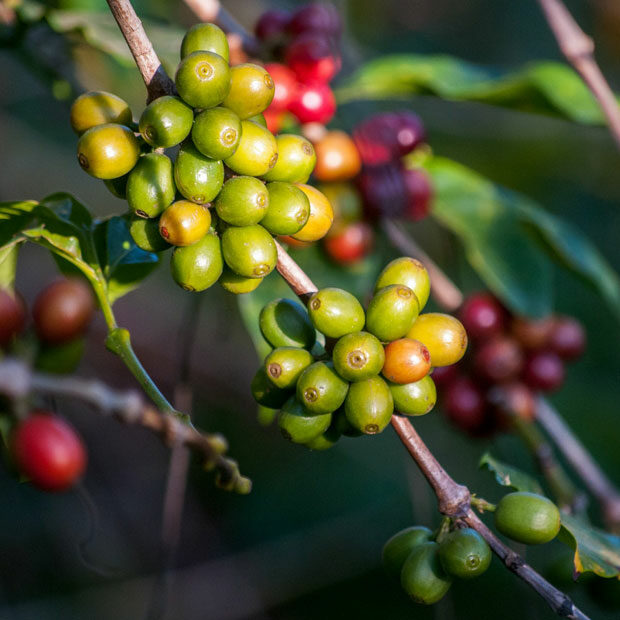
The pursuit of an exceptional cup of coffee has evolved beyond mere ritual, transforming into a rigorous scientific discipline. Driven by the "Third Wave of Coffee" movement, consumers and professionals alike are increasingly focusing on the intricate chemical and physical processes that dictate flavor, aroma, and mouthfeel. This shift underscores a broader commitment to quality, transparency, and a deeper understanding of coffee from bean to brew. Recent investigations into brewing methodologies, particularly for pour-over techniques, have illuminated critical parameters, revealing a complex interplay of variables that can be meticulously controlled for optimal results.
The Evolving Landscape of Coffee: From Commodity to Craft
The global coffee industry has experienced several transformative periods, often categorized into "waves." The First Wave, from the late 19th to mid-20th century, focused on making coffee widely accessible and affordable, prioritizing convenience and mass production. The Second Wave, emerging in the 1970s and 80s, introduced the concept of "specialty coffee," emphasizing origins, roast profiles, and café culture, popularized by chains like Starbucks. However, it is the Third Wave, gaining prominence in the early 2000s, that truly elevated coffee to an artisanal craft. This movement champions single-origin beans, light roasts that highlight inherent varietal characteristics, and meticulous brewing methods. Scandinavia, in particular, has become a hotbed for this scene, with roasters and enthusiasts embracing scientific rigor to unlock coffee’s full flavor potential. Monthly subscription services, such as Kaffebox, exemplify this trend, delivering curated selections from regional roasters, encouraging exploration of diverse profiles and processing methods. This sustained engagement fosters a critical palate, allowing enthusiasts to discern subtle nuances in origin, processing, and roasting. The extraordinary circumstances of 2020, with reduced social interaction, inadvertently provided many with increased time for contemplation and, for some, an opportunity to delve deeper into such interests, including the intricacies of coffee preparation. Engaging with tools like a coffee advent calendar, which offers daily blind tastings, underscores the complexity and variability of coffee flavors, often challenging preconceived notions about bean origin or processing and revealing how significantly processing can impact the final cup.

The Scientific Pursuit of Reproducible Brewing
Achieving consistently excellent pour-over coffee requires more than intuition; it demands a scientific approach. Early attempts at precise brewing often highlight a lack of reproducibility, underscoring the need for quantitative measurement and systematic adjustments. This realization typically prompts a deeper dive into the physics and chemistry of coffee extraction, a rabbit hole that, while complex, offers profound insights into optimizing every brew. The principles of extraction are not new to scientific exploration, having been applied to various culinary and chemical processes, from water infusions and oil extractions to ethanol-based preparations and even beer brewing. While previous discussions on coffee touched upon topics like Norwegian egg coffee, Aeropress convenience, or the effect of salt, these only scratched the surface compared to the extensive body of scientific literature now available. The last decade has witnessed a surge in research, particularly concerning pour-over and drip coffee, with a growing number of peer-reviewed scientific publications directly relevant to both commercial cafés and home brewing environments. These studies provide a robust framework for understanding and controlling the myriad factors influencing coffee quality.
From Bean to Brew: Parameters Under Control
The journey of coffee, from a fruit on a Coffea arabica shrub to the final beverage, involves numerous steps, each influenced by skilled individuals and specific processes. While many stages—cultivation, harvesting, processing, and roasting—are beyond the control of the end-user, the selection of high-quality, ethically sourced, and expertly roasted beans is paramount. Once these beans reach the kitchen bench, a new set of critical parameters come into play, offering the brewer direct influence over the final cup.
1. Brew Ratio (BR): The Foundation of a Recipe
The brew ratio, often referred to as the "golden ratio" in coffee circles, quantifies the proportion of water to coffee grounds. Typically expressed as grams of water per gram of coffee, a common starting point is 16.7 (1000g water to 60g coffee). This metric serves a similar function to Baker’s percentage in baking, providing a simple, scalable recipe for consistent results. Standard brew ratios for black coffee generally fall within the range of 15:1 to 25:1 (water:coffee), allowing for adjustment to personal preference or specific bean characteristics. Its utility lies in its ability to easily scale a recipe up or down while maintaining proportionality. The Specialty Coffee Association (SCA) often recommends a brew ratio between 1:15 and 1:18 for optimal results, balancing strength and extraction.
2. Total Dissolved Solids (TDS): Measuring Strength and Unlocking Flavor
The perceived strength of coffee is a crucial sensory attribute. An excessively strong brew can mask delicate flavors, often presenting as bitter or astringent. Conversely, diluting a strong coffee with hot water can sometimes dramatically reveal hidden fruity notes. This subjective adjustment highlights the importance of Total Dissolved Solids (TDS), an objective measure of coffee strength. TDS quantifies the percentage of soluble compounds extracted from the coffee grounds and dissolved in the water. While TDS does not directly measure flavor quality, it provides a critical numerical benchmark to assess if the brew strength is within an acceptable range or if it deviates significantly, indicating potential over- or under-extraction. The SCA typically aims for a TDS range of 1.15% to 1.35% for ideal filter coffee.
Traditionally, measuring TDS involved gravimetric analysis: evaporating a precisely weighed coffee sample to dryness and weighing the residue. However, this method is impractical for daily use, requiring highly sensitive laboratory balances (accurate to 0.0001 g) to detect the typical 6-7 mg of dry matter in a 500 mg sample, given that black coffee is over 98% water (typically 1.2-1.5% TDS).
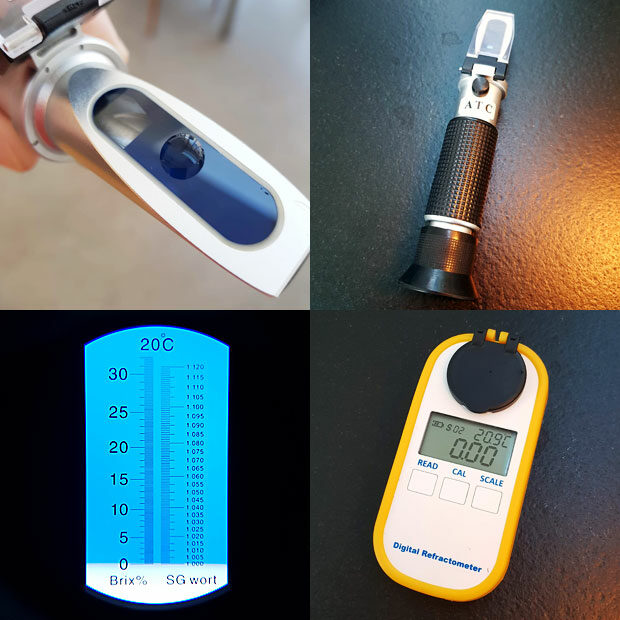
A more accessible and practical method is refractometry. Light travels at different speeds through pure water and water containing dissolved solids, a phenomenon measured by a refractometer. Analog handheld refractometers, often equipped with a %Brix scale, can provide a quick, albeit less precise, reading. A %Brix reading can be converted to %TDS by multiplying by approximately 0.85. While handheld devices offer a resolution of 0.0-0.2 %Brix, sufficient to determine if a brew is within the typical range (e.g., 1.4-1.8 %Brix for 1.2-1.5 %TDS), they lack the precision for fine-tuning. Despite this, their affordability and versatility—useful for measuring sugar content in sorbets (aiming for ~26 %Brix) or specific gravity in beer brewing—make them a valuable kitchen tool.
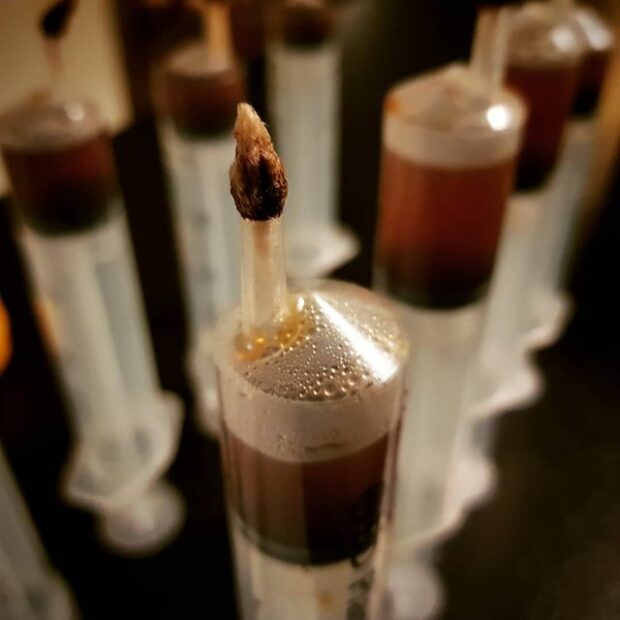
For greater accuracy, digital refractometers offer 0.01 °Brix readout and automatic TDS conversion, though at a higher cost, often exceeding several hundred dollars. When taking samples during the extraction process, it is crucial to hot-filter them (e.g., using syringes with cotton plugs) to halt further extraction and cool them completely before measurement, as temperature significantly affects refractive index. Care must be taken to prevent evaporation and ensure any condensed water is re-dissolved to maintain sample integrity. This DIY approach minimizes waste and offers a cost-effective alternative to specialized lab equipment.
3. Extraction Yield (EY and EEY): Unpacking Flavor Potential
Once TDS is measured, calculating the extraction yield provides deeper insight into how much of the coffee’s soluble material has been transferred into the brew. The Specialty Coffee Association (SCA) often references an ideal extraction yield range of 18-22% for optimal flavor balance. However, the calculation of extraction yield can be nuanced, particularly when distinguishing between immersion and percolation brewing methods due to the interstitial liquid retained by the coffee grounds.
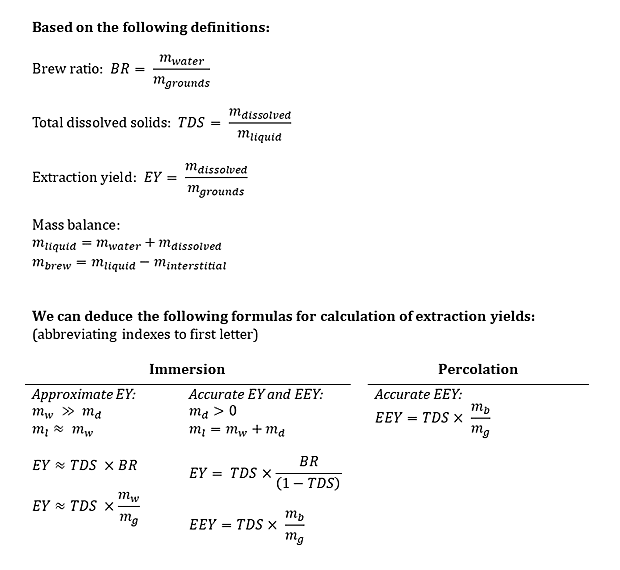
For clarity, two definitions of extraction yield are commonly employed:
- Extraction Yield (EY): Focuses on the total mass of solids removed from the coffee grounds relative to the initial dry mass of the grounds. This is particularly relevant for understanding the potential flavor profile extracted from the coffee.
- Effective Extraction Yield (EEY): Focuses on the mass of dissolved solids actually present in the final brewed cup relative to the initial dry mass of the grounds. This is more relevant from an economic perspective and for direct sensory evaluation.
In immersion brews (e.g., French press), the entire liquid mass is considered to be uniformly mixed, meaning the composition of the liquid in the cup is representative of the liquid retained within the grounds. Therefore, EY and EEY can be considered equivalent if the total liquid mass is used for calculation. However, for percolation brews (e.g., pour-over), the interstitial liquid remaining in the spent grounds does not contribute to the final beverage. Leading coffee scientists like Scott Rao and Jonathan Gagné have extensively discussed these complexities, emphasizing the need for precise definitions to avoid misinterpretation.
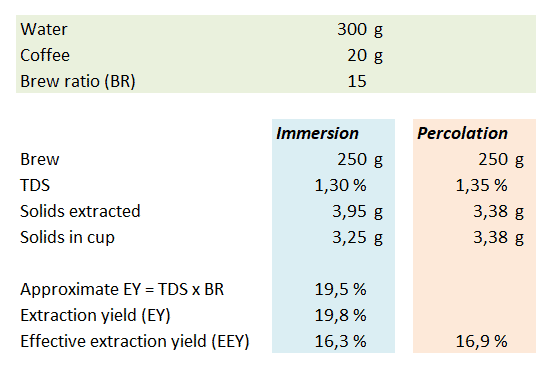
An illustrative example demonstrates these calculations: using 20g of coffee and 300g of water, yielding 250g of brewed coffee.
- For an immersion brew with 1.30% TDS: The total dissolved solids (m_dissolved) in the entire liquid mass (300g water + m_dissolved) is approximately 3.95g. The precise EY = TDS x BR / (1-TDS) = 1.30% x 15 / (100%-1.30%) = 19.8%. The EEY, focusing on the 250g in the cup, is 1.30% x 250g / 20g = 16.3%.
- For a percolation brew, assuming 1.35% TDS in the 250g cup: m_dissolved = 1.35% x 250g = 3.38g. The EEY = 1.35% x 250g / 20g = 16.9%. In percolation, EY typically equals EEY as the interstitial liquid is not part of the served beverage.
This comparison reveals that while immersion might extract more total solids from the grounds, percolation can be more efficient at delivering solids to the cup. The difference in extracted mass (e.g., 3.95g vs. 3.38g in the example) highlights why these two methods yield distinct flavor profiles, as the chemical composition of the extracted compounds will vary with total extraction. Accurate yield calculations also require considering factors like the initial water content of roasted beans (1-4%) and evaporation during brewing, although these are often disregarded for practical reasons. The precision of TDS measurement and coffee weighing directly impacts the accuracy of yield calculations; a 0.1% TDS