
Dr. Gabrielle Fundaro, a respected figure in human nutrition with a PhD, over a decade of coaching experience, and six powerlifting competitions to her name, found herself confronting a profound personal and professional paradox. Despite her extensive credentials and practical expertise, she harbored a deep-seated fear: abandoning the meticulous practice of macro tracking would jeopardize her meticulously maintained physique. This internal conflict ultimately spurred the development of a novel approach to eating, one that merges structured guidance with an individual’s innate biological signals: the Rate of Perceived Exertion (RPE)-Eating Scale.
The Unraveling of a Trusted Method
For years, Dr. Fundaro, like countless others in the fitness and nutrition communities, relied on macro counting as a cornerstone of her dietary regimen. This method, which involves precisely calculating and monitoring daily intake of macronutrients (proteins, carbohydrates, and fats), is widely adopted for its promise of quantifiable control over body composition and performance. Initially, it delivered results, providing a clear framework for managing her diet and supporting her powerlifting goals. The allure of "staying on track" through precise numbers was undeniable, offering a sense of order and predictability in an otherwise complex biological process.
However, the efficacy of macro tracking began to wane. What started as a valuable tool gradually morphed into a restrictive burden. Dr. Fundaro grew weary of the relentless vigilance required to keep her macros "perfectly in balance." The spontaneity of choosing a meal from a restaurant menu without immediate calculation, the simple pleasure of eating without a looming nutritional audit, became distant aspirations. This exhaustive mental load highlighted a critical flaw in her relationship with food: a dependence on external metrics that overshadowed her body’s internal wisdom. The thought of ceasing this practice was terrifying, conjuring fears of muscle loss, unwanted fat gain, and a complete loss of navigational ability in her own fueling choices. More profoundly, as an expert in her field, the idea of not knowing how to nourish herself without an app or tracker felt like a professional failing.
A Quest for Nutritional Autonomy
Driven by this growing dissatisfaction, Dr. Fundaro embarked on a quest for an alternative—a method that could align her nutritional objectives with a newfound sense of freedom and peace around food. Traditional alternatives presented their own set of limitations. Calorie counting, while simpler than macro tracking, still imposed a restrictive numerical constraint, offering little reprieve from the mental burden. Intuitive eating, which emphasizes tuning into internal hunger and fullness cues, also seemed ill-suited for her at the time. Years of relying on external macro targets had dulled her interoceptive awareness—her ability to sense and interpret internal bodily signals. She craved a structured approach, a bridge between rigid tracking and unfettered intuition.
The breakthrough arrived not in a nutrition textbook, but in the gym. Dr. Fundaro had adopted the Rate of Perceived Exertion (RPE) scale in her powerlifting training. Developed by Gunnar Borg in the 1960s, RPE is a psychophysical scale that allows individuals to subjectively quantify the intensity of their physical effort during exercise. Instead of relying solely on objective metrics like heart rate or weight lifted, RPE empowers athletes to gauge how hard they feel they are working, typically on a scale of 0-10 or 6-20. This framework proved transformative in her training, enabling her to lift more effectively, recover better, and foster a deeper connection with her body’s capabilities and limits. The combination of objective structure (the scale) and subjective interpretation (her perceived effort) proved remarkably potent. It was in this moment of clarity that the profound parallel struck her: if RPE could optimize physical training, why couldn’t a similar principle guide nutritional intake?
The Birth of RPE-Eating: Structure Meets Intuition
From this insight, the RPE-Eating Scale was born. Dr. Fundaro meticulously adapted the principles of RPE from the gym to the plate, creating a framework designed to help individuals:
- Regain confidence and self-trust around food.
- Improve nutritional awareness and competence.
- Free themselves from the shackles of constant food tracking.
This innovation marked a significant turning point in her own relationship with food, allowing her to finally trust her eating choices without the constant presence of a macro tracker.
Understanding the RPE-Eating Scale
To fully grasp RPE-Eating, it’s essential to understand its progenitor, the Rate of Perceived Exertion (RPE) in fitness. Gunnar Borg’s original RPE scale ranged from 6 to 20, but modern adaptations, including Dr. Fundaro’s, often simplify this to a more intuitive 0 to 10 scale, where 0 represents no exertion and 10 signifies maximum effort. This scale is invaluable in fitness for its ability to personalize training, allowing individuals to adjust their effort based on daily readiness, recovery, and specific goals. For instance, a powerlifter might aim for an RPE of 7/10 for a warm-up set, while a pregnant woman might use it to ensure she remains within a safe exertion zone during exercise. The power of RPE lies in its subjective nature; while a coach provides guidance, the ultimate interpretation of a "7/10 effort" rests with the individual, fostering autonomy and self-awareness.
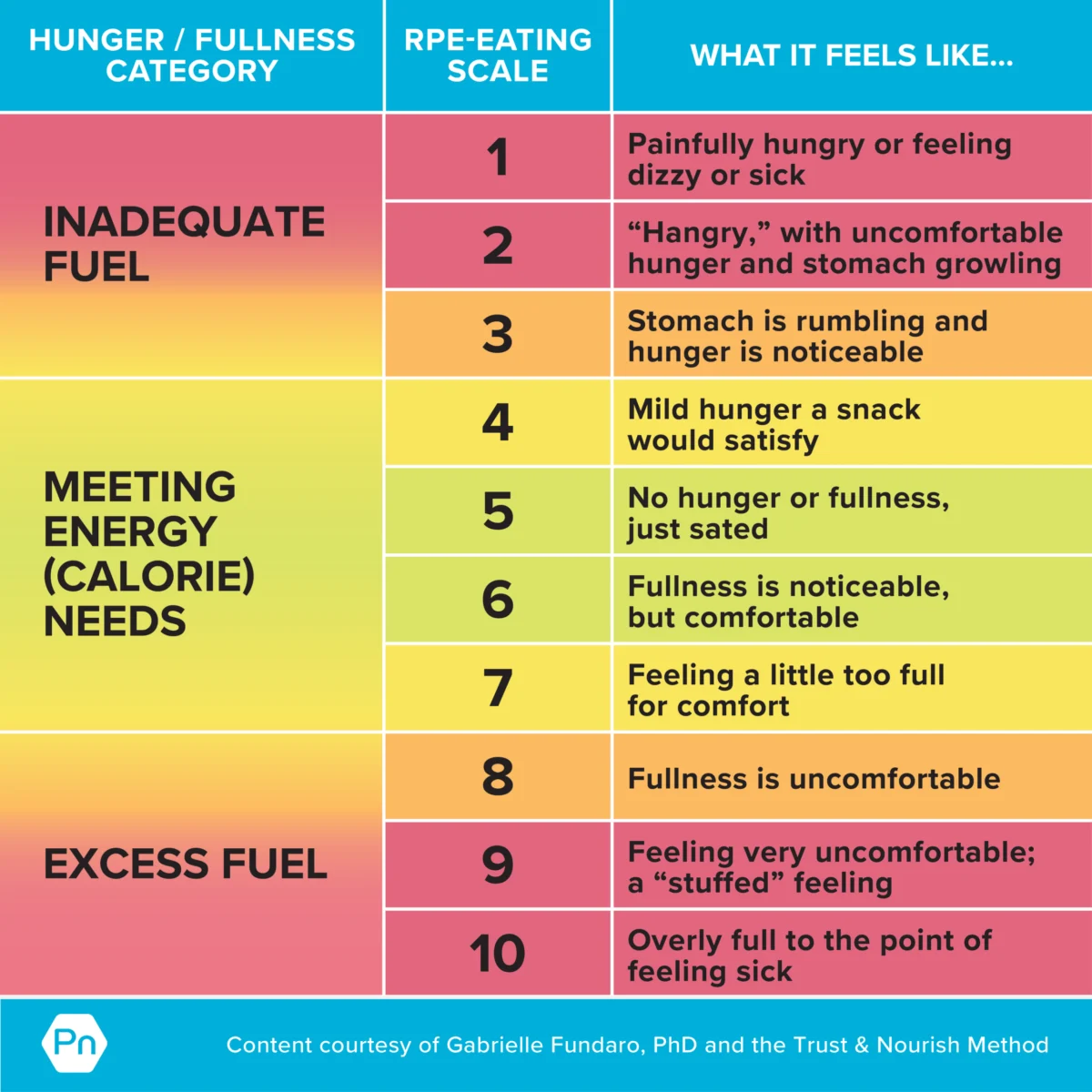
Dr. Fundaro applied this same philosophy to eating. Her RPE-Eating Scale also uses a 1-10 range, but instead of physical exertion, it measures perceived hunger and fullness levels.
The RPE-Eating Scale for Hunger and Fullness:
- 1: Painfully Hungry: Dizzy, sick, extreme hunger.
- 2: "Hangry": Uncomfortably hungry, stomach growling loudly.
- 3: Noticeable Hunger: Stomach rumbling, clear physical cues.
- 4: Mild Hunger: A snack would satisfy, beginning to think about food.
- 5: Neutral/Sated: No hunger or fullness, comfortable.
- 6: Noticeable Fullness: Comfortable, but definitely not hungry.
- 7: A Little Too Full: Slightly uncomfortable, perhaps a bit sluggish.
- 8: Uncomfortable Fullness: Feeling heavy, needing to loosen clothes.
- 9: Very Uncomfortable/Stuffed: Overly full, regretful.
- 10: Sickeningly Full: Nauseous, physically unwell from overeating.
The overarching goal of RPE-Eating mirrors its fitness counterpart: to cultivate the skill of accurately assessing one’s internal state and making informed decisions about food intake, thereby reducing reliance on external metrics.
Practical Implementation: A Four-Step Process
Adopting RPE-Eating requires practice and patience, especially for those accustomed to external food tracking. It’s a journey of reconnecting with internal cues that may have long been ignored or overridden.
Step 1: Clarify Your Intentions and Goals
RPE-Eating is fundamentally different from a traditional diet. Dr. Fundaro emphasizes that its primary aim is not body transformation or achieving "optimal" macros, but rather fostering inner trust and confidence. It’s about sensing what your body genuinely needs and providing appropriate nourishment. This necessitates a crucial shift in mindset: moving away from a desire for absolute control over body composition towards a willingness to trust the body’s adaptive capacity. While RPE-Eating can be adapted for specific physique goals, it’s not the most direct or efficient method for extreme changes. Its core strength lies in its ability to build self-trust and cultivate a healthier relationship with food, even if that means accepting natural fluctuations in one’s body.
Step 2: Re-Engage with Hunger and Fullness Cues
A critical component of RPE-Eating is distinguishing between true physiological hunger and psychological appetite. Hunger manifests through physical cues—stomach rumbling, emptiness, lightheadedness—signaling a need for energy. Appetite, conversely, is a desire for food, often influenced by sensory input (sight, smell, taste) or emotional states, and can persist even when physical hunger is satisfied. Years of dieting or tracking can blur these distinctions.
To re-establish this connection, Dr. Fundaro suggests a mindful eating practice:
- Before a meal, consult the RPE-Eating scale and note your hunger level.
- Eat mindfully, minimizing distractions, focusing on flavors, textures, and how your body feels.
- Mid-meal, check in again and record your hunger/fullness level.
- Upon finishing, record your final fullness level and consciously internalize the sensation of being adequately nourished.
Consistent practice, even for one meal a day, gradually sharpens interoceptive awareness, allowing individuals to trust their internal compass over external directives. This process aligns with principles of mindful eating, which have been shown to improve satiety and reduce overeating by enhancing awareness of physiological signals.

Step 3: Uncover Non-Hunger Eating Triggers
Life is rarely lived in a perfectly mindful bubble. Stress, emotions, and environmental cues often drive eating behaviors beyond physiological hunger. This is normal, but excessive reliance on food for non-nutritional needs can disrupt a healthy relationship with eating. Dr. Fundaro advocates for "Notice and Name" – a technique from behavioral coaching. When compulsive or mindless eating occurs, the individual is encouraged to pause and identify the underlying emotion (anxiety, sadness, boredom) or situation (a stressful email, an argument).
Once triggers are identified, the next step is to explore alternative, non-food coping mechanisms. This could involve deep breathing, a short walk, connecting with a friend, or engaging in a hobby. Expanding one’s repertoire of self-soothing strategies reduces the automatic reliance on food as the sole comfort, empowering individuals to respond to their needs with greater intention and agency. This self-awareness is crucial for long-term behavioral change and emotional regulation.
Step 4: Balance Satiety with Satisfaction
RPE-Eating recognizes that sustenance goes beyond mere physical fullness (satiety). A meal, even if calorically adequate, can leave one feeling emotionally unsatisfied. Satisfaction encompasses the holistic experience of being nourished, including the pleasure derived from food, cultural significance, and enjoyment. A diet focused solely on satiety might inadvertently lead to restriction, where certain food groups (e.g., desserts, comfort foods) are banned, even if other "healthy" options are consumed to fullness. This often results in a pendulum effect: restriction followed by eventual binging.
Dr. Fundaro encourages individuals to integrate genuinely enjoyable foods into their RPE-Eating practice. By mindfully consuming previously "off-limits" items and observing hunger/fullness levels, individuals learn that all foods can fit into a balanced approach. This fosters a more flexible and sustainable eating pattern, reducing the psychological burden of policing food choices and allowing for the inherent pleasure of eating, which is a fundamental human experience.
Who Benefits from RPE-Eating?
RPE-Eating is not a universal solution but serves as a powerful tool for specific populations. It is particularly well-suited for individuals who:
- Feel overly dependent on food tracking but wish to disengage.
- Experience anxiety or a sense of lost control when attempting to stop tracking.
- Desire a structured yet flexible system to guide their eating post-tracking.
- Are currently tracking food but have elevated risk factors for disordered eating (e.g., high body dissatisfaction, history of yo-yo dieting, participation in weight-class sports).
For coaches, RPE-Eating offers a "safety net" that can mitigate some of the risks associated with strict macro tracking, especially for vulnerable clients. However, it’s crucial to acknowledge that for individuals struggling with clinical eating disorders, RPE-Eating is not a substitute for professional treatment by a specialized therapist, doctor, or registered dietitian.
RPE-Eating and Weight Modification: A Nuanced Approach
While RPE-Eating primarily promotes a weight-neutral approach, Dr. Fundaro acknowledges that it can be adapted for intentional weight change, albeit with caution. She advocates for "safe weight modification," likening it to contact sports where inherent risks are managed through best practices. By removing the strictures of macro tracking, RPE-Eating relies on biofeedback and awareness of non-hunger triggers, providing a layer of safety that purely numerical tracking might lack.
For those pursuing weight gain, the recommendation is to generally aim for a fullness level of 7-8 on the RPE-Eating scale for most meals (categorized as "adequate fuel" moving towards "excess fuel"). Conversely, for weight loss, the target range would typically be 4-5 ("mild hunger" to "sated" within "adequate fuel"). However, Dr. Fundaro stresses that RPE-Eating is not designed for extreme weight modification, such as preparation for a bodybuilding competition, where highly precise, often aggressive, caloric manipulation is required. It is a tool for sustainable, mindful adjustment, not rapid, intensive transformation.
Beyond "Feelings": The Science of Interoceptive Awareness
Skeptics might dismiss RPE-Eating as merely "eating based on feelings." However, this overlooks the scientific basis of interoceptive awareness, the skill at the heart of the RPE framework. Just as RPE in exercise, once met with skepticism, is now widely accepted and scientifically validated as a reliable method for autoregulating training intensity, RPE-Eating cultivates a similar internal attunement. Research supports the accuracy and convenience of RPE in fitness, often proving as effective as more complex velocity-loss trackers.
Interoceptive awareness is the ability to perceive and interpret internal bodily sensations, such as heart rate, respiration, and—critically for eating—hunger and fullness signals. RPE-Eating systematically trains this skill. Instead of relying on external validation like glucose monitors or calorie counters, individuals learn to interpret their body’s inherent signals—stomach grumbling, energy levels, absence of hunger—as indicators of their nutritional needs. This process is inherently more convenient and accessible than constant technological monitoring, fostering a profound sense of self-efficacy and bodily trust. While initial attempts may involve misjudgments, consistent practice refines this internal calibration, much like an athlete learns to accurately gauge their RPE over time.
Potential Challenges and Adaptations
Despite its benefits, RPE-Eating is not without its challenges. It demands significant attention, introspection, and reflection on both physical and emotional states. This can be particularly difficult for individuals with demanding lifestyles, such as parents of young children or those with irregular work schedules, who may not have the luxury of leisurely, mindful meals.
In such cases, Dr. Fundaro suggests a flexible approach. Individuals can integrate RPE-Eating when circumstances allow, perhaps during a quiet lunch break or a dedicated evening meal. Alternatively, specific steps can be practiced in isolation, such as focusing solely on distinguishing hunger and fullness cues without attempting to overhaul the entire eating pattern. The goal is progress, not perfection, allowing the tool to adapt to individual realities rather than demanding rigid adherence.
An Off-Ramp to a Healthier Relationship with Food
Macro tracking, while a valuable educational tool for some, is not a sustainable lifelong practice for most. The transition away from such a structured system can be fraught with anxiety and a perceived loss of control. RPE-Eating offers a crucial "off-ramp," providing a systematic framework to bridge the gap between rigid external control and genuine internal autonomy. It addresses the psychological discomfort of letting go, offering a scaffold upon which individuals can rebuild their trust in their bodies.
This approach also challenges other ingrained habits, such as the compulsion to "always finish your plate," which, like macro tracking, relies on external cues rather than internal satiety signals. By fostering interoceptive awareness, RPE-Eating empowers individuals to make conscious choices based on their body’s needs, rather than external rules or social conditioning.
While RPE-Eating may not eliminate all the anxieties associated with shifting deeply ingrained eating patterns, it provides a structured language and a practical methodology to navigate this transition with greater confidence and less fear. As Dr. Fundaro succinctly puts it, "The goal is to know that you’re nourishing yourself—and you don’t need a food tracker to do that." It represents a paradigm shift, moving towards a future where individuals are empowered to be their own most trusted nutrition experts.
References
Click here to view the information sources referenced in this article.