
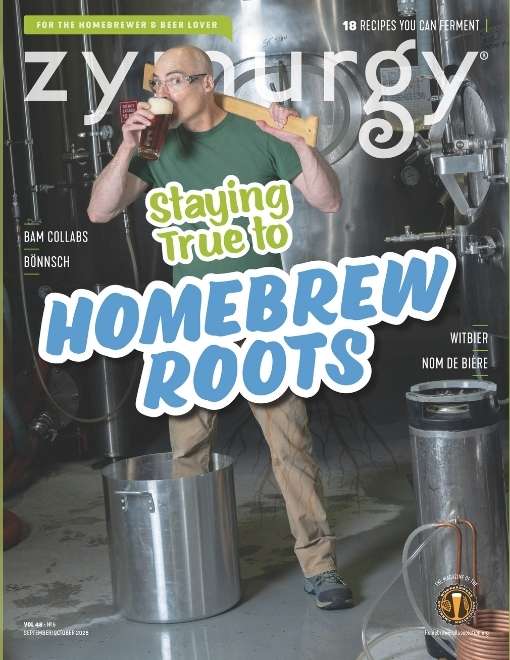
The American Homebrewers Association (AHA) has officially released the September/October 2025 issue of Zymurgy, the nation’s longest-running publication dedicated to the art and science of home fermentation. This landmark edition serves as a deep dive into the increasingly blurred lines between amateur enthusiasts and professional brewmasters, a phenomenon that has defined the American craft beer movement for nearly half a century. Featuring 18 curated recipes and extensive technical features, the issue highlights how the foundational skills learned in the kitchen and garage continue to drive innovation on the commercial stage.
The release comes at a pivotal time for the hobby. While the craft beer industry has matured and faced market consolidation, the grassroots community of homebrewers remains the primary engine for stylistic experimentation and technical education. The September/October issue encapsulates this spirit by profiling individuals who have successfully navigated the transition from hobbyist to award-winning professional, while providing current homebrewers with the high-level technical resources necessary to produce world-class beer.
The Professional Evolution of Gary Glass
The cover story, authored by Gabe Toth, chronicles the remarkable career trajectory of Gary Glass. For nearly two decades, Glass was synonymous with the American Homebrewers Association, serving as its director and acting as a primary advocate for homebrewing rights across the United States. His tenure at the AHA was marked by significant legislative victories, including the final legalization of homebrewing in all 50 states, a milestone achieved in 2013 when Alabama and Mississippi passed their respective bills.
However, the latest feature focuses on Glass’s "second act" in the brewhouse. After stepping down from his administrative and advocacy role, Glass transitioned into the professional production side of the industry. The article details his journey from overseeing a national organization to the rigorous daily operations of a commercial brewery. The transition culminated in a prestigious validation of his technical prowess: winning medals at the Great American Beer Festival (GABF).
Glass’s success serves as a case study for the "homebrew-to-pro" pipeline. His story underscores a fundamental truth of the American beer landscape: the technical discipline required to win high-level amateur competitions often translates directly to commercial success. Toth’s profile explores the psychological shift from being an advocate for the hobby to being a practitioner in a competitive market, offering insights into how Glass applied decades of theoretical knowledge to the physical demands of professional brewing.
Collaborative Ecosystems: The California Homebrew Scene
A significant portion of the September/October issue is dedicated to the historical and contemporary influence of California’s homebrewing clubs. Specifically, the magazine examines the "epic collaboration" involving the Bay Area Mashers and the Maltose Falcons. The Maltose Falcons, based in Los Angeles, hold the distinction of being the oldest homebrewing club in the United States, founded in 1974—four years before the federal legalization of the hobby.
The feature details a massive collaborative effort involving these clubs, local maltsters, and professional breweries. This synergy illustrates the unique "circular economy" of the craft beer world. Homebrew clubs often serve as R&D labs for professional brewers, who in turn provide the clubs with access to specialized ingredients and professional-grade equipment for large-scale "Big Brew" events.
The collaboration highlighted in this issue focused on the relationship between raw material producers—the maltsters—and the end-users. By involving maltsters directly in the brewing process with amateur clubs, the project allowed for a granular exploration of how specific grain varieties and floor-malting techniques impact the final profile of a beer. This type of community-driven data collection is invaluable to the industry, as it provides a testing ground for new ingredients before they are scaled for national distribution.

Technical Spotlights: Witbier and the Hazy Bönnsch
Zymurgy continues its tradition of providing rigorous technical guidance with features on two distinct European styles: the Belgian Witbier and the Bönnsch naturtrüb.
The exploration of Belgian Witbier is led by industry veterans Charlie Gottenkieny and Jason Perkins. Perkins, the brewmaster at Allagash Brewing Company, brings a wealth of expertise to the table, as his "Allagash White" is widely considered the gold standard for the style in North America. The article breaks down the delicate balance of unmalted wheat, coriander, and Curacao orange peel. It emphasizes the importance of yeast health and temperature control in achieving the signature phenolic and ester profile that defines a world-class Witbier. For homebrewers, this feature provides a rare look at how professional-level precision can be applied to five-gallon batches.
In a more niche exploration, brewer Gunnar Martens introduces readers to Bönnsch naturtrüb. While Kölsch—the clear, crisp ale of Cologne—is well-known globally, Bönnsch is its unfiltered, hazy cousin from the nearby city of Bonn. Martens explains the historical context of the style, which is traditionally served in a custom, stemless "Bönnsch" glass. The technical challenge of the style lies in maintaining a stable, yeast-driven haze without the astringency often found in poorly executed "hazy" beers. Martens’s contribution provides a roadmap for brewers looking to explore the lesser-known corners of German brewing tradition, blending old-world heritage with modern preferences for unfiltered ales.

The Psychology of the Pour: Competition and Nomenclature
Beyond the chemistry of fermentation, the issue addresses the creative and competitive aspects of the hobby. Ron Minkoff contributes a guide to the art of naming competition beers. While often overlooked, the name and description of a beer on a BJCP (Beer Judge Certification Program) scoresheet can influence a judge’s expectations.
Minkoff’s guide is described as witty and irreverent, yet it carries a factual core regarding the importance of "brand identity" even at the amateur level. In a field where hundreds of entries might be submitted for a single category, a name that is memorable—or a description that accurately prepares the judge’s palate—can be a deciding factor in the "Best of Show" round. This focus on the "soft skills" of brewing highlights the holistic approach Zymurgy takes toward the craft.
Supporting Data and Industry Context
The relevance of this issue is backed by significant industry data. According to the American Homebrewers Association, there are an estimated 1.1 million homebrewers in the United States who produce more than 1.4 million barrels of beer annually. This community is not merely a collection of hobbyists; it is a vital economic force. Homebrewers support a network of over 600 local homebrew supply shops and contribute to the demand for high-quality, diversified agricultural products like aroma hops and heirloom malts.
Furthermore, the "pro-am" connection is more than just a theme; it is the foundation of the industry. Surveys conducted by the Brewers Association indicate that upwards of 90% of professional craft brewers began their careers as homebrewers. The September/October 2025 issue of Zymurgy serves as a bridge for those currently in the "amateur" category who aspire to follow in the footsteps of Gary Glass or Jason Perkins.
Broader Implications for the Brewing Community
The publication of this issue under the leadership of Editor-in-Chief Dave Carpenter reflects a continued commitment to "homebrew activism." Carpenter, a seasoned brewer and writer, has steered the magazine toward content that balances DIY grit with professional-grade science. By providing 18 validated recipes, the magazine ensures that its readers are not just consuming theory but are actively engaging in the practice of brewing.
The inclusion of a "Free Zymurgy Online Preview" and a paywall for member-only content underscores the AHA’s business model of using high-value educational content to fund its advocacy work. Membership dues support the organization’s ability to lobby for favorable brewing laws, provide insurance for homebrew clubs, and organize the National Homebrew Competition, the largest event of its kind in the world.
As the craft beer landscape continues to evolve, the September/October 2025 issue of Zymurgy stands as a testament to the enduring power of the homebrewing community. By celebrating the achievements of veterans like Gary Glass and providing a platform for technical experts like Jason Perkins, the magazine reinforces the idea that the heart of brewing innovation will always be found in the hands of those who brew for the love of the craft. Whether it is a hazy Bönnsch or a meticulously balanced Witbier, the recipes and stories within this issue serve as a roadmap for the next generation of brewers who will inevitably shape the future of the global beer industry.