
The pursuit of the perfect cup of coffee is a journey deeply rooted in both intricate chemistry and meticulous craftsmanship, transforming what appears to be a simple daily ritual into a complex scientific endeavor. At its heart lies the process of extraction, where hot water selectively dissolves desirable compounds from ground coffee beans. This article delves into the sophisticated world of coffee extraction, examining two dominant brewing philosophies—pour-over (percolation) and immersion—and the myriad factors that govern their outcomes.
The Chemistry of Coffee Extraction: A Foundation
A single coffee bean harbors thousands of chemical compounds, including a diverse array of acids, sugars, lipids, volatile aromatics, and alkaloids like caffeine. Each of these compounds possesses unique solubility characteristics and extraction rates. This inherent variability is not a flaw but a fundamental aspect that allows for the vast spectrum of flavors and aromas coffee can offer. If all compounds were extracted at the same rate, there would be little room for nuance or creativity in brewing.
The ultimate goal in brewing is often not to achieve a maximal, all-encompassing extraction, which could yield up to 30% of the bean’s mass, often resulting in an intensely strong, potentially bitter, and unbalanced brew akin to a heavily steeped Turkish coffee. Instead, coffee aficionados and scientists alike strive for a "selective extraction"—a carefully calibrated process that preferentially dissolves compounds contributing to desirable flavors, while leaving behind those that impart unpleasant notes. This delicate balance, where compounds are extracted to varying degrees, is what defines a truly exceptional cup. Industry standards, such as those promoted by the Specialty Coffee Association (SCA), often target an extraction yield of 18-22% and a Total Dissolved Solids (TDS) concentration between 1.15% and 1.35%, representing a sweet spot for balance and flavor.
Pour-Over: A Symphony of Variables
Pour-over brewing, a method of percolation, involves gravity-driven filtration where hot water slowly passes through a bed of ground coffee, dripping into a vessel below. This technique stands apart from historical "coffee percolators," which recirculate heated coffee through the grounds via convection—a method often associated with over-extraction and bitterness. While deceptively simple in concept, pour-over is an immensely complex system with a surprising number of adjustable parameters, each playing a critical role in the final brew.
Parameters in Play
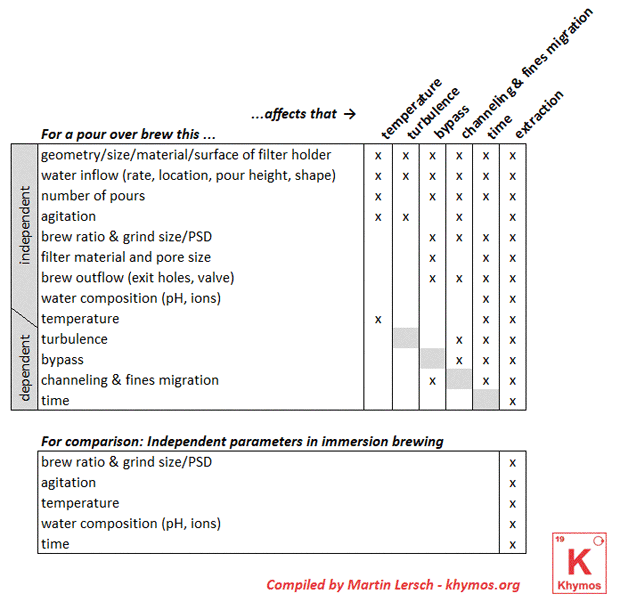
Beyond the foundational elements discussed in previous analyses—such as brew ratio (coffee-to-water), grind size and particle size distribution (PSD), water composition, and temperature—numerous other factors profoundly affect the outcome:
- Bloom: The initial wetting of coffee grounds, allowing trapped CO2 to escape, is crucial. A controlled bloom ensures even saturation and prevents channeling in subsequent pours.
- Agitation: The stirring or swirling of the coffee bed, whether intentional or incidental from pouring, impacts extraction uniformity.
- Pouring Technique: The speed, pattern, and height of water application directly influence the turbulence and contact time between water and grounds.
- Bed Depth and Geometry: The shape and depth of the coffee bed affect flow dynamics and pressure distribution.
- Filter Material and Pore Size: Paper, metal, or cloth filters each offer distinct filtration characteristics, impacting clarity, body, and the presence of oils and fines.
The Challenge of Control: Channeling and Bypass
The complexity of pour-over brewing means many parameters are correlated, creating a dynamic and often unpredictable system. For instance, a finer grind size increases the total surface area for extraction but also slows down water flow, potentially leading to filter clogging and increased contact time. However, it also raises the risk of "channeling," where water carves preferential paths through the coffee bed, leaving other areas under-extracted.
Another critical phenomenon is "bypass," where water flows around the coffee bed rather than through it, effectively diluting the brew without contributing to extraction. Water, being "lazy" from a fluid dynamics perspective, will always take the path of least resistance. This bypass can be exacerbated by fine grinds, certain filter holder designs that reduce filter contact, or fast pouring that allows water to accumulate above the coffee bed. Minimizing uncontrolled bypass is a primary goal for optimal percolation, as emphasized by leading coffee researchers like Jonathan Gagné.
Innovations in Design: Addressing Complexity Through Equipment
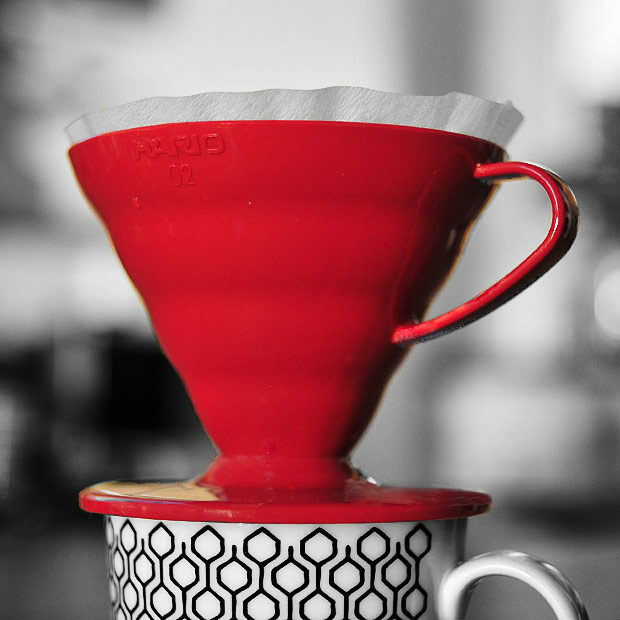
The "endless list" of pour-over devices available today—from the iconic Hario V60 to the Kalita Wave, Chemex, and countless others—testifies to the ongoing quest to "untie the coffee knot." Each design attempts to mitigate specific challenges and optimize extraction:
- Material and Insulation: The choice of material impacts thermal stability. Metal, being a good heat conductor, can lead to significant temperature loss unless insulated (e.g., Stagg X/XF with vacuum insulation) or possessing substantial thermal mass (like an espresso portafilter). Plastic (e.g., polypropylene V60) and ceramic are often preferred for their cost-effectiveness, limited heat loss, and sturdiness.
- Shape and Flow Dynamics: Trapezoid-shaped filters (Melitta) and cone-shaped filters (Hario V60) create different coffee bed geometries. A high, narrow cylindrical bed (as in some experimental designs) can maximize coffee-water contact but slow flow, while a flat bed (Kalita Wave) offers faster flow but risks channeling if not managed.
- Inside Wall Surface and Bypass Mitigation: Brewers like the Chemex, with its plain, smooth interior, aim to eliminate bypass by allowing the filter paper to cling to the surface, effectively blocking flow along the sides. Conversely, many other designs incorporate ridges or patterns (e.g., Hario V60’s spiraled ribs, Origami’s fluted design) to create channels for brewed coffee to flow, preventing the filter from sticking and ensuring a steady drip rate, though potentially allowing some bypass.
- Filter Types and Filtration Efficiency: Paper filters, the most common, provide a clean cup by removing fines and oils but can clog. Metal filters offer a fuller body due to the passage of fines and oils. Some brewers, like the Kalita Wave, utilize W-folded filters to increase surface area and reduce clogging. The rare Karlsbader brewer uses a coarse ceramic grating, offering minimal filtration.
- Inflow and Outflow Control Mechanisms: Controlling water inflow is crucial. Gooseneck kettles allow for precise, slow pouring to minimize disturbance. Specialized water distributors like the Gabi Dripmaster B or Melodrip ensure even saturation and a perfectly flat coffee bed. Outflow control is equally vital. Some drippers feature a single large exit hole for rapid flow, while others use multiple smaller holes. Innovative designs, such as the Clever Dripper or Hario Switch, incorporate a shut-off valve, allowing for an initial immersion phase followed by a controlled draw-down. This valve offers significant control over contact time, making recipes more scalable and repeatable by compensating for variations like grind size or coffee quantity.
The proliferation of YouTube tutorials on pour-over techniques underscores its complexity and the baristas’ continuous quest for mastery over these interconnected variables.
Immersion Brewing: Robustness and Repeatability
In contrast to the dynamic variables of pour-over, immersion brewing offers a more robust and repeatable approach. Here, all coffee grounds are steeped in water for a predetermined time, typically with all water added at once and an initial stir to ensure full saturation and de-gassing. After the desired extraction period, the brew is separated from the grounds via filtration.
The Immersion Principle
The core advantage of immersion is its inherent simplicity and control. Variables like pouring technique become largely irrelevant, as the coffee grounds are fully submerged. This leads to a more consistent saturation and extraction across all coffee particles, reducing the likelihood of channeling or uneven extraction. Consequently, sharing an immersion recipe between two individuals is far more likely to yield similar results, making it a favorite for home brewers seeking reliability.
French Press: Body and Texture
The French Press is the quintessential immersion brewer, characterized by its relatively coarse wire mesh filter. This filter allows a significant amount of coffee "fines"—tiny insoluble particles—to pass into the cup. These fines contribute a distinct body and texture to the beverage, often leaving a fine sediment at the bottom of the cup. While some appreciate this mouthfeel, the extended contact with these fines can also contribute to undesired bitterness. For those seeking a cleaner taste from their French Press, an additional paper filtration step can remove fines and some oils, significantly altering the cup profile. However, immersion coffee, even when filtered, can sometimes present a slightly muted flavor profile compared to a perfectly executed pour-over.
Hybrid Systems: Aeropress and Clever Dripper
Other immersion devices, such as the Aeropress and the Clever Dripper, bridge the gap between immersion and percolation. The Aeropress, a cylindrical brewer, uses pressure filtration (often with the inverted method for immersion) and a small paper filter to produce a clean, concentrated brew. The Clever Dripper, as mentioned, incorporates a shut-off valve, allowing for a full immersion phase before initiating a percolation draw-down. These hybrid systems offer the best of both worlds: the repeatability of immersion with elements of control over filtration and contact time.
A Century of Innovation: The Evolution of Coffee Makers
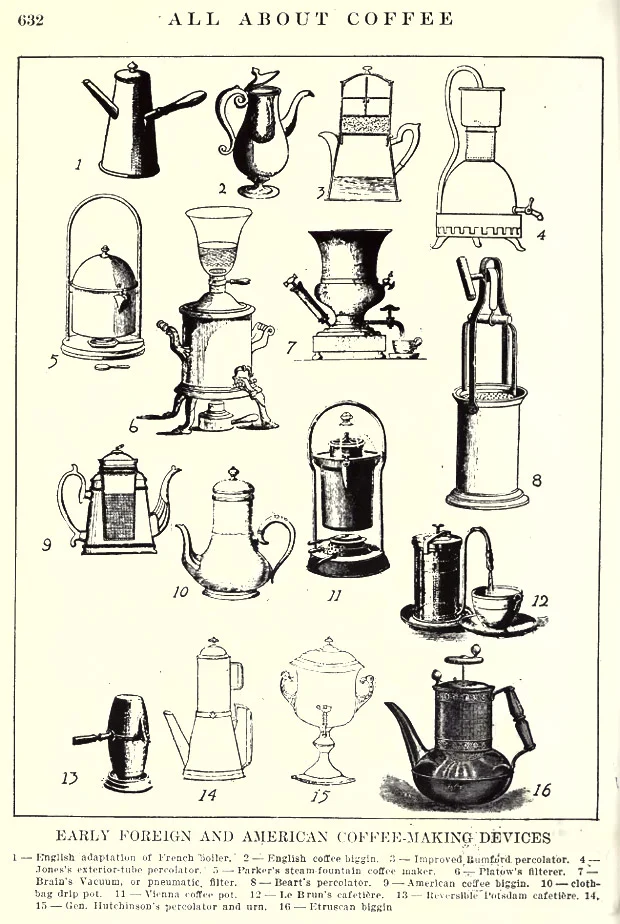
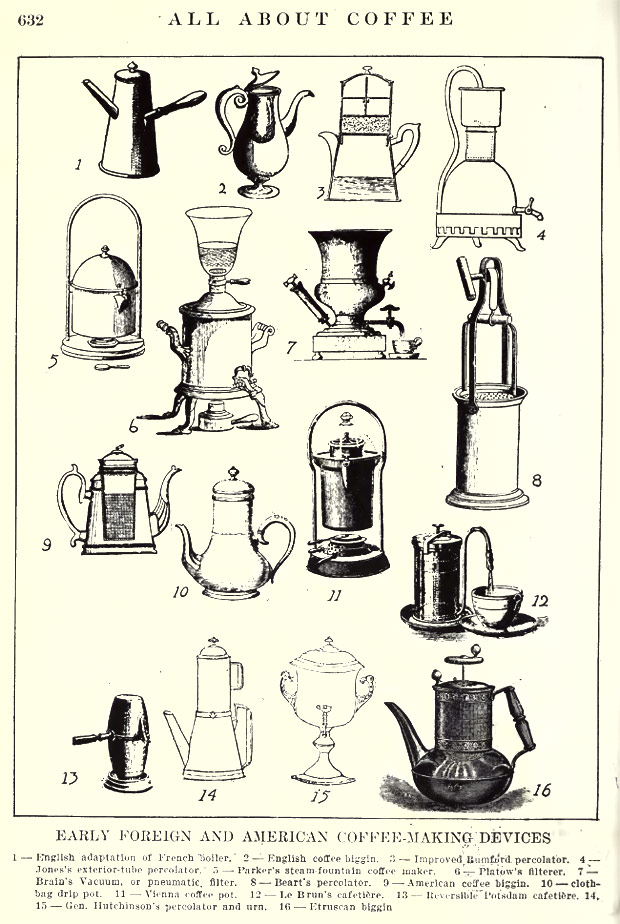
The ongoing innovation in coffee brewing equipment is not a modern phenomenon. As evidenced by illustrations from W. A. Ukers’ 1922 seminal work, "All About Coffee," inventors have been grappling with optimal extraction methods for over a century. From early 19th-century coffee percolators to Melitta Bentz’s invention of the paper filter and drip brewing in 1908, and the subsequent explosion of electric drip machines, the history of coffee brewing is a testament to continuous engineering and material science advancements. The recent surge in specialty pour-over devices—the Hario V60 in the 1950s (though popularized much later), the Chemex in the 1940s, and the Kalita Wave in the 2000s—reflects a renewed focus on precision and control. Each new device, with its unique geometry, material, and flow dynamics, represents another attempt to refine the extraction process and deliver an ever-improving cup.
Implications for the Modern Coffee Lover
The profound complexity of coffee extraction has significant implications for both professional baristas and home enthusiasts. For baristas, it elevates brewing from a simple task to an art form informed by science, demanding an understanding of fluid dynamics, chemistry, and sensory evaluation. For home brewers, it explains why replicating a "recipe" perfectly can be challenging and why unintended variations often lead to inconsistent results or even the propagation of brewing myths.
The pursuit of the "very best cup of coffee we have ever tasted," a sentiment famously captured by Gale Boetticher’s elaborate coffee setup in Breaking Bad, remains a driving force. While there may never be a single "ultimate" brewing method due to subjective preferences and the inherent variability of coffee itself, the continuous exploration of extraction science and equipment design brings us closer. This journey underscores that making coffee is not merely about combining hot water and grounds; it is a fascinating intersection of science, engineering, and sensory pleasure, continually evolving in the quest for liquid perfection. The future promises further innovations, potentially leveraging smart technology and AI to demystify some of these variables, yet the fundamental scientific principles will always guide the pursuit of the ideal brew.