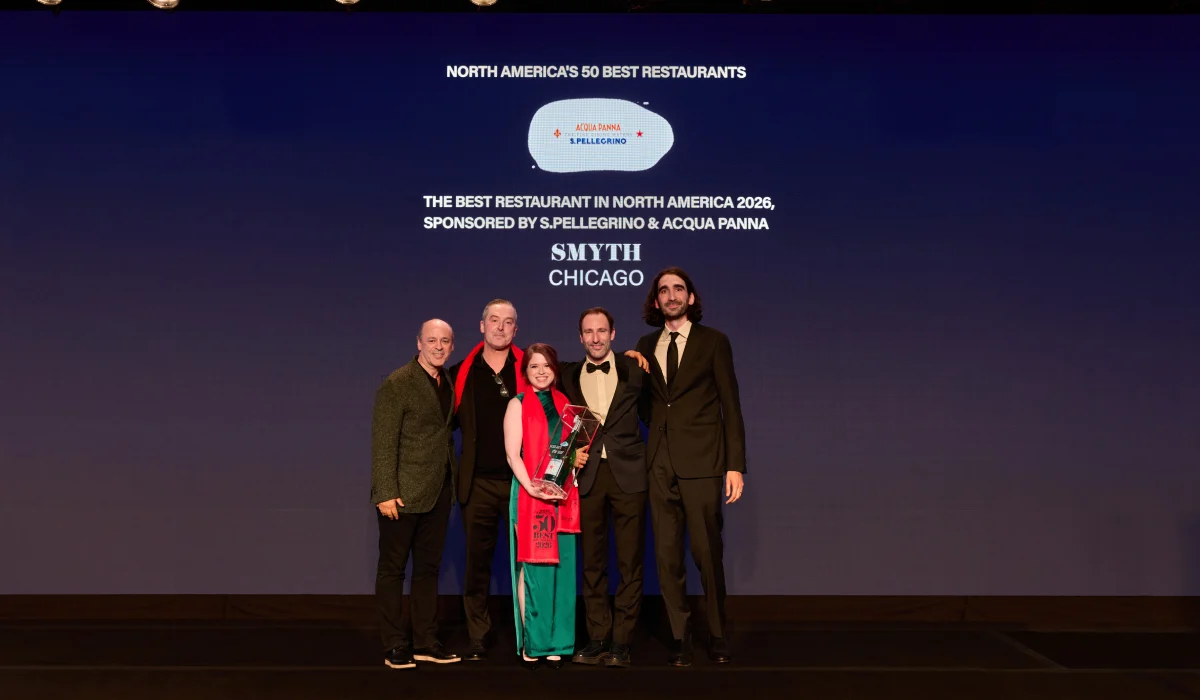

The North American culinary hierarchy underwent a significant realignment this week as Smyth, the acclaimed Chicago destination led by chefs John Shields and Karen Urie Shields, was officially crowned the number one restaurant on the North America’s 50 Best Restaurants 2026 list. Rising from the fourth position in the previous year’s rankings, the West Loop establishment’s ascent to the pinnacle of the industry marks a milestone for the Chicago dining scene and validates a decade of culinary evolution. The announcement, made during a prestigious gala that brought together the continent’s most influential chefs, restaurateurs, and critics, highlighted a broader trend of regional diversification and a surging performance by Canadian establishments.
The victory for Smyth comes as the restaurant celebrates a decade of operation, having been founded in 2016. Over the past ten years, the Shields have refined a concept that prioritizes intimacy, seasonality, and deep-rooted connections with local producers. The 2026 ranking reflects a growing consensus among the 50 Best Academy voters that the future of fine dining lies in highly personal, narrative-driven experiences rather than traditional, rigid notions of luxury.
The Decade-Long Journey of Smyth to the Top
When John and Karen Urie Shields founded Smyth in 2016, they brought with them a philosophy honed in the rural landscapes of Virginia before returning to the urban center of Chicago. The restaurant was envisioned as a dual-concept space, with the upscale Smyth located above the more casual Loyalist. Over the last ten years, Smyth has become synonymous with a "farm-to-table" ethos that transcends the cliché, utilizing a dedicated farm in Bourbonnais, Illinois, to dictate the daily flow of its tasting menu.
The 2026 jury praised the restaurant for its "constantly evolving" nature. Dishes at Smyth are rarely static; they are shaped by the micro-seasons of the Midwest, resulting in a dining experience that is as much about the passage of time as it is about culinary technique. The minimalist setting, which strips away the ostentation often associated with three-Michelin-starred establishments, was noted as a key factor in its appeal. By centering the guest experience on the kitchen’s creative output and the warmth of the hospitality, Smyth has successfully navigated the transition from a bold newcomer in 2016 to the definitive leader of the North American scene in 2026.
Canadian Culinary Excellence Reaches New Heights
One of the most striking developments in the 2026 rankings is the unprecedented success of Canadian restaurants. For the first time in the history of the regional list, Canadian establishments occupied two of the top three spots, signaling a shift in the continent’s gastronomic center of gravity.
Calgary’s Eight made a historic debut at No. 2, the highest entry for any new restaurant in the list’s history. Led by Chef Darren MacLean, Eight is an intimate, eight-seat counter experience that focuses on the diverse cultural heritage of Canada. Its recognition as the Best Restaurant in West Canada underscores Calgary’s emergence as a premier food destination.
Following closely at No. 3 was Restaurant Pearl Morissette, located in Lincoln, Ontario. Named the Best Restaurant in Central Canada, the establishment is celebrated for its integration with the Pearl Morissette winery and its commitment to regenerative agriculture. The presence of Montreal’s Mon Lapin at No. 5 and Toronto’s Quetzal at No. 8 further solidified Canada’s dominance in the top ten, with Quebec City’s Tanière3 rounding out the group at No. 9. In total, Canada secured 14 spots on the list of 50, a significant proportion that reflects the country’s burgeoning reputation for world-class hospitality.
Regional Diversity and the Rise of New Culinary Hubs
The 2026 list also serves as a testament to the geographical expansion of fine dining across North America. While traditional powerhouses like New York City and San Francisco maintained a strong presence, the inclusion of six new cities—Atlanta, Calgary, Collingwood, Minneapolis, San Diego, and Whistler—points to a decentralization of culinary talent.
Dakar NOLA in New Orleans secured the No. 4 spot, earning the title of Best Restaurant in the South U.S. This high ranking highlights the continued relevance of New Orleans as a cultural and culinary capital, moving beyond traditional Creole and Cajun tropes to embrace modern, African-inspired narratives.
The emergence of 18 newcomers on the list suggests a high level of volatility and innovation in the industry. Notable new entries include Atlanta’s Avize (No. 29), New Orleans’ Acamaya (No. 30), and San Diego’s Addison by William Bradley (No. 31). The inclusion of Minneapolis via Diane’s Place (No. 50) and the resort town of Whistler through Wild Blue (No. 47) demonstrates that excellence is increasingly being recognized in markets previously overlooked by international ranking systems.
Celebrating Individual Contributions and Iconography
Beyond the restaurant rankings, the 2026 awards ceremony honored several individuals whose careers have shaped the trajectory of American hospitality. In a moment of high emotion in his hometown of New Orleans, Emeril Lagasse was presented with the SevenRooms Icon Award. The honor recognizes Lagasse’s decades of influence, from his pioneering work at Commander’s Palace to his role in bringing "New American" cuisine to a global audience through television and his eponymous restaurant group.
The individual talent awards also highlighted the specialization and technical mastery required in modern gastronomy. Eunji Lee, of the New York City dessert boutique Lycée, was named North America’s Best Pastry Chef. Her work is celebrated for its architectural beauty and the seamless blending of Korean flavors with French pastry techniques. Similarly, Aldo Sohm of the legendary Le Bernardin was honored as North America’s Best Sommelier, a nod to his enduring excellence in wine service and education.
The Chefs’ Choice Award, the only peer-voted accolade on the list, was bestowed upon Corey Lee of Benu in San Francisco. This award is often considered one of the most prestigious by those within the industry, as it reflects the respect and admiration of fellow chefs. Mashama Bailey, the force behind The Grey in Savannah, Georgia, was named North America’s Best Female Chef, recognizing her pivotal role in reimagining Southern cuisine through the lens of the Black experience.
Sustainability and Innovation as Industry Standards
The 2026 rankings also placed a heavy emphasis on the industry’s responsibility toward the environment and social equity. Dominique Crenn’s Atelier Crenn in San Francisco received the Sustainable Restaurant Award. Crenn, a long-time advocate for ocean conservation and sustainable farming, has removed meat from her menus and operates with a zero-waste philosophy, setting a benchmark for high-end dining globally.
The "Highest Climber" award went to Washington, D.C.’s Albi, which surged 28 places to land at No. 6. This rapid ascent is attributed to Chef Michael Rafidi’s masterful modern interpretation of Levantine cuisine, proving that restaurants focusing on specific cultural heritages are finding a wider, more appreciative audience than ever before.
Statistical Breakdown and Geographic Distribution
The 2026 North America’s 50 Best Restaurants list provides a data-rich snapshot of the current state of the industry. The final tally included 36 restaurants from the United States and 14 from Canada. Within the U.S. contingent, New York City remained the most represented municipality, though its grip on the top ten has loosened compared to previous decades.
| Region | Number of Restaurants | Top Ranking |
|---|---|---|
| United States | 36 | Smyth (No. 1) |
| Canada | 14 | Eight (No. 2) |
The diversity of cuisines represented on the list has also reached an all-time high. From the indigenous-inspired flavors of the Pacific Northwest to the sophisticated Korean-American fusion seen in New York’s Atomix (No. 7) and Jungsik (No. 18), the list reflects a region that is increasingly comfortable with its multicultural identity.
Implications for the Future of North American Dining
The 2026 rankings suggest that the industry is entering a period of "post-opulence," where the value of a meal is measured by its story, its environmental footprint, and its emotional resonance rather than the price of its ingredients or the formality of its service. The success of Smyth, a restaurant founded ten years ago on the principles of simplicity and seasonality, serves as the primary evidence for this shift.
Faye Huggett, director of community for North America’s 50 Best Restaurants, noted in her official statement that the list "celebrates the extraordinary diversity, creativity, and excellence that define the region’s dining scene." She emphasized that the inclusion of both "pioneering dining institutions" and "bold new voices" reflects a dynamic landscape that is constantly pushing the boundaries of what is possible in a restaurant setting.
As Smyth begins its tenure as the Best Restaurant in North America, the focus will undoubtedly turn to how the Shields maintain their creative momentum. For the broader industry, the 2026 list provides a roadmap for success that prizes local identity and sustainable growth over rapid expansion. With 18 newcomers and a significant showing from Canadian cities, the message is clear: the next great culinary innovation could come from anywhere on the continent, provided it is rooted in authenticity and a passion for the craft.
The 2026 North America’s 50 Best Restaurants list stands not just as a ranking, but as a historical record of a culinary culture in transition—one that is more inclusive, more environmentally conscious, and more geographically diverse than at any point in its history.