
This seemingly innocuous statement, uttered by Anna, a highly accomplished law professional, recently underscored a pervasive challenge in modern health and wellness. Anna, known for her critical thinking and ability to dissect complex issues, found herself exploring a niche solution in her long-standing goal to lose approximately 15 pounds. Her rationale? "I’ve been reading about how microplastics in food containers can mess up our hormones and cause weight gain."
This focus on advanced, specific interventions came despite her concurrent struggles with basic health tenets: inconsistent gym attendance, frequent reliance on takeout, and sacrificing adequate sleep for late-night "doom scrolling." When asked about prioritizing consistent workouts or home-cooked meals, Anna’s response was telling: "Yeah, but I’ve tried that a thousand times. If it were that simple, it would have worked already."
Anna’s experience is far from unique; it reflects a widespread societal tendency to bypass fundamental, albeit often perceived as mundane, habit changes in favor of novel, ultra-specific "magic bullets" promising transformative results. This phenomenon is deeply embedded in the contemporary health landscape, fueled by a multi-billion-dollar wellness industry and the relentless pursuit of perfection.
The Pervasive Neglect of Health Fundamentals
The core issue lies in the consistent neglect of basic, evidence-backed health behaviors. Public health data paints a stark picture: only a small fraction of the population consistently adheres to fundamental health guidelines. For instance, a seminal study highlighted that a mere six percent of Americans consistently perform five key health behaviors: regular physical activity, a nutritious diet, adequate protein intake, sufficient sleep, and avoidance or reduction of excessive alcohol/drug consumption. This means nearly 94 percent of Americans are missing the mark on the very foundations of health.
These foundational behaviors – exercising for at least 30 minutes most days (a mix of aerobic and resistance training), consuming a diet primarily of whole or minimally processed foods (aiming for 80% compliance), ensuring sufficient protein intake (1.2 to 2.2 grams per kilogram of body weight), prioritizing seven to eight hours of quality sleep, and minimizing harmful substances – are universally acknowledged. Yet, their consistent implementation remains elusive for most. Adding elements like managing stress effectively and nurturing positive social relationships further shrinks the percentage of those who consistently meet all criteria.
The implications of this widespread neglect are profound, contributing to escalating rates of chronic diseases, increasing healthcare burdens, and a diminished quality of life for millions. Despite the simplicity of these recommendations, the journey to consistent adherence is fraught with psychological and practical barriers.
The Illusion of the "Magic Bullet": Why We Seek Complex Solutions
The allure of the "magic bullet" is powerful. Investing in new gear, popular supplements, or niche dietary trends feels like progress. Consuming endless articles and videos on "cutting-edge" strategies offers a sense of engagement. Waiting for the "perfect" moment or the "right" plan provides temporary comfort. However, real, sustainable change only materializes through consistent action.
The wellness industry, valued at over $4.4 trillion globally, often capitalizes on this human inclination. From specialized diets to advanced biohacking tools, the market is saturated with products and philosophies that promise accelerated results, often overshadowing the efficacy of basic lifestyle changes. The "BPA-free" movement, which Anna referenced, exemplifies this. Bisphenol A (BPA) is an industrial chemical used to make certain plastics and resins, with concerns emerging about its potential to leach into food and beverages and act as an endocrine disruptor. While many manufacturers have responded by offering BPA-free products, the scientific consensus on the direct, significant impact of typical BPA exposure on weight gain in humans, particularly compared to fundamental dietary and activity levels, remains a subject of ongoing research and debate. For many, addressing such specific concerns can become a distraction from more impactful, broader health habits.
Behavioral science offers insights into why we fall into this trap. Humans are wired to seek novelty and efficiency. The idea that a single product or technique can unlock significant health gains is inherently more appealing than the sustained, often repetitive effort required for basic habits. This psychological inclination, coupled with aggressive marketing, creates a fertile ground for "quick fixes" to flourish.
Common Barriers to Consistent Basic Health Actions
Several psychological and practical barriers commonly impede consistent adherence to fundamental health practices:
-
Ambition Overload:
When individuals decide to get healthier, they often embark on ambitious, comprehensive overhauls: exercising daily for an hour, adopting a "clean" diet at every meal, and committing to eight hours of sleep every night, often from a baseline of inactivity and poor sleep. This "all-or-nothing" approach, while well-intentioned, frequently sets individuals up for failure. Cognitive biases, such as the planning fallacy, lead us to overestimate our future time, energy, and motivation. The immediate comfort of creating an elaborate plan often masks its inherent impracticality within already busy lives. When these grand plans inevitably falter, individuals often blame themselves, attributing failure to a lack of willpower or discipline, rather than recognizing the unrealistic scope of their initial aspirations. This self-blame perpetuates a cycle of frustration and reinforces a narrative of personal struggle with consistency. -
The Lure of the "Cutting Edge":
A pervasive belief is that if health merely required eating vegetables, sleeping well, and exercising moderately, everyone would be healthy. This skepticism towards simplicity drives many to seek "hardcore," "industry-secret," or "cutting-edge" solutions. The fact that only a tiny fraction of the population consistently performs basic health behaviors underscores that the issue is not a lack of knowledge, but a lack of consistent execution. Simple behaviors are often perceived as boring, making novel diets or "magical" supplements more appealing. The promise of a "new outcome" or a "new us" through innovative methods is incredibly attractive. However, most highly specialized or "secret" strategies prove unsustainable, inaccessible, or ineffective, draining time, effort, and financial resources without yielding substantial returns, all while diverting attention from truly impactful actions. -
The Perfection Trap:
The health and fitness industry often propagates an image of "perfect" health: organic-only diets, marathon-running capabilities, and disciplined morning routines. This ideal, however, is an illusion. Perfection is unattainable in human health. Even the healthiest individuals experience illness, digestive issues, slumps, or simply bad days. The pursuit of an "optimal" or "perfect" self through a rigid plan can be deeply disappointing and counterproductive. It’s often more comforting to believe that adherence to a specific routine or supplement can grant immunity from human vulnerabilities. The irony is that achieving a realistic "best self" necessitates accommodating the "worst self"—the part that succumbs to temptations or lacks motivation. Life is inherently messy, unpredictable, and full of competing demands. Work pressures, family crises, or seasonal indulgences make perfect consistency impossible. Letting go of the illusion of a perfect self, one who always possesses ideal energy and willpower, and instead supporting one’s real self with its inherent fluctuations, is crucial for sustainable progress.
Navigating Ambivalence: A Normal Part of Change
The internal push-and-pull experienced when contemplating a change, like waking up earlier or reducing screen time, is known as ambivalence. It’s a natural and normal human response to change, characterized by wanting something while simultaneously desiring its opposite (e.g., wanting to eat healthier and wanting unrestricted treats). Similarly, resistance to change—wanting something but also not wanting it (e.g., wanting to stop mindless phone use but fearing the anxiety of being alone with thoughts)—is also fundamental. These contradictory emotions are not illogical; they signal that the change is meaningful and matters deeply to the individual. Recognizing ambivalence and resistance as inherent components of the change process, rather than obstacles, can shift the perspective from frustration to a deeper understanding of personal commitment.
A Framework for Effective and Realistic Action
Overcoming these barriers requires a strategic approach focused on realistic, sustainable action.
-
Explore the "Why" Before the "How":
Before embarking on any change, understanding deeper motivations is paramount. Asking introspective questions such as "Why is this change important to me now?" "What are the potential benefits of making this change?" "What are the consequences if I don’t make this change?" or utilizing tools like "The 5 Whys" (repeatedly asking "why" to uncover root motivations) can reveal intrinsic drivers. A clear understanding of the "why" provides a resilient, sustaining push, especially when challenges arise. This intrinsic motivation is far more powerful than external pressures or superficial desires. -
Prioritize the Most Effective Actions:
The human capacity for simultaneous, drastic change is limited. Effective change prioritizes essential actions that deliver the greatest impact relative to one’s goals. This involves identifying key areas such as movement, nutrition, and recovery practices. For instance, instead of attempting a complete dietary overhaul, an individual might focus on incorporating one extra serving of vegetables daily. Tools like "Skills, Practices, and Daily Actions Cheat Sheets" can guide individuals to select a specific domain (e.g., "Nutrition"), a skill within that domain (e.g., "Eat well intuitively"), a practice (e.g., "Eat to satisfied"), and a manageable daily action (e.g., "Record hunger and fullness levels at the start and end of meals"). This systematic approach ensures that efforts are directed towards high-leverage activities that build foundational habits. -
Make Action Possible, Even on Your Worst Day (The "Dial" Concept):
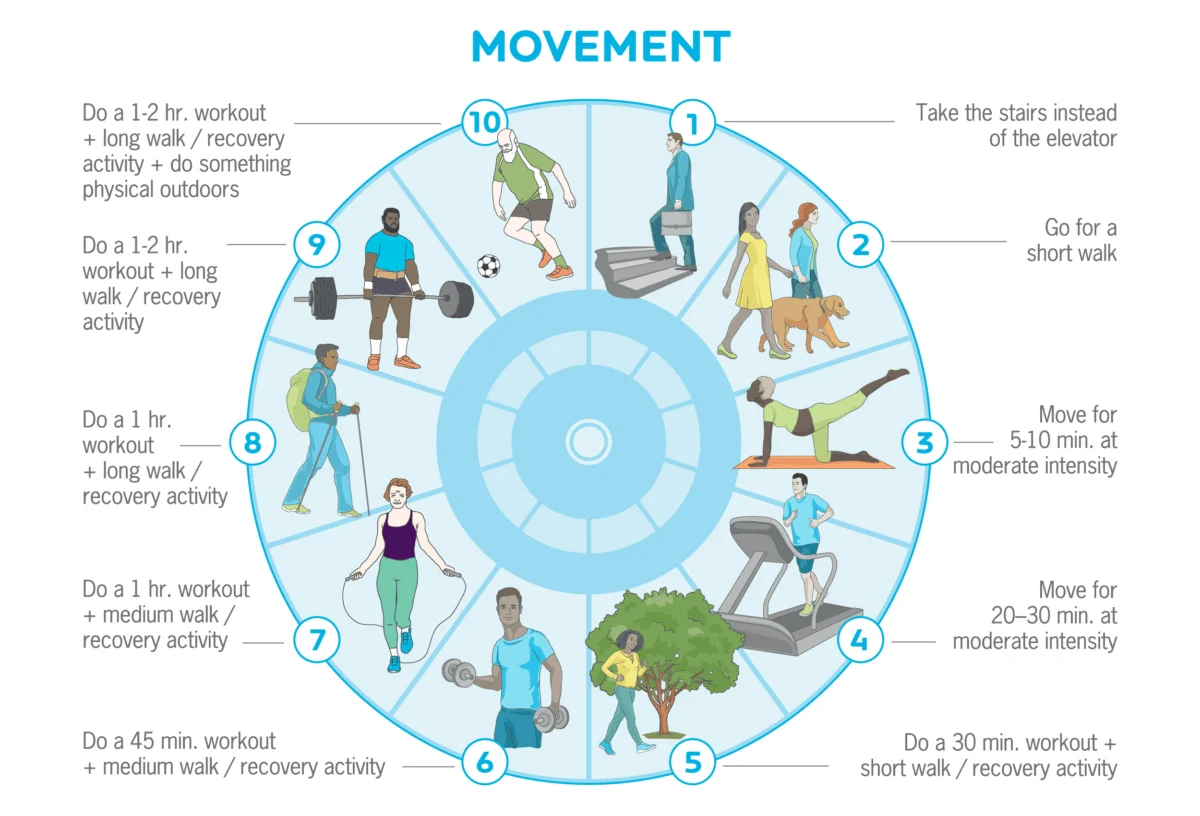
The pursuit of perfection often leads to an "all-or-nothing" mentality. To combat this, individuals should define a "floor" and a "ceiling" for their desired behaviors. The "floor" is the absolute minimum, the "pathetic goal" that is almost impossible not to achieve on the worst day (e.g., five minutes of walking, one extra portion of vegetables, three conscious deep breaths). The "ceiling" represents the ideal, maximal effort (e.g., a one-hour intense gym session, two hours of meal prep).
This establishes a flexible range, allowing health habits to be viewed not as an "on" or "off" switch, but as a dial. When life is smooth, the dial can be turned up to maximal effort. When life becomes chaotic, the dial can be turned down to the "floor" level. The critical insight is that any action within this range "counts." Doing the bare minimum is not failure; it is succeeding within the context of a real, unpredictable life. This paradigm shift fosters consistency by removing the pressure of perfection and validating effort, regardless of intensity. -
Create a Supportive Ecosystem:
Good intentions and willpower alone are often insufficient to sustain behavior change. The surrounding environment profoundly shapes our actions. Health and fitness professionals often have lives inherently structured to support healthy habits, making it easier for them. The strategy, therefore, is to "build an ecosystem that makes failing nearly impossible."
Research consistently demonstrates the power of environmental factors; for example, access to affordable grocers improves dietary habits, and proximity to gyms increases exercise rates. While changing neighborhoods may be impractical, individuals can exert control over their immediate environments. Examples include a "kitchen makeover" (washing and prepping healthy foods, making them easily accessible, and relegating less healthy options to less convenient locations) or structuring one’s workspace to encourage movement. This involves strategically removing temptations, increasing accessibility to desired options, and integrating reminders for desired behaviors. Investing effort in shaping one’s environment upfront significantly reduces the ongoing demand on willpower, making desired actions the obvious and easier choice.
Embracing C+ Effort: The Power of Imperfect Consistency
For many, particularly those with perfectionist tendencies, the concept of "C+ effort" can be challenging. However, this philosophy is not about aiming for mediocrity; it’s about acknowledging and working with inherent human imperfection. Expecting flawless execution invariably leads to short bursts of success followed by crashes. Adopting an attitude of compassion and acceptance towards one’s "human self" means recognizing vulnerabilities and working with them, rather than constantly battling against them.
There will be periods of peak performance, where "A" grade effort is effortlessly achieved. But there will also be times when only a "C+" or even "D" is possible. The crucial takeaway is that this lower-grade effort is not a failure; it is simply adapting the dial to life’s demands. Living a healthy, meaningful life is a continuous journey of striving for one’s best while allowing for flexibility, mistakes, and challenging periods. The surprising truth is that "good enough," consistently applied over the long run, far surpasses the impact of sporadic, perfect bursts of effort. It is in this sustained, imperfect consistency that true, lasting health transformations are forged.
References
Click here to view the information sources referenced in this article. (This would be a placeholder for actual citations in a published article).
If you’re a coach, or you want to be…
You can help people build sustainable nutrition and lifestyle habits that will significantly improve their physical and mental health—while you make a great living doing what you love. We’ll show you how.
If you’d like to learn more, consider the PN Level 1 Nutrition Coaching Certification. (You can enroll now at a big discount.)