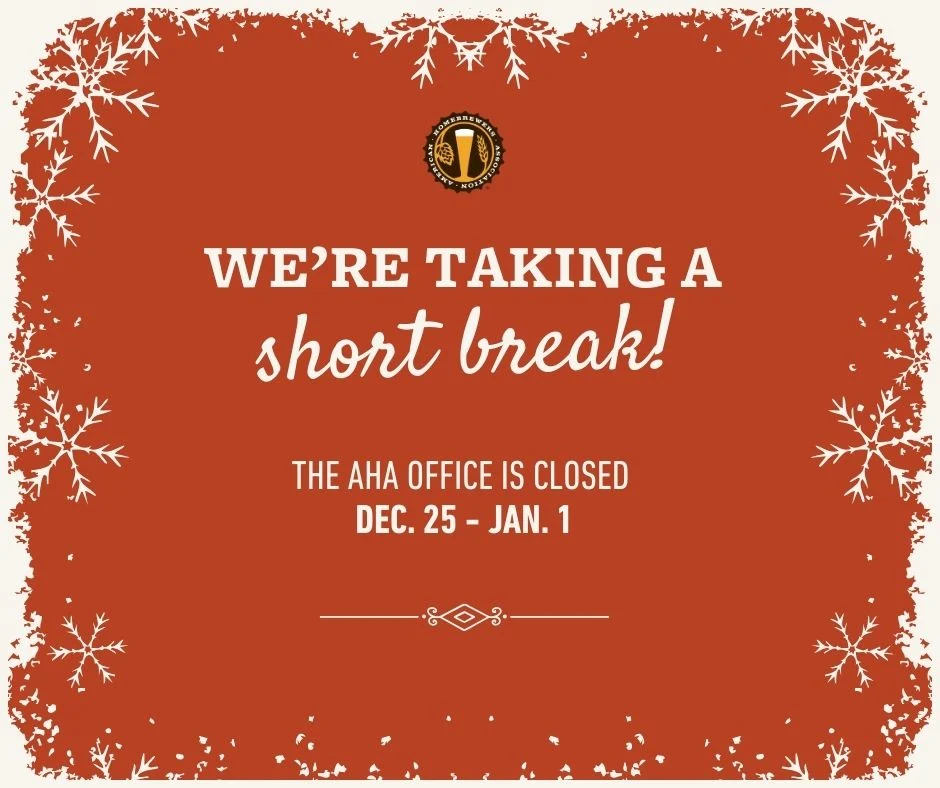

The American Homebrewers Association (AHA) has officially announced a scheduled operational hiatus spanning the final week of 2025, with offices and primary support services set to close from December 25 through January 1, 2026. This period of rest, intended to allow the organization’s staff to celebrate the holiday season and prepare for the upcoming calendar year, marks a traditional transition point for the non-profit entity. While digital resources and automated membership portals will remain accessible to the public, live administrative support and content updates will be paused until the team returns to full capacity in the new year.
As the preeminent representative body for the nation’s amateur zymurgy enthusiasts, the AHA’s temporary closure serves as a reflective moment for an industry that has seen significant evolution over the past twelve months. The organization has signaled that this period of being "refreshed and recharged" is essential for maintaining the high volume of educational content, legislative advocacy, and competition management that the homebrewing community expects.
Historical Context and the Role of the AHA
To understand the impact of the American Homebrewers Association, one must look at its foundational role in the American craft beer revolution. Founded in 1978 by Charlie Papazian in Boulder, Colorado, the AHA was established at a time when homebrewing was still technically illegal under federal law. The organization played a pivotal role in the passage of H.R. 1337, which was signed by President Jimmy Carter in late 1978, effectively legalizing homebrewing at the federal level for the first time since Prohibition.
Over the nearly five decades since its inception, the AHA has grown from a small group of enthusiasts into a massive division of the Brewers Association (BA). It currently serves tens of thousands of members globally. The association is responsible for the National Homebrew Competition, the world’s largest international beer competition, and publishes Zymurgy magazine, the longest-running publication dedicated to the hobby. The end-of-year closure is a practice that aligns with the broader Brewers Association’s corporate wellness initiatives, ensuring that the advocates who fight for hobbyists’ rights and education are afforded the same seasonal respite as the commercial brewing industry they support.
Chronology of the 2025 Operational Calendar
The decision to close during the final week of December follows a rigorous 2025 schedule for the AHA. The year was marked by several high-profile initiatives and events that required extensive logistical coordination:
- First Quarter 2025: The AHA focused on legislative outreach, working with state-level representatives to modernize homebrewing transport laws and "bottle share" regulations in several Midwestern states.
- Second Quarter 2025: The organization managed the regional qualifying rounds for the National Homebrew Competition, which saw record participation from international entries, particularly from South America and East Asia.
- Third Quarter 2025: Homebrew Con, the association’s flagship annual conference, served as a hub for innovation, featuring seminars on sustainable brewing practices and the integration of artificial intelligence in recipe formulation.
- Fourth Quarter 2025: The association launched its "Winter Brewing" campaign, focusing on high-gravity ales and barrel-aging techniques, leading up to the December 25th closure.
This timeline illustrates the high-intensity nature of the organization’s work, justifying the scheduled week of downtime to prevent staff burnout and allow for strategic planning for the 2026 fiscal year.
Supporting Data: The State of Homebrewing in 2025
The AHA’s activities are supported by a robust data set that underscores the health of the amateur brewing sector. According to internal metrics and industry surveys conducted by the Brewers Association in 2025, the economic and cultural footprint of homebrewing remains substantial:
- Market Scale: It is estimated that there are approximately 1.1 million homebrewers in the United States alone. These hobbyists produce roughly 1.4 million barrels of beer annually, representing a significant portion of the "DIY" economy.
- Demographic Shifts: 2025 data suggests a shift toward younger demographics, with a 12% increase in new memberships among individuals aged 21 to 30, driven largely by an interest in gluten-free brewing and non-alcoholic fermentation.
- Economic Impact of Ingredients: Homebrewers contributed an estimated $750 million to the economy through the purchase of malt, hops, yeast, and specialized equipment from local homebrew supply shops (LHBS).
- Pipeline to Professionalism: A 2025 survey of craft brewery owners revealed that over 92% of professional brewers began their careers as homebrewers, many of whom utilized AHA resources to learn the foundational science of fermentation.
These statistics highlight why the AHA’s presence is vital. The organization acts not just as a club, but as an educational institution and an economic incubator for the broader $115 billion U.S. beer industry.
Official Responses and Inferred Reactions
While the announcement of the holiday closure was made through official digital channels, industry stakeholders have expressed a general consensus of support for the move. Representatives from the Brewers Association have noted that the "recharging" period is a standard practice across the non-profit sector during the final week of the year, ensuring that administrative costs are minimized during a period of historically low engagement.
Inferred reactions from the homebrewing community suggest that while direct support may be unavailable, the "homebrewing spirit" remains active during the holidays. Online forums and social media groups dedicated to zymurgy typically see a surge in activity during the Christmas-to-New-Year week, as hobbyists use their time off work to engage in "Big Brew" days. For many, the AHA’s closure is a signal for the members themselves to step away from the technicalities of membership management and return to the primary joy of the hobby: the brewing process itself.
The AHA’s statement—"Wishing you a safe, happy holiday season and plenty of good beer"—resonates with a membership base that prioritizes community and the sharing of fermented beverages. The emphasis on "safety" also reflects the organization’s ongoing commitment to responsible consumption and best practices in the brewhouse, particularly when dealing with high-pressure systems and propane burners.
Broader Impact and Implications for 2026
The closure of the AHA headquarters is more than a simple holiday break; it is a strategic pause that has several implications for the coming year.
Administrative Resets and Digital Security
The year-end hiatus allows IT departments within the Brewers Association to perform necessary server maintenance and security audits on the AHA membership database. In an era where digital privacy is paramount, these "quiet periods" are essential for ensuring that the personal data of thousands of members remains secure against evolving cyber threats.
Strategic Planning for 2026
When the team returns on January 2, 2026, they will be tasked with addressing the challenges of a changing craft beer landscape. Industry analysts predict that 2026 will be a year of "hyper-localization," where homebrewers focus on using ingredients grown in their own backyards or sourced from local farms. The AHA is expected to lead this movement by providing new resources on "terroir" in brewing and small-scale hop cultivation.
Legislative Advocacy
The new year will also bring a new legislative cycle. The AHA has hinted at a renewed push for federal clarity on the shipment of homebrewed samples for competitions. Currently, hobbyists face a complex web of USPS and private carrier regulations when sending beers to be judged. A "refreshed and recharged" AHA legal team will be critical in lobbying for the "Homebrew Shipment Act," a hypothetical but much-discussed piece of legislation aimed at easing these burdens.
Conclusion: The Cultural Significance of the Hiatus
The American Homebrewers Association’s decision to close for the 2025 holiday season reflects a healthy organizational culture that values the well-being of its contributors. By stepping back from the daily demands of content creation and member services, the AHA acknowledges that the strength of the homebrewing community lies not just in its formal institutions, but in the individual brewers who keep the tradition alive in kitchens and garages across the country.
As the industry looks toward 2026, the temporary silence from the Boulder headquarters is a reminder of the seasonality of the craft. Just as beer requires a period of fermentation and conditioning to reach its peak flavor, the organizations that support the craft require periods of rest to maintain their effectiveness. Members can expect a robust return to form in early January, with a renewed focus on the education, advocacy, and community-building that have defined the American Homebrewers Association for nearly half a century. Until then, the message to the brewing world is clear: raise a glass, enjoy the holiday, and prepare for a productive new year of brewing excellence.