
After years of meticulous macro tracking, Dr. Gabrielle Fundaro, a highly credentialed expert in human nutrition, confronted a profound personal truth: the method that had once been her bedrock no longer served her. Despite her extensive academic background and practical experience, she found herself trapped in a cycle of dependency, fearing the very freedom she sought. This internal conflict, experienced by countless individuals navigating the complex world of nutrition, prompted Dr. Fundaro to pioneer a revolutionary approach: the Rate of Perceived Exertion (RPE) Eating Scale, designed to foster self-trust and nutritional autonomy.
The Expert’s Dilemma: When Data Becomes a Burden
Dr. Fundaro’s professional profile is formidable: a PhD in Human Nutrition, over a decade of experience as a nutrition coach, and a formidable record of six powerlifting competitions. By all objective measures, she should have possessed unshakeable confidence in her dietary choices. Yet, beneath the surface of expertise and achievement, lay a gnawing insecurity fueled by years of rigid macro counting. This practice, initially adopted to maintain her physique and "stay on track," eventually became a source of significant mental fatigue and a barrier to genuine enjoyment of food.
The efficacy of macro tracking, a popular method for precise dietary management, is well-documented, particularly for athletes or those with specific body composition goals. It involves meticulously logging the intake of macronutrients—proteins, carbohydrates, and fats—to meet predetermined targets. For a period, this system "worked" for Dr. Fundaro, providing a sense of control and predictability. However, the relentless vigilance required to maintain perfect macro balance began to erode her relationship with food. The simple act of choosing a meal from a menu transformed into an anxiety-laden calculation, stripping away the pleasure and spontaneity that eating should naturally entail. She longed for a reality where she could trust her body and her choices without constant external validation.
The thought of abandoning this ingrained practice, however, was terrifying. The anxieties were visceral and specific: "What if I don’t eat enough protein, and lose all my muscle?" "What if I overeat and gain fat?" "What if I have no idea how to fuel myself without tracking macros? And what does that say about me as an expert in the field of nutrition?" These questions underscore a common pitfall of over-reliance on external tracking: the atrophy of internal wisdom and self-trust. The very tools designed to empower can, paradoxically, foster dependence and self-doubt.
Seeking a New Path: Beyond Conventional Nutrition Frameworks
Dr. Fundaro’s struggle intensified, driving her to actively seek an alternative that could reconcile her nutritional goals with a profound sense of freedom and peace around food. Traditional alternatives presented their own limitations. Calorie counting, while a different metric, offered no escape from the restrictive mindset she was trying to shed. Indeed, for many, it can feel even more prescriptive.
Intuitive eating, an approach gaining significant traction in recent years for its focus on internal hunger and fullness cues, also didn’t immediately resonate with her. After years of diligently responding to external macro targets, Dr. Fundaro felt her internal compass for hunger and satiety was out of practice, too muted to be fully trusted. She recognized the value of intuition but felt a need for more structure, a bridge between rigid tracking and unguided freedom. This highlights a crucial point: effective nutritional strategies must consider an individual’s history and current state of self-awareness. For someone accustomed to external rules, a sudden plunge into pure intuition can feel overwhelming and unsustainable.
The Genesis of RPE-Eating: An Insight from the Gym
The breakthrough arrived not from a nutrition textbook, but from her experience in the gym. Dr. Fundaro had been utilizing the Rate of Perceived Exertion (RPE) scale in her powerlifting training. RPE is a widely accepted framework that allows individuals to subjectively quantify the effort expended during a physical activity, typically on a scale of 0 to 10. This self-assessment tool is invaluable for tailoring workouts safely and effectively, empowering lifters to train according to their body’s daily capacity rather than arbitrary numbers. She observed that by integrating RPE into her training, she was not only becoming stronger but also recovering more effectively. The synergy of structured guidance and personal intuition was undeniably effective.
It was then, in a moment of clarity akin to Sir Isaac Newton’s apocryphal apple, that the profound connection dawned on her: If RPE could revolutionize her training, couldn’t a similar, intuitive-yet-structured framework be applied to eating? This pivotal insight marked the birth of the RPE-Eating Scale.
Since its inception, Dr. Fundaro has successfully implemented this innovative method, both for herself and her clients. The RPE-Eating Scale has proven instrumental in helping individuals reclaim confidence and self-trust around food, significantly enhancing nutritional awareness and competence, and ultimately liberating them from the shackles of constant food tracking. Dr. Fundaro herself, a testament to her creation, now navigates her food choices with an ease and trust that was previously unimaginable, entirely free from macro trackers.
Understanding the RPE-Eating Scale
To fully grasp RPE-Eating, it’s essential to understand its progenitor: the Rate of Perceived Exertion (RPE) in fitness. Invented by Swedish psychologist Gunnar Borg in the 1960s, the original Borg RPE scale ranged from 6 to 20. However, many modern adaptations, including the one Dr. Fundaro utilizes, simplify this to a 0-10 scale, making it more intuitive and accessible.
The fitness RPE scale is structured as follows:
| Rating | Perceived Exertion Level |
|---|---|
| 0 | No exertion, at rest |
| 1 | Very light |
| 2-3 | Light |
| 4-5 | Moderate, somewhat hard |
| 6-7 | High, vigorous |
| 8-9 | Very hard |
| 10 | Maximum effort, highest possible |
Initially applied in clinical physiotherapy settings, the RPE scale is now a cornerstone of modern fitness training. For instance, powerlifters might use it to determine the appropriate weight for a given set, ensuring they train close to failure without overtraining. Pregnant women, conversely, might use it to ensure they stay within safe exertion limits during exercise.
The profound strength of RPE lies in its acknowledgment of human subjectivity. While a coach can suggest aiming for a "7/10" effort, the ultimate interpretation rests with the individual exerciser. This autonomy, coupled with clear guidelines, was precisely what Dr. Fundaro admired and sought to replicate in the realm of nutrition. She recognized that just as exercise performance fluctuates daily due to stress, sleep, and recovery, so too do our nutritional needs and internal cues.
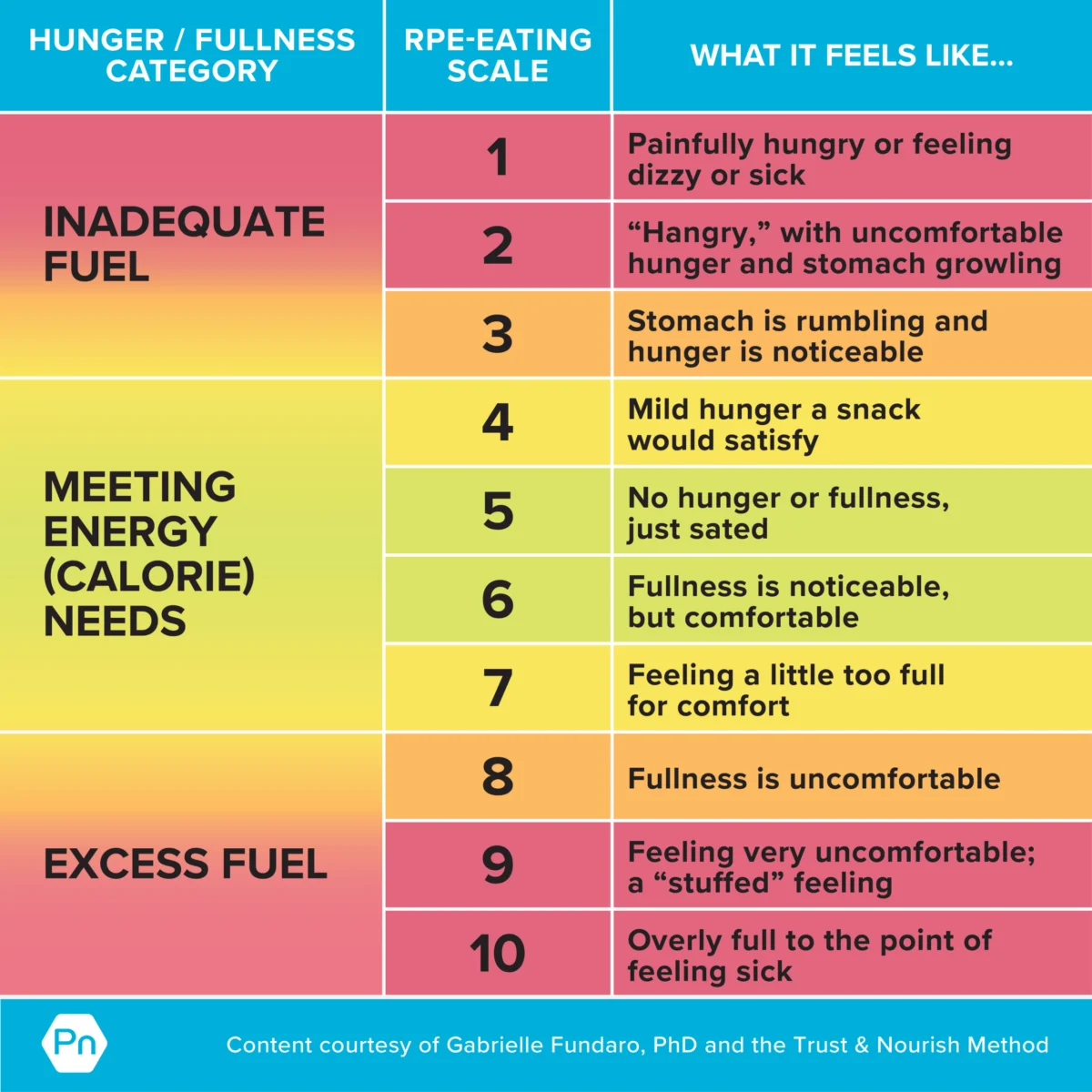
Applying these principles, Dr. Fundaro developed the RPE-Eating Scale, a 1-10 spectrum designed to guide individuals in assessing their hunger and fullness levels.
The RPE-Eating Scale:
- 1: Painfully hungry, dizzy, or sick.
- 2: "Hangry," uncomfortable hunger, stomach growling loudly.
- 3: Hunger is noticeable, stomach rumbling.
- 4: Mild hunger, a snack would satisfy.
- 5: No hunger or fullness, just sated.
- 6: Noticeable fullness, but comfortable.
- 7: A little too full for comfort.
- 8: Uncomfortable fullness.
- 9: Very uncomfortable, "stuffed."
- 10: Overly full to the point of feeling sick.
The core objective of RPE-Eating mirrors its fitness counterpart: to cultivate the skill of discerning your individual needs without external metrics. It’s a journey towards self-attunement, where personal experience becomes the most reliable guide.
Practical Application: Mastering RPE-Eating
Like any new skill, RPE-Eating requires practice and patience. It’s unrealistic to expect immediate perfect attunement, especially if internal cues have been long overridden by external rules. Dr. Fundaro outlines a structured approach to integrate RPE-Eating into daily life:
Step 1: Clarify Your Goals Beyond Body Composition
It’s crucial to understand that RPE-Eating is not merely another diet. Dr. Fundaro emphasizes: "It’s not about aiming to change your body. It’s not about feeling more control over your diet. Nor is it about feeling like you’re eating the ‘optimal’ diet." Its primary purpose is to build inner trust and confidence. While it can be adapted for specific physique goals like muscle gain or fat loss, it is not the most direct or efficient method for extreme body modification. The underlying philosophy prioritizes a healthy relationship with food and body over rigid adherence to numerical targets. This shift in perspective is often the most challenging, requiring individuals to release the expectation of hitting "perfect" macros at every meal. However, for those seeking to cultivate self-trust and intuitive nourishment, RPE-Eating offers a robust framework. It demands a willingness to accept that body changes may occur as one learns to listen to internal cues, fostering a healthier, more sustainable relationship with food.
Step 2: Re-establish Connection with Hunger Cues
Before diving into practice, it’s vital to differentiate between hunger and appetite. Hunger arises from physiological signals (stomach rumbling, lightheadedness) indicating a need for energy. Appetite, however, is the psychological desire or interest in eating, which can persist even after physical hunger is satisfied, often influenced by sensory appeal or emotional states. For individuals with a history of dieting, these two often become conflated.
RPE-Eating actively helps disentangle these signals. To practice:
- Before a meal, consult the RPE-Eating scale and record your hunger level.
- Eat mindfully, minimizing distractions. Focus on flavors, textures, and the evolving sensation in your body.
- Midway through the meal, check in again and record your hunger level.
- Upon finishing, record your final RPE score.
- Reflect on the sensation of comfortable fullness, "downloading" this feeling for future reference.
Consistent practice, even for one meal a day, gradually sharpens interoceptive awareness—the ability to perceive internal bodily states. This process systematically rebuilds trust in one’s internal compass, diminishing reliance on external trackers. The benefits of slow, mindful eating further enhance this practice, promoting better digestion and greater satisfaction, as explored in various nutrition challenges and guides.

Step 3: Identify Non-Hunger Eating Triggers
Life is rarely a perfectly mindful eating experience. Stress, emotions, and environmental cues frequently trigger eating that isn’t driven by physical hunger. The RPE-Eating framework acknowledges this reality and encourages self-awareness rather than self-recrimination.
Dr. Fundaro advocates for the "Notice and Name" technique. When compulsive or mindless eating occurs, pause and identify the underlying emotion (anxiety, sadness) or the preceding event (a difficult conversation, a stressful email). Once identified, explore the deeper need or desire that food is momentarily fulfilling. While eating for comfort is a natural human response, relying on it as the sole coping mechanism can be detrimental. Expanding one’s repertoire of self-soothing strategies—a brief walk, a breathing exercise, connecting with a friend—is crucial. This awareness, cultivated over time, empowers individuals to choose intentionally, addressing root causes rather than defaulting to food.
Step 4: Embrace Both Satiety and Satisfaction
A cornerstone of RPE-Eating is the understanding that nourishing oneself extends beyond mere caloric intake. Meals should fulfill two distinct criteria:
- Satiety: The physical sensation of being full, indicating that caloric and fuel needs are met.
- Satisfaction: A more holistic, pleasurable feeling that arises when caloric needs are met, and the meal itself was enjoyable and fulfilling on an emotional and sensory level.
Focusing solely on satiety, while physically sufficient, can lead to emotional deprivation. If beloved foods are perpetually "off-limits," an individual might eat until physically full yet remain unsatisfied, potentially leading to compensatory eating later. This restrictive mindset often creates a "pendulum effect" – periods of strict avoidance followed by binges.
RPE-Eating encourages incorporating genuinely enjoyed foods into one’s diet, practicing the scale with a variety of meals, including those previously restricted. This process helps dismantle the "good food/bad food" dichotomy, fostering a flexible and spontaneous approach to eating. By integrating satisfaction, individuals learn to adequately fuel themselves with diverse foods, cultivating a truly enjoyable and sustainable relationship with eating. This aligns with broader nutrition philosophies that advocate for flexibility and moderation over rigid abstinence, recognizing that pleasure is a vital component of long-term dietary success.
Who Benefits from RPE-Eating?
RPE-Eating is not a universal solution, but it is particularly well-suited for specific individuals and circumstances:
- Those who feel overly dependent on food tracking but desire liberation.
- Individuals who experience anxiety or a loss of control when attempting to stop tracking, leading to a quick return to the habit.
- People seeking a structured yet flexible guidance system to transition away from tracking.
- Individuals with elevated risk factors for developing eating disorders (e.g., high body dissatisfaction, history of yo-yo dieting, disordered eating patterns, participation in weight-class sports), as it offers a safer alternative to rigid macro tracking.
For coaches, Dr. Fundaro’s resources offer valuable guidance on applying this tool ethically and effectively. It is imperative to remember that RPE-Eating is a supportive framework and does not substitute for professional intervention from specialists like therapists, doctors, or registered dietitians for those struggling with clinical eating disorders. The focus remains on empowering individuals through self-awareness, not on prescribing a cure for complex psychological conditions.
RPE-Eating for Weight Modification: A Measured Approach
Dr. Fundaro consistently advocates for using RPE-Eating primarily in a weight-neutral context. She clarifies, "I’m not anti-weight modification. I’m pro safe weight modification." She draws an analogy to contact sports, where inherent risks can be mitigated through best practices. RPE-Eating provides a critical safety net by removing the intense focus on macro numbers, which can increase disordered eating risks, and instead relies on biofeedback and awareness of non-hunger triggers.
However, for those with specific, well-considered weight modification goals, RPE-Eating can be adapted. The strategy involves consciously aiming to hover around specific RPE ranges for most meals:
- For weight gain: Aim for an RPE of 7-8 (noticeable to a little too full) for most meals, ensuring consistent caloric surplus.
- For weight loss: Aim for an RPE of 4-5 (mild hunger to sated) for most meals, creating a moderate caloric deficit.
Crucially, Dr. Fundaro stresses that RPE-Eating is unsuitable for extreme weight modification, such as preparation for a bodybuilding competition. "That would be like using physio exercises to prepare for a powerlifting competition," she states, highlighting that it’s not the right tool for such intense, highly specialized objectives. This perspective underscores the importance of matching the tool to the specific goal, advocating for a pragmatic and health-oriented approach to body composition changes.
Addressing Skepticism: Intuition Grounded in Science
Skeptics might dismiss RPE-Eating as merely "eating based on feelings," a critique often leveled at intuitive eating approaches. However, this argument overlooks the scientific foundation of interoceptive awareness, the skill at the heart of RPE. Just as RPE in fitness was initially met with skepticism by lifters favoring quantifiable metrics, it is now widely accepted and scientifically validated as a reliable method for autoregulating training. Studies have demonstrated its accuracy and convenience compared to more complex, equipment-dependent tracking methods.
RPE-Eating similarly builds the skill of interoceptive awareness—the conscious perception of internal bodily sensations. The more proficient one becomes in this skill, the more informed and accurate their decisions become, whether in training or eating. Analogies abound: just as a slowing barbell indicates proximity to muscular failure, the absence of hunger at the end of a meal signals approaching fullness. Instead of relying on external validation like glucose monitors, RPE-Eating teaches individuals to interpret internal cues that correlate with physiological states, such as lowered blood sugar indicating hunger. This internal feedback loop is not only accurate but also far more convenient and accessible than constant technological monitoring.
While the process may not be flawless initially, with occasional instances of undereating or overeating, consistent practice steadily refines these core skills. It represents a shift from an external locus of control to an internal one, fostering a deeper, more sustainable connection with one’s body.
Considerations and Practicalities
While a powerful tool, RPE-Eating, like any method, has its limitations. It demands genuine attention to both physical and emotional feelings, followed by reflection. This can be challenging for individuals with demanding lifestyles, such as parents of young children or those with work schedules requiring frequent on-the-go meals.
For these individuals, Dr. Fundaro suggests a flexible approach:
- Selective Use: Apply RPE-Eating only when circumstances allow for a leisurely, mindful meal.
- Isolated Steps: Focus on developing specific aspects, such as simply enhancing awareness of hunger and fullness cues, without attempting to overhaul the entire eating process.
The goal is progress, not perfection. Even partial integration of RPE-Eating principles can yield significant benefits in terms of self-awareness and a healthier relationship with food.
The Off-Ramp to Food Freedom
Macro tracking, while not inherently detrimental, is often a temporary tool for nutritional education or specific goals, not a sustainable lifelong practice for most. The pervasive fear of stopping, however, keeps many tethered to tracking apps and scales.
RPE-Eating provides a vital "off-ramp," a structured transition away from rigid and restrictive macro tracking. It helps dismantle the reliance on external cues, whether they be numerical targets or the ingrained habit of "plate-cleaning." By cultivating internal awareness, individuals learn to trust their body’s signals over external directives.
While RPE-Eating cannot entirely eliminate the anxiety associated with transforming deeply ingrained eating habits, it offers a tangible framework and a common language to navigate this transition. It empowers individuals and their clients to approach eating with reduced fear, diminished stress, and significantly enhanced confidence. As Dr. Fundaro succinctly puts it, "The goal is to know that you’re nourishing yourself—and you don’t need a food tracker to do that." This liberation from external validation not only promotes better physical health but also fosters profound mental well-being and a sustainable, joyful relationship with food.
References
Click here to view the information sources referenced in this article.