
For over a decade, Dr. Gabrielle Fundaro stood at the intersection of rigorous science and athletic performance. With a PhD in Human Nutrition and a decorated career as a competitive powerlifter, she was the quintessential expert on body composition and metabolic health. Yet, behind the scenes, she faced a mounting psychological struggle common among athletes and nutrition enthusiasts: a profound dependency on macro-nutrient tracking that had begun to overshadow her quality of life.
The transition from viewing food as a collection of metrics to viewing it as a source of sustainable nourishment marks a significant shift in contemporary sports nutrition. Dr. Fundaro’s journey—and her subsequent development of the Rate of Perceived Exertion (RPE) Eating framework—reflects a broader movement toward "autoregulation" in health, where internal biological feedback replaces external digital monitoring.
The Evolution of Nutritional Tracking
The rise of digital macro-tracking apps over the last fifteen years has democratized nutritional awareness. By inputting grams of protein, carbohydrates, and fats, millions have gained a granular understanding of energy balance. However, clinical observations suggest that for a subset of the population, this precision can lead to a phenomenon known as "orthorexic-adjacent" behavior, where the psychological cost of maintaining perfect numbers begins to outweigh the physical benefits.
Dr. Fundaro’s experience illustrates this paradox. Having spent years meticulously balancing her macronutrient ratios to achieve specific athletic outcomes, she found that the discipline once required for her powerlifting competitions had morphed into a restrictive barrier. She reported a persistent, low-level anxiety: the fear that abandoning her tracking software would result in the immediate degradation of her muscle mass or an uncontrolled increase in body fat. This is a common sentiment in the fitness community, often referred to as "tracking anxiety."
The RPE-Eating Framework: A New Methodology
To bridge the gap between rigid data-driven dieting and the nebulous concept of intuitive eating, Dr. Fundaro adapted the Rate of Perceived Exertion (RPE) scale, a staple in strength and conditioning. Originally developed by Swedish psychophysicist Gunnar Borg in the 1960s, the RPE scale was designed to quantify the intensity of physical exercise. In weightlifting, a lifter might aim for an RPE of 8, meaning they feel they have two repetitions left in the tank before reaching technical failure.
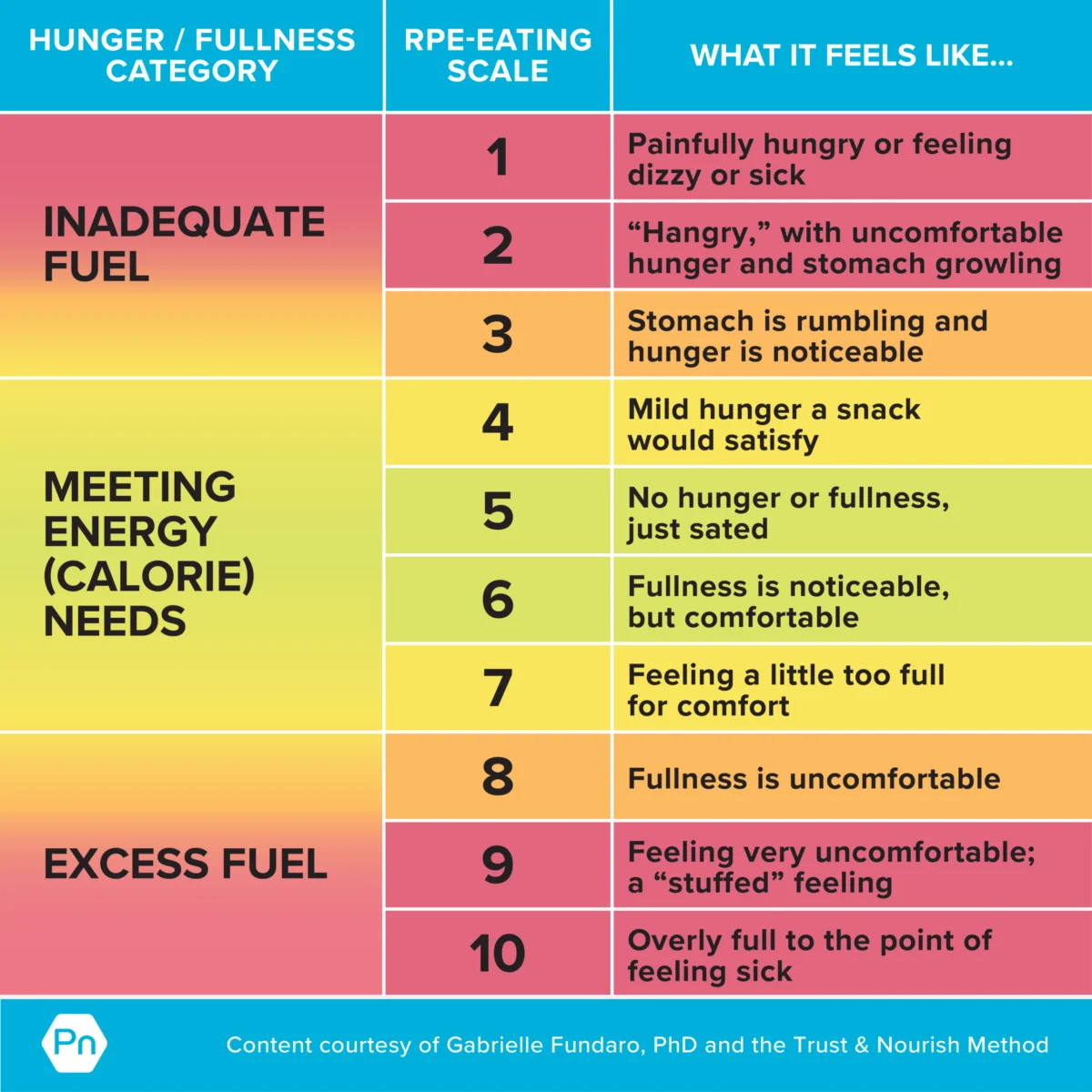
Dr. Fundaro’s adaptation, RPE-Eating, translates this concept into a 1-10 hunger and satiety scale. The methodology is structured as follows:
- 1-3 (Inadequate Fuel): Characterized by physical symptoms like dizziness, lightheadedness, or pronounced stomach rumbling.
- 4-7 (Adequate Fuel): The "sweet spot" where hunger is satiated and energy levels are stabilized.
- 8-10 (Excess Fuel): Ranges from comfortable fullness to physical discomfort or "stuffed" sensations.
The core objective is to move away from the "external controller"—the app or the spreadsheet—and toward the "internal controller"—the biological signals of the body.
Chronology of the Shift
The adoption of this method follows a distinct clinical progression. Initially, users are encouraged to log their hunger levels before and after meals, independent of caloric content. This phase, which typically lasts several weeks, aims to sharpen interoceptive awareness.

- Baseline Awareness: The user tracks hunger signals for one week without attempting to change their intake.
- Trigger Identification: The user begins to document "non-hunger" eating—instances where food is consumed for emotional regulation, such as stress, boredom, or social pressure.
- Satisfaction Calibration: The user learns to distinguish between physical satiety (fullness) and emotional satisfaction (pleasure).
- Autonomy Transition: The user gradually phases out digital tracking as confidence in their internal cues increases.
Supporting Data and Scientific Context
The psychological premise of RPE-Eating is supported by research into interoceptive awareness. Studies in behavioral medicine have shown that individuals with higher levels of interoception—the ability to perceive internal bodily states—are more successful at maintaining long-term weight stability without the need for strict dietary restriction.
Conversely, a 2021 study on the long-term impacts of diet tracking applications suggested that while short-term weight loss is often achieved, the reliance on external data can diminish a person’s natural ability to recognize hunger and fullness. This creates a cycle where the individual becomes "de-skilled," unable to trust their own physiological signals if the digital tool is unavailable.
Broader Implications for the Fitness Industry
The move toward RPE-Eating signifies a maturing of the sports nutrition industry. For years, the industry focused heavily on "optimal" performance, often disregarding the mental health implications of extreme precision. Coaches and nutritionists are increasingly acknowledging that a nutrition plan is only as good as its sustainability. If a program creates anxiety or social withdrawal, it may be counterproductive to the client’s long-term well-being.
Dr. Fundaro’s approach is not intended to replace medical intervention for those with diagnosed eating disorders; rather, it serves as a transitional tool for individuals who have mastered the "math" of nutrition but are struggling to achieve the "mindset" of health. It is particularly relevant for those transitioning away from high-stakes athletic environments, such as retired bodybuilders or powerlifters, who often struggle to redefine their relationship with food outside of competition prep.
Addressing the Critics
Skeptics of RPE-Eating often argue that "feelings-based" eating lacks the precision required for elite athletic development. However, proponents of autoregulation argue that humans are naturally capable of energy balance when not distracted by hyper-palatable, processed foods and rigid dietary dogmas.
The evidence from strength sports suggests that elite athletes can actually train harder and recover more effectively when they listen to their bodies rather than strictly adhering to a pre-written program. The same principle, Dr. Fundaro posits, applies to nutrition. By using the RPE-Eating scale, an individual can adjust their intake based on daily expenditure, stress levels, and recovery needs—variables that a static, app-based macro plan often ignores.
Conclusion: A Sustainable Future
The transition away from macro tracking is not a rejection of science, but an integration of it. By applying the rigor of an RPE framework to eating, individuals can achieve a balance that is both physically effective and psychologically sustainable.
For Dr. Fundaro, the results have been definitive. By trading the digital spreadsheet for an internal scale, she has achieved what she once thought impossible: the ability to maintain her physique while reclaiming the freedom to enjoy food spontaneously. As the fitness world continues to evolve, the adoption of such flexible, biofeedback-driven methods is likely to become a standard component of holistic health coaching, offering a path for those looking to exit the cycle of obsessive tracking and enter a phase of intuitive, sustainable nourishment.
The ultimate goal, according to the framework, is not to reach a specific number on a scale, but to reach a state of nutritional competence where the individual feels empowered to make decisions that serve their health, their goals, and their quality of life—all without the need for an app to validate the choice.