
The modern artisanal coffee movement has increasingly bridged the gap between culinary arts and rigorous chemical engineering. At the heart of this intersection lies the fundamental physics and chemistry of extraction, a complex thermodynamic process that governs every cup of brewed coffee. Across recent industry analyses and laboratory evaluations, researchers and coffee scientists have sought to decode the precise mechanisms that transform roasted coffee beans into a complex sensory beverage. Understanding these extraction dynamics requires a granular look at solubility, fluid mechanics, and the myriad equipment design paradigms that influence the final product.
The Chemistry of Solubility and the Myth of Even Extraction
When hot water interacts with roasted coffee grounds, it dissolves hundreds of distinct chemical compounds spanning multiple orders of magnitude in concentration. Each compound possesses a unique solubility profile and a specific extraction rate. Contrary to popular industry terminology that champions the concept of an "even extraction," chemical analysis reveals that the ultimate goal of high-end coffee brewing is, in fact, a controlled uneven extraction.
If all soluble compounds extracted at an identical rate, baristas and home enthusiasts would be stripped of creative variation. Achieving a total extraction yield of approximately 30 percent—akin to a finely boiled Turkish coffee utilizing ultra-fine grinds and prolonged steeping—maximizes the transfer of soluble bean components into the cup. However, this maximizing approach often results in an unbalanced flavor profile dominated by over-extracted, bitter compounds.
Instead, the art and science of specialty coffee rely on selective extraction. By manipulating variables such as water temperature, contact time, particle size distribution, and brew ratio, brewers can selectively target desirable aromatic and flavor compounds while leaving behind undesirable, overly bitter fractions.
Fluid Dynamics and the Problem of Bypass Water
Among the various brewing methodologies, the pour-over or percolation technique remains the standard for maximizing control over selective extraction. However, the fluid dynamics within a pour-over bed are notoriously complex and susceptible to unintended variables.
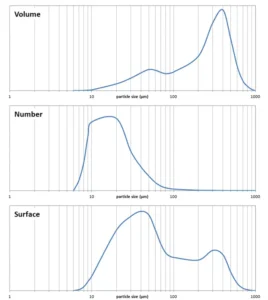
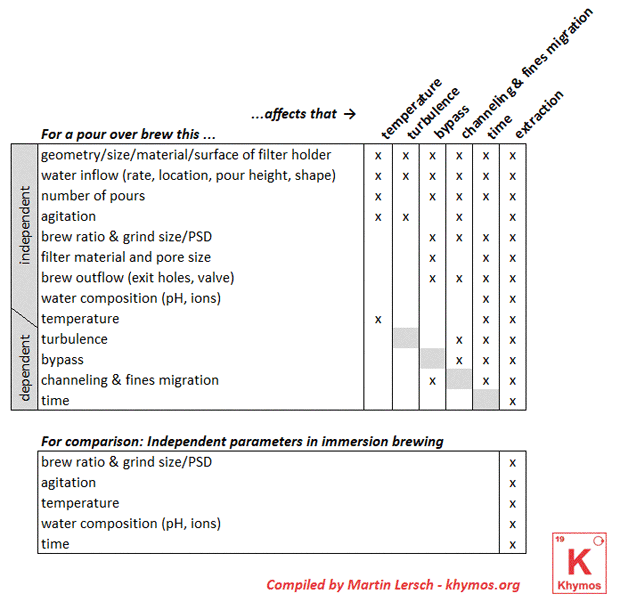
At the microscopic level, grind size and particle size distribution directly dictate the total surface area exposed to water. Finer particles increase hydrodynamic resistance, slowing down the flow rate and lengthening contact time, which theoretically enhances extraction. Yet, this introduces a critical vulnerability: channeling. Water, exhibiting the path-of-least-resistance behavior, will frequently bypass the dense coffee bed entirely, flowing instead through the sides of the filter where resistance is lowest.
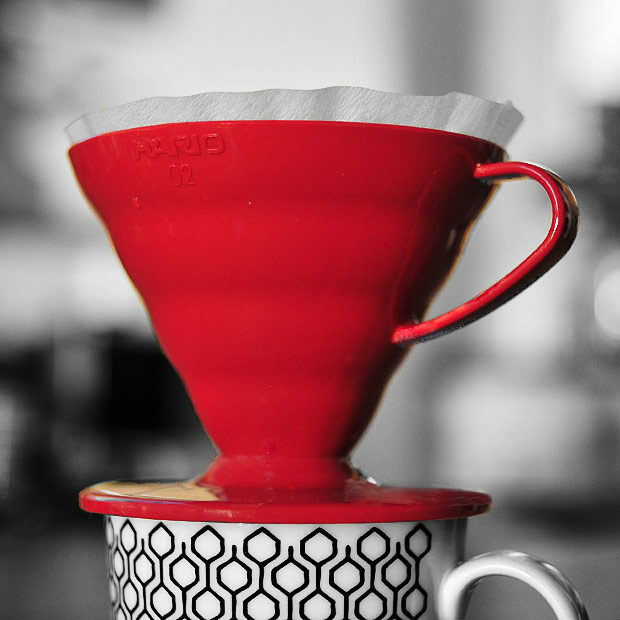
This phenomenon, known as bypass water, dilutes the final brew without participating in the meaningful extraction of soluble solids. Equipment design plays a pivotal role in either mitigating or exacerbating bypass. Filter holders featuring smooth inner walls often allow wet paper filters to cling tightly to the surface, effectively sealing off side-wall bypass. Conversely, drippers utilizing interior ridges, ribs, or fluted paper geometries intentionally create pathways for water to flow around the periphery, preventing absolute clogging at the expense of introducing uncontrolled dilution.
An Evolution of Equipment Design: From 1922 to Modern Engineering
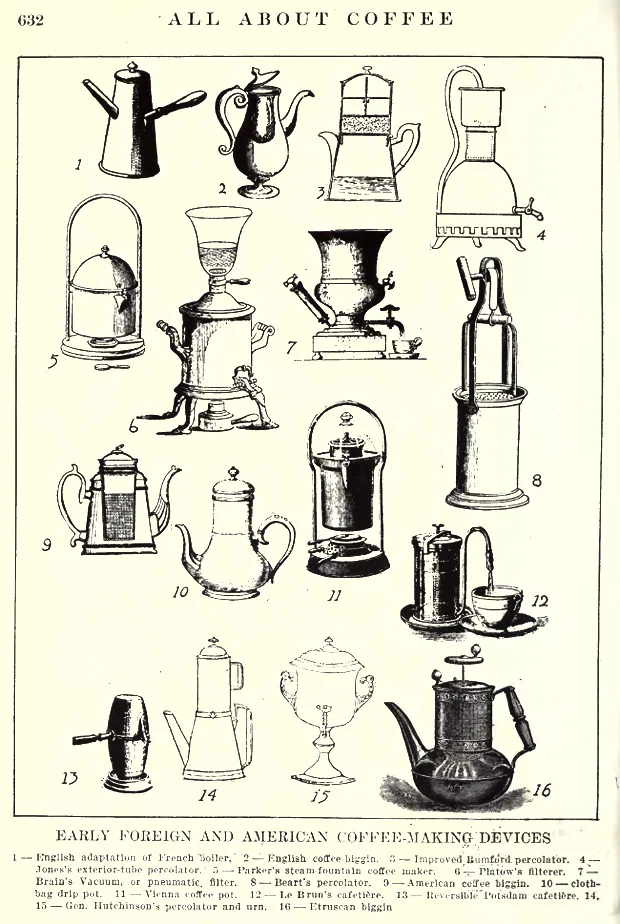
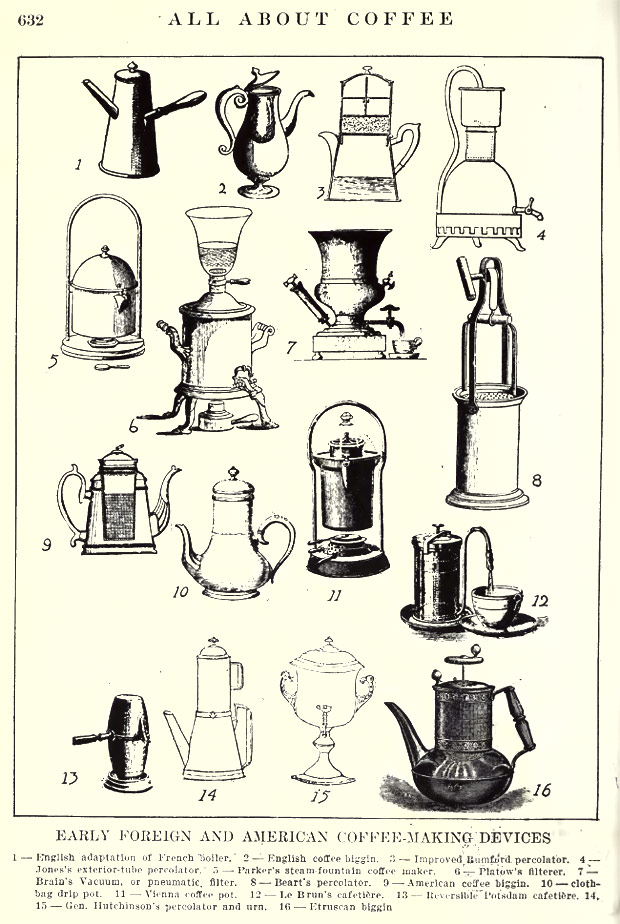
The quest to optimize coffee extraction is far from a contemporary obsession. Historical texts, such as William H. Ukers’ seminal 1922 publication All About Coffee, document centuries of mechanical innovation dedicated to perfecting drip and percolation devices.
Today’s market features an extensive array of filter holders, each engineered to address specific thermodynamic and hydrodynamic challenges. Manufacturers manipulate variables across several core categories:
- Material and Thermal Mass: Thermal stability is crucial for maintaining optimal extraction temperatures. Highly conductive materials like thin metals dissipate heat rapidly unless insulated via double-walled vacuum designs (such as the Stagg X/XF). Consequently, non-conductive materials like polypropylene plastics, ceramics, and thick glass are heavily favored to minimize thermal loss during the brewing cycle.
- Geometry and Bed Shape: Ranging from traditional trapezoidal Melitta-style cones to modern flat-bottom designs like the Kalita Wave and steep conical drippers like the Hario V60, geometry dictates the depth and shape of the coffee bed. Cylindrical, narrow beds maximize contact time, whereas flat, wide beds promote faster draw-downs but increase susceptibility to channeling.
- Outflow Control and Valves: Advanced modern brewers incorporate mechanical shut-off valves—exemplified by the Clever Dripper and Hario Switch—allowing operators to decouple extraction time from grind size entirely by initiating an initial immersion phase followed by a percolation draw-down.
Standardization Versus Variability in the Brewing Process
The inherent complexity of manual pour-over brewing introduces a significant degree of random variation. Because minor discrepancies in pouring height, kettle flow rate, and turbulence can dramatically alter extraction outcomes, two individuals following the exact same recipe will rarely produce identical cups. This high sensitivity to unrecorded parameters is the primary incubator for persistent coffee preparation myths and the lack of cross-platform reproducibility.
In response to these inconsistencies, many professionals have advocated for a shift toward immersion brewing methods, such as the French Press or the standard Aeropress technique.
Immersion Brewing as a Robust Alternative
Immersion brewing offers a stark contrast to the fluid-dynamic volatility of pour-overs. By steeping coffee grounds in a static body of water for a predetermined duration, the system naturally approaches a chemical equilibrium.
Because immersion methods typically utilize coarser grinds and allow water temperatures to gradually decline below 90 degrees Celsius, the extraction remains selectively balanced without requiring constant user intervention. Furthermore, immersion recipes yield exceptionally high repeatability; when shared among different operators, the resulting cup profiles remain remarkably consistent.
However, traditional immersion techniques—most notably the French Press—rely on coarse wire mesh filters rather than dense paper barriers. This mechanical difference permits micro-particles, commonly referred to as "fines," along with suspended coffee oils, to pass directly into the beverage. While these suspended solids contribute significant body, texture, and mouthfeel, they can also leave a discernible sediment at the base of the cup and introduce late-stage bitterness from unseparated fines. Implementing a secondary paper filtration step can clarify the cup profile, though it occasionally mutes the vibrant aromatic notes favored by specialty coffee enthusiasts.
Implications and Future Directions for Coffee Extraction Research
The continuous evolution of coffee brewing equipment reflects a broader industry-wide effort to eliminate random variables and achieve absolute control over chemical yields. While manual percolation methods offer unmatched potential for flavor nuance, their operational complexity demands rigorous standardization. Conversely, immersion systems prioritize reliability and reproducibility at the expense of precise flow control.
As research into coffee hydrodynamics and extraction kinetics progresses, future innovations will likely focus on closing the performance gap between manual adaptability and automated consistency. Whether through advanced valve-controlled drippers, uniform particle-sorting grinders, or precision water-distribution accessories, the ongoing pursuit of the ultimate cup remains firmly rooted in the empirical sciences of chemistry and physics.