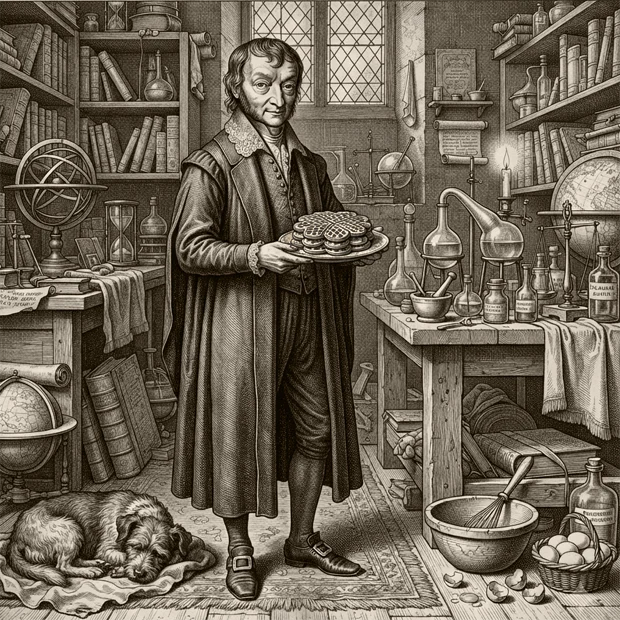

The intersection of theoretical chemistry and culinary arts has reached a new milestone with the public release of Avogadro, an advanced parametric waffle recipe generator. Launched on August 9, 2026, to coincide with the 250th anniversary of the birth of renowned Italian physicist and chemist Amedeo Avogadro, the digital tool represents the culmination of a conceptual project that began more than a decade ago. Designed to compute custom batter compositions on the spot based on user-defined parameters, the application bridges historical scientific legacy with modern algorithmic food science.
Main Facts and Core Functionality
Avogadro operates fundamentally differently from traditional digital recipe repositories. Rather than storing and retrieving pre-existing culinary formulas from a static database, the application functions as a dynamic calculator. Users select specific preferred ingredients across categories such as liquids, dairy, fats, eggs, starches, and sweeteners, and subsequently manipulate a series of interactive sliders governing qualitative properties including sweetness, richness, and tanginess.
The application instantly computes a precise, gram-scaled batter formulation tailored to the user’s specified egg count. A central feature of the interface is the "waffle heart quality indicator," a visual feedback mechanism that immediately evaluates whether a user-generated batter composition is physically viable and how closely its ingredient ratios mirror authentic traditional recipes. Notably, the system accommodates unconventional formulations, acknowledging that commercial mixes often depart significantly from historical norms without compromising structural integrity.
The platform provides two distinct user interfaces: a Standard Mode featuring simplified controls and curated ingredient lists designed for general accessibility, and an Expert Mode tailored for culinary professionals and advanced home cooks. Expert Mode unlocks the full spectrum of ingredients, eight distinct control sliders, and specialized presets, enabling the exploration of uncharted culinary territory.
Chronology of Development

The conceptual origins of the Avogadro generator trace back to 2014, when the initial framework was conceived as a theoretical exercise in culinary data modeling. Early developmental phases involved rudimentary interface mockups and a basic Excel spreadsheet model designed to analyze the mathematical relationships underpinning traditional Scandinavian waffle batters.
For over a decade, the project remained dormant while the creator amassed a corpus of approximately 1,000 traditional waffle recipes, predominantly sourced from Norway and Scandinavia. Many historical recipes from this collection relied on tacit knowledge, utilizing qualitative instructions such as adding flour until the batter achieved the "right consistency." This archival research highlighted a fundamental culinary question: what precise thresholds define a functional waffle batter, and at what point does a mixture cease to qualify as one?
The project was revitalized ahead of the 250th anniversary of Amedeo Avogadro’s birth. The launch date of August 9, 2026, was chosen deliberately to honor the scientist born in Turin, Italy, in 1776, whose foundational hypothesis concerning molecular volumes established essential principles for modern chemical stoichiometry.
Supporting Data and Mathematical Scale
The scope of the Avogadro generator is vast, driven by the sheer number of possible permutations generated by its ingredient selections and control sliders. The tool spans approximately $10^27$ distinct control settings, translating to one billion billion billion theoretical recipes.
To contextualize this scale, the developer noted its relationship to Avogadro’s constant ($6.02214076 times 10^23$), the fundamental physical constant representing the number of constituent particles, typically atoms or molecules, found in one mole of a substance. The generator’s potential output space covers roughly 1,660 moles’ worth of unique waffle batters.
However, culinary researchers and developers emphasize important technical caveats regarding these figures. The existence of $10^27$ control settings does not equate to an equivalent number of distinctly unique recipes. Mathematical rounding, the automated pruning of trace ingredients, and the physical constraints of baking mean that numerous distinct input configurations resolve to identical batter formulations. Furthermore, a subset of theoretical settings yields unworkable mixtures, a reality flagged visually by the absence of lobes in the application’s quality indicator. Nevertheless, the vast parameter space ensures that users can routinely discover novel formulations entirely absent from existing culinary literature.

Official Responses and Culinary Analysis
While formal institutional endorsements from culinary academies are pending, early adopters and food science commentators have praised the project for its rigorous approach to everyday baking. Culinary data analysts note that parametric recipe generation represents a growing trend in modern food technology, shifting the focus from static instruction manuals to algorithmic customization.
By attempting to quantify the traditional concept of "right consistency," the application provides a framework for analyzing the functional roles of fats, proteins, and starches in batters. Feedback mechanisms built into the platform encourage crowd-sourced validation, inviting users to report structural anomalies or exceptionally successful formulations via direct URLs. This empirical feedback loop is viewed by the developer as essential for refining the mathematical model that underpins the software’s consistency calculations.
Broader Impact and Implications
The introduction of Avogadro aligns with a broader movement toward computational gastronomy, a discipline that applies data science and machine learning to culinary arts, flavor pairing, and recipe optimization. By translating qualitative kitchen traditions into quantitative parameters, tools like Avogadro demystify the chemical reactions underlying baking and pastry arts.
The project also underscores the educational value of interdisciplinary naming conventions. By linking a ubiquitous household food item to a foundational figure in chemistry, the tool offers an engaging entry point for science education, demonstrating abstract concepts such as moles and molecular proportions through a tangible, edible medium.
As the platform enters its public release phase, it serves as both a functional utility for experimental bakers and a monument to long-term digital project management. Whether users engage with the simplified standard interface or push the boundaries of expert mode, the application invites a systematic exploration of comfort food through the lens of exact science.