
The morning ritual of brewing coffee is often regarded as a simple culinary habit, but beneath the dark surface of a standard cup lies a complex, microscopic universe of chemistry. While casual drinkers focus on the immediate effects of caffeine or the general profile of a roast, food scientists and analytical chemists view every cup as an intricate matrix of hundreds—if not thousands—of distinct chemical compounds. Understanding the hidden composition of coffee requires moving past basic measurements of strength and delving into the volatile and non-volatile components that govern human sensory perception.
A standard cup of black coffee is overwhelmingly composed of water, typically accounting for more than 98.5% of the beverage. The remaining 1.2% to 1.5% consists of Total Dissolved Solids (TDS)—meaning that for every single liter of brewed coffee, there are roughly 12 to 15 grams of solid matter extracted directly from approximately 60 grams of roasted coffee grounds. Though this fraction of solids is relatively small, it is entirely responsible for the beverage’s distinctive color, body, mouthfeel, aroma, and taste.
The Evolution of Coffee Chemistry Research
Scientific inquiry into the chemical composition of coffee has evolved significantly over the past century, transitioning from broad nutritional analysis to high-resolution chromatographic techniques capable of identifying trace compounds. Historically, researchers struggled to isolate and identify every molecule responsible for coffee’s multifaceted flavor profile due to technical limitations in separation science.
A major milestone in flavor research occurred in 1996, when researchers successfully utilized 22 key volatile compounds to construct synthetic "model" coffees designed to mimic the flavor profiles of Arabica and Robusta beans. While human assessors described these models as clearly coffee-like, the consensus was that 22 compounds were fundamentally insufficient to replicate the deep complexity of a naturally brewed cup.
Subsequent studies expanded the scientific understanding of these flavor drivers. An Aroma Extract Dilution Analysis (AEDA) conducted in 2002 revealed a striking gap in botanical and chemical knowledge: out of 40 key odorants identified in coffee, 13 remained completely unknown to science. These unknown molecules typically fall into two categories: either they exist in concentrations far too low to yield a sample large enough for full structural elucidation, or they possess exceptionally large molecular structures that complicate analytical resolution.
Volatiles, Non-Volatiles, and Sensory Perception
The chemical compounds extracted during the brewing process are broadly classified into two categories: volatile and non-volatile compounds. Each group plays a distinctly different role in how humans experience coffee through the senses of smell and taste.
Volatile compounds are responsible for the rich aromas that emanate from a fresh cup of coffee, traveling through the retronasal passage to the olfactory receptors. Conversely, non-volatile compounds remain in the liquid phase and interact directly with the tongue, delivering foundational tastes such as bitterness, sweetness, acidity, and astringency. Lipids and insoluble microscopic particles further contribute to the tactile sensation, or body, of the beverage.
Among the soluble components found in a standard cup are carbohydrates, organic acids, minerals and salts, proteins, lipids, and caffeine. A vast proportion of the dissolved mass remains categorized simply as unidentified compounds, which likely contribute significantly to the beverage’s deep color profile and inherent bitterness.
The Paradox of Concentration and Odor Thresholds
When examining the concentration ranges of various compounds within coffee, researchers encounter a logarithmic scale spanning more than nine orders of magnitude. This vast range includes groups of compounds measured in percentages alongside single chemical entities measured in parts per million (ppm), parts per billion (ppb), and even parts per trillion (ppt).
A common misconception in sensory science is that lower concentration directly equates to lower impact on flavor. While this principle holds true for individual compounds within a linear response region, it breaks down entirely when comparing different chemical species. This is due to the vast variability in human olfactory sensitivity.
Every chemical compound possesses a unique odor threshold—the minimum concentration at which a human nose can detect its presence. Consequently, a compound present in trace amounts as low as 0.0000000001% can exert just as much influence over the overall flavor profile as a compound present at a much higher concentration of 0.01%.
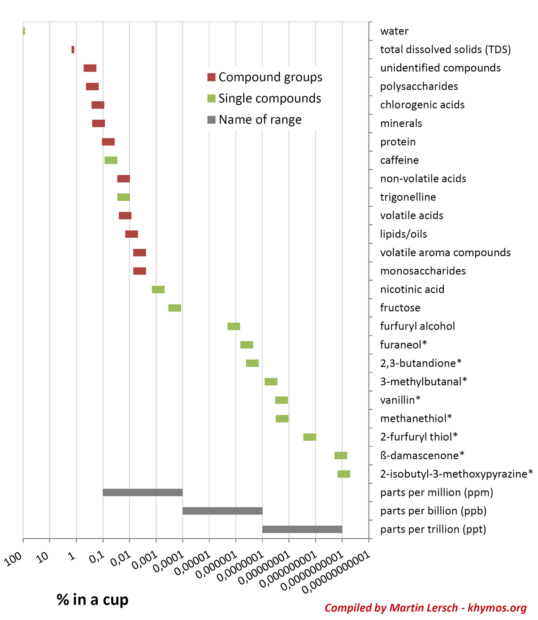
This phenomenon is quantified by the Odor Activity Value (OAV), calculated as a compound’s concentration divided by its specific odor threshold. A prime example of this extreme sensitivity is beta-damascenone, a potent aroma compound belonging to the rose ketone family. First discovered in rose oil during the 1960s—and famously utilized in the formulation of high-end fragrances such as Christian Dior’s Poison—beta-damascenone is present in coffee at concentrations as low as 1 part per trillion. Despite this infinitesimal presence, scientific studies have identified it as one of the top five most impactful odorants in coffee.
Polar versus Non-Polar Extraction Dynamics
The efficiency with which different compounds are extracted from coffee grounds depends heavily on their chemical polarity and the solvent properties of water.
Polar compounds—including organic acids, minerals, proteins, and soluble carbohydrates—dissolve readily in water. As a polar solvent, water successfully extracts more than 75% of the total polar compounds available in coffee grounds. In contrast, non-polar compounds, which include lipids and various volatile aroma precursors, exhibit low solubility in water. Typically, only 10% to 30% of these non-polar compounds make their way into the final cup during standard water-based brewing.
This disparity in extraction yields highlights the limitations of relying solely on Total Dissolved Solids (TDS) as a metric for coffee quality. While TDS remains the industry standard for measuring the sheer strength of a brew, it offers poor predictive value regarding aroma and flavor complexity. Because minute flavor-active compounds do not necessarily scale linearly or proportionally with mass extraction, two cups of coffee with identical TDS readings can taste vastly different.
Implications for the Future of Coffee Science
As analytical instrumentation continues to advance, food scientists expect to uncover additional key odorants and trace compounds that shape the sensory experience of coffee. While synthetic modeling and chemical mapping provide profound insights into flavor architecture, the human nose remains the ultimate analytical instrument. Exploring the complex interplay of polar extraction, trace volatiles, and variable odor thresholds ensures that the scientific study of coffee will remain as rich and multi-layered as the beverage itself.