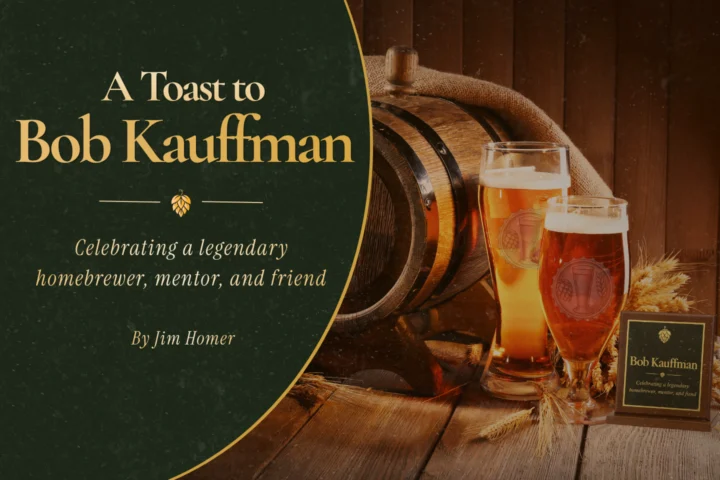

The American homebrewing community is mourning the loss of Bob Kauffman, a foundational figure in the movement and a long-time leader within the American Homebrewers Association (AHA), who passed away on Tuesday, April 28, at the age of 71. A resident of Boulder, Colorado, Kauffman was recognized not only for his technical proficiency as a brewer but for his tireless commitment to the institutional growth of the hobby and his role as a mentor to countless individuals who transitioned from amateur brewing to professional success. His death marks the end of an era for the Boulder-based brewing scene, where he was a fixture for more than three decades. Kauffman is survived by his wife, Caroline, and his two daughters, Angie and Crystal, leaving behind a legacy that is inextricably linked to the rise of craft beer culture in the United States.
A Life Dedicated to the Craft of Brewing
Bob Kauffman’s journey into the world of homebrewing began during a pivotal time for the hobby. Following the federal legalization of homebrewing in 1978, the 1980s and 1990s saw a surge in interest as enthusiasts sought to replicate and improve upon the limited styles of beer available in the commercial market. Kauffman was at the forefront of this wave, joining the Boulder-based homebrew club, Hop Barley and the Alers, in the early 1990s. His involvement was never merely passive; he quickly became a cornerstone of the organization, serving multiple terms as president and introducing structural changes that remain in use today. One of his most enduring contributions to the club was a system designed to distribute meeting responsibilities among members, ensuring that the burden of organization did not fall on a single individual and fostering a more collaborative environment.
Kauffman’s technical expertise was particularly noted in his mastery of all-grain brewing, a complex process that involves mashing malted grains to extract fermentable sugars, as opposed to using pre-prepared malt extracts. This method allows for greater control over the flavor profile and body of the beer but requires a significant investment in equipment and knowledge. Kauffman was known for his willingness to share this knowledge, often inviting aspiring brewers into his home to demonstrate the process. Jeff Griffith, now a professional brewer at Twisted Pine Brewing in Boulder, credits Kauffman with launching his 21-year career. Griffith recalled how Kauffman once brought a lunch to his house specifically to spend the day teaching him the intricacies of the all-grain method. This spirit of mentorship was a recurring theme in Kauffman’s life, as he helped bridge the gap between hobbyist enthusiasm and professional discipline.
The Legend of the Kitchen Floor Tripel
Among the many anecdotes that define Kauffman’s reputation, the story of the "Kitchen Floor Tripel" stands as a testament to his resourcefulness and the sometimes-unpredictable nature of homebrewing. During an early attempt at brewing a Belgian-style Tripel—a high-alcohol, complex ale—a mechanical failure caused a significant amount of hot, sweet wort to spill onto his kitchen floor. Rather than abandoning the batch, Kauffman used clean terry-cloth towels to soak up the liquid, which he then wrung out back into the brew kettle.
The resulting beer was not only salvaged but went on to win an award at a local brewing competition. While Kauffman eventually refined the recipe to exclude the "floor" element, the story became a piece of local lore, illustrating his pragmatic approach to the craft. It also highlighted a fundamental truth of the homebrewing community: that mistakes are often the greatest teachers, and that the quality of the final product is the ultimate measure of success.
Institutional Leadership and National Impact
Kauffman’s influence extended far beyond the local level. He was a dedicated member of the American Homebrewers Association, an organization that represents over 46,000 members and advocates for the rights of homebrewers nationwide. From 2008 to 2013, Kauffman served on the AHA Governing Committee, the predecessor to the current AHA Board of Directors. In this role, he was a staunch advocate for the "common homebrewer," focusing on practical ways to improve resources for clubs and resisting the influence of internal politics.
His colleagues on the committee remember him as a man of quiet depth and integrity. Crispy Frey, a member of the Homebrew Con Committee, noted that Kauffman’s input was always guided by his vast experience rather than a desire for attention. "Bob had little interest in politics or appearances," Frey remarked, emphasizing that Kauffman’s primary goal was always the betterment of the community. This sentiment was echoed by fellow committee member Susan Ruud, who described him as a "champion for what was best for homebrewing" who provided insightful contributions without ever seeking the spotlight.
Kauffman was also a regular fixture at the National Homebrewers Conference, now known as Homebrew Con. His involvement spanned decades, from the 1996 conference in New Orleans to the 2018 event in Portland, Oregon. In 2007, he served as the co-chair for the conference in Denver, a role that required immense logistical coordination and a deep understanding of the needs of the brewing community. His ability to manage large-scale events was further evidenced by his long-standing service on the judging staff for the Great American Beer Festival (GABF) and the World Beer Cup.
Maintaining the Integrity of Competition
The Great American Beer Festival and the World Beer Cup are among the most prestigious beer competitions in the world, requiring a high degree of organization and technical accuracy. For many years, Kauffman served as a table captain, a critical role that involves managing volunteers and ensuring the integrity of the blind judging process. As a table captain, Kauffman was responsible for ensuring that each beer was served at the correct temperature, in the correct order, and in the properly numbered cups to prevent any bias among the judges.
This work, while often behind the scenes, was vital to the credibility of these competitions. The growth of the craft beer industry relies heavily on the standards set by such events, and Kauffman’s meticulousness helped maintain those standards. His transition from a homebrewer to a key official in international competitions mirrored the broader trajectory of the American beer scene, where the boundaries between amateur passion and professional excellence often blur.
Chronology of a Brewing Career
The timeline of Bob Kauffman’s involvement in the brewing world reflects the steady growth of the movement in Colorado and beyond:
- Early 1990s: Joins Hop Barley and the Alers, the premier homebrew club in Boulder, Colorado.
- 1996: Attends the National Homebrewers Conference in New Orleans, beginning a multi-decade streak of attendance.
- 1999: Serves as a panelist on homebrew clubs at the national conference, sharing his expertise on organizational management.
- 2007: Co-chairs the National Homebrewers Conference in Denver, overseeing one of the largest gatherings of homebrewers in the country at that time.
- 2008–2013: Serves on the AHA Governing Committee, influencing national policy and resources for the hobby.
- 1990s–2010s: Frequent volunteer and table captain for the Great American Beer Festival and the World Beer Cup.
- 2018: Attends his final Homebrew Con in Portland, Oregon.
- April 28, 2020: Passes away at the age of 71.
Broader Implications and Community Reaction
The passing of Bob Kauffman has prompted a wave of tributes from the highest levels of the brewing industry. Charlie Papazian, the co-founder of the American Homebrewers Association and widely considered the "father" of the homebrewing movement, succinctly described Kauffman as a "legend." Julia Herz, the Executive Director of the AHA, recalled how Kauffman’s technical advice—such as his early adoption of pumps in the brewing process—was always delivered with a forward-looking perspective. "He taught me that pumps are good ‘so when I’m old I can still brew!’" Herz shared, reflecting on his practical wisdom.
Kauffman’s impact is perhaps most visible in the "mentorship tree" he created. By teaching the fundamentals of all-grain brewing to enthusiasts in the 1990s, he contributed to the talent pool that would eventually staff and lead Colorado’s world-renowned craft breweries. His focus on community building rather than personal accolades helped create a supportive environment where information was shared freely, a characteristic that remains a hallmark of the craft beer industry today.
Janis Gross, the former National Homebrew Competition Director, emphasized that while Kauffman was a skilled brewer, his greatest achievement was fostering the brewing community. This sentiment is shared by many in the Boulder area who remember him not just as a brewer, but as a sports fan, a poker player, and a friend with a "sly smile" and a "devious twinkle in his eye," as described by fellow brewer Drew Beechum.
Analysis of a Legacy
Bob Kauffman’s life illustrates the significant role that individual hobbyists play in the development of broader cultural and economic movements. The craft beer revolution in the United States did not happen in a vacuum; it was built on the backs of dedicated amateurs who treated their hobby with the seriousness of a profession. Kauffman’s work with the AHA and his leadership in local clubs provided the organizational framework necessary for the hobby to flourish.
His focus on the "common homebrewer" ensured that as the industry grew and became more commercialized, the grassroots spirit of the movement remained intact. As the brewing community looks forward, the systems Kauffman implemented and the brewers he trained will continue to influence the industry. His death is a loss to the community, but his contributions remain embedded in the fabric of American brewing culture. The "huge toast" offered by his peers is a fitting tribute to a man who spent his life ensuring that the world had "more better beers" and a more connected community to enjoy them.