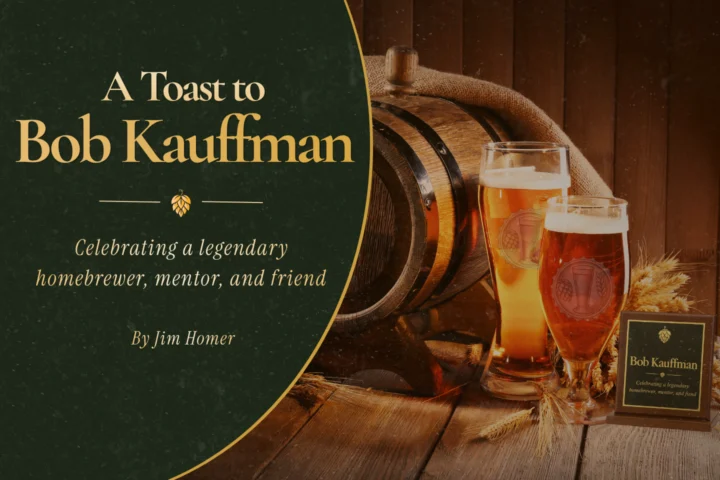

The American homebrewing community is mourning the loss of Bob Kauffman, a foundational figure in the hobby’s modern era, who passed away on Tuesday, April 28, at the age of 71. A resident of Boulder, Colorado, Kauffman was a long-time member of the American Homebrewers Association (AHA) and served as a pivotal leader, mentor, and organizer within the craft beer movement for nearly three decades. His contributions spanned the technical aspects of brewing, the organizational structure of local clubs, and the national governance of the AHA, leaving an indelible mark on the culture of fermentation in the United States.
A Pillar of the Boulder Brewing Scene
Bob Kauffman’s journey in homebrewing began in earnest during the early 1990s, a period often cited as the "second wave" of the American craft beer revolution. Settling in Boulder, Colorado—a city that would become a global epicenter for craft brewing—Kauffman joined the Hop Barley and the Alers homebrew club. His involvement was not merely as a hobbyist but as a community builder. He served several terms as club president, during which he implemented a decentralized system for sharing meeting responsibilities. This organizational model, designed to prevent leadership burnout and encourage member participation, remains a blueprint for homebrew clubs across the country.
His influence extended beyond administrative duties into the realm of technical education. In the 1990s, the transition from "extract brewing" (using pre-processed malt syrup) to "all-grain brewing" (the more complex process of mashing malted barley) was a significant hurdle for many enthusiasts. Kauffman was an early adopter and a patient teacher of the all-grain method. Jeff Griffith, now a professional brewer at Twisted Pine Brewing in Boulder, credits Kauffman with launching his 21-year career. Griffith recalls Kauffman bringing a lunch to his home specifically to spend the day teaching him the nuances of the mash and the boil. Such anecdotes are common among the Boulder brewing elite, where Kauffman is remembered as the "force" that helped bridge the gap between amateur experimentation and professional-grade production.
The Legend of the Kitchen Floor Tripel
Among the many stories that define Kauffman’s legacy, none is as frequently cited as the "Kitchen Floor Tripel." In his early days of all-grain brewing, a mechanical failure led to a significant spill of sweet wort across his kitchen floor. In a display of the resourcefulness—and perhaps the iron stomach—characteristic of early homebrewers, Kauffman used clean terry-cloth towels to soak up the liquid, wrung them back into the kettle, and proceeded with the boil.
The resulting beer not only defied expectations of contamination but went on to win an award at a local competition. While Kauffman eventually refined his process to exclude the use of floor-sopped towels, the story became a staple of homebrewing lore. It symbolized his pragmatic approach to the craft: a belief that brewing was a resilient, living process that rewarded persistence and a sense of humor.
Leadership at the National Level
Kauffman’s impact was not limited to the local level. From 2008 to 2013, he served on the AHA Governing Committee, the predecessor to the current AHA Board of Directors. This period was one of explosive growth for the association, as homebrewing transitioned from a niche hobby to a mainstream cultural phenomenon. During his tenure, Kauffman was known as a "quiet but deep" thinker who eschewed the politics of the industry in favor of advocating for the "common homebrewer."
His colleagues on the committee, including Crispy Frey and Susan Ruud, remember him as a champion for club resources. He was instrumental in developing tools that helped small clubs organize competitions, manage memberships, and navigate the legal complexities of serving homebrewed beer at public events. His focus was consistently on the grassroots level, ensuring that the AHA remained a service-oriented organization for its tens of thousands of members.
Kauffman was also a fixture at the National Homebrewers Conference, now known as Homebrew Con. He attended nearly every conference from 1996 in New Orleans to 2018 in Portland, Oregon. In 2007, he took on the monumental task of co-chairing the conference in Denver. This event is remembered as a turning point for the conference’s scale and professionalization, blending technical seminars with the social camaraderie that Kauffman valued.
Contributions to the Professional Industry
While he remained a homebrewer at heart, Kauffman’s expertise was highly sought after by the professional brewing industry. For many years, he served on the judging staff for the Great American Beer Festival (GABF) and the World Beer Cup. These events are the most prestigious beer competitions in the world, requiring a high level of sensory precision and organizational discipline.
Kauffman ascended to the role of Table Captain, a position of significant responsibility. In this capacity, he managed the logistics of the judging process, ensuring that thousands of entries were correctly categorized, poured into numbered cups to maintain anonymity, and presented to judges at the optimal temperature. His work behind the scenes ensured the integrity of the medals awarded to professional breweries, further cementing his status as a bridge between the amateur and professional worlds.
Tributes from the Brewing Community
The news of Kauffman’s passing prompted a wave of tributes from the highest echelons of the brewing world. Charlie Papazian, the co-founder of the American Homebrewers Association and the "father" of the homebrewing movement, described Kauffman simply as "a legend."
Julia Herz, the AHA Executive Director, highlighted his influence on her own brewing journey. She recalled a "shadow brewing" session at his home where he taught her the importance of using pumps in a homebrew rig—not just for efficiency, but for longevity. Kauffman famously remarked that he used pumps "so when I’m old I can still brew," a testament to his lifelong commitment to the hobby.
Denny Conn, a prominent AHA Forum Moderator, noted that "if the world had more Bobs, it would be a better place," while others remembered his "devious twinkle" and his love for Denver sports and high-stakes poker games. These reflections paint a picture of a man who was as dedicated to his friends and community as he was to the perfect pint of ale.
Technical Context: The Evolution of the Hobby
To understand the weight of Kauffman’s contributions, one must consider the technical evolution of homebrewing during his lifetime. When Kauffman began, high-quality ingredients and specialized equipment were difficult to source. The "all-grain" movement he championed required a deep understanding of enzymatic chemistry and temperature control—knowledge that was not yet readily available on the internet.
By mentoring others and serving on the AHA Governing Committee, Kauffman helped democratize this knowledge. The systems he helped build allowed for the sharing of recipes, the standardization of judging, and the creation of a collective intelligence that has since fueled the craft beer industry. Many of the professional breweries operating today in the Colorado Front Range owe their existence to the culture of excellence and education that Kauffman fostered in the 1990s and 2000s.
Broader Implications and Legacy
Bob Kauffman’s death marks the passing of a member of the "vanguard" generation of American homebrewers. This generation took a hobby that had been legalized only in 1978 and turned it into a sophisticated discipline that changed the global beverage landscape.
His legacy is found in the thriving homebrew clubs that use his organizational structures, in the professional brewers who still use the techniques he taught them in their kitchens, and in the continued success of the GABF and the AHA. He proved that leadership does not always require a loud voice or a desire for the spotlight; often, it is found in the quiet dedication to helping others improve their craft.
Kauffman is survived by his wife, Caroline, and his daughters, Angie and Crystal. The family has received an outpouring of support from the brewing community, a community that Kauffman helped build, one batch at a time. As the homebrewing world raises a glass in his honor, they celebrate a man who believed that better beer made for a better world, and who spent his life ensuring both.