
Building upon previous discussions regarding the influence of brewing parameters such as brew ratio, total dissolved solids, extraction yield, grind size, water composition, water temperature, and filter material, the focus now shifts to the profound chemical intricacies present within the final cup. Far from a simple beverage, a typical cup of black coffee is a complex aqueous solution, overwhelmingly composed of water—more than 98.5%. The remaining 1.2% to 1.5% consists of total dissolved solids (TDS), meaning that a single liter of brewed coffee contains approximately 12 to 15 grams of various compounds meticulously extracted from about 60 grams of coffee grounds. These extracted compounds are the architects of coffee’s distinctive color, taste, and aroma, underpinning its global appeal and cultural significance.
The Hidden Universe in Your Coffee Cup
The seemingly humble coffee bean, when subjected to the intricate processes of roasting and brewing, releases an astonishing array of chemical components. Advanced analytical techniques, particularly various forms of chromatography such as Gas Chromatography-Mass Spectrometry (GC-MS) and Liquid Chromatography-Mass Spectrometry (LC-MS), reveal that coffee contains hundreds, if not thousands, of different molecules. While a significant portion of these have been identified and characterized by food scientists, a considerable number remain elusive. A seminal aroma extract dilution analysis (AEDA) conducted in 2002 highlighted this challenge, indicating that 13 of the 40 key odorants in coffee were, at that time, still unknown [1].
The difficulty in identifying these compounds stems from several factors. Many are present in incredibly low concentrations, often in parts per billion (ppb) or even parts per trillion (ppt), making it arduous to obtain sufficient quantities for comprehensive structural elucidation. Furthermore, some unidentified molecules may possess large and complex structures, complicating the analytical process required to resolve their precise chemical makeup. This ongoing scientific quest underscores the sheer complexity of coffee’s sensory profile, suggesting that the full chemical blueprint of coffee remains an active area of research.
A Symphony of Scent and Sensation: Volatile and Non-Volatile Compounds
The rich sensory experience of coffee is primarily orchestrated by two broad categories of compounds: volatile and non-volatile. Volatile compounds, characterized by their low boiling points, readily evaporate and ascend to the olfactory receptors in the nose, contributing to coffee’s intricate aroma. Non-volatile compounds, conversely, interact with taste receptors on the tongue, defining the beverage’s fundamental taste attributes. While some molecules can contribute to both aroma and taste, their impact often differs, with taste thresholds typically being significantly higher than odor thresholds.
The palate encounters a diverse range of tastes in coffee, including bitterness, sweetness, acidity, and astringency. Bitterness, a hallmark of coffee, is primarily attributed to compounds such as quinides, chlorogenic acid lactones, and, of course, caffeine. Sweetness, though often subtle, derives from various carbohydrates and soluble oligosaccharides. Acidity, crucial for brightness and complexity, is influenced by organic acids like citric, malic, and acetic acids, which develop during roasting and brewing. Astringency, a mouth-drying sensation, is often linked to polyphenols and tannins. Beyond taste, non-volatile compounds and even tiny insoluble particles contribute significantly to the "body" and "mouthfeel" of coffee, ranging from light and tea-like to rich and syrupy. The interplay of these components creates the multifaceted sensory experience that coffee aficionados cherish.

When delving deeper into the soluble components, researchers identify groups such as carbohydrates (sugars, soluble oligosaccharides), various acids, essential minerals and salts, proteins, lipids, and the well-known stimulant, caffeine. Alongside these, a broad spectrum of volatile aroma compounds exist, many of which are present in minute quantities yet possess profound sensory impact. A substantial "unidentified" fraction also exists, believed to contribute significantly to coffee’s characteristic color and bitterness.
The Elusive Quest for Synthetic Coffee
The intricate chemical composition of coffee poses a formidable challenge to scientists attempting to replicate its flavor synthetically. A notable study from 1996 illustrated this difficulty, where researchers managed to create two "model" coffees mimicking Arabica and Robusta varieties using a selection of 22 key volatile compounds [2]. While sensory assessors described these synthetic concoctions as "clearly coffee-like," the phrasing itself suggests an incomplete replication, implying a lack of the nuanced complexity found in naturally brewed coffee.
This scientific endeavor highlights the significant hurdle in capturing the full spectrum of coffee’s flavor. The sheer number of compounds involved, coupled with the synergistic and antagonistic interactions between them, creates a sensory tapestry that is incredibly difficult to reconstruct. Experts in flavor science consistently emphasize that achieving a perfect, indistinguishable replication remains a distant scientific and engineering goal. Modern initiatives exploring "lab-grown" or "cell-cultured" coffee face similar challenges, not only in accurately replicating the full chemical profile but also in overcoming economic viability hurdles, scaling production, and addressing potential consumer acceptance issues. The expectation among connoisseurs is that genuine, naturally derived coffee will retain its unchallenged position for the foreseeable future, offering an experience far richer than anything "clearly coffee-like."
The Power of the Miniscule: Odor Activity Values and Trace Compounds
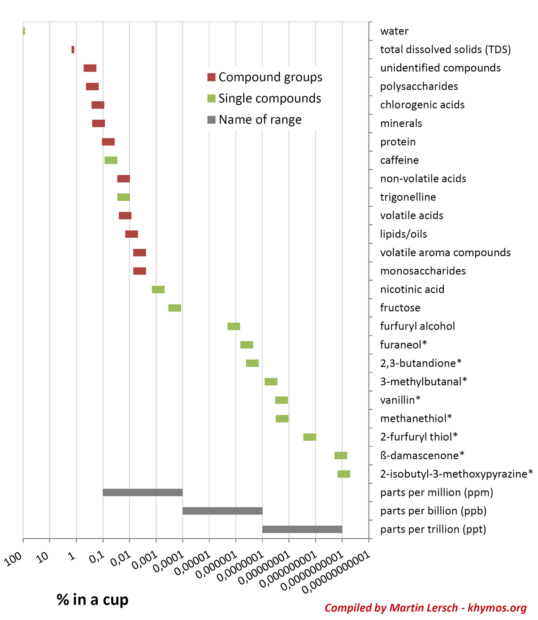
A critical aspect of coffee flavor chemistry lies in understanding that concentration does not always equate to impact. While a concentration graph spanning over nine orders of magnitude illustrates the vast differences in compound abundance, the sensory contribution of each molecule is determined by its individual odor threshold. This concept is encapsulated by the "Odor Activity Value" (OAV), calculated by dividing a compound’s concentration by its odor threshold. A high OAV signifies a potent odorant, even if present in infinitesimal amounts. Consequently, a compound present at 0.0000000001% can exert as much influence on the overall flavor as another compound present at 0.01%, a phenomenon that underscores the extraordinary sensitivity of the human olfactory system.
Among these potent trace compounds, β-damascenone stands out as a prime example. This remarkable molecule can be found in coffee at concentrations as low as 1 part per trillion (ppt) yet is recognized as one of the top five most impactful odorants [1]. β-damascenone belongs to a family of compounds known as rose ketones, first identified in rose oil during the 1960s. Its name itself, derived from the Damask rose (Rosa × damascena), hints at its floral origins. The Swiss flavor and fragrance company Firmenich pioneered the use of rose ketones, integrating β-damascenone and its relatives into iconic perfumes like Dior’s "Poison" in the 1980s, leveraging their potent and multifaceted aroma.
The sensory profile of β-damascenone is incredibly diverse, encompassing fruity (blackcurrant, apple, plum), floral (rose, honey), woody, and even tobacco-like notes. Its formation during coffee roasting is complex, often linked to the thermal degradation of carotenoids and the Maillard reaction, contributing significantly to the desired "caramel-like" and "fruity" characteristics of a well-roasted bean. Its presence is not exclusive to coffee; β-damascenone is also a key aroma component in other beloved foods and beverages, including tomatoes, wine, and tea, highlighting its broad significance in flavor chemistry. The ability to accurately measure odor thresholds and quantify compounds at such minuscule concentrations represents a significant scientific undertaking, making it plausible that further critical, low-concentration odorants in coffee await discovery.
The Science of Extraction: Polar, Non-Polar, and the Role of Solvents
The brewing process is fundamentally an act of extraction, selectively dissolving compounds from coffee grounds into hot water. The efficiency of this extraction is heavily influenced by the polarity of the compounds and the solvent used. Water, being a highly polar solvent, excels at extracting polar compounds. This group includes acids, minerals, proteins, and carbohydrates, with typically over 75% of these water-soluble constituents making their way into the brew [2].
Conversely, non-polar compounds, such as many volatile aroma molecules and lipids (oils), exhibit low solubility in water. As a result, only about 10% to 30% of these non-polar components are typically extracted during conventional water-based brewing. This differential extraction rate between polar and non-polar compounds has significant implications for the final flavor profile and underlies the differences observed across various brewing methods. For instance, espresso, with its high pressure and short contact time, tends to extract a different balance of compounds compared to a pour-over or French press, which allow for longer interaction with water.
Understanding this polarity dynamic opens avenues for exploring alternative extraction methods. The use of less polar solvents, such as ethanol, could theoretically unlock additional dimensions of coffee flavor by extracting a higher proportion of the non-polar compounds that water leaves behind. While experimental, this concept mirrors industrial processes like decaffeination, where solvents such as supercritical CO2 or ethyl acetate are employed to selectively remove caffeine (a moderately polar alkaloid) while preserving other desirable flavor components. In the realm of experimental mixology, alcohol-based coffee extractions are sometimes used to create novel flavor bases, demonstrating the potential for non-aqueous solvents to reveal different facets of coffee’s chemical richness.
Beyond Total Dissolved Solids: A Holistic View of Coffee Quality
While Total Dissolved Solids (TDS) measurements provide a valuable metric for coffee strength, they offer an incomplete picture of the beverage’s overall quality and sensory profile. The concentration ranges of various compounds reveal that only a select few compound groups are present in sufficient quantities to significantly influence the TDS reading. The critical limitation of TDS lies in its inability to correlate with the extraction rates of the minute, yet immensely impactful, aroma compounds. As previously discussed, polar and non-polar compounds extract at vastly different rates, meaning a TDS measurement primarily reflects the extraction of the more abundant, water-soluble components, not necessarily the delicate balance of volatiles that define aroma and nuance.
Consequently, a high TDS does not inherently guarantee a superior cup of coffee, nor does a specific TDS level predict the presence or absence of desired flavor notes. This scientific understanding has prompted a shift in the specialty coffee industry, moving beyond a sole reliance on quantitative metrics like TDS towards a more holistic approach that integrates rigorous sensory evaluation. Professional cupping protocols, standardized by organizations like the Specialty Coffee Association (SCA), employ trained palates and olfactory systems as the ultimate analytical detectors. These methods emphasize evaluating attributes such as aroma, flavor, acidity, body, balance, and aftertaste, providing a comprehensive assessment that chemical analysis alone cannot fully capture.
This nuanced understanding of coffee chemistry and its extraction dynamics continues to drive innovation across the coffee value chain. From optimizing roasting profiles to enhance specific flavor precursors, to developing new coffee varieties through selective breeding, and designing advanced brewing equipment, the interplay between scientific insight and artisanal craft remains paramount. The ongoing research into coffee’s chemical composition promises to unlock even deeper insights into its potential health benefits and to continually refine the art and science of brewing the perfect cup. Ultimately, the human nose and palate, refined through centuries of appreciation, remain indispensable tools in exploring the endless wonders of coffee extraction.