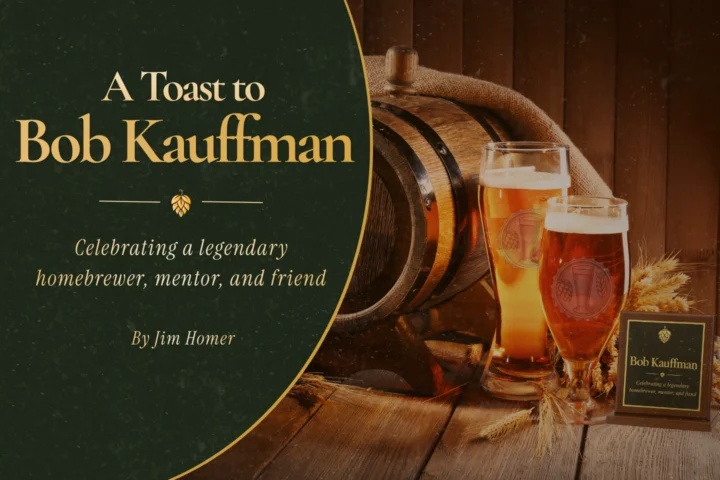

The American homebrewing community is mourning the loss of Bob Kauffman, a foundational figure in the hobby’s modern era, who passed away on Tuesday, April 28, at the age of 71. A resident of Boulder, Colorado, Kauffman was more than a dedicated hobbyist; he was a mentor, an institutional leader, and a primary architect of the communal structures that define the American Homebrewers Association (AHA) today. His death marks the end of a chapter for the Boulder-based "Hop Barley and the Alers" homebrew club and leaves a significant void in the national judging circuits of the Great American Beer Festival and the World Beer Cup.
Kauffman’s influence spanned over three decades, a period during which homebrewing transitioned from a niche, often misunderstood pastime into a sophisticated precursor to the multibillion-dollar craft beer industry. His contributions were characterized by a rare blend of technical proficiency and a quiet, unassuming leadership style that prioritized the "common homebrewer" over political posturing. As the industry reflects on his passing, his life serves as a roadmap for the growth of the craft beer movement in the United States.
A Pillar of the Boulder Brewing Scene
Bob Kauffman’s journey into the heart of the brewing world began in earnest in the early 1990s. He joined "Hop Barley and the Alers," one of the oldest and most prestigious homebrew clubs in the country, located in the brewing mecca of Boulder, Colorado. This period was a formative time for the hobby; the AHA, founded in 1978 by Charlie Papazian, was expanding its reach, and Boulder was the epicenter of this cultural shift.
Kauffman did not merely participate in the club; he shaped its operational DNA. Serving several terms as president, he introduced a system for sharing meeting responsibilities that ensured the club remained democratic and sustainable. This organizational foresight is credited with helping the club survive the ebbs and flows of hobbyist interest over the decades. His peers remember him not just for the quality of his beer, but for his ability to foster a sense of belonging among newcomers.
Janis Gross, the former National Homebrew Competition Director, noted that Kauffman’s greatest achievement was his role as a community builder. By creating a welcoming environment, he ensured that the knowledge of brewing was passed down through generations of enthusiasts. This mentorship is perhaps most evident in the career of Jeff Griffith, the head brewer at Twisted Pine Brewing in Boulder. Griffith credits Kauffman with teaching him the intricacies of all-grain brewing—a complex process that involves mashing malted grains rather than using pre-prepared extracts. That single lesson sparked a 21-year professional career, illustrating how Kauffman’s hobby-level instruction fueled the professional craft beer explosion.
The "Kitchen Floor Tripel" and the Spirit of Resilience
Among the many anecdotes that define Kauffman’s legacy, none is more famous within the Boulder community than the story of the "Kitchen Floor Tripel." In the early days of his all-grain brewing experiments, a mechanical failure led to a significant spill of sweet wort across his kitchen floor. Rather than abandoning the batch, Kauffman utilized clean terry-cloth towels to soak up the liquid, wrung them back into the kettle, and proceeded with the boil.
The resulting beer, a Belgian-style Tripel, went on to win an award at a local competition. While Kauffman eventually refined his process to exclude the use of floor-soaked towels, the story became a legendary example of the homebrewer’s spirit: a mix of resourcefulness, humor, and a refusal to let a good batch go to waste. It also highlighted his technical skill; to produce an award-winning beer under such circumstances requires an expert understanding of fermentation and sanitation.
Institutional Leadership and National Impact
Kauffman’s impact extended far beyond the local club level. From 2008 to 2013, he served on the AHA Governing Committee, the predecessor to the current AHA Board of Directors. This was a critical period for the organization as it navigated the rapid expansion of the National Homebrewers Conference (now known as Homebrew Con).
On the committee, Kauffman was known as a "gentle, deep, and quiet" voice. Fellow committee member Crispy Frey recalled that Kauffman had little interest in the optics of leadership. Instead, he focused on practical improvements for homebrew clubs across the nation. He championed the development of resources that helped small clubs organize competitions, manage memberships, and secure insurance—infrastructure that remains vital to the hobby’s health today.
His logistical expertise was also a cornerstone of the 2007 National Homebrewers Conference in Denver, which he co-chaired alongside Jim Homer. The 2007 event is often cited as a turning point for the conference, showcasing a level of professionalism and scale that set the standard for future gatherings. Kauffman’s involvement in the National Homebrewers Conference spanned over twenty years, from the 1996 New Orleans event to the 2018 conference in Portland, Oregon.
A Master of the Judging Table
For many in the wider beer industry, Kauffman was the face of the judging staff at the Great American Beer Festival (GABF) and the World Beer Cup. These competitions are among the most rigorous in the world, requiring precise organization to ensure that thousands of entries are judged fairly and anonymously.
Kauffman rose to the rank of table captain, a role that required managing volunteers and ensuring the integrity of the "blind" tasting process. His responsibility was to ensure that every beer was poured into the correctly numbered cup and delivered to the judges at the right temperature and in the right order. This "behind-the-scenes" work is essential to the credibility of the medals awarded at GABF, which can make or break a commercial brewery’s reputation. His peers in the judging circle, such as Drew Beechum and Susan Ruud, remember him as a man of few words but immense insight, always carrying a "sly smile" that suggested he found as much joy in the process as he did in the product.
The Technical Evolution: From Extract to All-Grain
Kauffman’s tenure in the brewing world mirrored the technological evolution of the hobby. When he began, most homebrewers relied on malt extract. Kauffman was an early adopter and advocate for all-grain brewing, which allows for greater control over the flavor profile and body of the beer.
Julia Herz, the Executive Director of the AHA, recalled a "shadow brew" session at Kauffman’s house where he demonstrated the use of mechanical pumps. His reasoning was characteristically pragmatic: "so when I’m old I can still brew!" This transition toward more sophisticated home setups—incorporating pumps, temperature-controlled fermentation, and advanced water chemistry—was something Kauffman helped normalize within his club and the broader AHA community.
Broader Implications and Legacy
The passing of Bob Kauffman is a reminder of the human capital that built the modern American beer landscape. The "Boulder scene" of the 90s, of which Kauffman was a central figure, provided the blueprint for the community-centric model of craft beer that has since spread globally.
His legacy is found in the thousands of brewers who learned their craft through the AHA resources he helped develop, and in the professional brewers like Jeff Griffith who transitioned from the kitchen to the brewhouse under his tutelage. Charlie Papazian, the co-founder of the AHA, summarized Kauffman’s status in the simplest terms: "He is a legend."
Kauffman’s approach to brewing—valuing the process, the community, and the simple joy of a well-made beer—remains the North Star for the AHA. As the organization continues to evolve, the systems he put in place for club management and the standards he set for competition judging continue to serve as the foundation of the hobby.
Bob Kauffman is survived by his wife, Caroline, and his daughters, Angie and Crystal. The brewing community at large has offered a "huge toast" to a man who not only made better beer but made the world of beer a better place through his quiet dedication and enduring friendship. His story is a testament to the idea that a hobby, when pursued with passion and shared with others, can leave a lasting mark on an entire industry.