
The morning ritual of brewing coffee often appears simple, yet the dark, aromatic liquid that fills our cups is a marvel of chemical engineering, a complex symphony of hundreds, if not thousands, of distinct molecules. Far from being a mere infusion of ground beans in hot water, a single cup of black coffee represents an intricate extraction process, yielding a beverage that is predominantly water but owes its profound character to a minute percentage of dissolved solids. This intricate composition is what bestows upon coffee its celebrated color, multifaceted taste, and captivating aroma, elements that continue to fascinate both scientists and connoisseurs alike.
The Liquid Paradox: More Than Just Water
At its core, a typical cup of black coffee is remarkably simple in its major constituent: over 98.5% water. However, the remaining 1.2% to 1.5% of total dissolved solids (TDS) is where the true magic resides. This seemingly small fraction translates into a significant amount of material: in one liter of expertly brewed coffee, approximately 12 to 15 grams of various compounds have been meticulously extracted from an average of 60 grams of roasted coffee grounds. This demonstrates an efficiency of extraction that belies the simple act of pouring hot water over coffee. The parameters influencing this extraction, such as brew ratio, grind size, water composition, temperature, and filter material, were previously explored as crucial factors in shaping the final brew. Now, the focus shifts to the fascinating array of chemical entities that actually make it into the cup.
Unveiling the Hidden Orchestra of Aroma and Taste
Through advanced chromatographic techniques, which act like chemical sieves capable of separating individual components, scientists have identified hundreds of different molecules in coffee, with estimates suggesting the presence of thousands. Many of these compounds are well-characterized, their structures and sensory contributions understood. Yet, the journey of discovery is far from over. A significant aroma extract dilution analysis (AEDA) conducted in 2002 revealed a remarkable finding: 13 out of the 40 most crucial odorants in coffee remained unidentified at that time [1]. This highlights the profound complexity of coffee’s aromatic profile and the persistent challenges in fully characterizing it.
The difficulty in identifying these elusive compounds stems from several factors. Their presence in extremely low concentrations often makes it arduous to obtain sufficient sample material for comprehensive structural elucidation. Furthermore, the sheer size and intricate architecture of some molecules can complicate the process of resolving their correct chemical structures. This ongoing scientific quest underscores why recreating coffee synthetically remains a formidable challenge. A 1996 study, for instance, managed to synthesize two "model" coffees, mimicking Arabica and Robusta profiles, using just 22 key volatile compounds [2]. While sensory assessors described these models as "clearly coffee-like," the consensus among experts is that 22 compounds are woefully insufficient to perfectly replicate the nuanced aroma of natural coffee. The quest for a truly indistinguishable synthetic coffee remains a distant goal, emphasizing the unparalleled complexity of nature’s brew.
The Chemical Constituents: A Deeper Dive
The myriad compounds in coffee can be broadly categorized into volatile and non-volatile groups. Volatile compounds, characterized by their low boiling points, readily evaporate and find their way into the nasal passages, contributing to the coffee’s rich aroma. Non-volatile compounds, conversely, remain in the liquid phase and primarily influence the taste profile perceived by the tongue, along with contributing to the beverage’s body and texture. While some molecules can impact both aroma and taste, their taste thresholds are typically much higher than their odor thresholds. The spectrum of tastes encountered in coffee—bitterness, sweetness, acidity, and astringency—is a direct consequence of these non-volatile components. Furthermore, lipids (oils) and insoluble micro-particles contribute significantly to the perceived body and mouthfeel of coffee, offering a tactile dimension to the drinking experience.
A closer examination of the soluble components reveals several key chemical families:

- Carbohydrates: These include various sugars (e.g., sucrose, glucose, fructose) and soluble oligosaccharides. They contribute to sweetness and body, and critically, participate in the Maillard reaction during roasting, generating a vast array of flavor compounds.
- Acids: Coffee contains a diverse array of acids, including chlorogenic acids (CGA), quinic acid, citric acid, malic acid, and acetic acid. CGAs are particularly abundant and contribute to coffee’s characteristic bitterness and astringency, while also acting as potent antioxidants. Quinic acid contributes to sourness, and citric acid lends a bright, fruity acidity.
- Minerals/Salts: Essential minerals like potassium, magnesium, and calcium are extracted into the brew. These not only contribute to the overall mineral content but also play a crucial role in buffering the acidity and influencing the perception of other flavors. Water composition, specifically the mineral content, is known to significantly impact extraction dynamics and the final taste profile.
- Proteins and Amino Acids: While most proteins coagulate and remain in the spent grounds during brewing, smaller peptides and free amino acids are extracted. These are vital precursors for many aroma compounds formed during the roasting process through Maillard reactions and Strecker degradation.
- Lipids: Coffee oils, though largely non-polar, are partially emulsified or dissolved, contributing to the coffee’s body, mouthfeel, and retention of volatile aroma compounds. They are more prevalent in espresso due to higher pressure extraction.
- Alkaloids: Caffeine is the most famous alkaloid, a well-known stimulant. Its concentration can range from 0.05% to 0.2% of the beverage, contributing to bitterness and stimulating the central nervous system. Trigonelline is another significant alkaloid, which degrades during roasting to produce nicotinic acid (Vitamin B3) and a range of volatile compounds, influencing both taste and aroma.
- Volatile Aroma Compounds: This is the most diverse group, responsible for the vast aromatic spectrum of coffee. These compounds include furans, pyrazines, pyrroles, aldehydes, ketones, esters, and sulfur-containing compounds, each contributing specific notes ranging from nutty and caramel to fruity, floral, and earthy.
- Unidentified Compounds: A substantial portion of extracted solids, particularly those contributing to color and bitterness, remains uncharacterized, a testament to the ongoing frontiers in coffee chemistry.
The transformation of these compounds during roasting is critical. The high temperatures trigger complex chemical reactions like the Maillard reaction (responsible for browning and hundreds of flavor compounds) and Strecker degradation, which break down amino acids and sugars to create a cascade of new aroma molecules. The skill of a roaster lies in meticulously controlling these reactions to develop desired flavor profiles.
The Power of Perception: Odor Activity Values and Trace Compounds
Perhaps one of the most remarkable aspects of coffee chemistry is the disproportionate impact of certain trace compounds. A visual representation of coffee’s composition, often plotted on a logarithmic scale, reveals concentration ranges spanning more than nine orders of magnitude. This vast range underscores a crucial principle in sensory science: a compound’s concentration does not directly correlate with its perceived impact. This is where the concept of Odor Activity Value (OAV) becomes paramount. OAV is defined as the concentration of a compound divided by its odor threshold—the minimum concentration at which it can be detected by the human nose.
This means that a compound present at an astonishingly low concentration, perhaps 0.0000000001% (1 part per trillion, or ppt), could exert as significant an influence on the overall flavor as another compound present at 0.01%! The human olfactory system possesses an extraordinary sensitivity to specific molecules, making it a superb analytical detector.
A prime example of this phenomenon is $beta$-damascenone. This potent odorant is found in coffee at concentrations as low as 1 part per trillion (ppt), yet it is considered one of the top five key odorants, significantly contributing to coffee’s complex aroma [1]. $beta$-damascenone belongs to a family of compounds known as rose ketones, first identified in rose oil in the 1960s. Its name is derived from the Damask rose (Rosa × damascena), where it was initially discovered. Pioneering work by flavor and fragrance companies, such as Firmenich, saw rose ketones, including $beta$-damascenone, become integral to iconic perfumes like Dior’s Poison. In coffee, $beta$-damascenone imparts a complex array of notes, often described as fruity (blackcurrant, apple), floral (rose), sweet, and woody. The ability to accurately measure odor thresholds and quantify compounds at such minuscule concentrations is an arduous task, suggesting that the discovery of additional key odorants in coffee is highly probable in the years to come.
Extraction Dynamics: Polar, Non-Polar, and the Role of Water
The brewing process is fundamentally an act of selective extraction. Compounds in coffee can also be grouped by their polarity: polar compounds (e.g., acids, minerals, proteins, carbohydrates) are highly soluble in water, a polar solvent. Consequently, brewing with water typically extracts over 75% of these polar compounds [2]. Non-polar compounds, which include many volatile aroma molecules and lipids, have low solubility in water. As a result, only about 10-30% of these non-polar compounds are extracted during conventional water-based brewing.
This differential extraction rate is a critical factor in understanding coffee flavor. The choice of solvent dictates which compounds are preferentially extracted, influencing the final balance of flavors. For instance, while water is the traditional and most common solvent, the use of less polar solvents like ethanol could potentially unlock additional dimensions of coffee extraction, yielding a beverage with a significantly different chemical profile and sensory experience. This concept is already explored in processes like decaffeination, which often employs organic solvents.
Beyond TDS: The Limitations of Simple Metrics
Given the chemical complexity, it becomes evident why simple metrics like Total Dissolved Solids (TDS) measurements, while useful for gauging coffee strength, fall short in predicting the full aroma and flavor profile of a cup. TDS primarily reflects the concentration of the most abundant soluble compounds. However, the compounds present in minute quantities, particularly the potent aroma compounds with low odor thresholds, do not significantly influence TDS readings.
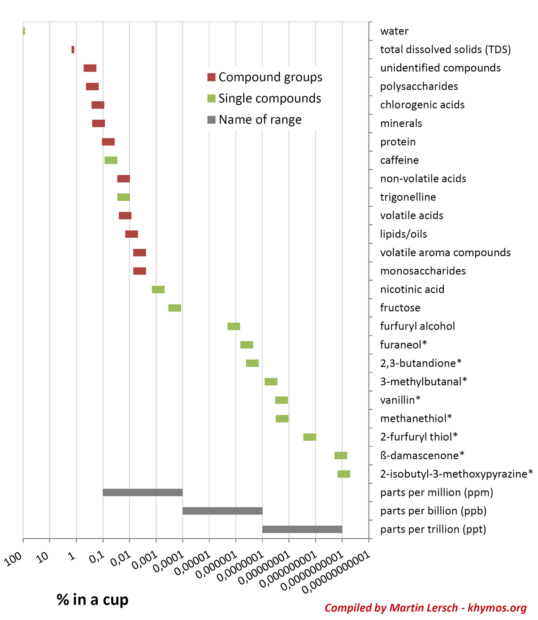
The lack of a direct correlation between TDS and the extraction rates of these critical trace compounds means that two coffees with identical TDS values could possess vastly different flavor profiles. This is further complicated by the differential extraction of polar and non-polar compounds. Therefore, while TDS offers a convenient and accessible measure for consistency in brewing, it cannot capture the intricate interplay of hundreds of molecules that define a coffee’s character. For most enthusiasts and professionals, the human nose and palate remain the most sophisticated and indispensable analytical tools in the ongoing exploration of coffee extraction. Scientific research continues to develop more advanced analytical techniques, but the subjective, holistic experience of tasting coffee is yet to be fully replicated by instrumentation.
The Ongoing Scientific Frontier and Broader Implications
The ongoing scientific endeavor to decode coffee’s chemical blueprint holds significant implications for various stakeholders. For the coffee industry, a deeper understanding of these compounds can lead to advancements in bean selection, roasting techniques, and brewing methodologies, enabling greater consistency and the development of novel flavor profiles. Roasters and baristas, informed by this chemical knowledge, can fine-tune their processes to highlight specific attributes, offering consumers an increasingly diverse and refined coffee experience. The development of better quality control measures and the ability to detect adulteration are also critical industrial benefits.
For researchers, coffee serves as a fascinating model for studying complex food matrices, pushing the boundaries of analytical chemistry and sensory science. Future research is likely to leverage artificial intelligence and machine learning to predict flavor profiles based on chemical data, potentially revolutionizing coffee breeding and product development. The exploration of alternative extraction methods, perhaps employing novel solvents or advanced pressure and temperature profiles, also represents a promising avenue.
For consumers, this growing body of knowledge fosters a deeper appreciation for the beverage they enjoy daily. Understanding the science behind the brew can empower individuals to experiment with brewing parameters and explore the vast world of coffee with a more informed perspective. It underscores the artisanal skill involved in coffee production, from cultivation to brewing, and highlights the "natural magic" inherent in a product derived from a humble bean.
In conclusion, the seemingly straightforward cup of coffee is, in reality, a testament to nature’s profound chemical complexity and the remarkable capabilities of scientific inquiry. From the major components like water and carbohydrates to the infinitesimally small yet powerfully impactful trace aroma compounds, each molecule plays a role in the symphony of flavor and aroma. The journey of scientific discovery continues, promising even deeper insights into this beloved beverage and ensuring that the pursuit of the perfect cup remains an endlessly fascinating quest.
References
[1] Sanz, C.; Czerny, M.; Cid, C.; Schieberle, P. Eur. Food. Res. Technol., 2002, 214, 299 (DOI: 10.1007/s00217-001-0459-9)
[2] Semmelroch, P.; Grosch, W. J. Agric. Food Chem. 1996, 44, 537 (DOI: 10.1021/jf9505988)
[3] Belitz, H.-D.; Grosch, W.; Schieberle, P. (ed.), 2004, Food Chemistry (3rd edition) Springer.
[4] Amanpour, A.; Selli, S. J. Food Proc. Pres. 2016, 40, 1116 (DOI: 10.1111/jfpp.12692)
[5] Batali, M. E.; Frost, S. C.; Lebrilla, C. B.; Ristenpart, W. D.; Guinard, J.-X. J. Sci. Food Agric. 2020, 7, 2953 (DOI: 10.1002/jsfa.10323)