
The pursuit of the perfect cup of coffee is a journey fraught with scientific intricacies and artistic interpretations, a delicate balance between extracting desirable compounds and avoiding the bitter, astringent notes of over-extraction. At its core, coffee brewing is a complex chemical process where water acts as a solvent, drawing out hundreds of aromatic and flavor compounds from ground coffee beans. This process, known as extraction, is influenced by an astonishing array of variables, making the simple act of brewing a profound scientific challenge. This article delves into the two primary methods dominating the specialty coffee landscape—pour-over (percolation) and immersion brewing—exploring their inherent complexities, design innovations, and the ongoing quest for repeatability and unparalleled flavor.
The Nuance of Extraction: Beyond "Evenness"
A common misconception in coffee circles is that the goal of brewing is an "even extraction," implying that all soluble compounds should be extracted to the same degree. However, from a chemical perspective, the objective is often a selective extraction. Roasted coffee beans, even when perfected by expert roasters, contain a vast spectrum of chemical compounds, each with unique solubility and extraction rates. These compounds, ranging from complex carbohydrates and lipids to organic acids, amino acids, and volatile aromatics, exist across nine orders of magnitude in concentration within a brewed cup. If all these compounds were extracted uniformly, there would be little room for the creativity and variation that define modern coffee brewing.
The ideal scenario involves preferentially extracting the compounds that contribute to sweetness, acidity, and desired aromatics, while minimizing the extraction of bitter or undesirable elements that tend to extract later or at higher concentrations. For instance, caffeine, while soluble, often contributes bitterness when over-extracted, while delicate fruit esters are more volatile and extract quickly. Achieving a "total extraction," akin to a finely ground Turkish coffee brewed for extended periods, could yield up to 30% of the coffee bean’s mass in dissolved solids. While strong, this often results in a dense, sometimes muddy, flavor profile, lacking the clarity and nuance prized in specialty coffee. Therefore, the art of brewing lies in manipulating variables to achieve this selective extraction, crafting a beverage that accurately reflects the desirable soluble parts of the bean without overwhelming the palate.
Pour-Over Brewing: A Symphony of Variables
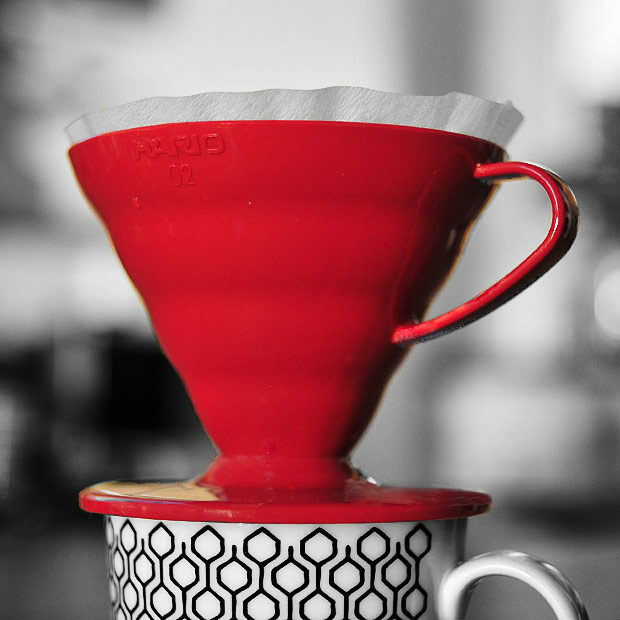
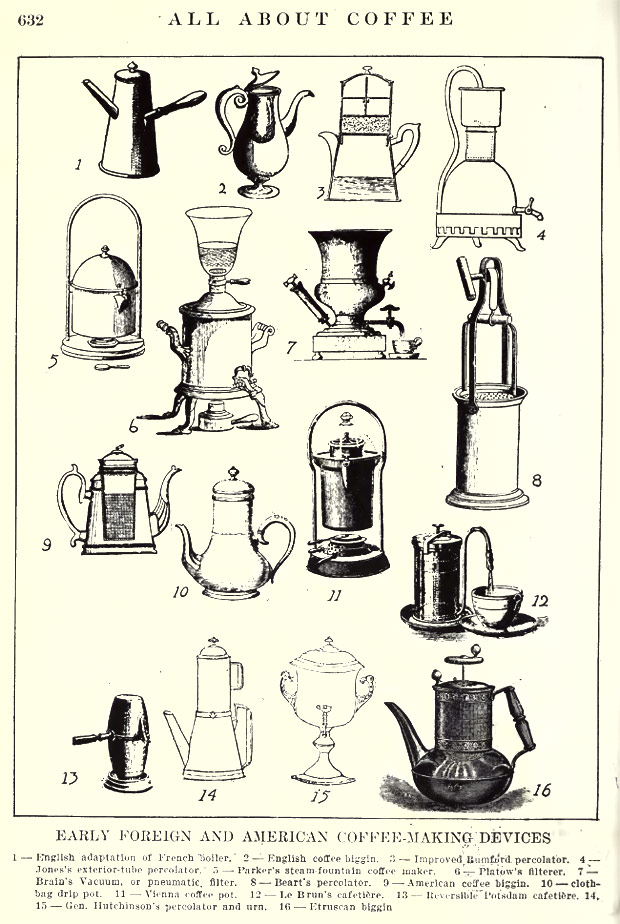
Pour-over brewing, a method where hot water is poured over a bed of ground coffee, allowing the brew to drip through a filter by gravity, may seem deceptively simple. Yet, it represents an immensely complex system with a multitude of adjustable parameters. The method, a descendant of early percolation techniques, gained significant traction in the early 20th century with innovations like Melitta Bentz’s paper filter in 1908, revolutionizing home brewing by separating grounds from the liquid. Modern pour-over, exemplified by devices like the Hario V60 (introduced in 2004) and the Kalita Wave, has elevated this technique to an art form, offering baristas and enthusiasts unparalleled control.
The parameters influencing the final pour-over result are extensive:
- Brew Ratio: The precise ratio of coffee grounds to water.
- Grind Size and Particle Size Distribution (PSD): Finer grinds increase surface area for extraction but can impede water flow. PSD, the uniformity of grind particles, is critical; uneven grinds lead to uneven extraction.
- Water Composition and Temperature: Mineral content (e.g., hardness, alkalinity) affects extraction efficiency and flavor perception, while temperature significantly impacts solubility kinetics. Typically, water between 90-96°C (195-205°F) is recommended.
- Filter Material and Pore Size: Paper, cloth, or metal filters each impart different characteristics, affecting clarity, body, and the retention of oils and fines.
- Flow Rate and Pouring Technique: The speed and pattern of water application are crucial. A slow, controlled pour minimizes channeling and ensures even saturation.
- Bloom Phase: An initial pour to wet the grounds, allowing CO2 to degas, which prevents channeling and promotes more uniform extraction.
- Agitation: Stirring or swirling the coffee bed can increase extraction, but also risks over-extraction or channeling if not carefully managed.
- Coffee Bed Geometry: The shape (cone, flat-bottom, trapezoid) and depth of the coffee bed influence water flow dynamics and contact time.
- Bypass: Water that flows around, rather than through, the coffee bed, leading to under-extracted and diluted coffee.
The inherent complexity is compounded by the strong correlations between many of these parameters. For instance, a finer grind size not only increases the surface area for extraction but also reduces water flow rate, extending contact time and increasing the risk of filter clogging. This slowdown can, paradoxically, increase bypass if water accumulates above the coffee bed, seeking the path of least resistance around the saturated grounds. Water, in essence, is "lazy," and will always find the quickest route, often through the sides of the filter or areas of lower density in the coffee bed.
The Bypass Conundrum and Equipment Innovation
Bypass is a critical, yet often overlooked, factor. Water that bypasses the coffee bed does not contribute to extraction; it merely dilutes the final brew. This phenomenon is exacerbated by certain filter holder designs (e.g., those with ridges or patterns on the inside walls) that allow water to flow between the filter paper and the brewer wall. Coffee scientists, like Jonathan Gagné, have emphasized the importance of minimizing uncontrolled bypass for optimal percolation. Designs like the Chemex, with its smooth walls and thick filter, inherently reduce bypass by sealing the filter to the brewer’s surface. In contrast, many brewers with ribbed designs aim to maintain flow even with finer grinds, accepting a degree of bypass as a trade-off for speed and clog prevention.
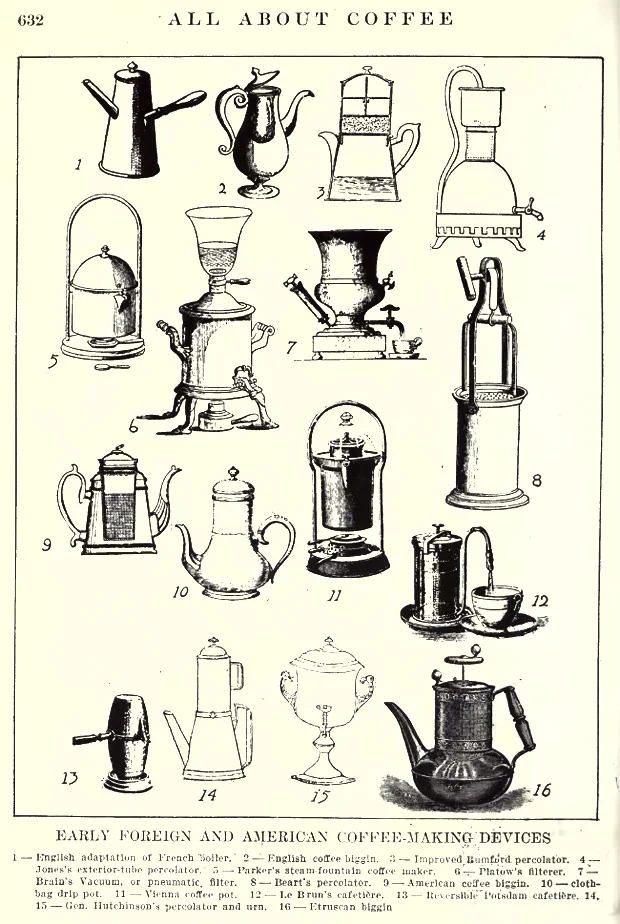
The extensive market of pour-over devices—from the iconic Hario V60 (plastic, ceramic, glass), Kalita Wave (metal, glass, ceramic), Chemex (glass), to newer innovations like the Origami (ceramic) and Stagg X/XF (vacuum-insulated metal)—testifies to the industry’s relentless effort to "untie the coffee knot." Each design tweak, whether it’s the material (plastic for thermal stability and cost, ceramic for heat retention, vacuum-insulated metal for minimal heat loss), the shape (conical for deep bed and longer contact, flat-bottom for even extraction and faster flow), or the internal structure (ribs to prevent filter collapse, smooth walls for minimal bypass), is an attempt to optimize specific aspects of extraction.
Inflow control, often achieved through specialized kettles with gooseneck spouts or innovative water distributors like the Gabi Dripmaster B or Melodrip, aims to ensure even wetting of the coffee bed and prevent channeling. Outflow control, seen in devices with valves like the Clever Dripper or Hario Switch, allows brewers to pause percolation, introducing an immersion phase to gain more control over contact time, especially when scaling recipes or managing grind variations. The diversity reflects a nuanced understanding that no single design is universally "best"; rather, each offers a unique set of compromises and advantages tailored to different brewing philosophies and desired outcomes.
Immersion Brewing: Simplicity and Repeatability
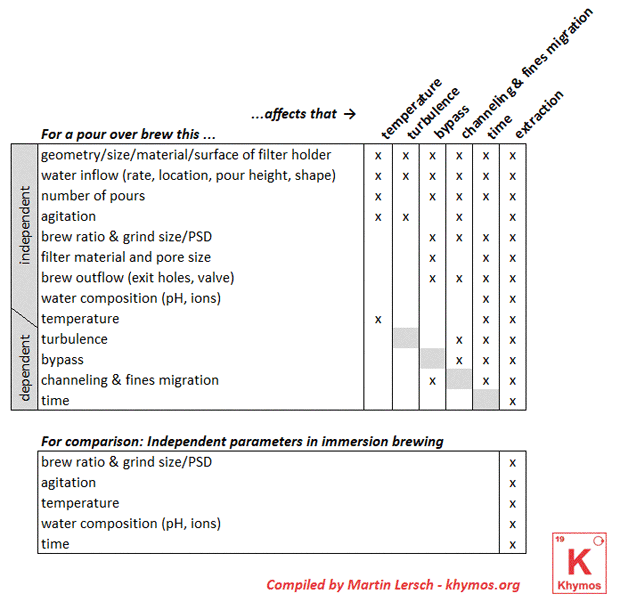
In contrast to the intricate dance of pour-over, immersion brewing offers a robust and often more repeatable method. Here, all the coffee grounds are steeped in the entire volume of hot water for a set duration, ensuring full contact. Initial stirring helps to fully saturate the grounds and release trapped gases. After the desired steeping time, the brew is separated from the grounds, typically via filtration.
The primary advantage of immersion brewing lies in its consistency. Sharing an immersion recipe between two individuals is more likely to yield similar results because many of the sensitive pour-over variables (flow rate, pouring technique, bloom dynamics) are minimized or eliminated. This "foolproof" nature makes it appealing for home brewers seeking reliability without constant vigilance.
From a chemical perspective, immersion brewing allows for a near-equilibrium state to be approached between the coffee grounds and the water. Extraction yield (EY) and total dissolved solids (TDS) increase over time, eventually leveling off as the solution becomes saturated with soluble compounds. While the grind size is typically coarser than for pour-over, and the temperature gradually drops below the initial brewing temperature, immersion brewing is still a selective process. By varying steeping time, grind size, and brew ratio, a wide range of flavor profiles can be achieved.
Iconic immersion devices include the French Press and the Aeropress. The French Press, invented in the mid-19th century, is characterized by its mesh filter, which allows a significant amount of coffee fines and oils to pass into the cup. This contributes to a full-bodied, rich beverage, often with a pleasant sediment that enhances mouthfeel. However, these fines can also contribute to bitterness if over-extracted or simply allowed to linger, leading some enthusiasts to double-filter French Press coffee through paper for a cleaner cup. The Aeropress, a more recent innovation (2005), uses air pressure to force brewed coffee through a small paper filter, producing a clean cup with a unique combination of immersion and pressure filtration benefits. Its sealed chamber and ability to use finer grinds offer further control over extraction.
Hybrid Approaches and the Quest for Control
The ongoing evolution of coffee brewing has seen the emergence of hybrid devices that cleverly blend elements of both pour-over and immersion. The Clever Dripper, for example, functions as a pour-over device but incorporates a shut-off valve, allowing for a controlled immersion phase before drawdown. Similarly, the Hario Switch integrates a valve into its V60 cone, enabling brewers to initiate an immersion period before opening the valve for percolation. These innovations represent a strategic effort to harness the best of both worlds: the robust repeatability of immersion combined with the clarity and nuanced flavor potential of percolation.
Other devices like the Tricolate or the Proper brewer seek to eliminate bypass entirely by ensuring all water flows uniformly through a flat bed of coffee, often with specialized showerheads for even saturation. These designs aim for maximum extraction efficiency and clarity, pushing the boundaries of what’s possible in a non-pressurized system. The underlying philosophy for many of these newer designs is that "only the coffee should restrict the flow of water," rather than the equipment itself, except for intentional control mechanisms like valves.
The Broader Impact: Industry and Consumer Perspectives
The profound complexity of coffee extraction has significant implications for both the coffee industry and the everyday consumer. For professional baristas, mastering pour-over brewing requires extensive training, precision, and an intuitive understanding of how minute adjustments cascade through the system. This complexity, while offering artistic freedom, also introduces unintended variables, making perfect replication a constant challenge. It also fuels the proliferation of "coffee myths" and diverse techniques often lacking a solid scientific basis.
For consumers, this means that following a seemingly identical "recipe" might not yield consistent results, as most recipes fail to detail all the correlated parameters with sufficient precision. This variability can be frustrating, yet it also fosters a deeper engagement with the brewing process, encouraging experimentation and personal discovery.
The specialty coffee market, valued at over $50 billion globally, thrives on this pursuit of quality and experience. Equipment manufacturers are continuously innovating, driven by demand for precision, ease of use, and the promise of a superior cup. From smart brewers with integrated scales and temperature control to advanced grinder technologies that produce highly uniform grinds, the industry is responding to the scientific understanding of extraction. Coffee scientists and enthusiasts alike emphasize that a deeper comprehension of the underlying chemistry and physics is paramount to demystifying the brewing process and unlocking its full potential.
The ultimate goal, as eloquently captured in popular culture through depictions like Gale Boetticher’s meticulously engineered coffee setup in Breaking Bad, remains the pursuit of the "very best cup of coffee we have ever tasted." This enduring quest propels innovation, pushing the boundaries of equipment design, brewing techniques, and our scientific understanding of coffee. As research continues to unravel the subtle interactions between coffee, water, and brewing methods, the future promises even greater control, consistency, and, ultimately, more delightful coffee experiences for everyone. The journey to the perfect cup is far from over; it is an evolving dialogue between science, craft, and an unwavering passion for coffee.