When a standard cup of black coffee is poured, the casual observer sees a simple dark beverage. However, beneath the surface lies a complex biochemical matrix. Composed of more than 98.5 percent water, the average cup derives its character from a minuscule 1.2 to 1.5 percent of Total Dissolved Solids (TDS). This means that in a single liter of brewed coffee, approximately 12 to 15 grams of soluble matter—extracted from roughly 60 grams of coffee beans—interact to create a sensory experience that has fascinated food scientists, chemists, and master roasters for decades.
Understanding the precise composition of this daily ritual requires looking beyond simple brewing parameters like grind size, water temperature, and brew ratio. Modern chromatographic and spectroscopic analyses reveal that a single cup of coffee contains hundreds, and potentially thousands, of distinct chemical molecules. These compounds dictate the beverage’s color, mouthfeel, acidity, and aroma, bridging the gap between basic agricultural commodities and intricate molecular gastronomy.
The Historical Timeline of Coffee Chemistry Research
The scientific quest to decode the chemical fingerprint of coffee spans more than a century, evolving from basic botanical classification to advanced molecular profiling.
In the early decades of the 20th century, researchers primarily focused on major macronutrients, caffeine, and broad classes of acids. It was not until the mid-1960s that trace volatile compounds began receiving rigorous analytical attention, marked by the discovery of rose ketones—such as beta-damascenone—originally isolated from rose oil.
A significant milestone arrived in 1996, when food chemists published a landmark study demonstrating that synthetic "model" coffees could be formulated using just 22 key volatile compounds. While sensory assessors described these synthetic replicas as "clearly coffee-like," they lacked the full depth and complexity of authentic Arabica and Robusta brews. This highlighted a fundamental reality of food science: replicating the profound sensory profile of natural coffee requires far more than a handful of isolated chemicals.
Further technological advancements occurred in 2002, when an Aroma Extract Dilution Analysis (AEDA) revealed that out of 40 key odorants in coffee, 13 remained entirely unknown to science. The inability to fully characterize these molecules stemmed from two primary obstacles: extremely low concentrations that hindered sample collection, and large molecular structures that complicated structural elucidation.
By 2016 and 2020, subsequent studies utilizing high-resolution mass spectrometry and advanced metabolomics further mapped the vast array of carbohydrates, lipids, and volatile organic compounds present in the beverage, underscoring how much remains to be discovered.

Volatiles, Non-Volatiles, and Sensory Perception
The chemical constituents of coffee fall neatly into two broad categories: volatile and non-volatile compounds. Each group plays a distinctly different role in how humans perceive the beverage.
Volatile compounds readily vaporize at room or serving temperatures, ascending into the nasal cavity to deliver the complex aromas associated with freshly brewed coffee—ranging from floral and fruity notes to earthy, nutty, and smoky tones. Conversely, non-volatile compounds remain in the liquid phase, directly engaging taste receptors on the tongue and interacting with the palate. These non-volatiles are responsible for the fundamental tastes of bitterness, sweetness, acidity, and astringency. Furthermore, non-volatile lipids and microscopic insoluble particles contribute significantly to the body, viscosity, and overall texture of the beverage.
A closer examination of the soluble components reveals a diverse chemical profile. Carbohydrates, including simple sugars and soluble oligosaccharides, provide sweetness and body. Organic acids impart brightness and acidity. Minerals and salts add savory depth, while proteins, lipids, and caffeine round out the structural matrix. A substantial portion of the dissolved solids remains unidentified, likely contributing heavily to the characteristic dark color and inherent bitterness of the beverage.
The Paradox of Concentration: From Parts Per Trillion to Major Solids
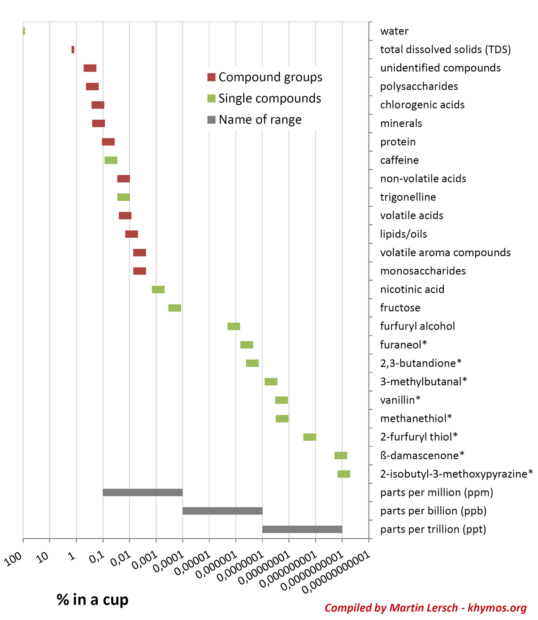
When plotting the concentration ranges of coffee compounds on a logarithmic scale, researchers encounter a striking phenomenon spanning more than nine orders of magnitude. It is a common misconception that a lower concentration implies a negligible impact on flavor. While linear dilution applies to individual compounds within specific ranges, it fails when comparing structurally distinct molecules because human olfactory receptors possess vastly different thresholds of sensitivity.
For instance, a specific aromatic compound present at a concentration of just 0.0000000001% (1 part per trillion, or ppt) can exert as much influence on overall flavor as a compound present at 0.01%. This concept is quantified using the Odor Activity Value (OAV), defined as a compound’s concentration divided by its specific odor threshold.
Beta-damascenone serves as a prime example of this biochemical paradox. Originally discovered in Damask roses (Rosa × damascena) and famously utilized by fragrance houses like Firmenich in complex perfumes such as Dior’s Poison, beta-damascenone is also present in coffee at trace levels down to 1 part per trillion. Despite this minuscule concentration, its extraordinarily low odor threshold places it among the top five most impactful odorants in a cup of coffee. Because identifying and quantifying compounds at such low thresholds requires tedious laboratory work, researchers anticipate that additional key odorants will be discovered in future analyses.
Polar Versus Non-Polar Extraction Dynamics
Another critical dimension of coffee chemistry involves the polarity of extracted compounds. Soluble components in coffee are divided into polar and non-polar groups based on their chemical affinities.
Polar compounds—including acids, minerals, proteins, and carbohydrates—dissolve readily in water. As a polar solvent, water extracts more than 75 percent of the available polar compounds during a standard brewing cycle. In contrast, non-polar compounds, which include volatile aroma molecules and lipids, exhibit low water solubility. Consequently, standard water-based brewing extracts only 10 to 30 percent of the non-polar compounds present in roasted coffee grounds.
This disparity has profound implications for extraction theory. While industrial food scientists and avant-garde culinary researchers occasionally explore alternative solvents, such as ethanol, to extract non-polar flavor dimensions, water remains the universal medium for traditional coffee preparation.
Analytical Limitations and the Limits of TDS
For decades, Total Dissolved Solids (TDS) has served as the industry standard for measuring coffee strength. Typically falling between 1.2 and 1.5 percent in a standard drip or filter coffee, TDS provides a reliable, repeatable metric for commercial roasters and specialty cafes monitoring extraction efficiency.
However, food scientists emphasize that TDS measurements have severe limitations. Because only a small fraction of the compound groups in coffee are present in sufficient quantities to significantly influence the overall TDS percentage, the metric functions as a blunt instrument. Furthermore, there is no direct correlation ensuring that trace flavor compounds and major dissolved solids are extracted at the same rate—especially given the vast differences in extraction yields between polar and non-polar substances.
Consequently, while a refractometer can accurately measure the dissolved strength of a brew, a TDS measurement alone is a poor predictor of actual aroma, flavor harmony, and cup quality.
Broader Implications for the Coffee Industry
The ongoing scientific mapping of coffee’s chemical composition carries substantial implications for the global coffee industry, from agricultural practices to advanced brewing technology.
By understanding the exact pathways through which volatile and non-volatile compounds develop during roasting, producers and roasters can fine-tune thermal profiles to preserve delicate flavor precursors like beta-damascenone. Similarly, advancements in analytical chemistry enable equipment manufacturers to design commercial and domestic extraction systems that optimize water temperature and pressure, maximizing the yield of desirable aromatic compounds while minimizing harsh, over-extracted bitter elements.
Ultimately, while sophisticated gas chromatography and mass spectrometry continue to unveil the molecular secrets of the daily brew, the human nose remains the supreme analytical detector. As research progresses, the synergy between rigorous analytical science and traditional sensory evaluation will continue to elevate the craft of coffee production worldwide.