
The pursuit of the ideal cup of coffee has long bridged the gap between culinary art and rigorous physical science. At its core, brewing coffee is a complex chemical extraction process wherein water dissolves hundreds of distinct soluble compounds found within roasted and ground beans. These compounds vary drastically in their solubility and extraction rates, spanning orders of magnitude in concentration. Far from being a flaw, this chemical diversity is the foundation of coffee craftsmanship. If every compound extracted at an identical rate, the resulting beverage would lack nuance, leaving little room for flavor variation or creative control.
To understand the mechanics of coffee preparation, researchers and specialty coffee authorities have increasingly turned to fluid dynamics, thermodynamics, and material science. The way water interacts with coffee grounds determines not only the final taste profile, but also exposes the inherent limitations of various brewing methodologies. From the intricate variables of pour-over percolation to the reliable predictability of full-immersion systems, mastering the extraction process requires a granular understanding of how physical hardware influences chemical output.
The Chemistry of Selective Extraction
When evaluating coffee extraction, achieving a uniform or "even" extraction is often cited as a primary objective. However, from a chemical perspective, an optimal brew actually relies on an uneven extraction. Different flavor and aromatic compounds dissolve at different stages of the brewing cycle. Acids and fruit notes extract rapidly in the early stages, followed by sweet sugars, and finally heavier, often bitter, plant compounds late in the process.
If the goal were merely to extract the maximum possible mass from the bean, one would grind the coffee to a microscopic powder and steep it for an extended period, or boil it directly, mirroring traditional unfiltered preparations like Turkish coffee. While this method can yield extraction yields approaching 30 percent, resulting in a heavy and robust beverage, it often introduces harsh, over-extracted flavors.
Instead, the objective of modern specialty brewing is selective extraction. Baristas aim to harvest the desirable aromatic and flavor compounds while leaving behind the unpalatable, bitter elements. This fine-tuned balancing act is most commonly pursued through percolation techniques, such as pour-over brewing, which allows water to flow progressively through a bed of coffee grounds.
The Hidden Complexity of Pour-Over Brewing
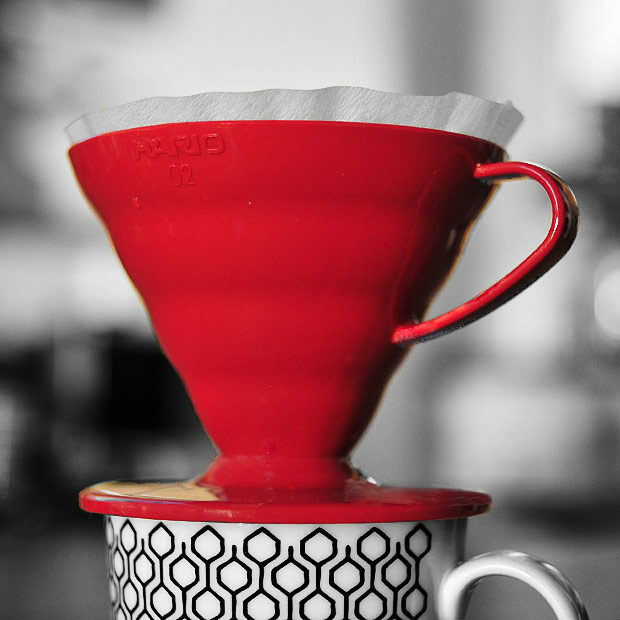
Pour-over brewing appears deceptively simple: hot water is poured over a bed of ground coffee, relying on gravity filtration to drip into a vessel below. Yet, an analysis of the physical variables reveals a deeply intricate system. Independent variables—such as brew ratio, particle size distribution, water temperature, mineral composition, and filter material—interact dynamically with dependent variables like flow rate, contact time, thermal loss, and extraction yield.
Among these variables, particle size distribution and its effect on water flow remain critical. Finer coffee particles increase the total surface area available for extraction, which enhances the dissolution of compounds. However, these fine particles also pack tightly together, slowing the flow rate and increasing contact time.
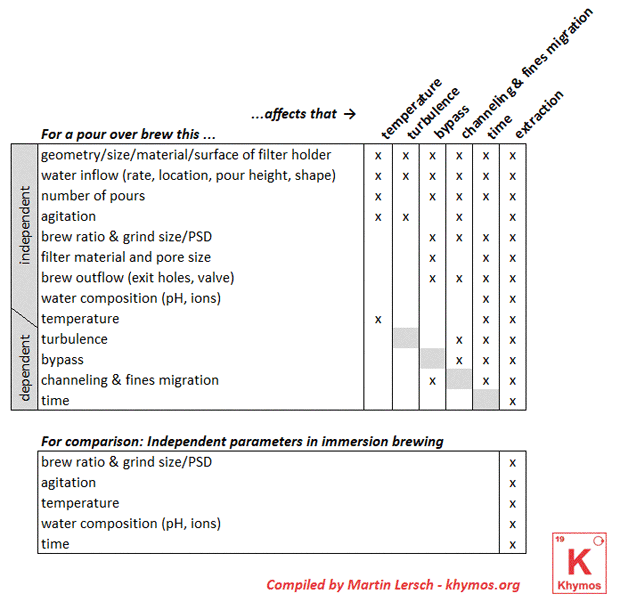
This dynamic introduces a persistent hydrodynamic challenge: water always follows the path of least resistance. When a coffee bed becomes clogged or densely packed, standing water above the bed may bypass the coffee matrix entirely, finding alternative routes through the sides of the paper filter. This phenomenon, known as bypassing, dilutes the brew and leads to under-extraction in certain areas while simultaneously over-extracting others.
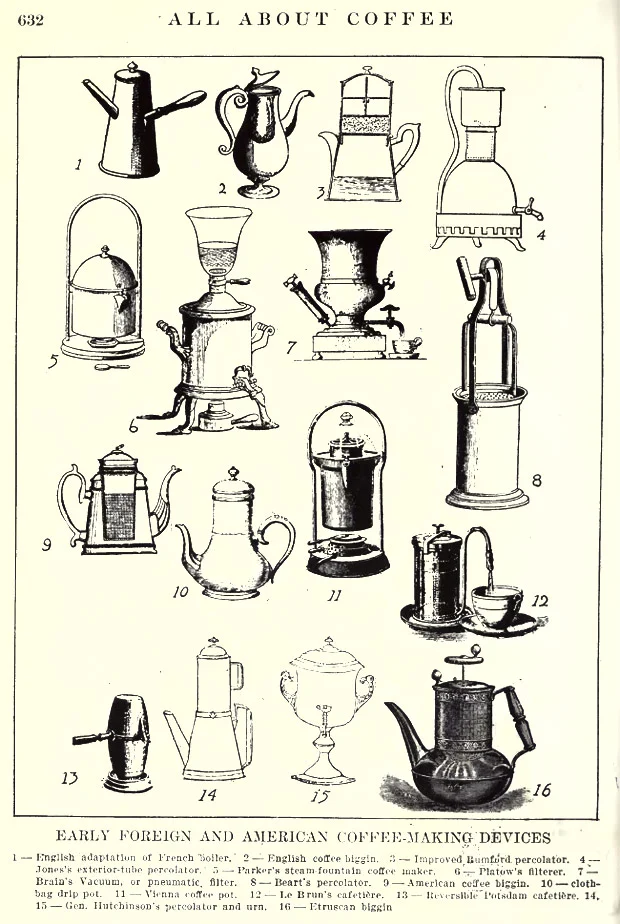
The proliferation of brewing equipment on the market reflects decades of engineering attempts to mitigate these variables. Inventors have altered every conceivable parameter, from the material composition of the filter holder to its internal geometry.
Engineering the Hardware: Material, Shape, and Flow Control
The design of coffee-making equipment is rarely accidental. Manufacturers continually modify hardware specifications to address specific thermodynamic and fluid-dynamic hurdles:
- Material and Thermal Mass: Maintaining a stable brewing temperature is essential for consistent extraction. Highly conductive metals rapidly absorb heat from brewing water unless insulated by a vacuum barrier, such as in double-walled brewers. Conversely, materials like plastic, ceramic, and glass offer different compromises regarding thermal retention, durability, and heat loss.
- Geometry and Bed Shape: Traditional trapezoidal, cone-shaped, and flat-bottom brewers dictate the physical shape of the coffee bed. A tall, narrow cylindrical bed maximizes contact time between water and grounds but increases the risk of slow flow rates, whereas flat-bottom designs encourage faster drainage.
- Internal Wall Structure and Bypass Reduction: Smooth internal walls can cause wet filter paper to adhere tightly, halting side-drainage completely—a design characteristic of the Chemex. Other brewers incorporate internal ridges or patterns to maintain a gap between the paper and the wall, permitting controlled liquid flow while managing the extent of fluid bypassing.
- Inflow and Outflow Regulation: Modern accessories, such as specialized water distribution screens (e.g., the Melodrip or Gabi Dripmaster), break up the pouring stream to prevent physical disruption of the coffee bed, thereby reducing the likelihood of channeling. Similarly, exit hole configurations and mechanical valves—such as those found on the Clever Dripper or Hario Switch—allow operators to shift dynamically between immersion and percolation phases.
Immersion Brewing: The Pursuit of Repeatability
While pour-over methods offer high levels of customization, their complexity introduces random variations and operational inconsistencies. This sensitivity to technique is precisely why immersion brewing methods—such as the French Press or the Aeropress—remain popular for home and professional use alike.
In full-immersion systems, coffee grounds are steeped directly in water for a predetermined duration, with all water typically introduced at once. This method decouples extraction time from grind size to a significant degree, allowing for robust control over total dissolved solids (TDS) and extraction yield. Because the chemical system approaches a dynamic equilibrium between the liquid and the coffee grounds, immersion brewing is inherently forgiving. The recipe can be replicated across different operators with minimal deviation in flavor outcome.
However, immersion systems present their own trade-offs. Traditional filtration methods utilizing coarse wire mesh filters, common in French presses, permit microscopic coffee particles—known as "fines"—to pass into the final beverage. While these suspended solids contribute heavy body and rich texture, they also extend the extraction of bitter compounds and leave a noticeable sediment at the bottom of the cup. Incorporating paper filters into immersion setups can eliminate these particulates, yielding a cleaner, more transparent cup, albeit one with a lighter mouthfeel.
Broader Implications and Industry Analysis
The ongoing evolution of coffee extraction equipment highlights a broader trend within the culinary sciences: the quantification of sensory experiences. By systematically examining variables like fluid dynamics, thermal conductivity, and particle distribution, industry professionals and researchers are gradually demystifying a craft historically driven by intuition and folklore.
Despite these technological advancements, the fundamental challenge remains balancing scientific precision with practical usability. While engineering innovations continue to push the boundaries of extraction efficiency, the ultimate metric of success stays anchored in human sensory perception. As manufacturers introduce new geometries, valves, and filtration mechanisms to untie the complex "coffee knot," the search for the optimal cup continues to drive both commercial design and scientific inquiry.