
Dave & Buster’s Entertainment Inc., the prominent nationwide operator of dining and entertainment complexes, is navigating a critical juncture in its corporate history. Following a challenging second-quarter financial performance that missed Wall Street consensus estimates, the company has initiated a sweeping operational and strategic realignment. Under the leadership of newly appointed Chief Executive Officer Darin Harper, who stepped into the role following the retirement of Tarun Lal, the brand is systematically addressing historical vulnerabilities in marketing consistency, pricing architecture, and in-store execution. With 184 units currently operating domestically and internationally, the brand boasts remarkable name recognition—surpassing 90 percent aided awareness—yet contends with the unique reality of an occasion-based business model where the average consumer visits fewer than two times per calendar year.
This infrequent visitation pattern leaves exceptionally narrow margins for operational error. According to executive leadership, when consumers decide to allocate their discretionary entertainment budgets toward an eatertainment concept, Dave & Buster’s has not consistently remained the obvious, top-of-mind choice in recent years. To reverse this trend, Harper and his newly reinforced executive team have launched a comprehensive transformation plan centered on cultural relevance, disciplined marketing investment, simplified value propositions, and elevated guest service standards.
Financial Realities and Second-Quarter Earnings Miss
The urgency underlying Dave & Buster’s strategic pivot was underscored by its Q2 financial disclosures, which triggered a double-digit slide in the company’s stock price. For the quarter, the chain reported total revenues of $544.1 million, representing a 2.4 percent decrease year-over-year and falling roughly 2 percent short of Wall Street projections as the company lapped $10 million in deferred revenue from the prior year. Adjusted EBITDA reached $98.9 million, missing consensus estimates by approximately 18 percent.
Same-store sales declined 2.9 percent, which constituted a sequential improvement over the 5.4 percent drop recorded in the first quarter, resulting in a two-year stacked decline of 5.9 percent. Operational indicators demonstrated progressive momentum as the quarter advanced, with same-store sales improving from a negative 5.0 percent in June to a negative 1.6 percent in July, a trajectory that continued into the third quarter.
Beneath the headline figures, performance varied significantly across operating segments. Food and beverage (F&B) comps delivered positive results for the fifth consecutive quarter, climbing 7.6 percent. Special events likewise extended a growth streak, advancing for the seventh consecutive reporting period. However, the core entertainment division continued to face headwinds, posting an imputed high-single-digit negative comparable store sales figure—an improvement, nevertheless, from the low-double-digit declines experienced over the preceding two quarters.
Leadership Restructuring and Strategic Timeline
The implementation of the current turnaround strategy coincides with significant changes in the company’s executive suite. Darin Harper assumed the role of CEO last month, transitioning from his previous position as Chief Financial Officer following the brief tenure of former CEO Tarun Lal, who retired after less than a year at the helm. To shore up foundational capabilities, the company moved swiftly in the second quarter to fill critical vacancies in marketing and operations.
Jeremy Tucker joined Dave & Buster’s as Chief Marketing Officer, bringing extensive industry experience from prominent consumer brands including AutoNation, Planet Fitness, Doritos, The Walt Disney Company, and Spin Master. Tucker’s appointment directly addresses what Harper characterized as a systemic vulnerability: the company had operated without a dedicated CMO for over a year and lacked consistent marketing leadership for several years. This vacuum had resulted in a volatile promotional calendar, fragmented media strategies, measurement challenges, and disjointed consumer messaging.
Concurrently, the company appointed Amanda Busby as Chief Operating Officer. Busby brings nearly two decades of operational expertise from Red Robin, where she oversaw 230 locations as Vice President of Operations, alongside extensive experience managing multi-unit hospitality networks at SSP America. Together, Harper, Tucker, and Busby form a cohesive leadership team tasked with executing a four-pillar turnaround strategy designed to stabilize top-line performance and maximize operational efficiency.
Reimagining Marketing and Capturing Cultural Relevance
At the core of the brand’s new marketing philosophy is a pivot away from broad, disconnected national advertising campaigns toward targeted, lower- to middle-funnel messaging synchronized with personal, seasonal, and cultural calendars. Historically, Dave & Buster’s relied on extensive, capital-intensive tent-pole campaigns that frequently failed to establish an evergreen value proposition in the minds of consumers.
Under Tucker’s direction, the marketing department is restructuring its media deployment to enhance targeting, discoverability, and message retention. Because Dave & Buster’s is rarely an impulse destination—consumers almost universally plan their excursions in advance rather than dropping in casually—establishing a clear, memorable value proposition is paramount.
The company is capitalizing on high-visibility cultural and sporting moments to drive localized traffic. Demonstrating the efficacy of this approach, previous activations around global sporting events, such as the World Cup, generated double-digit sales growth through comprehensive four-wall executions that integrated themed food and beverage menus, reskinned arcade games, prize integrations, and ticketed viewing parties.
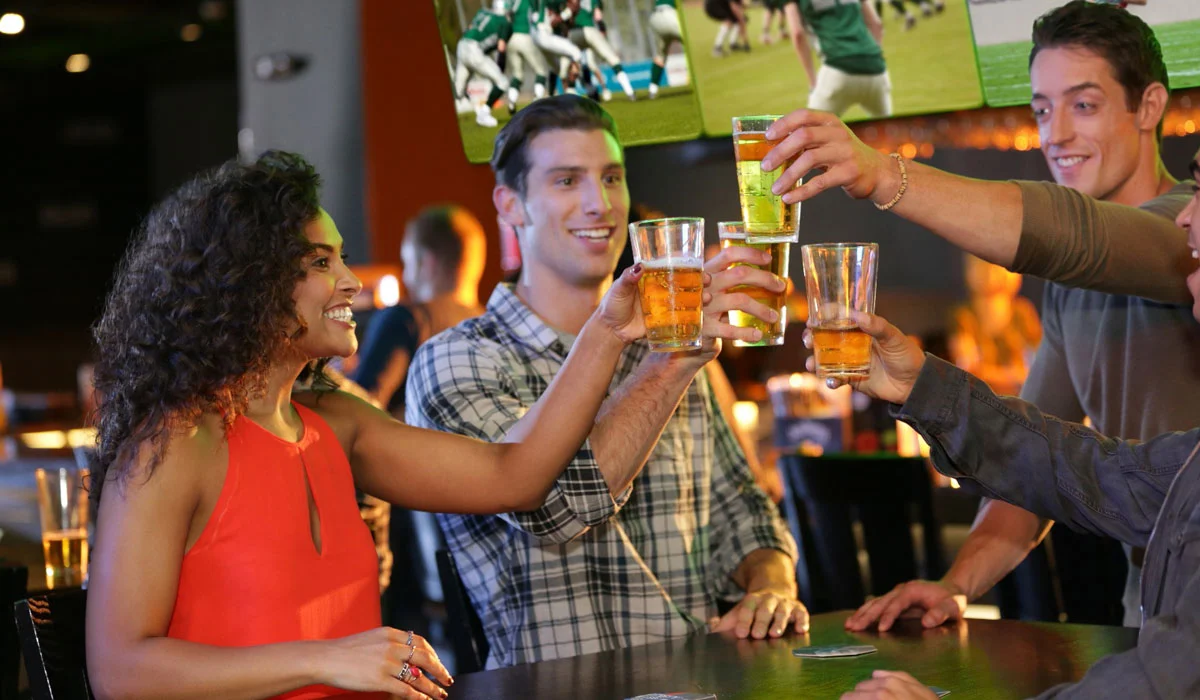
Furthermore, sports entertainment represents a massive untapped opportunity for the brand. Market research indicates that more than half of Dave & Buster’s customers actively watch football, basketball, or baseball. When these consumers patronize dining and drinking establishments to view live sporting events, over 90 percent purchase food and more than 80 percent order alcoholic beverages. By upgrading its 40-foot audiovisual screens, refining localized sports programming, and tailoring gameday promotions, management aims to capture a larger share of the sports-viewing demographic that traditionally overlooks Dave & Buster’s as a primary destination.
Midway Innovation and the Integration of In-Culture Collectibles
On the entertainment front, consumer research reveals that over 70 percent of guests consider the introduction of novel games and attractions to be a primary incentive for more frequent visitations. Recognizing that the brand underinvested in its midway attractions over recent years, management has accelerated the rollout of new gaming intellectual property.
So far this year, Dave & Buster’s has introduced ten new games and attractions, featuring prominent entertainment franchises such as Mandalorian and Grogu, John Wick, Stranger Things, Hot Wheels, ICEE Slush Rush, Perfect Pump, and Odin’s Hammer. These additions will be complemented by bespoke proprietary games developed entirely in-house.
A vital component of the updated entertainment strategy involves capitalizing on the surging popularity of in-culture collectibles. Leveraging its brand awareness and established entertainment partnerships, Dave & Buster’s is integrating exclusive merchandise and collectible items directly into its midway experiences and WIN! redemption stores. Management views collectibles as a natural extension of its demographic’s preferences, capable of driving sustained engagement and repeat visits.
Overhauling Pricing Architecture and Value Perception
Parallel to entertainment enhancements, the company has systematically overhauled its pricing architecture to correct historical missteps. In preceding years, aggressive pricing strategies blurred the brand’s value equation, alienating price-sensitive consumers and complicating the rate card.
Management simplified the rate card to ensure absolute clarity regarding the benefits included with various purchasing tiers. By recalibrating game pricing and adjusting redemption mechanics, Dave & Buster’s successfully enabled customers to play longer and dwell in the midway for extended periods—yielding 16 to 20 percent increases in both play time and physical dwell time. Extended midway engagement naturally correlates with higher food and beverage attachment rates.
These value adjustments have been reinforced by the continued success of the Eat & Play Combo kiosk offering, which effectively converts arcade gamers into restaurant diners, alongside popular recurring promotions such as half-price games on Wednesdays and Sundays. Crucially, these pricing adjustments were executed without compressing product basket sizes or operating margins, positioning the brand favorably relative to industry competitors.
Operational Excellence and Fleet Modernization
The fourth pillar of Harper’s turnaround strategy centers on rigorous operational execution. Operating under the principle that the guest experience can never exceed the team member experience, COO Amanda Busby is actively raising service standards through enhanced field leadership, comprehensive employee training programs, and strict accountability metrics.
A primary operational focus has been accelerating speed of service across both dining rooms and midway redemption centers. Given the infrequent visitation patterns of the typical customer, eliminating friction points during their limited visits is critical to securing repeat business.
To complement operational improvements, Dave & Buster’s is aggressively advancing its restaurant remodeling program. During fiscal 2026, the company completed comprehensive remodels across six strategic markets—Cincinnati, Jacksonville, San Antonio, Nashville, San Diego, and Miami—with additional projects scheduled for Frisco, Texas, and Westbury, New York. Early performance data indicates that these modernized prototypes significantly outperform legacy units by improving spatial navigation, modernizing aesthetics, and eliminating unproductive capital expenditures.
Capital Allocation and Financial Discipline
In alignment with its refined operational focus, Dave & Buster’s is realigning its capital allocation strategy to prioritize core business fundamentals over rapid physical expansion. Year-to-date net capital expenditures have reached $127.6 million, with annual spending projected to finish just under $200 million, encompassing store remodels, new gaming technology, and infrastructure upgrades. Capital expenditures are expected to moderate to approximately $150 million by fiscal 2027.
The company opened six domestic stores during the second quarter, bringing the total number of domestic openings in the first half of the calendar year to seven, comprising five Dave & Buster’s units and two Main Event locations. The broader portfolio currently encompasses 250 company-owned restaurants—including 66 Main Event locations—alongside six international franchise units. Management plans to open four additional domestic locations during the remainder of the year and five across fiscal 2027, temporarily directing the majority of its financial resources toward interior optimization, digital integration, and operational efficiency.
To further bolster financial resilience, Dave & Buster’s established a dedicated internal team tasked with identifying enterprise-wide cost savings. This initiative has already unlocked $15 million in structural efficiencies slated for realization over the next 12 months, with executive management targeting an eventual doubling of those savings.
Analyst Perspectives and Broader Industry Implications
Industry observers note that Dave & Buster’s decisive strategic pivot reflects broader pressures confronting the eatertainment sector, where discretionary consumer spending faces heightened scrutiny amid macroeconomic uncertainties. By concentrating capital on high-return internal initiatives—such as targeted digital marketing, midway revitalization, and unit remodels—management is attempting to build a resilient operational foundation capable of weathering economic fluctuations.
While near-term financial metrics indicate that the brand remains in a transitional recovery phase, the structural reforms instituted by Harper, Tucker, and Busby provide a clear roadmap for long-term growth. By aligning marketing messaging with cultural moments, simplifying the consumer value proposition, and enforcing rigorous operational standards at the store level, Dave & Buster’s aims to transform infrequent guests into loyal, recurring patrons. As the company navigates the remainder of fiscal 2026, the success of these initiatives will serve as a vital bellwether for the broader experiential dining and entertainment industry.