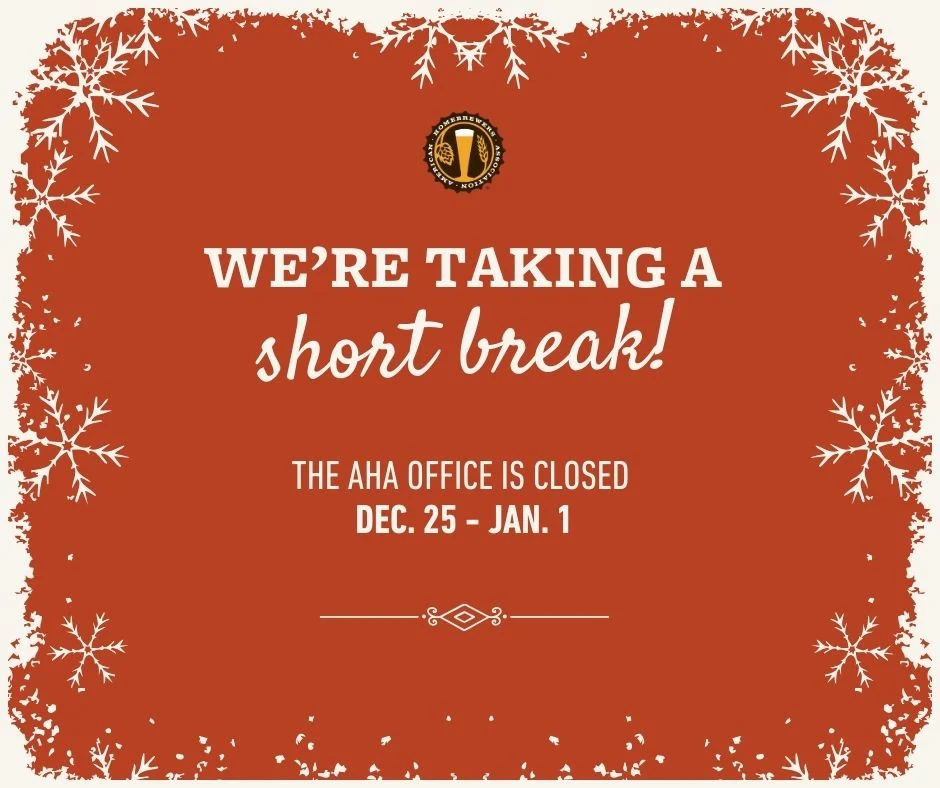

The American Homebrewers Association (AHA) has officially announced its annual year-end closure, marking a period of scheduled hiatus from December 25, 2025, through January 1, 2026. This strategic pause is designed to allow the organization’s professional staff to observe the holiday season, facilitating a period of recuperation following a year characterized by significant advocacy efforts and community engagement. While the central offices in Boulder, Colorado, will remain inactive during this window, the association has assured its global membership that digital resources will remain accessible, with a full return to operational status scheduled for the first business day of the new year.
The announcement, delivered via the organization’s official communication channels, emphasizes a commitment to employee wellness and organizational longevity. By "refreshing and recharging," the AHA aims to enter 2026 with a renewed focus on its core mission: the promotion of homebrewing culture, the protection of the rights of homebrewers, and the provision of educational resources for the estimated 1.1 million homebrewers currently active within the United States. This closure reflects a broader trend among non-profit advocacy groups within the craft beverage sector, which increasingly prioritize end-of-year administrative resets to finalize strategic planning for the upcoming fiscal cycle.
A Historical Context: The American Homebrewers Association and Its Legacy
To understand the significance of this organizational pause, one must look at the foundational role the AHA has played in the American craft beer movement. Established in 1978 by Charlie Papazian in Boulder, Colorado, the AHA was born during an era when homebrewing was still technically illegal under federal law. The organization was instrumental in the passage of the Cranston-Williams Act, which was signed into law by President Jimmy Carter in late 1978, effectively legalizing the production of beer for personal or family use at the federal level.
Since its inception, the AHA has grown from a small group of enthusiasts into a massive advocacy powerhouse under the umbrella of the Brewers Association (BA). It serves as the primary voice for hobbyists, providing a bridge between the amateur enthusiast and the professional brewing industry. The annual holiday closure is not merely a break from labor; it is a symbolic conclusion to another year of defending the legislative interests of brewers. Throughout 2025, the AHA continued its work in state-level advocacy, pushing for modernized laws regarding the transport of homebrew to competitions and the clarification of tax codes that affect small-scale fermenters.
Chronology of the 2025 Homebrewing Year
The 2025 calendar year was a pivotal one for the American Homebrewers Association, marked by several high-profile events and initiatives that led up to this December closure.
- May 2025: National Big Brew Day: On the first Saturday in May, the AHA coordinated thousands of simultaneous brew sessions across the globe. This event served as a major membership drive and a public demonstration of the hobby’s vitality.
- June 2025: Homebrew Con in Portland: The annual conference returned to the Pacific Northwest, featuring technical seminars on yeast management, water chemistry, and the integration of sustainable practices in home brewing.
- August 2025: Legislative Victory in Local Jurisdictions: The AHA’s legal subcommittee reported success in several Midwestern states, where homebrewers were granted expanded rights to share their creations at non-profit festivals.
- November 2025: Learn to Homebrew Day: This international grassroots event focused on bringing newcomers into the fold, utilizing the AHA’s "Introduction to Brewing" curriculum to demystify the fermentation process for thousands of participants.
- December 25, 2025: Commencement of Holiday Closure: The official start of the year-end hiatus, allowing staff to transition from public-facing duties to private observance.
Supporting Data: The State of Homebrewing in 2025
The decision to pause operations comes at a time when the homebrewing industry is navigating a complex economic landscape. According to data compiled by the Brewers Association, homebrewers contribute significantly to the broader craft beer economy. It is estimated that homebrewers spend over $700 million annually on ingredients, equipment, and educational materials.
In 2025, market analysis indicated a shift in consumer behavior within the hobby. While traditional "all-grain" brewing remains the gold standard for enthusiasts, there has been a 12% increase in the adoption of high-tech, automated brewing systems. These systems, which allow for precision control via smartphone applications, have lowered the barrier to entry for younger demographics. Furthermore, the AHA reported a record number of entries in the 2025 National Homebrew Competition, with over 4,000 unique entries across 40 distinct style categories.
The demographics of the association have also seen a diversification. In 2025, the AHA noted a 15% increase in female membership and a 10% increase in international affiliations, particularly in South America and Southeast Asia, where craft beer culture is experiencing rapid acceleration. The holiday closure provides the staff with the necessary time to analyze these data points to better tailor their 2026 programming.
The Significance of Winter in the Brewing Cycle
The timing of the AHA’s closure aligns with the natural seasonal cycle of the brewing community. For many homebrewers, the period between Christmas and New Year’s Day is a peak production time. The cooler ambient temperatures in much of the Northern Hemisphere provide ideal conditions for "lagering"—the cold storage process required for bottom-fermenting beers.
During this week, many members engage in the production of "Winter Warmers" and high-gravity "Holiday Ales." These beers often involve complex malt bills and the addition of seasonal adjuncts such as spruce tips, cinnamon, nutmeg, and orange peel. By closing its administrative offices, the AHA acknowledges that its members are likely occupied with their own fermentation projects. The organization’s website continues to serve as a repository for these seasonal recipes and troubleshooting guides, ensuring that the community remains supported even in the absence of live staff interaction.
Official Responses and Community Implications
While the AHA has not issued a formal press release beyond its digital announcement, industry analysts suggest that the move is viewed positively by the brewing community. "The AHA staff works tirelessly throughout the year, especially during the heavy summer competition circuit," noted one industry consultant. "A week of downtime is standard practice for professional organizations of this scale and ensures that the team does not suffer from burnout."
For the individual member, the implications are minimal. Shipping of physical merchandise from the AHA store, such as books and apparel, will be paused until January 2, 2026. However, digital memberships can still be renewed, and the Zymurgy magazine archive—the association’s flagship publication—remains accessible via the mobile app. The primary impact will be felt by those seeking direct administrative assistance or those involved in ongoing committee work, which will resume in tandem with the office reopening.
Broader Impact and 2026 Strategic Outlook
Looking ahead to 2026, the American Homebrewers Association faces both opportunities and challenges. The craft beer industry at large has seen a stabilization after years of exponential growth, and the AHA is tasked with ensuring that homebrewing remains a relevant and attractive hobby in a crowded recreational market.
One of the key initiatives expected for 2026 is a renewed focus on non-alcoholic (NA) homebrewing. As the "sober curious" movement continues to gain traction, the AHA has signaled plans to expand its educational content regarding the technical challenges of producing high-quality NA beer at home, including vacuum distillation and the use of specialized maltose-negative yeast strains.
Additionally, the association is expected to ramp up its "Governing Committee" elections in the first quarter of 2026. This democratic process allows members to have a direct say in the organization’s advocacy priorities. The holiday break allows the current leadership to finalize the slate of candidates and prepare the digital voting infrastructure.
The closure also serves as a reminder of the symbiotic relationship between the AHA and local homebrew shops (LHBS). While the national organization takes a break, local retailers often see a surge in business as brewers use their holiday time to visit their neighborhood stores for grain, hops, and yeast. The AHA’s "Shop Local" initiative continues to encourage members to support these small businesses, which are the backbone of the brewing ecosystem.
Conclusion
The American Homebrewers Association’s decision to close from December 25 to January 1 is a calculated move to preserve the health and efficacy of its organizational structure. It marks the end of a productive 2025 and serves as a bridge to a year that promises further technological integration and community expansion. As the staff takes this time to celebrate and reflect, the global homebrewing community continues to ferment, driven by the resources and advocacy that the AHA has provided for nearly five decades. When the doors reopen in January, the association will be positioned to continue its role as the definitive authority on the art and science of home fermentation, ensuring that the "plenty of good beer" wished for in their holiday message remains a reality for all.