
The pervasive culture of meticulous nutritional tracking has become a cornerstone for many seeking to manage their health and body composition. For Dr. Gabrielle Fundaro, a highly credentialed expert with a PhD in Human Nutrition, over a decade of coaching experience, and six powerlifting competitions, macro tracking was once a trusted tool. Yet, despite her formidable academic and practical background, Dr. Fundaro eventually confronted a profound personal dilemma: the very method she had long relied upon had ceased to serve her, fostering anxiety rather than confidence around food. Her journey illuminates a growing challenge for individuals navigating the complexities of modern nutrition advice and offers a groundbreaking alternative: the Rate of Perceived Exertion (RPE) Eating Scale.
The Burden of Constant Tracking: An Expert’s Personal Struggle
For years, Dr. Fundaro meticulously counted her macronutrients – proteins, carbohydrates, and fats – a common strategy to maintain dietary discipline and optimize her physique for powerlifting. Initially, this systematic approach provided structure and yielded results, helping her stay "on track" with her eating habits. However, the relentless vigilance required eventually took its toll. The mental fatigue of constantly calculating, planning, and ensuring perfect macro balance became an exhausting burden. She yearned for the simple pleasure of choosing a meal from a menu without the accompanying internal calculus, trusting her body and its needs without external validation.
This internal conflict was particularly striking given her professional standing. If anyone should possess inherent confidence in their food choices, it was Dr. Fundaro. Her extensive education and practical experience made her an authority in the field. Yet, she confessed to feeling far from confident, trapped by the fear of relinquishing control. The thought of abandoning tracking conjured anxieties about losing muscle mass due to insufficient protein, gaining unwanted fat from overeating, or, perhaps most acutely, the professional embarrassment of admitting an inability to fuel herself without external metrics. These fears highlight a critical, yet often unacknowledged, aspect of rigid dietary tracking: its potential to erode intrinsic trust in one’s own bodily signals and create a dependency that can feel liberating at first, but ultimately become restrictive.
Seeking a Path to Freedom: Beyond Conventional Approaches
Recognizing the unsustainable nature of her relationship with macro tracking, Dr. Fundaro embarked on a quest for an alternative. Her goal was clear: a system that could support her nutritional objectives while simultaneously fostering a sense of freedom and peace around food. Traditional alternatives, however, presented their own limitations. Calorie counting, she quickly dismissed, was merely a different form of restriction, potentially even more rigid than macro tracking. Its focus remained on external numbers, failing to address the underlying psychological dependence.
Intuitive eating, a philosophy that emphasizes listening to internal hunger and fullness cues, also didn’t immediately resonate. While conceptually appealing, years of relying on precise external macro targets had dulled her ability to trust her body’s natural instincts. She recognized that a sudden leap into pure intuition, without any structural framework, would likely lead to feeling adrift and overwhelmed. The psychological shift required to transition from meticulous quantification to unguided instinct was too vast, necessitating a bridge—a method that offered both structure and a path toward self-trust.
The Genesis of an Idea: Learning from the Gym
The breakthrough came from an unexpected quarter: her own powerlifting training. Dr. Fundaro had begun incorporating the Rate of Perceived Exertion (RPE) scale into her workouts. Invented by Swedish psychologist Gunnar Borg in the 1960s, the RPE scale is a scientifically validated tool used to quantify the subjective intensity of physical activity. Borg’s original scale ranged from 6 to 20, but modern adaptations, including the 0-10 scale Dr. Fundaro used, are widely adopted.
In fitness, RPE allows individuals to gauge how hard they are working on a given exercise, enabling them to adjust their effort level based on how they feel on any particular day. For powerlifters, it helps determine appropriate lifting weights; for pregnant women, it ensures safe exertion levels. This autoregulatory approach, where internal feedback guides training decisions, is a cornerstone of effective and sustainable fitness. Dr. Fundaro observed that by using RPE, she was not only getting stronger but also recovering more effectively. This blend of objective structure (a defined scale) and subjective intuition (her personal feeling of exertion) proved incredibly potent.
It was then that the profound insight struck her, much like Newton’s apple: if RPE could revolutionize her training by fostering self-awareness and autonomy, could a similar framework be applied to eating? This pivotal moment marked the birth of the RPE-Eating Scale.
Introducing the RPE-Eating Scale: A New Paradigm for Nourishment
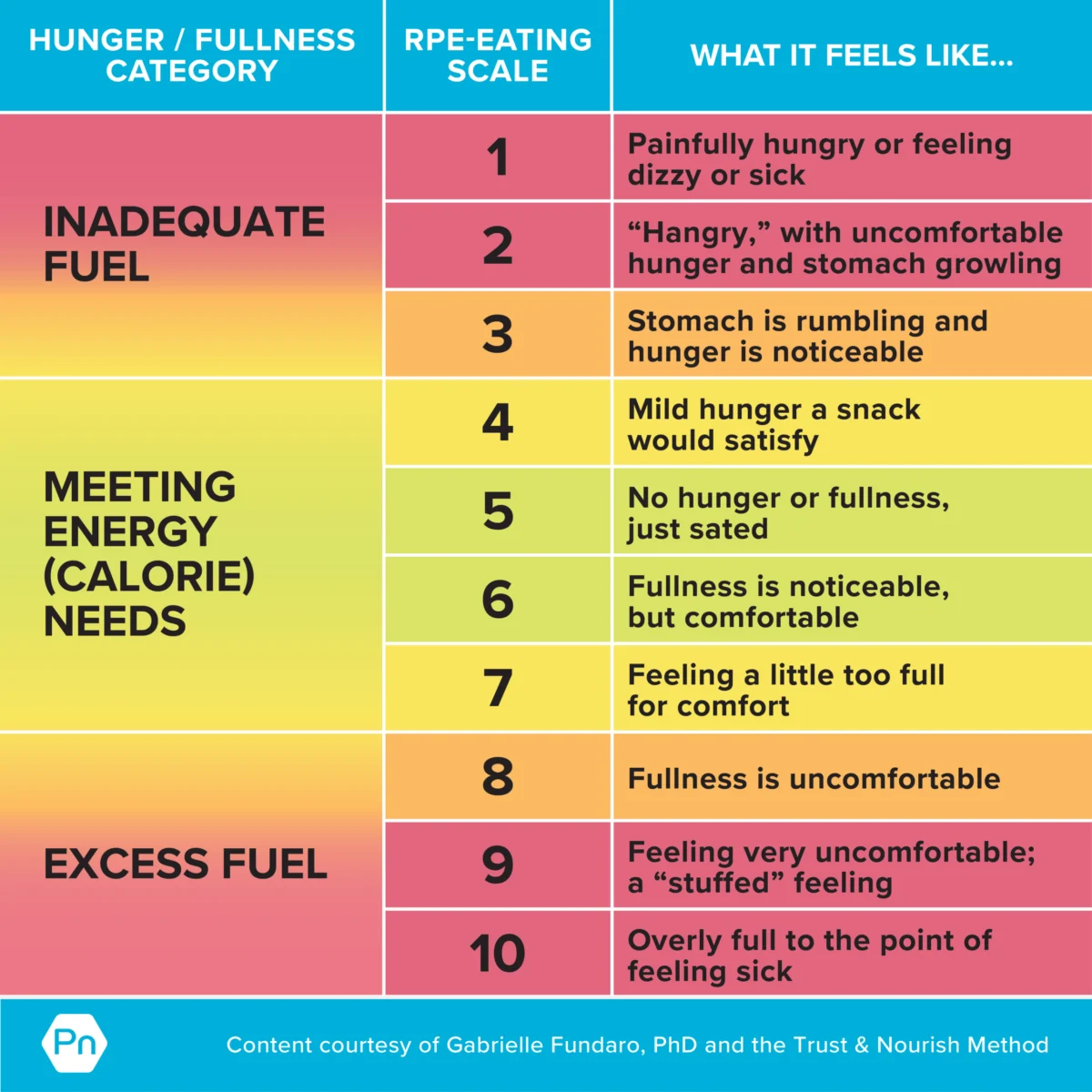
The RPE-Eating Scale adapts the principles of the exercise RPE scale to hunger and fullness cues. It provides a structured yet flexible framework for individuals to tune into their internal sensations, fostering confidence and self-trust around food choices. The scale, typically ranging from 1 to 10, categorizes different levels of hunger and fullness:
| Rating | Perceived Hunger/Fullness Level | Fuel Category |
|---|---|---|
| 1 | Painfully hungry, dizzy, sick | Inadequate Fuel |
| 2 | "Hangry," uncomfortable hunger, stomach growling | Inadequate Fuel |
| 3 | Hunger noticeable, stomach rumbling | Inadequate Fuel |
| 4 | Mild hunger, a snack would satisfy | Adequate Fuel |
| 5 | No hunger or fullness, just sated | Adequate Fuel |
| 6 | Noticeable fullness, but comfortable | Adequate Fuel |
| 7 | A little too full for comfort | Adequate Fuel |
| 8 | Uncomfortable fullness | Excess Fuel |
| 9 | Very uncomfortable, "stuffed" | Excess Fuel |
| 10 | Overly full to the point of feeling sick | Excess Fuel |
The primary objective of RPE-Eating is to develop the skill of interoceptive awareness – the ability to perceive and interpret internal bodily signals – to guide food choices without relying on external metrics like tracking apps. This shift empowers individuals to become their own most reliable nutritional guides, moving away from a dependency that can often feel disempowering in the long run.
How to Practice RPE-Eating: Four Foundational Steps
Implementing RPE-Eating, like any new skill, requires practice and patience, especially for those accustomed to external tracking. Dr. Fundaro outlines four key steps:
1. Get Clear on Your Goals: RPE-Eating is fundamentally different from a diet. Dr. Fundaro emphasizes that its core purpose is not about body manipulation or achieving an "optimal" diet in a prescriptive sense. Instead, it’s about building inner trust and confidence, sensing what your body truly needs, and providing appropriate nourishment. While it can be adapted for specific physique goals (like muscle gain or fat loss), it is not the most efficient tool for extreme body modification, such as competitive bodybuilding, which demands highly precise, often restrictive, dietary protocols. The method encourages a philosophical shift: accepting that your body might change, but trusting your ability to nourish it effectively. This approach aligns with a broader movement in nutrition toward weight-neutral health, focusing on well-being and sustainable habits over strict aesthetic outcomes.
2. Practice Identifying Your Hunger Cues: This step involves distinguishing between true physiological hunger and psychological appetite. Hunger arises from physical cues—stomach rumbling, lightheadedness, a general sense of emptiness—signaling the body’s need for energy. Appetite, conversely, is the desire or interest in eating, often influenced by sensory input (sight, smell of food) or emotional states, and can persist even after hunger is satisfied. The RPE-Eating scale helps individuals reconnect with their innate physical hunger signals.
To practice, before each meal, rate your hunger level using the RPE-Eating scale. Eat mindfully, limiting distractions, savoring flavors, and paying attention to how your body feels. Halfway through, re-evaluate your hunger. Upon finishing, note your fullness level. This repeated practice helps "download" the sensation of satiety, recalibrating your internal compass. Over time, this mindful approach strengthens interoceptive awareness, allowing for a more accurate interpretation of the body’s subtle signals.

3. Get to Know Your Non-Hunger Triggers: Life is rarely a perfectly mindful eating experience. Stress, emotions, and environmental cues often trigger eating beyond physical hunger. Dr. Fundaro advocates for developing awareness of these "non-hunger triggers." Using a technique akin to "Notice and Name" from mindfulness practices, individuals can identify the emotions (anxiety, sadness), situations (a difficult email, an argument), or even times of day that precede compulsive eating.
Once identified, the crucial next step is to explore what underlying need or desire might be driving the behavior. Eating for comfort is a natural human response, but if it becomes the sole coping mechanism, it can be counterproductive. Expanding one’s repertoire of self-soothing strategies—a short walk, deep breathing, connecting with a friend—provides alternatives that address the root cause of the emotional discomfort, rather than simply masking it with food. This self-awareness is as vital as understanding hunger cues, leading to more intentional eating patterns.
4. Eat for Satiety AND Satisfaction: A critical distinction in the RPE-Eating framework is between satiety and satisfaction. Satiety refers to the physical feeling of fullness, where calorie and fuel needs are met. Satisfaction, however, encompasses a more holistic sense of being nourished, where the meal is not only physically adequate but also emotionally pleasurable. Many restrictive diets focus solely on satiety, often banning "unhealthy" or "indulgent" foods. This can lead to a constant feeling of deprivation, even if caloric needs are met. The psychological impact of such restriction often results in a "restrict-binge" cycle, where deprivation eventually leads to overconsumption of the forbidden foods.
RPE-Eating encourages incorporating foods that bring genuine enjoyment, even those previously deemed "off-limits." By practicing the scale with a diverse range of meals, including those that offer both physical sustenance and emotional pleasure, individuals learn to trust their ability to adequately fuel themselves without fear. This integration of pleasure into the eating experience is crucial for building a healthy, sustainable relationship with food, recognizing that humans eat for reasons beyond mere physiological necessity—for joy, tradition, community, and comfort.
RPE-Eating: For Whom Is It Best Suited?
RPE-Eating is not a universal panacea but a specialized tool. It is particularly beneficial for individuals who:
- Feel overly dependent on food tracking but desire autonomy.
- Experience anxiety or a loss of control when attempting to stop tracking.
- Seek a structured system to transition away from rigid tracking without feeling completely unguided.
- Have elevated risk factors for developing eating disorders, such as a history of yo-yo dieting, disordered eating patterns, high body dissatisfaction, or participation in weight-class sports. For these individuals, the constant external focus of macro tracking can exacerbate unhealthy relationships with food. RPE-Eating offers a safer alternative by shifting focus inward.
It is crucial to note that RPE-Eating is not a substitute for professional treatment for eating disorders. Individuals struggling with such conditions should seek guidance from qualified healthcare professionals, including therapists, doctors, or registered dietitians specializing in eating disorders. For coaches, Dr. Fundaro provides resources to adapt this tool responsibly, emphasizing client-centered flexibility.
Navigating Weight Goals with RPE-Eating
While RPE-Eating is primarily designed for a weight-neutral approach, fostering self-trust and awareness, it can be adapted for intentional weight modification with careful consideration. Dr. Fundaro advocates for "safe weight modification," comparing it to contact sports where inherent risks are mitigated by best practices. By removing the potentially triggering elements of macro tracking and emphasizing biofeedback, RPE-Eating offers a "safety net" that purely numerical tracking often lacks.
For those pursuing weight gain, Dr. Fundaro suggests aiming to consistently eat within the 7 to 8 range on the RPE-Eating scale (noticeable to a little too full for comfort). Conversely, for weight loss, the target range would typically be 4 to 5 (mild hunger to sated). However, she reiterates that for extreme weight modification, such as for a bodybuilding competition, RPE-Eating is not the appropriate tool. This level of precision requires a more aggressive, externally-driven approach that is outside the scope and intent of RPE-Eating, which prioritizes a healthy and sustainable relationship with food over extreme, short-term outcomes.
Beyond "Feelings Over Facts": The Science of Interoceptive Awareness
Skeptics might dismiss RPE-Eating as merely "eating based on feelings," lacking scientific rigor. However, this argument overlooks the robust scientific foundation of RPE itself. In fitness, RPE was initially met with similar skepticism but is now widely accepted and validated as an effective method for autoregulation and managing training load. Studies have demonstrated its accuracy and convenience compared to more complex physiological measurements.
RPE-Eating similarly cultivates interoceptive awareness, the sophisticated ability to perceive and interpret internal bodily sensations. This skill is far from arbitrary; it is a fundamental aspect of self-regulation and overall well-being. Enhanced interoceptive awareness correlates with improved emotional regulation, better decision-making, and a stronger sense of self. Just as a lifter learns to interpret a slowing bar speed as an indicator of proximity to failure, an RPE-Eater learns to interpret the absence of hunger as an indicator of fullness. These internal cues, such as stomach grumbling or lightheadedness, directly correlate with physiological states like lowered blood sugar, making them valid, accessible, and convenient indicators of nutritional need. While not as precise as continuous glucose monitoring, they offer a practical, intuitive, and highly personalized alternative for daily eating decisions. This process may involve initial periods of undereating or overeating as the skill develops, but with consistent practice, the accuracy of internal guidance improves significantly.
Acknowledging the Downsides and Practical Adaptations
Like any tool, RPE-Eating has its limitations. It demands a significant level of self-awareness, presence, and reflection—qualities that can be challenging to cultivate in today’s fast-paced world. For busy individuals, such as parents with young children or those with demanding work schedules that necessitate eating on the go, the ideal scenario of leisurely, mindful meals may be unattainable.
However, the beauty of RPE-Eating lies in its adaptability. It doesn’t require an all-or-nothing commitment. Individuals can choose to apply its principles when feasible, perhaps during a quiet lunch break or a dedicated evening meal. Alternatively, specific steps can be adopted in isolation, such as focusing solely on developing awareness of hunger and fullness cues without attempting to overhaul all eating habits. The goal is progress, not perfection, and to integrate these practices in a way that enhances, rather than burdens, one’s life.
An Off-Ramp to Food Freedom
Macro tracking, while a valuable educational tool for understanding nutrition, is not a sustainable lifestyle for most. The transition away from such a rigid system can be daunting, fraught with fears of losing control. RPE-Eating offers a vital "off-ramp," providing a structured pathway to detach from external dependency. It addresses not only the quantitative aspect of eating but also the psychological one, helping to dismantle ingrained habits like "always finishing your plate," which, like macro tracking, relies on external cues rather than internal satisfaction.
While RPE-Eating won’t magically eliminate all anxieties associated with changing deeply ingrained eating patterns, it equips individuals with a practical framework and a shared language to approach food with less fear, reduced stress, and significantly greater confidence. As Dr. Fundaro aptly summarizes, "The goal is to know that you’re nourishing yourself—and you don’t need a food tracker to do that." This philosophy marks a profound shift towards empowered, intuitive, and ultimately more peaceful eating.
References
Click here to view the information sources referenced in this article.