
The seasonal transition from winter to spring marks a significant shift in home and professional baking, bringing a renewed focus on spiced, enriched doughs. Foremost among these traditions is the hot cross bun, a spiced sweet bun traditionally consumed on Good Friday to mark the culmination of Lent. While commercial yeast has long dominated mass-produced iterations of this pastry, contemporary artisanal bakers are increasingly turning to natural fermentation methods. By integrating sourdough cultures with modern pastry science—specifically the Asian-originating tangzhong technique—bakers are achieving unprecedented levels of texture, flavor complexity, and longevity in their seasonal products.
Historical Context and the Evolution of the Hot Cross Bun
The origins of the hot cross bun are deeply embedded in European culinary history, with written records and folklore tracing the spiced pastry back centuries. Historically baked to commemorate the end of Lenten fasting, the buns were traditionally marked with a cross to symbolize the crucifixion. Over generations, the formula evolved from a rudimentary spiced loaf into a rich, pillowy treat characterized by warming spices like cinnamon, allspice, and nutmeg, combined with citrus zest and dried fruits such as raisins and currants.
Despite their rich heritage, traditional hot cross buns faced a textural decline with the advent of industrial baking. Commercial yeast accelerated production schedules but sacrificed the nuanced acidity and extended shelf life provided by slow lactic acid fermentation. Modern sourdough practitioners have sought to reclaim this heritage, utilizing wild yeast and beneficial bacteria to break down complex carbohydrates, thereby enhancing digestibility and introducing a subtle, sophisticated tang that cuts through the rich sugar and butter matrix of the dough.
Technical Innovation: The Integration of Tangzhong and Sweet Levain
A primary challenge in enriched dough baking is moisture retention. Fats like butter and eggs inhibit gluten development and can lead to a dry crumb if not properly managed. To combat this, master bakers have adapted the tangzhong method—a Japanese technique traditionally used in Hokkaido milk bread—into European-style enriched formulas.
The process involves cooking a small portion of the recipe’s flour and liquid (in this case, high-protein white flour and whole milk) over medium-low heat until it forms a cohesive paste. This gelatinization of starches allows the flour to absorb significantly more liquid, trapping moisture within the structural matrix of the dough. Consequently, the resulting hot cross buns achieve a distinct pillowy, pull-apart texture that resists staling far longer than conventional brioche or bun recipes.
Furthermore, the formulation utilizes a specialized sweet levain. By introducing superfine sugar directly into the sourdough starter culture during the overnight incubation phase, bakers condition the wild yeasts to operate efficiently within a heavy, fat-rich environment. This step serves a dual purpose: it accelerates the sluggish fermentation typical of enriched doughs while suppressing excessive acetic acid production, ensuring the final product features a gentle, rounded acidity rather than an overpowering sourness.
Comprehensive Baking Schedule and Methodology
Executing a successful batch of artisanal sourdough hot cross buns requires meticulous temporal planning. Because enriched doughs ferment at a slower rate than lean bread doughs, the production cycle typically spans over twenty-four hours, divided into precise operational phases.
- The Overnight Prep (9:00 PM): The process begins by mixing the sweet levain using ripe sourdough starter, high-protein flour, water, and superfine sugar. Simultaneously, dried fruits such as Thompson raisins and currants may be placed in a water soaker to plump up, ensuring they do not draw essential moisture away from the dough during baking.
- Thermal Preparation and Tangzhong Creation (8:00 AM, Next Day): Butter is portioned and brought to room temperature, while the tangzhong paste is cooked, whisked continuously for five to eight minutes until thickened, and set aside to cool.
- Dough Mixing and Development (8:30 AM): Utilizing a mechanical stand mixer or a commercial spiral mixer, the primary dry ingredients, spices, citrus zests, eggs, water, salt, and the mature sweet levain are combined. Gluten is developed to a strong, elastic windowpane stage before softened butter is incorporated incrementally. The fruit inclusions are folded in at the very end to prevent premature tearing of the gluten network.
- Bulk Fermentation (9:00 AM to 1:00 PM): The dough undergoes a four-hour bulk fermentation phase at a controlled warm room temperature (approximately 74°F to 76°F). Intermittent stretches and folds are applied during the initial stages to build structural integrity and evenly distribute the fruit.
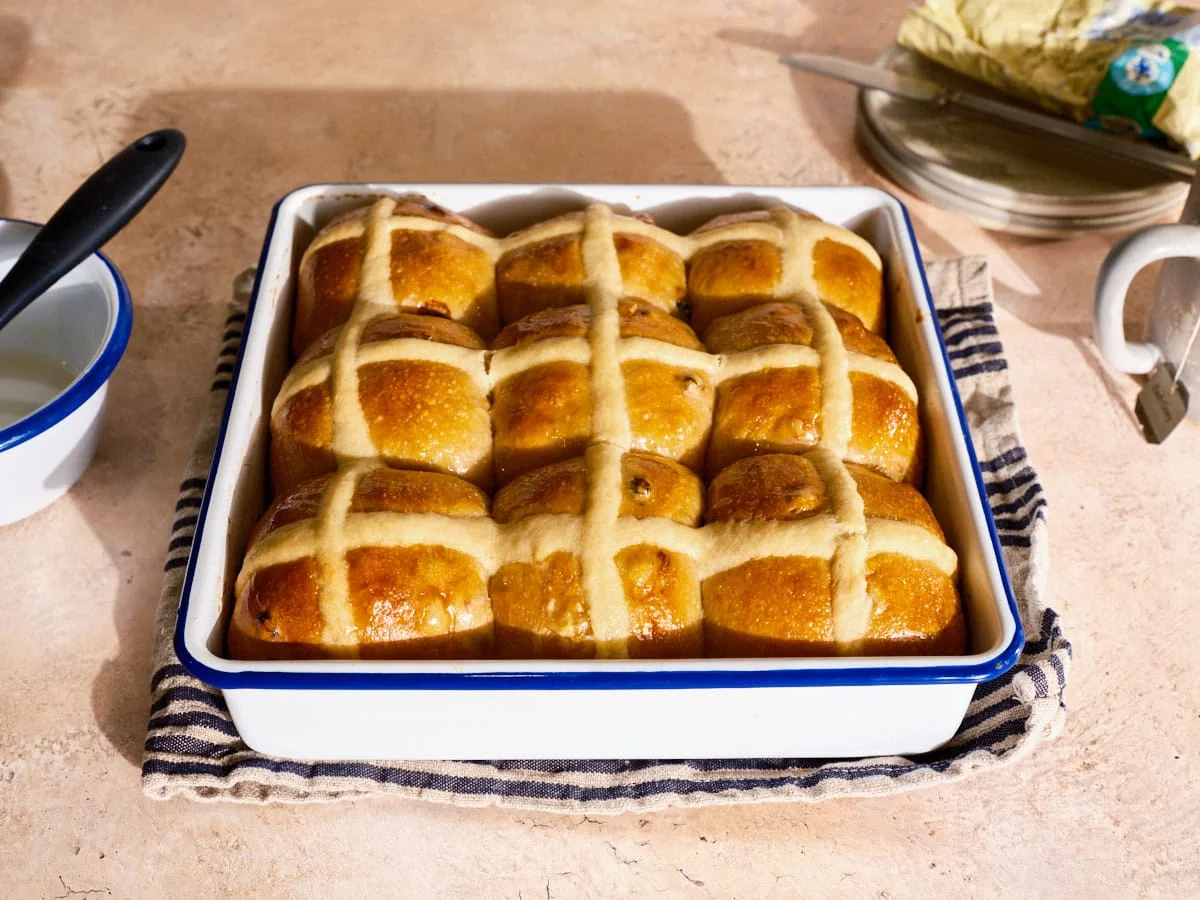
- Division and Shaping (1:00 PM): The dough is divided into uniform 115-gram portions and tightly rounded into smooth balls. These are arranged in a heavily buttered square baking pan to encourage lateral and vertical expansion, creating the characteristic pull-apart geometry. An overnight refrigeration option is available at this stage for bakers wishing to delay the final proof.
- Final Proofing (1:30 PM to 5:30 PM): A prolonged room-temperature proof allows the heavy, enriched dough to expand fully until it feels exceptionally light, airy, and soft to the touch.
- Finishing, Piping, and Baking (5:30 PM): Prior to entering a 400°F oven, the buns receive a delicate egg wash and are piped with a traditional flour-and-water paste to form the symbolic crosses. After an initial high-heat bake to encourage oven spring, the temperature is reduced to finish cooking the interior. Upon removal from the oven, a simple syrup glaze is brushed over the surface to impart a glossy finish and seal in residual moisture.
Nutritional and Economic Implications for Artisan Bakeries
The resurgence of handcrafted, naturally leavened holiday pastries reflects broader consumer shifts toward artisanal foods with transparent, high-quality ingredients. From an economic perspective, items like sourdough hot cross buns allow independent bakeries and home bakers to command premium pricing during seasonal windows by highlighting superior craftsmanship, organic or high-protein flours, and complex flavor profiles.
Nutritionally, the extended fermentation process facilitated by sourdough inoculation breaks down phytic acid present in the wheat, rendering minerals more bioavailable and improving overall digestibility compared to rapidly produced commercial alternatives. As culinary enthusiasts continue to experiment with advanced hydration techniques like tangzhong, traditional holiday foods are experiencing a renaissance that bridges historical reverence with modern food science.