
The seemingly simple act of brewing coffee is, in fact, a remarkably complex interplay of chemistry, physics, and engineering, where a multitude of variables converge to determine the final taste profile. As highlighted in a recent analysis of coffee’s chemical composition, the beverage contains an astonishing array of compounds whose concentrations can span nine orders of magnitude. This chemical diversity is not merely an academic curiosity but a fundamental aspect that dictates the entire brewing process, influencing how each compound dissolves and extracts from the roasted bean at its own specific rate. Far from being a flaw, this inherent variability is precisely what allows for the vast spectrum of flavors and aromas that coffee connoisseurs cherish, providing ample room for creativity and nuanced adjustments in brewing techniques.
The Intricacies of Selective Extraction
If all compounds within a coffee bean were extracted uniformly, the resulting brew would offer little flexibility or distinction. However, the reality is that each component—from volatile aromatics to bitter quinic acids and sweet carbohydrates—possesses a unique solubility and extraction kinetic. Achieving what many perceive as the "best" cup of coffee rarely involves a complete, indiscriminate extraction of all soluble matter. Such an approach, often characterized by grinding coffee as finely as possible, prolonged steeping, and even boiling (akin to a Turkish coffee without sugar or spices), would push the extraction yield towards its theoretical maximum of approximately 30%. While potentially strong and flavorful, this method risks over-extraction of undesirable compounds, leading to a flat, overly bitter, or astringent profile.
Instead, the true artistry and science of coffee brewing lie in selective extraction. This process aims to selectively dissolve specific compounds to achieve a balanced and desirable flavor profile, rather than extracting all compounds to the same degree. Chemically speaking, this means striving for an uneven extraction, where certain desirable compounds are maximized while the extraction of less desirable ones is controlled or minimized. The pour-over or percolation technique stands out as a preferred method for achieving this delicate balance, offering unparalleled control over the extraction process. It is crucial to distinguish this percolation from the historical "coffee percolator" devices, popular in the mid-20th century, which used convection to cycle hot water through a coffee bed—a method largely criticized for over-extraction and poor temperature control.
Pour-Over: A Symphony of Variables
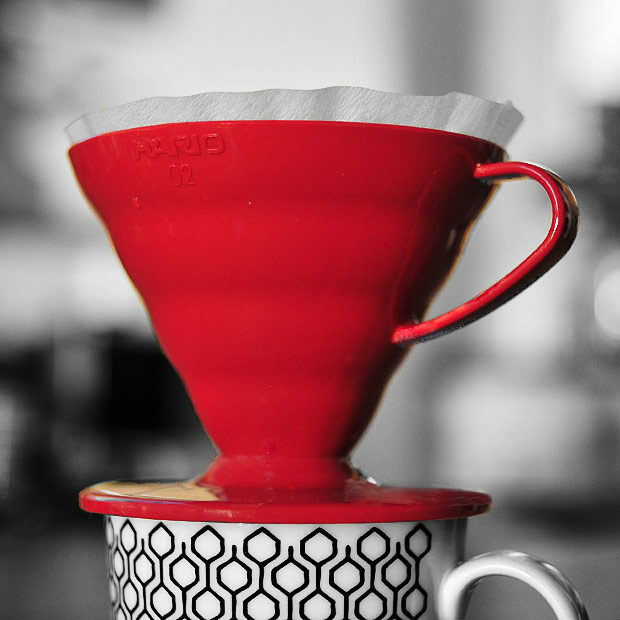
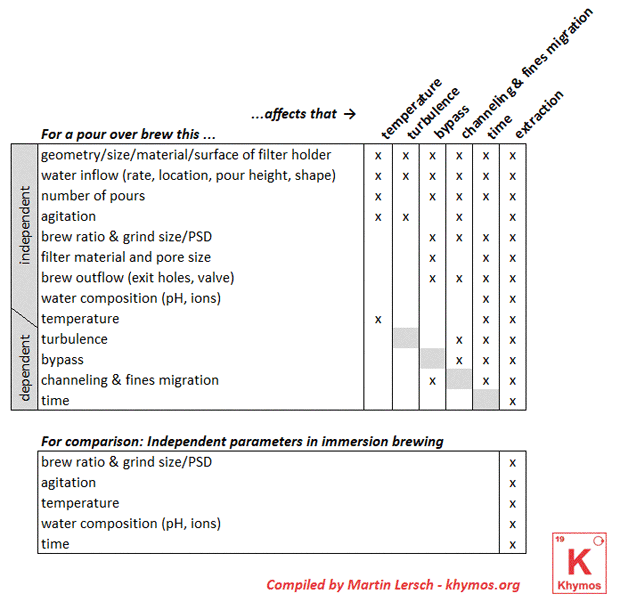
At its core, pour-over brewing involves pouring hot water over ground coffee, allowing gravity to filter the brew through a paper or metal filter into a vessel below. This seemingly straightforward process belies an extraordinary level of complexity, with a surprisingly large number of parameters that can be adjusted, each influencing the final cup. Beyond foundational elements like brew ratio, grind size distribution, water composition, and temperature—discussed in earlier parts of this series—many other factors contribute to the pour-over’s intricate system.
These additional parameters include, but are not limited to: the material and insulation of the filter holder, its internal shape and geometry, the surface texture of the inner walls, the type and design of the filter paper, the method of water inflow control, the design of exit holes, and crucially, the management of bypass flow. The challenge is compounded by the fact that many of these parameters are highly correlated, creating a web of dependencies that makes precise control and accurate prediction difficult.
Consider, for example, the relationship between grind size and particle size distribution (PSD). Finer grinds increase the total surface area available for extraction, accelerating the dissolution of coffee compounds. However, finer particles also impede water flow, extending contact time, and can risk filter clogging, further slowing the process. This dynamic interaction makes grind size a critical determinant of extraction yield and flow rate. Furthermore, grind size and PSD can influence "channeling," where water finds paths of least resistance through the coffee bed, leading to uneven extraction. As the old adage goes, "water is lazy"; it will always seek the quickest route, potentially bypassing significant portions of the coffee bed if not carefully managed. This bypass can be exacerbated by a finer grind and filter holders designed with patterns that reduce filter contact, allowing water to flow around the coffee bed rather than through it.
This intricate web of correlated variables underscores why pour-over brewing is an immensely complex system to master, as evidenced by the proliferation of instructional videos and specialized equipment in the coffee world. Yet, it is precisely this high degree of control that makes pour-over a favorite among professional baristas and home brewers seeking to craft a truly exceptional cup.
The Pitfalls of Complexity: Myths and Inconsistent Recipes
The inherent complexity of pour-over brewing, while offering control, also introduces challenges. Unintended and random variations can easily arise, leading to what some describe as "coffee preparation myths" – anecdotal advice that may work under specific, unstated conditions but fail to generalize. A significant consequence of this complexity is the difficulty in replicating results. Two individuals following the same written recipe may produce vastly different coffees because most recipes, even detailed ones, often fail to account for the full spectrum of parameters and their subtle interactions. This lack of exhaustive detail leaves too much to chance, making consistency an elusive goal without deep understanding and precise control.
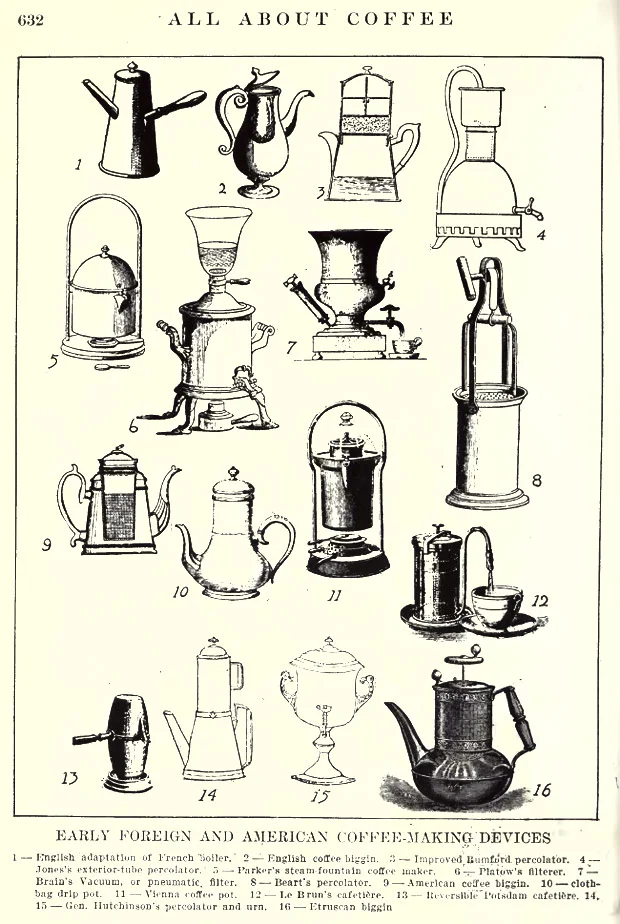
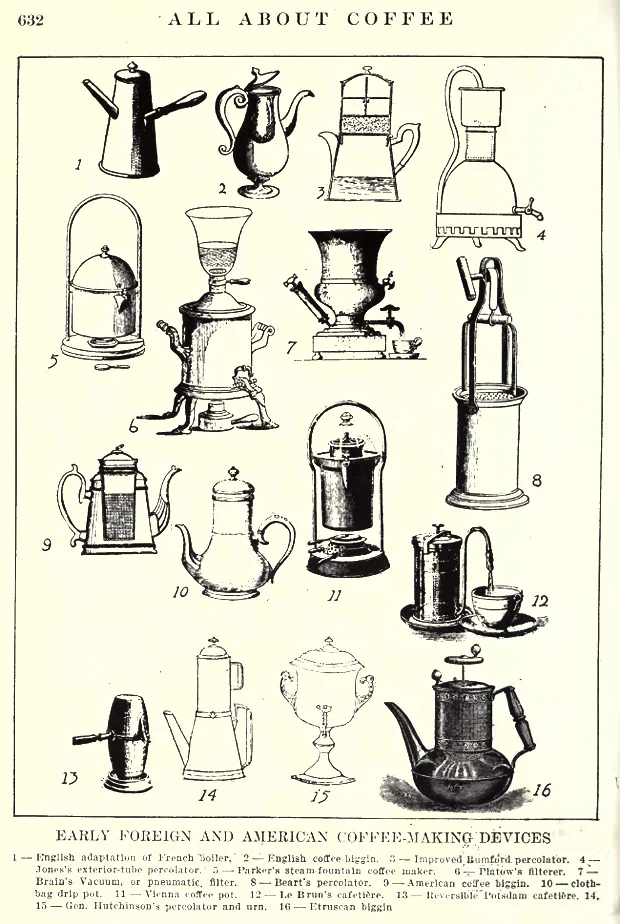
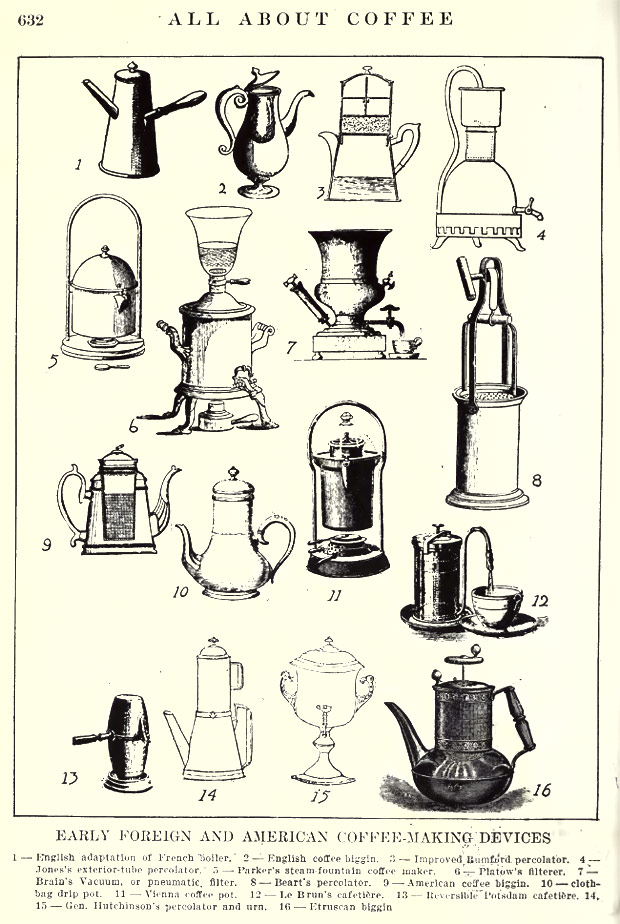
The historical pursuit of brewing perfection is not a new phenomenon. As early as 1922, W. A. Ukers’ seminal work, "All About Coffee," showcased a remarkable diversity of coffee makers, illustrating centuries of innovation aimed at improving extraction. This legacy continues today, with an ever-expanding array of pour-over devices, each featuring subtle design differences intended to address specific aspects of the extraction challenge.
Anatomy of Pour-Over Brewers: Design Choices and Their Impact
Modern pour-over brewers showcase ingenious design variations, each with a specific purpose in untangling the "coffee knot." Key design elements and their implications include:
- Material and Insulation: Temperature stability is paramount during brewing. Materials like metal, being excellent heat conductors, can lead to significant heat loss unless double-walled (e.g., Stagg X/XF) or possessing substantial thermal mass (like an espresso portafilter). Plastic (e.g., Hario V60) or ceramic are often preferred for their cost-effectiveness, limited heat loss, and durability, especially given the frequent handling of filter holders. Glass, while aesthetically pleasing and offering good insulation, is prone to breakage.
- Shape and Geometry: The shape of the filter holder dictates the geometry of the coffee bed, directly influencing water flow. Melitta’s traditional trapezoid shape contrasts with the conical designs of the Hario V60 or the flat-bottomed Kalita Wave. A tall, narrow cylindrical bed maximizes coffee-water contact but slows flow, while a flat bed allows for faster flow but increases the risk of channeling.
- Inside Wall Surface: The texture of the filter holder’s inner walls affects how the paper filter adheres. A smooth surface, as seen in the Chemex, can cause the wet filter to cling, effectively blocking flow along the sides and minimizing bypass. Conversely, ridges or patterns (common in many conical drippers) allow coffee to flow through the filter even when it clings, facilitating drainage and preventing clogging.
- Filter Type: Paper filters are dominant, offering clarity and cleanliness by trapping fines and some oils. Cylindrical brewers like the Aeropress use plain discs, while cone and trapezoid drippers use tailored, unfolded papers. Fines clogging paper filters is a common issue, mitigated by increasing surface area through fluted or W-folded designs (e.g., Kalita Wave). Metal filters, found in some brewers or as alternatives, allow more fines and oils into the cup, contributing to body but potentially increasing bitterness. The Karlsbader brewer is a unique exception, using only a coarse ceramic grating.
- Inflow Control: The manner in which water is introduced is crucial. Simple pouring can disturb the coffee bed, leading to channeling. Gooseneck kettles provide precise control over pouring height and flow rate. More advanced solutions include water distributors like the Gabi Dripmaster B or Melodrip, which feature multiple small holes for an even, gentle shower, ensuring a perfectly flat coffee bed. A drawback, however, is potential temperature loss with uncovered distributors.
- Exit Holes and Outflow Control: The number, size, and design of exit holes, combined with internal surface patterns, determine the overall flow rate. Single, large holes with prominent ridges (e.g., Hario V60) maximize flow, while smaller or fewer holes, or smooth surfaces that allow filter adhesion, reduce it. Some innovative drippers, such as the Clever brewer or Hario Switch, incorporate an on/off valve to restrict or completely halt flow. This allows for an initial immersion phase followed by a controlled percolation, offering superior control over extraction time, especially when scaling recipes.
- Bypass: Water that bypasses the coffee bed without interacting with the grounds merely dilutes the brew without contributing to extraction. Minimizing bypass is a key objective for optimal percolation, as emphasized by coffee scientists like Jonathan Gagné. A plain filter clinging to a smooth surface significantly reduces bypass. Adding water slowly, avoiding a high water column above the coffee bed, also helps. Conversely, ridges, patterned surfaces, or fluted papers can inadvertently increase bypass. The ideal scenario, from an extraction perspective, is for the coffee bed itself to be the primary restriction to water flow, rather than the equipment design. This is why cylindrical filter holders with flat filters situated entirely below the coffee bed, such as the Aeropress, Delter, Tricolate, or Vietnamese Phin, are gaining recognition for their ability to virtually eliminate bypass.
Immersion Brewing: The Pursuit of Repeatability
While pour-over offers unparalleled control, its complexity can be a double-edged sword. For those prioritizing repeatability and a robust, less attention-demanding method, immersion brewing presents an appealing alternative. As a chemist might appreciate, immersion brewing is inherently more forgiving. When two individuals follow the same immersion recipe, they are likely to achieve very similar results, a stark contrast to the variability often seen with pour-over.
In immersion brewing, all coffee grounds are steeped in the full volume of water for a predetermined duration. An initial stir helps to degas the coffee and ensure uniform wetting. After the desired contact time, the brew is separated from the grounds, typically through filtration. Pressure filtration, as seen in the French press or the inverted Aeropress method, is common. A key advantage of pressure filtration is that brewing time can be controlled largely independently of grind size, offering a robust mechanism for managing extraction yield (EY) and total dissolved solids (TDS). Both TDS and EY will increase with steeping time, eventually plateauing as the system approaches equilibrium between the coffee brew and the grounds.
Even though immersion brewing typically uses a coarser grind than a full-extraction technique and often experiences a rapid temperature drop below 90°C, it still achieves a selective extraction. The longer contact time allows for a different balance of compounds to dissolve, often resulting in a rich and flavorful cup. Adjusting extraction time, grind size, and brew ratio further expands the possibilities within this robust method.
The French press, a quintessential immersion brewer, is characterized by its relatively open wire mesh filter. This allows a significant amount of coffee fines to pass into the cup, contributing to a distinctive body and texture, often accompanied by a visible sediment. While some appreciate this mouthfeel, the extended presence of fines can also contribute undesired bitterness. For a cleaner, brighter cup, many recommend filtering French press coffee through a paper filter post-brewing to remove these fines and some oils—an experiment highly recommended for its illuminating effects on flavor perception. Despite these adjustments, immersion coffee can sometimes be perceived as slightly "muted" compared to a well-executed pour-over, reflecting the different extraction dynamics.
The Enduring Quest for the Ideal Brew
The journey through coffee extraction reveals a fascinating intersection of science, art, and innovation. From the meticulous control offered by pour-over methods to the robust simplicity of immersion brewing, each technique presents its own set of advantages and challenges. The quest for the "ultimate cup" is not about finding a single, universally superior method, but rather understanding the scientific principles that underpin each approach and leveraging them to achieve specific sensory goals.
The popular culture depiction of coffee brewing, such as Gale Boetticher’s elaborate setup in "Breaking Bad," brilliantly captures this enduring human aspiration: to craft the very best cup of coffee ever tasted. This ongoing pursuit drives continuous innovation in equipment design, refinement of brewing techniques, and deeper scientific understanding of coffee’s complex chemistry. As the coffee industry continues to evolve, new ideas and technologies will undoubtedly emerge, bringing us closer to unlocking the full, nuanced potential of this beloved beverage. The next chapter in this coffee series promises to explore some of these novel concepts, pushing the boundaries of what is possible in the pursuit of coffee perfection.