
The pursuit of the perfect cup of coffee is a sophisticated blend of chemistry and mechanics, where nuanced flavor profiles emerge from the precise control of extraction. Two primary methods, pour-over and immersion, represent distinct philosophies in this quest, each offering unique advantages and challenges for both professional baristas and home enthusiasts. Understanding the scientific principles underpinning these techniques, alongside the evolution of brewing equipment, is crucial to appreciating the rich tapestry of flavors coffee can offer.
The Chemistry of Coffee Extraction: From Bean to Brew
At its core, coffee brewing is an act of selective extraction. A typical cup of coffee contains thousands of chemical compounds, ranging from highly soluble acids and sugars to less soluble lipids, carbohydrates, and melanoidins, spanning nine orders of magnitude in concentration. The precise solubility and extraction rate of each compound are critical to the final taste. If all compounds were extracted uniformly, the resulting brew would likely be strong but one-dimensional, approaching the composition of the soluble part of the coffee bean—an extraction yield nearing 30%. This might resemble a Turkish coffee, thick and potent, but not necessarily the most desirable flavor profile.
Instead, the goal for many coffee aficionados is a selective extraction. This means intentionally extracting certain compounds to different degrees, creating a complex and balanced flavor profile. This concept often leads to the term "uneven extraction" from a chemical perspective, where the brewer aims to highlight specific characteristics of the coffee bean by manipulating how different compounds dissolve into the water. Key metrics in this process are Total Dissolved Solids (TDS), which indicates the strength of the coffee, and Extraction Yield (EY), representing the percentage of soluble material extracted from the coffee grounds. The Specialty Coffee Association (SCA) provides a brewing control chart that outlines an "ideal" range for TDS (1.15-1.35%) and EY (18-22%), aiming for a balance of strength and flavor. Achieving this balance requires a deep understanding of the variables involved.
A Historical Perspective on Coffee Brewing Innovation
The quest for optimal coffee extraction is not a modern phenomenon. Humans have been brewing coffee for centuries, initially by simply boiling ground beans. The first true "coffee percolator," which used convection to cycle hot water through grounds, emerged in the early 19th century, with inventor Benjamin Thompson (Count Rumford) credited with an early design around 1806. These early percolators, while innovative for their time and popular into the 1970s, often recirculated brewed coffee over the grounds, leading to over-extraction and bitter flavors.
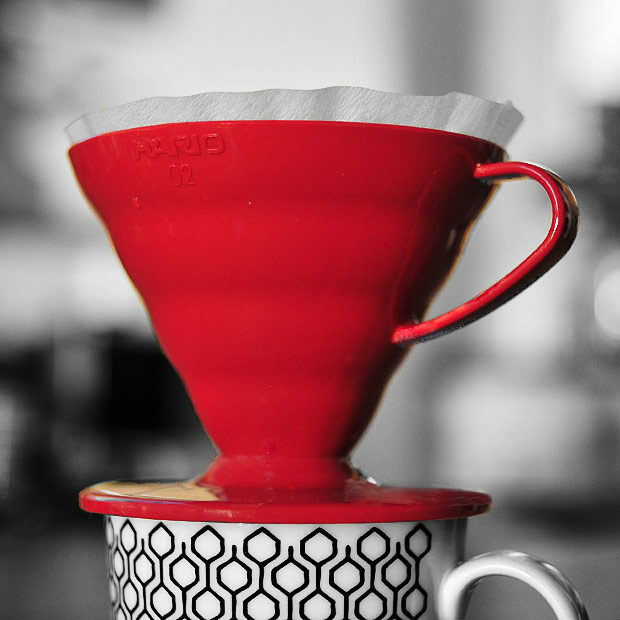
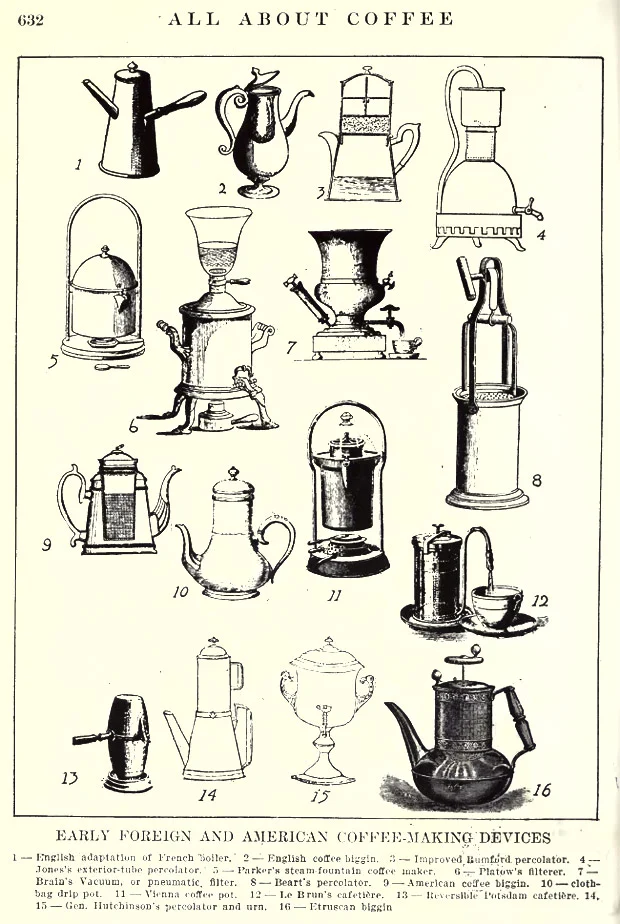
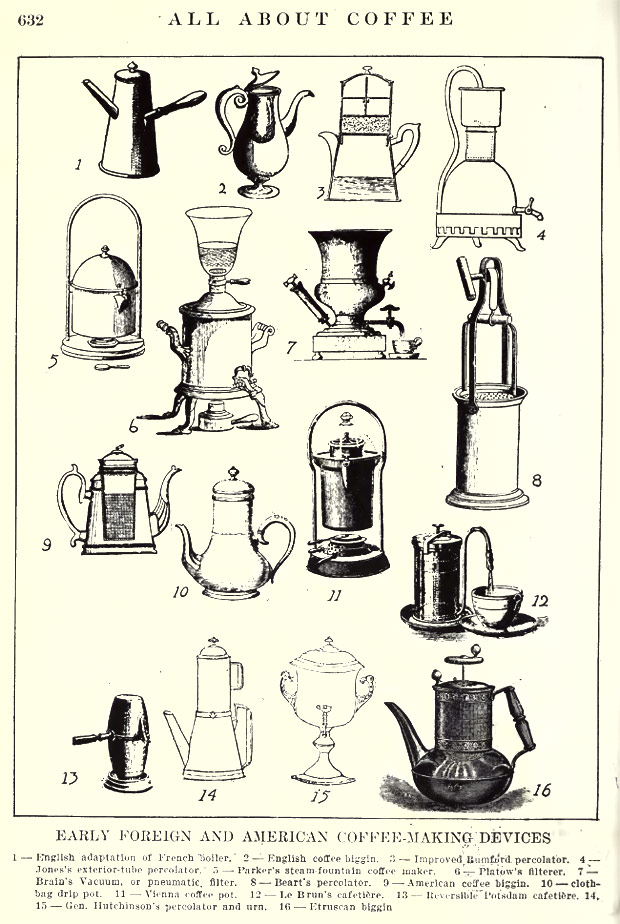
A pivotal moment arrived in 1908 when German housewife Melitta Bentz, seeking a cleaner cup free of grounds, invented the paper coffee filter and the first pour-over cone. This simple innovation revolutionized home brewing by separating the grounds cleanly from the liquid. The 20th century saw further evolution with the Chemex brewer in 1941, designed by chemist Peter Schlumbohm, which combined elegant design with a thick paper filter for an exceptionally clean cup. The latter part of the century and early 2000s ushered in the "third wave" of coffee, characterized by a renewed focus on bean origin, roast quality, and precise brewing techniques. This era saw the introduction of iconic brewers like the Hario V60 in 2004, celebrated for its conical design and large single hole, and the AeroPress in 2005, known for its versatility and immersion-then-press approach. The comprehensive "All About Coffee" by W.A. Ukers, published in 1922, even then illustrated the vast array of coffee makers, demonstrating that the pursuit of brewing perfection has long driven innovation.
Pour-Over Brewing: The Art of Controlled Percolation
Pour-over brewing, or percolation in its purest form, involves pouring hot water over a bed of ground coffee, allowing gravity to filter the brew through a permeable medium into a vessel below. While seemingly straightforward, the method is deceptively complex, offering an immense number of parameters for adjustment, making it a favorite among those who seek ultimate control over their cup.
The Labyrinth of Variables
The final result of a pour-over brew is influenced by a dynamic interplay of factors:
- Grind Size and Particle Size Distribution (PSD): This is perhaps the most critical variable. Finer grinds increase the total surface area available for extraction, leading to a faster and more complete dissolution of compounds. However, too fine a grind can impede water flow, extending contact time excessively and risking over-extraction and bitterness. A wide PSD (many fine particles alongside coarser ones) can lead to clogging and inconsistent extraction, where water finds paths of least resistance, bypassing significant portions of the coffee bed.
- Water Chemistry and Temperature: The composition of the water—its mineral content (hardness, alkalinity), pH, and purity—profoundly affects extraction. Minerals like magnesium and calcium can enhance flavor extraction, while excessive alkalinity can mute acidity. Optimal brewing temperature typically ranges from 90-96°C (195-205°F), balancing efficient extraction with preventing scorching.
- Brew Ratio: The ratio of coffee grounds to water dictates the strength (TDS) of the final brew. Common ratios range from 1:15 to 1:18 (grams of coffee to grams of water), with variations tailored to specific beans and desired strengths.
- Pouring Dynamics: The technique of pouring water is an art form. The "bloom" phase, an initial pour to degas the coffee, prepares the bed for even saturation. Subsequent pours, whether continuous or pulsed, affect agitation, water distribution, and ultimately, channeling—where water carves preferential paths through the coffee bed, leading to under-extraction in some areas and over-extraction in others.
Equipment Design and Its Impact
The design of pour-over drippers plays a significant role in managing these variables and influencing the extraction process. Manufacturers are constantly "untying the coffee knot" by introducing subtle design differences intended to optimize flow, temperature, and contact.
- Material and Insulation: The material of the filter holder affects thermal stability. Metal, being a good conductor, can lead to heat loss unless double-walled and vacuum-insulated (e.g., Fellow Stagg X/XF). Ceramic and plastic (like the polypropylene Hario V60) offer better heat retention and are less fragile than glass, contributing to a more stable brewing temperature.
- Shape and Geometry: The internal shape dictates the coffee bed’s geometry. Cone-shaped drippers (Hario V60, Chemex) create a deeper, narrower bed, promoting longer contact time and potentially higher extraction. Flat-bottomed drippers (Kalita Wave, April Brewer) create a shallower, wider bed, which can lead to faster flow but also increases the risk of channeling if not managed properly. The bed’s depth influences how water flows through the coffee, impacting contact time and extraction uniformity.
- Inside Wall Surface: The internal surface of the dripper interacts with the filter paper. Smooth surfaces (Chemex) can cause wet paper to stick, effectively blocking flow along the sides and minimizing bypass. Drippers with ridges or patterns (Hario V60, Origami) allow water to flow between the filter and the dripper wall, facilitating faster drainage but potentially increasing bypass.
- Filter Types: Paper filters are most common, but metal filters are also used. Paper filters (plain, fluted, or W-folded) significantly impact flow rate and clarity. Plain filters can clog more easily with fines, while fluted or W-folded filters (Kalita Wave) offer increased surface area for filtration, reducing clogging and speeding flow. Coarser filters, like the ceramic grating in a Karlsbader coffee maker, allow more fines and oils through, contributing to body but less clarity.
- Inflow Control: The method of water delivery affects saturation. Gooseneck kettles provide precise control over pouring height and flow rate, minimizing disturbance to the coffee bed and promoting even saturation. Accessories like the Gabi Dripmaster or Melodrip distribute water evenly across the coffee bed through multiple small holes, preventing channeling and ensuring a perfectly flat bed, though some designs may suffer from temperature loss.
- Outflow Control: The number and size of exit holes, along with any integrated valves, control the overall flow rate and contact time. Drippers with a single large hole (Hario V60) generally allow for faster flow, giving the brewer more control through grind size and pouring technique. Drippers with multiple smaller holes (Kalita Wave) tend to create a more restricted, consistent flow. Some innovative designs, like the Clever Dripper or Hario Switch, incorporate a shut-off valve, allowing for an initial immersion phase followed by a controlled percolation, offering a hybrid approach that combines the benefits of both methods and makes scaling recipes easier.
The Bypass Conundrum
A critical, often overlooked, aspect of pour-over brewing is bypass. This refers to water that flows around, rather than through, the coffee bed, directly into the carafe. Bypass water does not participate in extraction and only serves to dilute the brew. While sometimes used intentionally to adjust strength, uncontrolled bypass is generally undesirable as it diminishes flavor concentration and complexity. Jonathan Gagné, in his work on optimal percolation brewing, highlights minimizing bypass as a key principle.
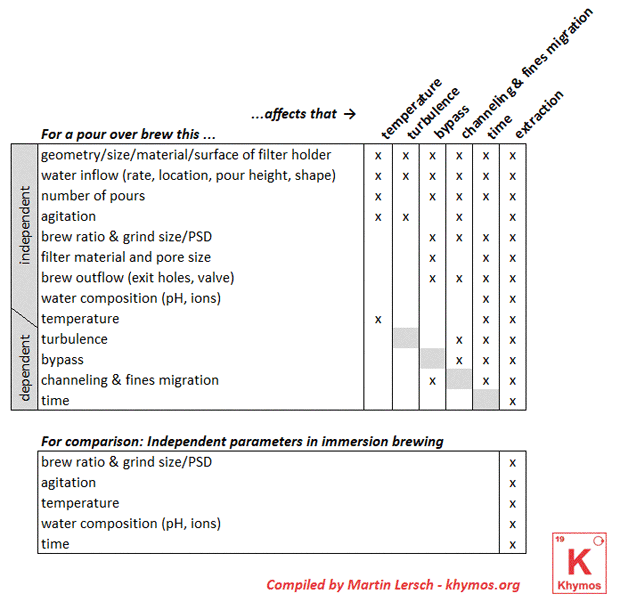
Designs like the Chemex, with its thick filter clinging to a smooth surface, effectively minimize bypass. Conversely, drippers with internal ridges or those using fluted filters can inadvertently increase bypass by creating channels for water to flow along the filter sides. The rate of water addition also influences bypass; if water stands high above the coffee bed, it will naturally seek the path of least resistance, which can be around the edges of the coffee bed rather than through it. From an extraction standpoint, ideally, only the coffee grounds should restrict the flow of water, not the equipment itself (unless it’s a deliberate control mechanism like a valve). The rarity of cylindrical filter holders with a flat filter situated entirely below the coffee bed (like the AeroPress, Tricolate, or Proper) is puzzling, as these designs inherently minimize bypass by forcing all water through the coffee puck.
Challenges of Repeatability and the Rise of Myths
The sheer number of interdependent variables in pour-over brewing makes it an immensely complex system to accurately describe and control. This complexity is both its strength, offering immense creative control, and its weakness. It often leads to unintended variations and the proliferation of "coffee preparation myths." Two individuals following the "same" recipe may produce vastly different cups simply because most recipes fail to account for all the intricate parameters with sufficient detail—from water chemistry to the specific pouring height and filter adhesion. This lack of explicit control contributes to the perception that coffee brewing is more art than science, though ongoing research seeks to demystify these variables.
Immersion Brewing: Robustness and Reproducibility
In contrast to the delicate dance of pour-over, immersion brewing offers a more robust and repeatable approach. Here, all the coffee grounds are steeped in the full volume of hot water for a set duration, allowing for a near-equilibrium extraction. The slurry is often stirred initially to ensure even saturation and degasification. After the desired contact time, the brew is separated from the grounds by filtration, often under pressure.
Principles of Immersion
Immersion brewing is inherently less susceptible to variables like pouring technique or channeling. Because the coffee grounds are fully submerged, every particle has an equal opportunity for extraction, leading to a more consistent flavor profile. The primary controls are brew ratio, grind size, water temperature, and crucially, steep time. Longer steep times generally lead to higher TDS and EY, approaching equilibrium between the coffee brew and the grounds. While the grind size is typically coarser than for pour-over, and temperature often drops below 90°C relatively quickly, immersion brewing still achieves a selective extraction, often yielding a wonderfully balanced cup.
Key Immersion Devices
- French Press: Characterized by a relatively open wire mesh filter, the French Press allows a significant amount of fines and oils to pass into the cup. This contributes to a full-bodied, rich texture, often with a visible sediment at the bottom. While many appreciate this mouthfeel, the extended contact with fines can sometimes introduce undesirable bitterness or a "muddy" flavor. To achieve a cleaner taste, some enthusiasts filter French Press coffee through paper, which removes fines and some oils, resulting in a clearer, though sometimes slightly less viscous, beverage.
- AeroPress (Inverted Method): When brewed inverted, the AeroPress functions as a pure immersion brewer. Coffee and water steep together before being pressed through a paper filter (or metal filter) under pressure. This method offers excellent control over steep time and grind, producing a clean cup with good body and minimal sediment.
- Clever Dripper: This device represents a popular hybrid, combining the immersion of a French Press with the clean filtration of a pour-over. It features a stop valve at the bottom, allowing coffee to steep fully before being released through a paper filter, offering the best of both worlds: robust extraction and a clean cup.
Advantages and Disadvantages
The main advantage of immersion brewing is its repeatability. Given the same recipe, two different individuals are likely to produce very similar cups. This makes it a foolproof method that requires less meticulous attention than pour-over. It also excels at producing a full-bodied cup. However, immersion can sometimes lead to a "muted" flavor profile compared to a perfectly executed pour-over, as the less selective extraction might not highlight the brightest acidity or most delicate aromatics. The presence of sediment in methods like the French Press is also a point of contention for some.
The Evolving Landscape of Coffee Makers: Bridging the Gap
The ongoing innovation in coffee equipment reflects the persistent quest for the ultimate cup. Manufacturers are keenly aware of the complexities and trade-offs inherent in different brewing methods. Many new designs aim to bridge the gap between the control of pour-over and the repeatability of immersion. Hybrid brewers like the Clever Dripper and Hario Switch exemplify this, allowing for initial immersion before transitioning to percolation, granting brewers the ability to fine-tune contact time independent of grind size or flow rate.
Designers of these myriad devices, from the vacuum-insulated Stagg X/XF prioritizing thermal stability to the Tricolate focusing on zero bypass and even water distribution, are all "untieing the coffee knot." Their intentions are clear: to minimize uncontrolled variables, enhance extraction uniformity, and improve repeatability. This drive is further supported by technological advancements in related fields, such as smart kettles offering precise temperature control, high-precision grinders achieving consistent particle size distribution, and refractometers providing instant TDS readings for objective feedback. These tools empower both professional baristas and home users to approach coffee brewing with greater scientific rigor.
Broader Implications: The Third Wave and the Quest for Perfection
The rise of the "third wave" coffee movement has profoundly influenced how coffee is perceived and prepared. It shifted the focus from mass consumption to appreciating coffee as an artisanal product, emphasizing single-origin beans, specific roast profiles, and meticulous brewing. This movement has elevated the role of the barista from a beverage preparer to a skilled artisan and, in many ways, a chemist. They are expected not only to execute recipes but also to understand the underlying science, troubleshoot issues, and educate consumers.
This cultural shift has also led to a burgeoning market for specialized coffee equipment and a wealth of educational content, from online forums to countless YouTube tutorials dissecting every aspect of pour-over technique. The pursuit of the "very best cup of coffee we have ever tasted" has become a global phenomenon, resonating with anyone who has experienced a truly exceptional brew. The memorable scene in "Breaking Bad" where Gale Boetticher meticulously explains his elaborate coffee extraction setup to Walter White perfectly captures this passionate, almost obsessive, dedication to scientific precision in the service of flavor. It underscores that the quest for coffee perfection is not just a niche hobby but a cultural touchstone.
The journey to the perfect cup remains dynamic, driven by scientific inquiry, innovative design, and a passionate global community. While the complexities of pour-over offer unparalleled control and the robustness of immersion provides dependable consistency, the ongoing evolution of brewing methods promises even more exciting possibilities in the future of coffee, pushing the boundaries of what is achievable in flavor, aroma, and experience.