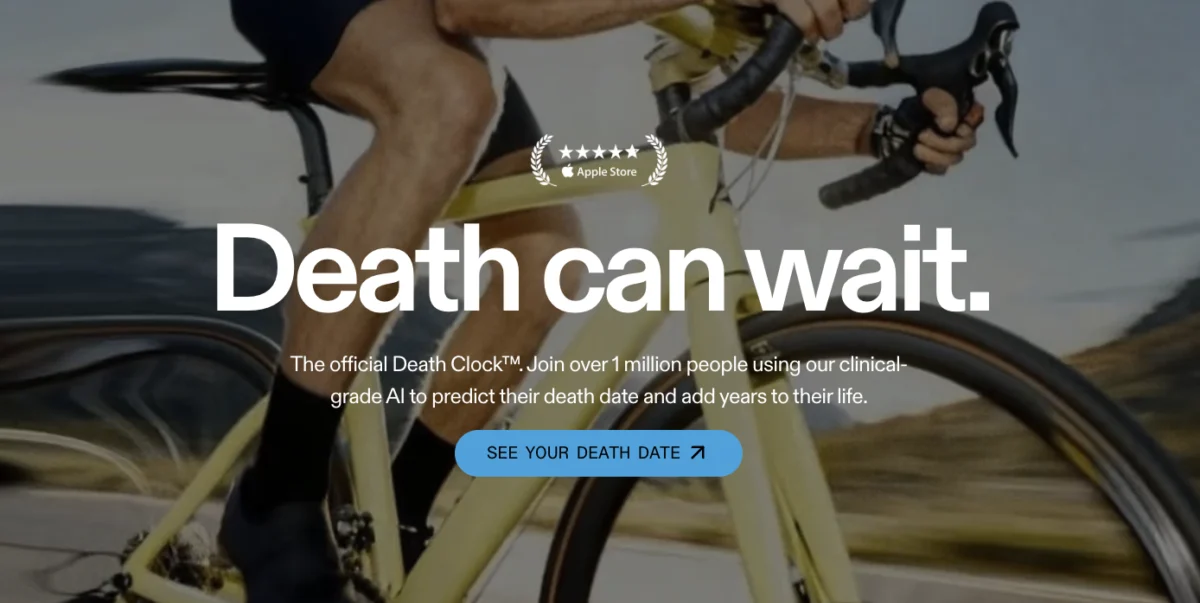

In the dynamic and often unpredictable landscape of technological innovation, a new player has emerged with a proposition that is as provocative as it is profound: an application designed to predict an individual’s lifespan. Brent Franson, the founder and CEO of Death Clock, has leveraged a pivotal moment of entrepreneurial crisis to birth a digital tool that is rapidly capturing global attention. The genesis of Death Clock can be traced back to the unceremonious end of Franson’s previous venture, a health-tracking application that, despite raising a substantial $10 million in funding, ultimately failed to gain market traction. Faced with the imminent demise of his company, Franson embarked on a radical pivot, a strategic maneuver that led to the creation of an app with a name that is as audacious as its premise.
"It’s probably a really, really stupid idea to actually name it Death Clock," Franson candidly admitted during an appearance on The Spoon Podcast. He further elaborated on the calculated risk involved, stating, "But if it’s a good idea, it’s a really good idea. It’s an 80 percent chance it’s a terrible idea. But there’s a 20 percent chance that it’s a really good idea." This admission underscores the high-stakes gamble Franson took, transforming a moment of existential dread for his company into a potentially groundbreaking service for individuals.
The app’s unexpected virality, driven in no small part by its attention-grabbing moniker, belies a deeper philosophical and data-driven foundation. Franson’s conviction stems from his personal experiences and his observations of the limitations within the current healthcare system, particularly its shortcomings in fostering lasting behavioral change and prioritizing preventative care. "What I became pretty convinced of in my life is that our healthcare system is just not very good at helping people change behavior," Franson explained. "It’s not good at preventative health. And that’s really obvious in addiction." This critique forms the bedrock of Death Clock’s mission, aiming to empower individuals with insights that the traditional medical establishment, in Franson’s view, often fails to provide effectively.
At the heart of Death Clock lies a sophisticated artificial intelligence engine, meticulously trained on an extensive corpus of longevity research. This AI is engineered not merely to offer a grim prediction, but to serve as a catalyst for proactive health management. "We trained an AI on 1,200 longevity studies to make a few predictions," Franson revealed. "One, it predicts the day you’re going to die. And two, it predicts how much longer it thinks you can live if you manage your health." This dual-pronged approach—predictive and prescriptive—positions Death Clock as more than just a morbid curiosity; it is a tool designed to incentivize and guide users towards healthier lifestyles.
The initial reception to Death Clock surpassed even Franson’s optimistic 20% probability. The app rapidly ascended the charts of app stores worldwide, resonating with a palpable, pent-up demand for accessible and effective preventative health solutions that operate independently of conventional healthcare pathways. This enthusiastic user adoption validated Franson’s thesis that a significant segment of the population is actively seeking ways to take control of their health and longevity beyond the confines of traditional medical advice.
Expanding Horizons: The Launch of Life Lab
Building upon the success and foundational insights derived from Death Clock, the company has now unveiled its ambitious next phase: Life Lab. This innovative offering, described as an AI-powered health concierge, is seamlessly integrated within the existing Death Clock application. Life Lab aims to democratize access to personalized health insights by consolidating nationwide blood testing services, advanced biomarker tracking, and the secure integration of uploaded physician records. The overarching goal, as articulated by Franson, is to provide everyday consumers with a "private doctor quality roadmap."
The impetus for Life Lab is rooted in Franson’s astute observation of socioeconomic disparities in healthcare access and outcomes. "The number one factor that determines how long you’re going to live is how much money you have," he stated. "Basically, the more money you have, the more you can opt out of the healthcare system and cash pay for good preventative health." Life Lab is engineered to bridge this gap, leveraging sophisticated software to provide a level of personalized health intelligence previously attainable only by those with significant financial resources. By aggregating diverse health data points and applying advanced AI analysis, Life Lab aims to offer a comprehensive, actionable, and personalized health strategy for a broader demographic.
Navigating the Longevity Frontier: A Critical Perspective
Death Clock’s emergence places it squarely within Silicon Valley’s burgeoning longevity sector, a field attracting substantial investor interest and fostering a discourse around radical life extension. However, Franson maintains a discerning and often critical stance on the more extreme aspects of this movement. While acknowledging the genuine underlying demand for improved health and longevity, he expresses significant reservations about what he perceives as excessive claims and a lack of transparency at the fringes of the industry.

"Selling immortality is one of the oldest frauds in the book," Franson asserted, drawing a clear distinction between his company’s objectives and those espousing unattainable promises. "If you’re insinuating that if you buy my stuff, you might not die, I think that’s reckless. And I think it gives everybody in the space a bad name." This principled stance highlights Franson’s commitment to grounded, evidence-based approaches rather than speculative, potentially misleading marketing.
Instead of pursuing the elusive goal of immortality, Franson has strategically calibrated Death Clock’s mission towards a more achievable and impactful objective: "helping 100 million people live 10 years longer." This ambitious yet realistic target underscores the company’s focus on tangible improvements in healthspan and quality of life. "That’s not live forever. That’s just being healthier for longer," Franson clarified, reinforcing the pragmatic philosophy that guides Death Clock’s development and outreach.
Data-Driven Predictions and Ethical Considerations
The underlying technology of Death Clock relies on the extrapolation of vast datasets from longitudinal studies. These studies, often spanning decades and involving tens of thousands of participants, provide crucial insights into the correlation between lifestyle choices, genetic predispositions, environmental factors, and mortality. By analyzing these complex relationships, the AI can identify patterns and predict probabilistic outcomes. For instance, a prominent study published in the New England Journal of Medicine in 2018 analyzed data from over 500,000 individuals and identified key risk factors for premature death, including diet, exercise, smoking, and alcohol consumption. Such research forms the empirical basis for Death Clock’s predictive models.
The ethical implications of providing users with a projected lifespan are significant. While Franson emphasizes the app’s role in promoting healthier behaviors, concerns may arise regarding potential psychological distress, anxiety, or fatalism among users who receive unfavorable predictions. Death Clock’s strategy to mitigate these risks appears to lie in its dual prediction model, which immediately offers a path toward improvement through health management. This approach frames the prediction not as a fixed destiny, but as an actionable starting point for positive change. The company’s commitment to transparency regarding the probabilistic nature of its predictions and the limitations of AI in forecasting complex biological systems will be crucial for maintaining user trust.
The Broader Impact on Preventative Healthcare
The success of Death Clock and the introduction of Life Lab signal a potential paradigm shift in how individuals engage with their own health. By offering accessible, AI-driven insights and tools, these platforms challenge the traditional gatekeepers of health information and intervention. This democratization of health data could empower individuals to become more active participants in their well-being, fostering a culture of proactive self-care.
Furthermore, the model pioneered by Death Clock could exert pressure on the established healthcare industry to adapt and innovate. The demand for personalized, preventative health solutions, as evidenced by Death Clock’s rapid growth, suggests a market ripe for disruption. Healthcare providers and insurers may need to explore partnerships with such technology companies or develop their own integrated solutions to remain competitive and meet evolving patient expectations.
The company’s strategic positioning within the longevity movement, coupled with its grounded approach, suggests a potentially sustainable business model. While the allure of "living forever" may capture headlines, the practical pursuit of "living healthier for longer" resonates with a broader audience and addresses a more immediate human desire. In a field often characterized by hype and unfulfilled promises, Franson and Death Clock are charting a course defined by data, pragmatism, and a touch of dark humor, a combination that may prove to be a uniquely effective strategy for long-term success.
The full conversation with Brent Franson is available for listening on Apple Podcasts and Spotify.