
The past year has brought the concept of exponential growth into sharp public focus, largely in the context of the SARS-CoV-2 virus’s alarming spread. This mathematical phenomenon, often counterintuitive in its progression—appearing dormant before a sudden, dramatic acceleration—explains both the rapid escalation of global health crises and, surprisingly, the unseen power behind a global surge in home baking. As lockdowns confined populations worldwide, a fascinating culinary counter-narrative emerged: a steep rise in home baking, particularly with yeast, leading to unprecedented demand and widespread shortages of this humble but essential ingredient. This surge illuminated the critical role of microbial growth in daily life and prompted a re-evaluation of how home bakers manage their resources, leveraging scientific principles to maximize scarce supplies.
The Pandemic’s Culinary Shift: A Global Phenomenon
The onset of the COVID-19 pandemic in early 2020 triggered widespread lockdowns, stay-at-home orders, and a dramatic shift in global lifestyles. With restaurants closed, social gatherings restricted, and commuting eliminated for many, individuals found themselves with unprecedented amounts of time at home. This period catalyzed a profound resurgence in domestic activities, with home baking emerging as one of the most prominent trends. From sourdough starters meticulously nurtured to simple bread loaves and intricate pastries, kitchens around the world became sites of culinary experimentation and comfort.
This shift was not merely anecdotal; it was reflected in tangible market data. Reports from food retailers globally indicated a massive spike in sales of staple baking ingredients. Flour sales soared, with some regions experiencing a 100-200% increase in demand. Crucially, yeast—the microscopic engine of leavened baked goods—became a hot commodity. In countries like Norway, where the original observation was made, yeast packets were reportedly sold out for weeks and even months. This phenomenon was replicated across continents, from North America to Europe and Australia, as consumers emptied supermarket shelves in pursuit of the elusive leavening agent. The sudden, overwhelming demand for small retail packets of yeast far outstripped the existing supply chain capacity, which was primarily geared towards steady, predictable consumer purchase patterns or bulk industrial use. This unexpected bottleneck underscored the fragility of supply chains in the face of rapid shifts in consumer behavior driven by unforeseen global events.
Exponential Growth: A Double-Edged Sword
At the heart of both the pandemic’s spread and the baker’s craft lies the principle of exponential growth. This concept describes a process where the rate of change of a quantity is proportional to the quantity itself, leading to increasingly rapid growth over time. Its counterintuitive nature is famously illustrated by the ancient "wheat and chessboard problem," where placing one grain of wheat on the first square, two on the second, four on the third, and so on, quickly leads to an astronomically large number of grains on the final squares, far exceeding global production. Similarly, a virus, starting with a few cases, can rapidly overwhelm healthcare systems due to its exponential transmission.
In a more benign, yet equally powerful context, yeast demonstrates this principle with remarkable efficiency. Saccharomyces cerevisiae, the common baker’s yeast, is a single-celled fungus that reproduces through a process called budding. Under ideal conditions—optimal temperature (typically around 25-35°C), sufficient nutrients (sugars), adequate moisture, and access to oxygen—a single yeast cell can grow and divide into two new cells in approximately 100 minutes. This constitutes a full life cycle in less than two hours. The implications of this rapid doubling are profound:
- After 100 minutes: 1 cell becomes 2.
- After 200 minutes (approx. 3.3 hours): 2 cells become 4.
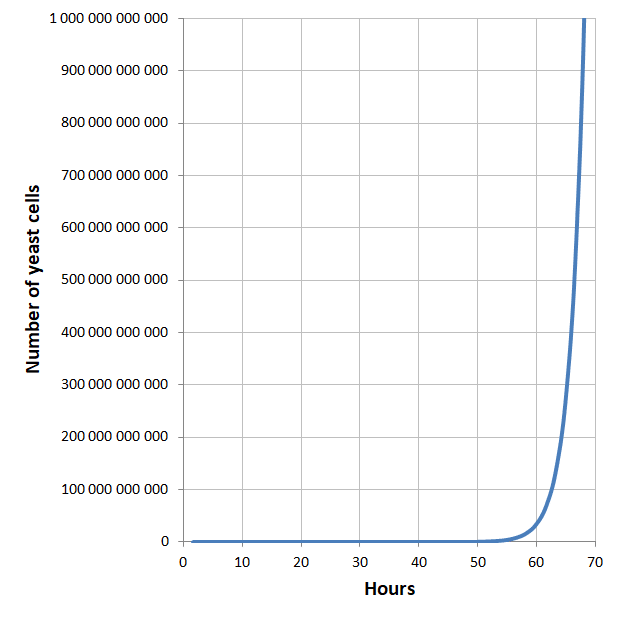
- After 24 hours (14.4 doubling cycles): A single cell can proliferate into approximately 16,384 cells (2^14.4).
- After 48 hours (28.8 doubling cycles): The count surges to roughly 268 million cells (2^28.8).
- Before 72 hours (3 days): The population can reach an astonishing one trillion (1,000,000,000,000) yeast cells.
To put this into perspective, a typical 50-gram block of compressed fresh yeast contains a similar order of magnitude of active yeast cells. While such exponential growth rates are achievable in commercial yeast production facilities under tightly controlled, nutrient-rich environments, the conditions within a bread dough are considerably more challenging. Factors like limited oxygen, fluctuating temperatures, competition for nutrients, and the accumulation of metabolic byproducts (like alcohol) all serve to slow down the proliferation rate. Nevertheless, the underlying principle remains: given enough time and suitable conditions, a minuscule initial population of yeast can generate a vast colony capable of thoroughly leavening a dough.
Strategic Yeast Management: Maximizing a Scarce Resource
The widespread yeast shortages during the pandemic forced many home bakers to reconsider their traditional methods. Instead of adhering to recipes that often call for relatively large quantities of yeast for quick leavening, bakers adopted a more judicious and scientific approach: using significantly smaller amounts of yeast and compensating with extended fermentation times. This "less yeast, more time" philosophy became a cornerstone of pandemic-era baking.
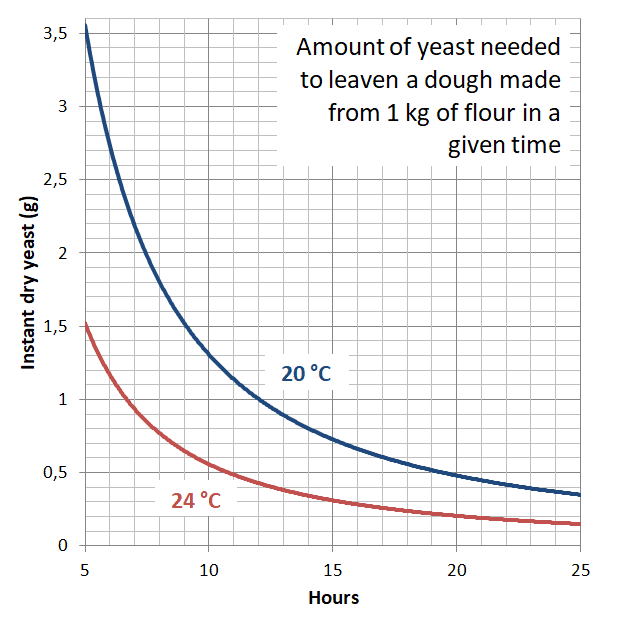
This strategy is rooted in the understanding of yeast’s exponential growth. If a small initial population of yeast is given sufficient time in a conducive environment, it will naturally multiply to the required numbers to effectively leaven the dough. For example, a dough made with 1 kilogram of wheat flour might traditionally call for 7-10 grams of instant dry yeast for a quick rise. However, by allowing a much longer fermentation period—say, 20 hours at a moderate room temperature of 20°C—the amount of instant dry yeast can be drastically reduced to as little as 0.48 grams. This micro-dosing approach not only conserves precious yeast supplies but also yields superior results in terms of flavor and texture.
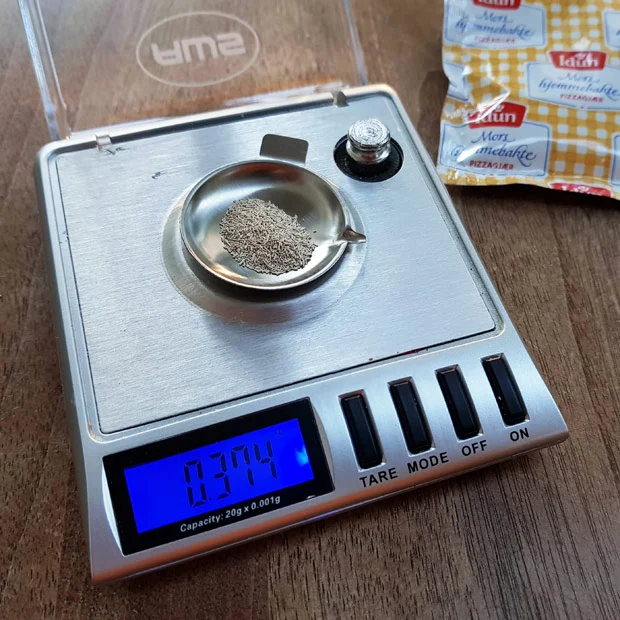
Achieving such precision in yeast measurement necessitates specialized tools. Standard kitchen scales, which typically measure in whole grams or tenths of grams, are insufficient for quantities as small as 0.48 grams. This led to an increased interest in and purchase of digital balances capable of measuring with a precision of 0.001 grams. While these are not laboratory-grade instruments, they are significantly more accurate than conventional kitchen scales and have become increasingly affordable for home use. The investment in such equipment allowed home bakers to meticulously control their ingredients, optimizing the use of their limited yeast reserves and ensuring consistent, high-quality results even with minimal quantities. This practice highlighted how understanding the science of ingredients could empower home cooks to overcome supply chain challenges.
Technological Aids for the Modern Baker
The digital age also played a crucial role in empowering home bakers during this period. The proliferation of smartphone applications dedicated to culinary calculations offered invaluable assistance in optimizing baking processes. Among these, the "PizzApp+" for Android devices gained particular prominence as a comprehensive tool for calculating precise ingredient quantities for various doughs.
PizzApp+ stands out for its versatility and accuracy. Users can input desired parameters such as flour weight, proofing time, and ambient temperature, and the app will provide the exact quantities of water, salt, and critically, yeast. It accommodates different types of yeast—fresh compressed yeast, active dry yeast, and instant dry yeast—as well as liquid and firm sourdough starters. This flexibility made it an indispensable companion for bakers looking to adapt recipes or experiment with new techniques, especially when dealing with limited yeast.
For instance, the app’s ability to calculate that only 0.48 grams of instant dry yeast are needed for 1 kilogram of flour when proofing for 20 hours at 20°C provided a practical, data-driven solution to the yeast shortage. It demystified the process, allowing even novice bakers to confidently employ long fermentation methods. Such applications effectively bridged the gap between scientific principles and practical home baking, demonstrating how technology could enhance culinary skills and resource management in times of scarcity. Their user-friendly interfaces and robust algorithms contributed significantly to the democratization of advanced baking techniques.
Beyond Leavening: The Flavor Dimension of Slow Fermentation
While the primary function of yeast is leavening, the "less yeast, more time" approach offers significant culinary benefits extending far beyond mere conservation. Long, slow fermentation fundamentally transforms the flavor profile and texture of baked goods. When yeast is allowed to work gradually over many hours, it has more time to consume sugars and produce a wider array of metabolic byproducts, including various alcohols and organic acids, which contribute to a more complex and nuanced flavor.
Crucially, extended fermentation periods also create an environment conducive to the growth and activity of lactic acid bacteria (LAB). These bacteria, naturally present in flour, are the unsung heroes behind the distinctive tang and depth of sourdough bread. Even in "straight doughs" made with commercial yeast, a prolonged bulk fermentation allows LAB to proliferate. They convert sugars into lactic and acetic acids, which impart desirable sour notes, enhance the bread’s aroma, and contribute to a more open, irregular crumb structure. This contrasts sharply with quick-rise doughs, which often yield a simpler, sometimes "yeasty" flavor and a more uniform texture.
The development of these organic acids also has practical advantages, such as improving the dough’s extensibility and elasticity, making it easier to handle, and potentially extending the bread’s shelf life. By embracing slow fermentation, pandemic bakers inadvertently elevated the quality of their homemade bread, discovering that patience was not just a virtue for conserving yeast but also a key ingredient for superior taste and texture. This revelation deepened many individuals’ appreciation for the artisanal aspects of bread making.
The Sourdough Alternative and the Allure of Instant Yeast
Amidst the yeast shortages, many aspiring bakers turned to sourdough as a self-sufficient alternative. Sourdough relies on a "starter"—a symbiotic culture of wild yeasts and lactic acid bacteria—to leaven bread. Nurturing a sourdough starter became a widespread activity, symbolizing resilience and a deeper connection to traditional food preparation. Sourdough offers unique benefits: a distinct tangy flavor, a chewy texture, and the satisfaction of creating bread from scratch without relying on commercial yeast. It also carries perceived health benefits, such as improved digestibility due to the predigestion of gluten and starches by the microbial community.
However, sourdough baking comes with its own set of challenges. It requires a significant time commitment, meticulous maintenance of the starter, and a steeper learning curve compared to using instant yeast. The convenience, reliability, and relatively quicker results offered by instant dry yeast remain undeniably alluring for many. For those with busy schedules or new to baking, instant dry yeast provides a dependable and accessible entry point into the world of homemade bread, offering consistent performance with minimal fuss.
Even as sourdough enjoyed a renaissance, the enduring appeal of instant yeast highlights its practical advantages. It requires no prior preparation, activates quickly, and stores well. For many, the choice between sourdough and instant yeast often boils down to a balance between artisanal pursuit and everyday convenience. The pandemic, while pushing many towards sourdough, also solidified the position of instant dry yeast as an indispensable tool for the modern home baker, especially when its use is optimized through scientific understanding.
Broader Implications and Future Trends
The global baking boom and subsequent yeast shortages during the COVID-19 pandemic have left a lasting impact on consumer behavior, supply chains, and the broader culinary landscape. The experience fostered a renewed appreciation for home cooking and baking, with many individuals acquiring new skills and adopting new habits. While the intensity of home baking may have receded from its peak as economies reopened, a significant segment of the population is expected to continue their culinary pursuits, valuing the freshness, control over ingredients, and personal satisfaction derived from homemade food.
For manufacturers and retailers, the episode served as a crucial lesson in supply chain resilience. The sudden, unprecedented surge in demand for specific retail-packaged goods highlighted vulnerabilities and prompted a re-evaluation of inventory management, production capacities, and distribution networks to better withstand future unexpected market shifts. The ability to quickly pivot production lines or anticipate demand spikes for niche products will be critical.
Furthermore, the pandemic accelerated the integration of technology into everyday culinary practices. The widespread adoption of baking apps like PizzApp+ indicates a growing openness among home cooks to leverage digital tools for precision and optimization. This trend is likely to continue, with more sophisticated applications emerging to assist with meal planning, ingredient sourcing, and technique refinement.
Finally, the emphasis on using less yeast and adopting longer fermentation times has brought a more sustainable and mindful approach to baking into the mainstream. This practice not only conserves resources but also elevates the quality of the final product, encouraging patience and a deeper understanding of the biological processes involved in food preparation. The insights gained from observing exponential growth, both in a global health crisis and in the humble yeast packet, have underscored the interconnectedness of scientific principles with practical, everyday life, leaving an indelible mark on how we approach our kitchens and our world.