The pursuit of an exceptional cup of coffee has evolved significantly, moving beyond simple daily ritual to embrace a rigorous scientific methodology. This shift, driven by a burgeoning community of enthusiasts and professionals, highlights the intricate interplay of chemistry and physics in transforming roasted beans into a complex, aromatic beverage. Modern coffee appreciation, often termed the "third wave," champions traceability, quality, and a profound understanding of every stage from cultivation to brewing. For many, this journey begins with a practical need for caffeine, transitioning over years into a sophisticated appreciation for nuanced flavors and the scientific principles that unlock them. The extraordinary circumstances of recent years, such as the social restrictions of 2020, further propelled home-based experimentation, leading individuals to delve deeper into the mechanics of coffee brewing. Structured tasting experiences, like coffee advent calendars offering 24 days of blind tasting, reveal the profound impact of origin and processing methods on flavor profiles. Simultaneously, practical challenges, such as inconsistencies in pour-over techniques, underscore the need for controlled, reproducible methods, pushing enthusiasts down a "rabbit hole" of scientific inquiry.
The Evolution of Coffee Appreciation: From Necessity to Nuance
Coffee consumption historically served as a stimulant, its primary role being to provide energy and focus. For many, the transition from occasional to regular consumption is often linked to demanding routines, such as long commutes or intensive academic pursuits like a PhD. Initially, the focus remains on the caffeine content. However, as familiarity deepens and palates develop, the appreciation broadens to encompass the diverse flavor spectrum of coffee. This personal evolution mirrors a larger cultural shift – the rise of the "third wave of coffee." This movement, particularly vibrant in regions like Scandinavia, emphasizes high-quality, single-origin beans, lighter roasts that highlight inherent varietal characteristics, and meticulous brewing methods. Monthly coffee subscriptions, curated from various roasters across Norway, Sweden, and Denmark, exemplify this trend, offering a consistent supply of specialty beans for exploration. This cultural backdrop sets the stage for a more scientific approach to brewing, moving away from conventional wisdom towards empirical understanding. Previous explorations into extraction, whether concerning water, oil, ethanol, or even beer brewing, provide a foundational understanding for dissecting the complexities of coffee. However, the sheer volume of scientific information and practical insights that have emerged in the last decade, particularly concerning pour-over and drip coffee, underscores a rapid acceleration in this field.

The Scientific Toolkit: Key Parameters for Controlled Extraction
Achieving consistency and optimizing flavor in coffee brewing relies on understanding and controlling several critical parameters. These factors, ranging from the macroscopic to the microscopic, collectively dictate the final sensory experience.
Brew Ratio (BR)
The brew ratio (BR) is a fundamental metric, defining the amount of water used relative to the mass of ground coffee. Expressed as water mass divided by coffee mass (e.g., 1000g water / 60g coffee = BR 16.7), it serves as the cornerstone for any coffee "recipe." Similar to the baker’s percentage in baking, BR provides a simple, scalable method for remembering and adjusting brewing parameters. Typical brew ratios for black coffee generally fall within the range of 15:1 to 25:1 (water to coffee). This ratio is crucial for scaling recipes up or down, ensuring proportional consistency regardless of the batch size. Understanding and consistently applying a specific brew ratio is the first step towards reproducible results and a deeper understanding of how coffee strength can be manipulated.
Total Dissolved Solids (TDS) and Refractometry
The strength of coffee, often perceived as its intensity, is objectively measured by its Total Dissolved Solids (TDS) content. TDS represents the percentage of soluble compounds extracted from the coffee grounds into the water. While a high TDS can sometimes be misinterpreted as bitterness, it primarily indicates concentration. Adjusting TDS, often by simply adding hot water to an overly strong brew, can dramatically unlock latent fruity flavors or temper excessive bitterness. Measuring TDS traditionally involved gravimetric methods – evaporating a sample to dryness and weighing the residue. However, this method is impractical for daily brewing, requiring laboratory-grade balances to detect the minute amounts (1.2-1.5% for typical coffee, corresponding to 6-7mg in a 500mg sample).
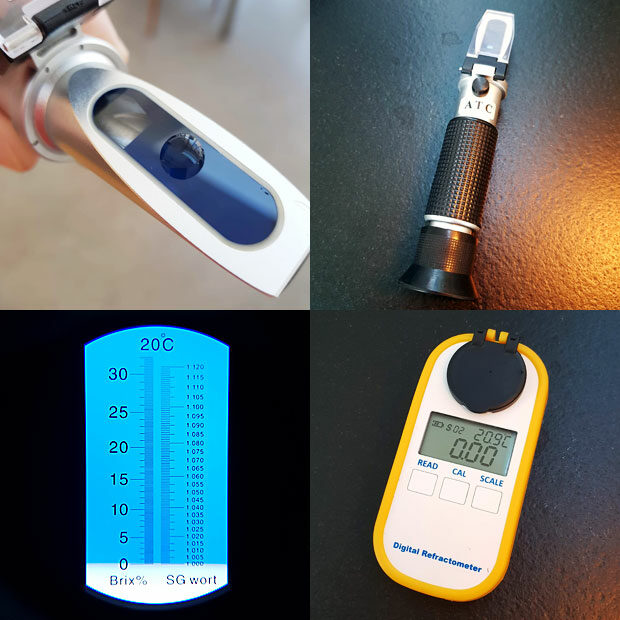
A more accessible and practical method for measuring TDS utilizes refractometry. Light travels at different speeds through pure water versus water containing dissolved solids, causing a change in refractive index. This phenomenon is leveraged by refractometers. Analog handheld refractometers, readily available with a %Brix scale, offer a cost-effective solution. %Brix can be converted to %TDS by multiplying by approximately 0.85 (a factor verifiable with instant coffee solutions). These handheld devices typically provide a resolution of 0.0-0.2 %Brix, sufficient to confirm if a brew falls within the normal TDS range (e.g., 1.4-1.8 %Brix, equating to 1.2-1.5 %TDS). While not precise enough for fine-tuning, they are invaluable for identifying overly strong or weak brews and distinguishing strength from bitterness or astringency. Furthermore, handheld refractometers offer versatility in the kitchen, useful for applications like sorbet preparation (aiming for 26 %Brix) or beer brewing (with an SG scale). Digital refractometers offer superior accuracy (e.g., 0.01 °B readout) and automatic TDS conversion but come at a higher price point.
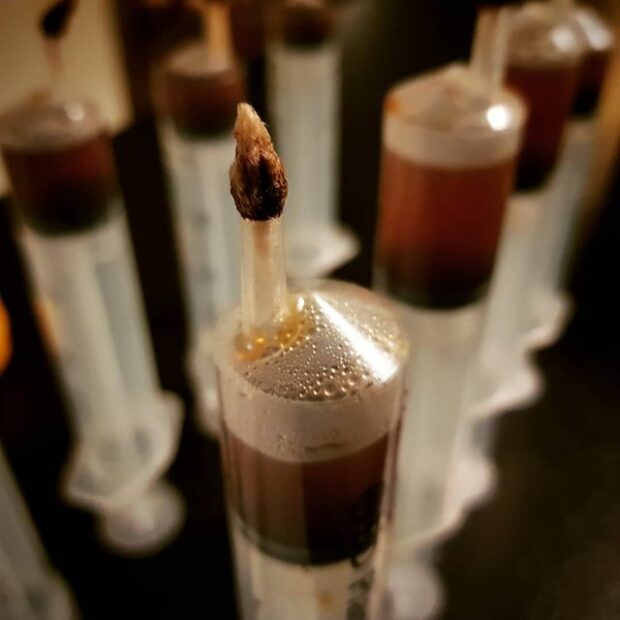
For accurate TDS measurement during extraction, samples must be hot-filtered to halt further extraction and then cooled completely before measurement. A practical, DIY solution involves using plastic syringes with a cotton plug for hot filtering and subsequent cooling. This minimizes evaporation and eliminates the need for expensive lab-grade syringe filters. It’s a testament to the fact that over 98% of black coffee is water, a fact often hard to grasp given its intense flavor profile.
Extraction Yield (EY and EEY)
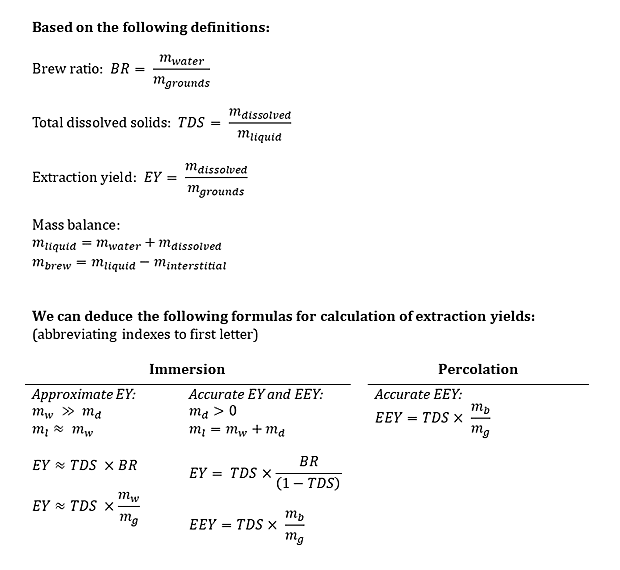
Building upon TDS measurements, the Extraction Yield (EY) quantifies the percentage of soluble material removed from the coffee grounds. This metric is crucial for understanding the efficiency of the brewing process and its impact on flavor. The calculation of EY can become complex, particularly for percolation brews where interstitial liquid between grounds needs consideration. Two distinct definitions are often employed:
- Extraction Yield (EY): Calculated based on the total liquid mass, including any liquid remaining in the grounds.
- Effective Extraction Yield (EEY): Focused on the dissolved solids delivered specifically to the cup.
For immersion brews (where all liquid is mixed), EY and EEY can differ. For percolation brews (like pour-over), where interstitial liquid doesn’t make it to the cup, EY often approximates EEY as the calculation focuses on the liquid that does end up in the cup. This distinction is vital both from an economic perspective (maximizing yield in the cup) and a flavor perspective (understanding what has been removed from the grounds). Formulas derived from BR and TDS allow for both approximate and precise calculations, taking into account the mass contributed by dissolved solids themselves.
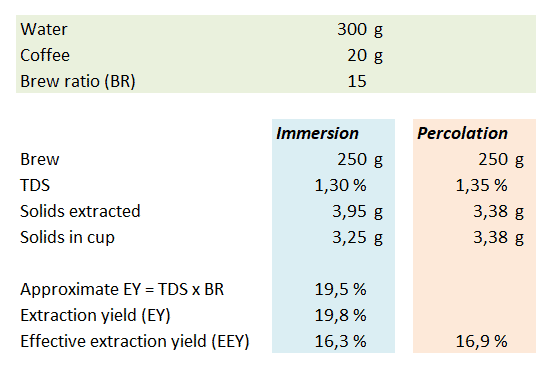
For example, using 300g water and 20g coffee to yield 250g brew:
- An immersion brew with 1.30% TDS implies approximately 3.95g dissolved solids, leading to an EY of 19.8% (precise) and an EEY of 16.3%.
- A percolation brew with 1.35% TDS in the cup yields 3.38g dissolved solids, resulting in an EEY of 16.9%.
This example clearly illustrates that while immersion may extract more from the grounds into the total liquid mass, percolation can be more effective at delivering those solids into the final cup. The difference in extracted mass (e.g., 3.95g vs. 3.38g) directly explains the sensory variations between immersion and percolation methods, as the composition of extracted compounds will not be identical. While calculating EY, factors like evaporation (which affects brew ratio and temperature) and the inherent water content of roasted beans (1-4%) are often disregarded for practical simplicity, though they contribute to the overall accuracy. Precision in weighing coffee grounds and measuring TDS directly impacts the reliability of yield calculations. A small uncertainty in TDS (e.g., 0.02%) can translate to a notable uncertainty in the calculated EY, especially with less accurate tools like handheld refractometers.
Grind Size and Particle Size Distribution (PSD)
The grinding of roasted coffee beans is a critical step, as it dictates the surface area available for extraction. However, grinding is not a uniform process; beans shatter into a distribution of particle sizes, from large "boulders" to extremely small "fines" (typically defined as particles under 100 µm). Understanding this Particle Size Distribution (PSD) is paramount. Visualizing PSD can be misleading if only volume distribution is considered. While fines may constitute a small percentage by volume, they can represent a vast number of particles and, crucially, a disproportionately large surface area. Indeed, surface area distribution reveals that over half of the extraction can occur from particles smaller than 100 µm. This is significant, especially considering preliminary research suggesting that coffee particles are only extracted to a depth of approximately 100 µm, leaving the core of larger particles unextracted – essentially "wasted" coffee. Larger particles, however, are not without purpose; they form the structural bed of a filter, facilitating flow and reducing drawdown time in pour-over methods.
The ideal particle size and distribution for pour-over coffee generally favor a narrow distribution, minimizing fines to prevent clogging and promote consistent flow rates. Cheap blade grinders produce a highly uneven grind with an excessive amount of fines, rendering them unsuitable for quality brewing. Burr grinders, available in various materials and geometries (flat or conical), are the preferred choice. While high-end industrial grinders can achieve exceptionally narrow PSDs, suggesting that commercially pre-ground filter coffee could theoretically offer a more uniform grind than most home equipment, the rapid oxidation of ground coffee necessitates grinding beans fresh, immediately before brewing. The question of optimizing PSD for home brewers remains an area of active experimentation, with ideas like double grinding (coarse followed by fine) or the use of specialized sieves (e.g., from Kruve) or even adapted grain mills for pre-crushing. Discussions around the merits of flat versus conical burrs are ongoing, with flat burrs often favored in higher-end machines for their potential to produce more uniform grinds, sometimes with specific designs optimized for espresso (which benefits from some fines) or pour-over (where fines are less desired). Ultimately, the choice of grind size is often a balance between maximizing extraction and ensuring an adequate flow rate, especially in pour-over methods, while Aeropress circumvents flow rate issues with pressure-assisted filtration.
Beyond the Grind: Other Critical Factors in Coffee Brewing
While brew ratio, TDS, and PSD are central to extraction mechanics, several other factors significantly influence the final cup.
Freshness of Beans
The freshness of roasted coffee beans is non-negotiable for optimal flavor. Roasted coffee contains volatile aromatic compounds that are susceptible to oxidation when exposed to air. This oxidation process leads to the degradation of desirable flavors and the development of stale, rancid notes as oils turn rancid. Storing beans in airtight, opaque bags, ideally purged with an inert gas like nitrogen, helps preserve their integrity. Once a bag is opened, the clock starts ticking; quality rapidly declines within days. Therefore, grinding coffee only immediately before brewing is paramount, as grinding vastly increases the surface area exposed to oxygen. For longer-term storage, refrigeration or freezing can slow down the chemical reactions responsible for staling.
Water Composition
Water is not merely a solvent; its mineral composition profoundly impacts coffee flavor. Just as in beer and tea brewing, specific mineral profiles in water enhance or detract from the extraction of certain compounds. Hardness minerals like magnesium and calcium, along with bicarbonates, play key roles in buffering acidity and facilitating the extraction of desirable flavors. Soft water, common in regions like Norway, may require mineral supplementation to achieve an optimal brewing profile. Conversely, areas with very hard water might benefit from using distilled water and adding specific salts. Specialized water recipes and online calculators allow brewers to adjust their tap water’s mineral content, replicating ideal profiles for coffee extraction. This area of coffee science is dynamic, with ongoing research refining our understanding of optimal water chemistry.
Temperature
Temperature is a critical variable influencing the kinetics and selectivity of extraction. The solubility of various chemical compounds, as well as their diffusion rates, increases with higher temperatures. To maximize extraction efficiency, brewing close to 100 °C is generally recommended for hot coffee. However, "maximum extraction" does not always equate to the "best possible cup," as excessive temperatures can lead to the extraction of undesirable bitter compounds. Conversely, cold brewing intentionally utilizes lower temperatures (e.g., in a refrigerator) to achieve a slower, more selective extraction over an extended period. Cold brews yield a distinct flavor profile, often characterized by lower acidity and bitterness, due to the temperature-dependent solubility of compounds. When comparing hot and cold brews, it’s also important to consider the serving temperature, as the perception of sweetness and bitterness can weaken as a beverage cools, while sourness and saltiness remain more consistent.
Filter Material
The choice of filter material significantly affects both the clarity and mouthfeel of the final brew. Paper filters are the most common and are highly effective at retaining fine particles, leading to a "cleaner" cup profile. The ability to detect microscopic particles is remarkably acute; for example, in chocolate, a "just notable difference" in particle size can be as small as 5 µm. This explains why a French press, which uses a coarse metal mesh, produces a "muddy" or "full-bodied" cup compared to the "clean" taste of a Chemex, which employs a very thick paper filter, leaving a visible residue in the former. Reusable filters made of metal, cloth, or nylon offer cost savings but often allow more fines and oils to pass through.
Beyond particle retention, paper filters also absorb some oils, which contribute significantly to the taste and mouthfeel in an espresso. Experimenting with metal filters in pour-over setups (e.g., V60, Kalita) can provide a benchmark for understanding the contribution of these oils. Within paper filters, choices abound: bleached versus unbleached. While environmental concerns often drive the preference for unbleached, bleached filters typically contain fewer residues that could impart off-flavors, as the bleaching process removes lignin and hemicellulose, leaving purer cellulose. Modern bleaching techniques largely avoid chlorine, using other oxidizing agents. The scientific study of filter paper, including pore size and its dynamic changes when wet, reveals a complex field where material science directly impacts brewing performance.
Implications and Future Directions
The meticulous investigation of coffee brewing parameters offers profound implications for both home enthusiasts and the commercial coffee industry. For the home brewer, a scientific understanding transforms the daily ritual into an informed, experimental process, enabling consistent quality and the ability to troubleshoot undesirable flavors. For cafes and roasters, this knowledge is critical for maintaining product consistency, optimizing extraction efficiency, and innovating new brewing techniques.
The parameters discussed can be prioritized for exploration, starting with the most impactful:
- Brew Ratio, Total Dissolved Solids, and Extraction Yield: These interconnected metrics form the foundation for understanding and controlling the strength and efficiency of extraction. Without a handle on these, other adjustments may yield inconsistent results.
- Grind Size and Particle Size Distribution: Crucial for managing extraction rates and flow dynamics, especially in percolation methods.
- Freshness of Beans: The quality of the raw material is paramount; even perfectly extracted stale beans will disappoint.
- Water Composition: While impactful, its influence is often less pronounced than the initial three parameters, especially if basic parameters are uncontrolled.
- Temperature: Fine-tuning temperature allows for nuanced control over extraction kinetics and solubility.
- Filter Material: A more subtle influence, affecting clarity and mouthfeel.
The "Coffee Compass" tool, developed by Barista Hustle, provides a practical framework for diagnosing and adjusting brewing parameters based on sensory feedback (e.g., too sour, too bitter, too weak). This iterative approach, combining scientific measurement with sensory evaluation, embodies the modern coffee enthusiast’s journey.
While much progress has been made, ongoing research continues to uncover new insights into the complex chemistry of coffee extraction. Future developments may include more accessible and precise tools for home brewers, advanced computational models for predicting optimal brewing parameters, and a deeper understanding of the health implications of various coffee compounds. The scientific pursuit of the perfect brew is an ever-evolving field, promising even more refined and delightful coffee experiences.