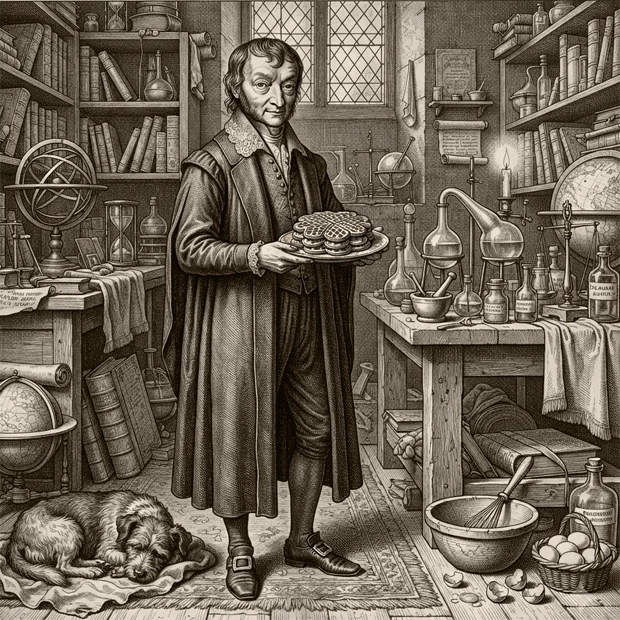

The intersection of quantitative chemistry and culinary arts has yielded an unusual digital tool: a parametric waffle recipe generator named in honor of physicist and chemist Amedeo Avogadro. Released on August 9, 2026—the exact 250th anniversary of Avogadro’s birth—the application attempts to bridge the gap between historical kitchen intuition and mathematical modeling. Developed by culinary science enthusiast Martin Lersch, the platform known as "Avogadro" calculates custom waffle batters in real time based on user-selected ingredients and physical property sliders, drawing on a corpus of approximately 1,000 traditional Scandinavian recipes.
Main Facts and System Architecture
Unlike traditional digital cookbooks that rely on a static database of pre-recorded formulas, Avogadro operates entirely on parametric generation. Users select base components across categories such as liquids, dairy, fats, eggs, starches, and sweeteners, subsequently adjusting sliders that dictate properties like sweetness, richness, and tanginess.
The application instantly computes a precise batter formulation measured in grams, scaled dynamically to the number of eggs selected. Accompanying this output is a "waffle heart quality indicator," a visual diagnostic tool that provides immediate feedback on two metrics: structural viability (whether the batter will cook successfully) and compositional typicality compared to existing real-world waffle standards.
The generator features two distinct interfaces: a standard mode tailored for casual users with simplified controls and restricted ingredient lists, and an expert mode that exposes the full parameter set. Expert mode grants access to all eight operational sliders, an expanded pantry of ingredients, and advanced structural presets, allowing creators to explore formulations outside the scope of published literature.
Historical Context and Genesis of the Project
The conceptual roots of the Avogadro generator stretch back more than a decade. The project originated in 2014, when Lersch initially conceptualized the system, producing primitive interface mockups and preliminary mathematical models in Microsoft Excel. At the time, computational constraints, interface limitations, and competing priorities stalled the project, leaving it dormant for twelve years.

The conceptual breakthrough that enabled the tool’s eventual realization stemmed from an extensive archival undertaking. Over years of research, Lersch compiled a database of roughly 1,000 historical waffle recipes, predominantly originating from Norway and other Scandinavian regions.
This archival work exposed a recurring methodological challenge in historical baking literature: older recipes frequently omitted precise measurements, relying instead on qualitative instructions such as "add flour until the batter has the right consistency." This reliance on tacit knowledge—the unwritten, experiential understanding of culinary practitioners—sparked a fundamental research question: Where is the precise boundary that separates a viable waffle batter from an unusable mixture?
To answer this, the system was designed to mathematically codify what generations of home cooks understood implicitly through practice.
Chronology of Development
The timeline of the Avogadro project highlights the gradual intersection of culinary anthropology and software development:
- 2014: Initial project conception, drafting of early interface wireframes, and creation of a rudimentary Excel-based batter calculation model.
- 2014–2025: Accumulation and standardization of a corpus of approximately 1,000 historic Scandinavian waffle recipes to identify common compositional ratios and structural baselines.
- Early 2026: Revitalization of the software architecture, transitioning the Excel model into a responsive, live-calculating web application featuring ternary plotting mechanics and real-time validation indicators.
- August 9, 2026: Official public launch of the Avogadro platform, coinciding globally with the 250th birth anniversary of Amedeo Avogadro.
Supporting Data and the Mathematics of the Waffle
The naming convention of the application derives directly from Avogadro’s Number ($6.02214076 times 10^23$), the fundamental physical constant that defines the number of constituent particles, such as atoms or molecules, in a mole.
By calculating every possible permutation of ingredient selections and slider positions, the Avogadro generator yields approximately $10^27$ distinct control settings. When evaluated against Avogadro’s Number, the digital parameter space encompasses roughly 1,660 moles’ worth of theoretical waffle batters.

However, culinary and data scientists note an important caveat regarding this vast theoretical scope. The existence of $10^27$ control settings does not translate to an equivalent number of distinct culinary outcomes. System rounding, the mathematical pruning of trace ingredients, and physical constraints mean that many distinct control combinations resolve to identical formulations. Furthermore, a significant subset of the theoretical parameter space falls outside the boundaries of physical viability—generations of chemical interactions that would yield uncookable liquids or solids, flagged appropriately by the application’s quality indicator.
Implications for Culinary Science and Gastronomy
The launch of the Avogadro generator reflects a broader trend toward the application of quantitative methods and data modeling within modern gastronomy. By treating recipe development as a parametric equation rather than a fixed narrative, tools of this nature allow researchers and home cooks to systematically explore the culinary space between established regional traditions and experimental cuisine.
Food science analysts point out that while commercial waffle mixes often occupy chemically distinct positions compared to traditional artisanal recipes—frequently leaning toward the fringes of standard quality indicators without sacrificing consumer appeal—such tools provide empirical backing to subjective kitchen practices. By converting qualitative instructions like "proper consistency" into verifiable mass-to-volume ratios, the software offers a reproducible framework for studying texture, structure, and flavor integration in baked goods.
Community Involvement and Future Outlook
Because it is statistically impossible for any single researcher to manually test $10^27$ batter formulations, the developer has positioned the launch as an open-ended collaborative experiment. Users engaging with either the standard or expert modes are encouraged to report edge-case anomalies, structural failures, or exceptional culinary discoveries back to the platform.
Rather than presenting a finished, immutable encyclopedia of baking, Avogadro functions as an interactive exploratory engine—inviting chemists, bakers, and enthusiasts to mark the 250th anniversary of one of science’s most influential theorists by testing the mathematical limits of the humble waffle.