
The statement encapsulates a pervasive fear within modern diet culture, one that even highly qualified experts like Dr. Gabrielle Fundaro, a PhD in Human Nutrition with over a decade of coaching experience and six powerlifting competitions under her belt, found herself confronting. Despite her extensive credentials and practical experience in the nuanced world of nutrition, Dr. Fundaro admitted that the meticulous practice of macro tracking, once a cornerstone of her approach, had ceased to serve her. What began as a tool for precision and control had evolved into a source of anxiety, trapping her in a cycle of dependence and apprehension about letting go.
For years, macro counting was Dr. Fundaro’s steadfast companion, a method she employed to maintain her dietary discipline and physique. It was a strategy that offered tangible numbers and a clear framework, providing a sense of "being on track." And for a considerable period, it worked, delivering predictable results and aligning with the common fitness narrative of optimizing nutrient intake for performance and aesthetics. However, the efficacy of this external tracking mechanism eventually waned, replaced by a growing fatigue and mental burden. The constant calculation, the inability to spontaneously enjoy a meal without scrutinizing its macro composition, and the pervasive worry about deviations began to erode her confidence and joy around food.
The thought of discontinuing macro tracking, however, was unsettling. This trepidation is a common experience among individuals deeply embedded in quantitative dietary methods. The fear stems from a perceived loss of control and the uncertainty of navigating food choices without explicit guidelines. Dr. Fundaro articulated these anxieties candidly: "What if I don’t eat enough protein, and lose all my muscle?" "What if I overeat and gain fat?" And perhaps most acutely for an expert in her field, "What if I have no idea how to fuel myself without tracking macros? And what does that say about me as an expert in the field of nutrition?" These questions highlight the psychological dependence that can develop around such precise tracking, where internal bodily cues are often overridden or ignored in favor of external metrics.
The Search for a Sustainable Alternative to Rigid Tracking
As Dr. Fundaro wrestled with the growing dissatisfaction of macro tracking, her desire for an alternative intensified. She sought a method that could harmonize her nutritional goals with a renewed sense of freedom and peace concerning food. The existing popular alternatives, however, presented their own challenges. Calorie counting, while a fundamental aspect of energy balance, felt equally, if not more, restrictive than macro tracking. It merely shifted the focus of numerical adherence without addressing the underlying psychological rigidity.
Intuitive eating, an approach that emphasizes listening to the body’s internal hunger and fullness cues, also didn’t immediately resonate with her. After years of meticulously adhering to external targets—her macro numbers—Dr. Fundaro found her internal compass dulled, her trust in her own instincts diminished. The transition to pure intuition felt too unstructured, too reliant on a sensitivity she felt she had lost or suppressed. This dilemma underscores a critical gap in the landscape of dietary approaches: a need for a framework that offers guidance without the shackles of strict quantification, bridging the divide between rigid rules and complete self-direction.
The genesis of her innovative solution emerged from an entirely different domain: her powerlifting training. Dr. Fundaro had begun incorporating the Rate of Perceived Exertion (RPE) scale into her lifting regimen. RPE is a psychophysiological tool that allows individuals to subjectively quantify the intensity of their physical effort during exercise. It provides a structured way to gauge exertion, helping athletes train safely and effectively, adapting to their body’s daily fluctuations rather than rigidly sticking to pre-set weights or reps. Dr. Fundaro observed that by using RPE, she was not only becoming stronger but also recovering more effectively. The synergy between a structured framework and intuitive self-assessment in her training was remarkably effective, leading to a profound realization.
From the Gym Floor to the Dinner Plate: The Birth of RPE-Eating
The "aha!" moment struck Dr. Fundaro with the clarity of a Newtonian insight: if RPE could optimize her physical training by blending structure with intuition, couldn’t a similar framework be applied to eating? This pivotal question led to the development of the RPE-Eating Scale, a revolutionary approach designed to help individuals navigate their food choices with greater self-awareness and trust.
Since its inception, the RPE-Eating Scale has provided Dr. Fundaro and her clients with a powerful tool to regain confidence and self-trust around food, enhance nutritional awareness and competence, and ultimately liberate themselves from the relentless demands of food tracking. Dr. Fundaro herself, once bound by macro targets, now trusts her eating choices without a tracker in sight, embodying the freedom she champions.
Understanding the RPE Framework: A Foundation for Internal Guidance
To fully appreciate RPE-Eating, it’s essential to understand its origins in the fitness world. The Rate of Perceived Exertion (RPE) scale was initially developed by Swedish psychologist Gunnar Borg in the 1960s. Borg’s original scale ranged from 6 to 20, designed to correlate with heart rate during exercise (e.g., an RPE of 12 might correspond to a heart rate of 120 bpm). Over time, many modern fitness applications, including Dr. Fundaro’s adaptation, have adopted a simplified 0-10 scale for ease of use and broader applicability.
The RPE scale in fitness operates as follows:
| Rating | Perceived Exertion Level |
|---|---|
| 0 | No exertion, at rest |
| 1 | Very light |
| 2-3 | Light |
| 4-5 | Moderate, somewhat hard |
| 6-7 | High, vigorous |
| 8-9 | Very hard |
| 10 | Maximum effort, highest possible |
Initially utilized in physiotherapy for rehabilitation, RPE has become a widely accepted and valuable tool in various fitness settings. Powerlifters, for instance, use it for autoregulation, adjusting their training loads based on how demanding a set feels on a given day, rather than strictly adhering to pre-planned percentages. Pregnant individuals might use it to ensure they maintain a safe level of exertion without overdoing it.
The power of RPE lies in its acknowledgment of human subjectivity. Training intensity is not purely an objective measure of weight lifted or speed achieved; it is also a subjective experience influenced by sleep, stress, nutrition, and recovery. The RPE scale empowers exercisers to judge their own effort, fostering autonomy. While a coach might suggest "aim for a 7/10 this set," the ultimate interpretation rests with the individual, allowing for a personalized and responsive training approach. Dr. Fundaro recognized this principle as deeply valuable – a way to provide structure without removing individual agency. This appreciation for personalized, internally guided effort was the direct inspiration for her RPE-Eating Scale.
The RPE-Eating Scale: Applying Perceived Exertion to Nourishment
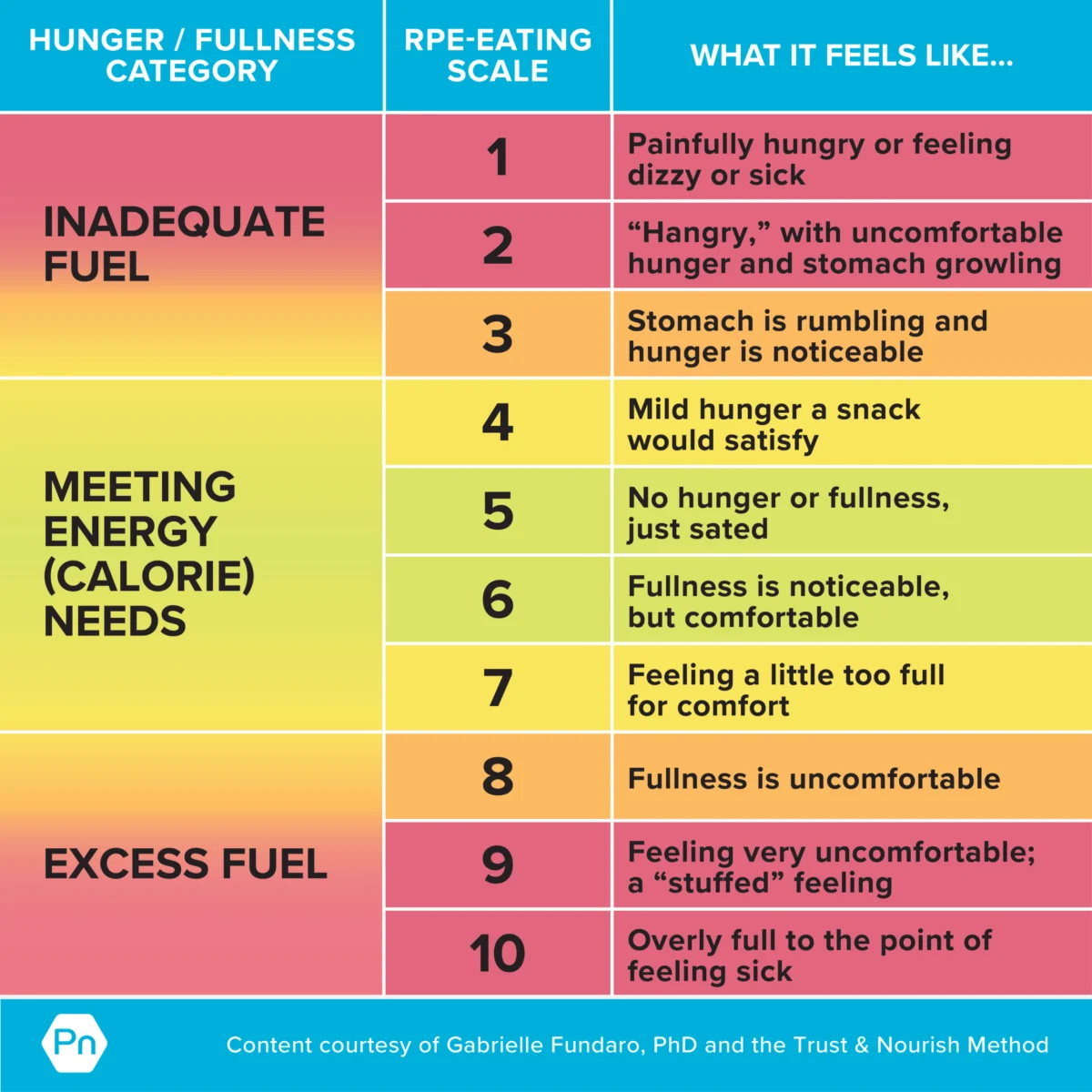
Dr. Fundaro meticulously adapted the 0-10 scale and its core principles to the realm of eating, creating a framework for assessing hunger and fullness. The RPE-Eating Scale provides a continuum of sensations, from painful hunger to uncomfortable fullness, offering a structured language for internal experience:
RPE-Eating Scale: Hunger and Fullness
| Rating | Hunger/Fullness Sensation |
|---|---|
| 1 | Painfully hungry, dizzy or sick |
| 2 | "Hangry," uncomfortable hunger, stomach growling |
| 3 | Hunger noticeable, stomach rumbling |
| 4 | Mild hunger, a snack would satisfy |
| 5 | No hunger or fullness, just sated |
| 6 | Noticeable fullness, but comfortable |
| 7 | A little too full for comfort |
| 8 | Uncomfortable fullness |
| 9 | Very uncomfortable or "stuffed" |
| 10 | Overly full to the point of feeling sick |
The fundamental goal of RPE-Eating mirrors its fitness counterpart: to develop the skill of determining what is sufficient for you, individually, without reliance on external metrics such as calorie counts, macro targets, or restrictive dietary rules. It’s about cultivating interoceptive awareness, the conscious perception of internal bodily states, and using this awareness to guide nutritional decisions.
Practical Implementation: How to Practice RPE-Eating
Like any new skill, mastering RPE-Eating requires consistent practice and patience. It’s particularly challenging if one has spent years overriding internal cues with external rules. Dr. Fundaro emphasizes that immediate perfect attunement is not the expectation; rather, it’s a gradual process of relearning and rebuilding trust.
Step #1: Clarify Your Goals Beyond Body Composition
A critical first step is to redefine one’s motivation for engaging with RPE-Eating. Dr. Fundaro stresses that this is not merely another diet aimed at body alteration or exerting more control over food. While it can be adapted for specific physique goals like muscle gain or fat loss, it is not the most direct or efficient method for extreme changes. Its primary purpose is far more profound: "It’s about sensing into what your body needs and giving yourself appropriate nourishment—while building inner trust and confidence along the way."
This reframing is crucial, especially for those accustomed to diet-centric thinking. It requires a willingness to trust the body’s inherent wisdom and accept that bodily changes might occur as a result of shifting away from rigid control. The challenge lies in letting go of the expectation of hitting "optimal" macros at every meal and embracing a more holistic, responsive approach to nourishment. For individuals seeking to cultivate greater self-trust and a healthier relationship with food, RPE-Eating serves as an invaluable tool.

Step #2: Practice Identifying Your Hunger Cues
A cornerstone of RPE-Eating is differentiating between true physiological hunger and psychological appetite. Hunger is driven by physical signals—a growling stomach, a feeling of emptiness, lightheadedness—indicating the body’s need for energy. Appetite, on the other hand, is the desire or interest in eating, often influenced by external stimuli (sight, smell of food), emotions, or social contexts, and can persist even when physical hunger is satisfied. Years of dieting and external tracking can blur these distinctions, making it difficult to discern genuine bodily needs.
To practice this discernment, Dr. Fundaro suggests a mindful eating exercise:
- Before your next meal, consult the RPE-Eating scale and identify your current hunger level, recording the number.
- Eat your meal with intentional presence, minimizing distractions. Focus on the flavors, textures, and the evolving sensations in your body.
- Halfway through the meal, pause and re-assess your hunger level on the scale, recording the new number.
- Continue eating if still hungry. Once finished, record your final fullness level.
- Take a moment to internalize the feeling of comfortable fullness, registering it in your mind and body as an updated reference point.
Consistent practice of this exercise, even for one meal a day, helps to re-establish a connection with internal hunger and fullness signals, fostering greater self-trust than any external tracker could provide.
Step #3: Recognize Non-Hunger Eating Triggers
Life is rarely a mindful, perfectly controlled experience. Stress, emotions, and external situations frequently trigger eating behaviors that have little to do with physiological hunger. The experience of "stress eating" or reaching for comfort food after a challenging day is universal. RPE-Eating acknowledges this reality and encourages awareness rather than judgment.
Dr. Fundaro advocates for the "Notice and Name" technique. When engaging in rapid or mindless eating, pause and observe what is happening. Can you identify an underlying emotion—anxiety, sadness, boredom? Can you pinpoint a preceding event—a difficult conversation, a frustrating task? By recognizing these non-hunger triggers, individuals can begin to understand the deeper needs they are attempting to address with food.
Emotional eating, while normal, can become problematic if it’s the sole coping mechanism. The next step is to explore alternative, non-food strategies for self-soothing or addressing emotional needs. This could involve a brief walk, a breathing exercise, connecting with a friend, or engaging in a hobby. Expanding one’s repertoire of coping mechanisms empowers individuals to respond to emotional triggers in ways that are ultimately more supportive of their well-being, fostering eating with greater intention and awareness.
Step #4: Eat for Satiety AND Satisfaction
A crucial distinction within the RPE-Eating framework is between satiety and satisfaction. Satiety refers to the physical sensation of fullness, where the body’s caloric and fuel needs have been met. Satisfaction, however, encompasses a more holistic feeling of nourishment, where the meal has not only met physical needs but also provided pleasure and emotional fulfillment.
A common pitfall in restrictive dieting is eating solely for satiety while neglecting satisfaction. This often involves avoiding "forbidden" foods, even if they are deeply desired. One might consume a nutritionally adequate meal, yet still feel an underlying sense of deprivation if a craving for something specific, like chocolate or pizza, remains unaddressed. This can lead to a constant mental battle, a feeling of policing oneself, and ultimately, a pendulum swing between restriction and overconsumption. The psychological impact of food restriction, even if calories are technically sufficient, can be profound, often leading to increased cravings and eventual binges.
RPE-Eating actively encourages the integration of satisfaction. Humans eat for myriad reasons beyond mere biological fuel: pleasure, cultural tradition, social connection, and novelty are all integral to the human experience of food. To cultivate a truly healthy relationship with eating, these aspects cannot be ignored. Dr. Fundaro suggests intentionally incorporating previously "off-limits" foods into one’s diet, practicing the RPE technique with them. By observing hunger and fullness cues while consuming enjoyable foods, individuals can dismantle the psychological power these foods once held, learning that they can be enjoyed in moderation without fear or guilt. This practice fosters a flexible, spontaneous, and genuinely pleasurable approach to eating, building competence in navigating a diverse food environment.
Implications and Broader Context of RPE-Eating
RPE-Eating represents a significant contribution to the evolving discourse on nutrition and well-being, offering a nuanced alternative to both rigid tracking and unstructured intuitive eating. Its applicability extends to several groups:
- Individuals Dependent on Food Tracking: For those who feel enslaved by apps and scales, RPE-Eating provides a structured "off-ramp," a transition mechanism away from external dependence towards internal guidance.
- Those Fearing Loss of Control: The inherent structure of the RPE scale offers a sense of safety and guidance, mitigating the anxiety often associated with discontinuing tracking.
- Individuals Seeking a Guided, Non-Restrictive System: It provides a framework for self-regulation that doesn’t dictate specific foods or quantities but empowers the individual to interpret their body’s signals.
- Individuals at Risk for Disordered Eating: In contexts where external tracking might exacerbate body dissatisfaction, yo-yo dieting, or disordered eating patterns (e.g., weight-class sports, certain aesthetic-focused communities), RPE-Eating offers a safer, more self-compassionate approach. However, it’s crucial to note that for clinical eating disorders, RPE-Eating is a supportive tool, not a replacement for specialized professional help from therapists, doctors, or registered dietitians.
RPE-Eating for Weight Modification
While Dr. Fundaro advocates for a weight-neutral application of RPE-Eating, she acknowledges its potential for weight modification when approached with caution. She emphasizes a "pro-safe weight modification" stance, comparing it to contact sports where inherent risks can be mitigated through best practices. RPE-Eating, by removing the strictures of macro-tracking and focusing on biofeedback and non-hunger triggers, provides a safety net against the disordered eating patterns that can sometimes arise from rigid quantitative approaches.
For those with intentional weight goals:
- Weight Gain: Aim to consistently eat within the 7 to 8 range on the RPE-Eating scale, ensuring a caloric surplus.
- Weight Loss: Aim for the 4 to 5 range for most meals, creating a moderate caloric deficit.
It’s important to understand that RPE-Eating is not designed for extreme body modifications, such as those required for competitive bodybuilding. As Dr. Fundaro aptly puts it, "That would be like using physio exercises to prepare for a powerlifting competition." It’s about sustainable, health-oriented adjustments, not rapid, extreme changes.
Addressing Skepticism: "Feelings Over Facts?"
Skeptics might dismiss RPE-Eating as overly subjective or "feelings-based." However, this critique mirrors the initial skepticism faced by RPE in the fitness world, which is now widely accepted and scientifically validated as a reliable method for training autoregulation. Research consistently demonstrates the accuracy and convenience of RPE in guiding training intensity, often outperforming more complex tracking methods like velocity loss trackers for general application.
The scientific underpinning of RPE-Eating lies in its cultivation of interoceptive awareness, the conscious perception of internal bodily sensations. This is not merely about "feelings" but about developing a refined sensitivity to physiological signals. Just as a lifter learns to interpret the slowing speed of a barbell as an indicator of impending muscular failure, an RPE-Eater learns to interpret stomach grumbling, energy levels, and subtle sensations of fullness as reliable indicators of their nutritional needs. These internal cues correlate with physiological changes, such as blood sugar levels, providing practical and accessible feedback without the need for external devices like continuous glucose monitors. While the process won’t be flawless initially, consistent practice hones this critical skill.
Potential Downsides and Flexible Application
Like any tool, RPE-Eating has its limitations. It demands a significant level of attention, reflection, and self-awareness, which can be challenging in fast-paced modern life. Individuals with demanding schedules, such as parents of young children or those whose jobs require eating on the go, may find it difficult to consistently engage in the mindful check-ins required.
In such cases, flexibility is key. RPE-Eating doesn’t need to be an all-or-nothing endeavor. Individuals can choose to apply it when circumstances permit, such as during a quiet lunch break, or focus on isolated steps, like simply practicing awareness of hunger and fullness cues without attempting to change anything else. The goal is progress, not perfection.
RPE-Eating as an "Off-Ramp" to Food Freedom
Ultimately, RPE-Eating serves as a vital bridge for those seeking to transition away from the rigidity of prolonged macro tracking. While macro tracking can be an invaluable educational tool for understanding nutrition, it is rarely a sustainable long-term practice for most. The psychological dependence it can foster, where external metrics dictate internal experience, often leads to anxiety and a fractured relationship with food.
By providing a structured yet flexible framework, RPE-Eating offers a pathway to rebuild self-trust and cultivate a more intuitive, confident approach to nourishment. It helps individuals move beyond external cues, whether they be macro targets or the ingrained habit of "cleaning one’s plate," towards an internally guided system. While it cannot magically eliminate the fears associated with changing deeply ingrained eating patterns, it equips individuals and coaches with the language and tools to navigate this transition with reduced fear, less stress, and a profound increase in self-confidence. The overarching message, as articulated by Dr. Fundaro, is clear and empowering: "The goal is to know that you’re nourishing yourself—and you don’t need a food tracker to do that."