
The fundamental chemistry of artisan bread baking hinges on a single, highly nuanced variable: dough hydration. Far from being a static metric dictated strictly by a recipe, hydration represents the precise ratio of water to flour, acting as the primary driver of crumb structure, crust characteristics, and overall fermentation dynamics. In professional and advanced home baking circles, understanding how water interacts with varying protein matrices, whole-grain compositions, and ambient environments is essential for consistent production outcomes.
To evaluate the mechanics of bread production, commercial bakers and researchers analyze hydration not merely as liquid added to dry goods, but as a dynamic catalyst that transforms raw ingredients into a viscoelastic matrix capable of gas retention. This technical overview examines the calculation methodologies, flour interactions, advanced staging techniques, and environmental factors that govern dough hydration.
Mathematical Foundations and Baker’s Percentages
In professional baking nomenclature, hydration is universally calculated using baker’s percentages. This system indexes all ingredients against the total weight of the flour, which is automatically designated as 100%. The mathematical formula for determining dough hydration requires dividing the total weight of the water by the total weight of the flour, then multiplying the quotient by 100.
For example, a formula specifying 1,000 grams of flour and 700 grams of water yields a 70% hydration level. This standardized calculation allows bakers to scale recipes seamlessly and compare formulas across different production volumes. However, experienced bakers emphasize that the resulting percentage serves merely as a baseline guideline rather than an absolute physical law. Because agricultural products vary by harvest, milling technique, and storage conditions, identical hydration percentages can yield vastly different physical dough characteristics depending on the specific batch of flour employed.
The Spectrum of Hydration: From Low to High
The water content of a dough directly dictates the physical behavior of the gluten network and the structural properties of the finished loaf. Variations in hydration alter everything from mixing resistance to shelf life.
Lower-hydration formulas, typically ranging from 60% to 68%, produce stiff, easily manageable doughs. These lower-moisture matrices are characteristic of traditional bagels, pretzels, and specific regional pan loaves. Because water molecules are restricted, gluten development occurs rapidly under mechanical action, yielding a tight, uniform crumb and a thick, substantial crust. These doughs require less specialized handling and hold their shape reliably during proofing and scoring.
Conversely, higher-hydration formulas spanning 75% to 85% and above demand rigorous technical skill and precise temperature control. These wet doughs—often utilized in specialty items like ciabatta, focaccia, and open-crumb artisan boules—exhibit extended mixing requirements and reduced structural stability. When managed successfully through proper fermentation and shaping, high-hydration doughs produce a thin, delicate crust accompanied by an open, custard-like interior crumb. However, exceeding the optimal hydration threshold for a given flour can result in structural collapse, excessive stickiness, and accelerated staling.
Flour Chemistry and Absorption Capacity
The capacity of a flour to absorb and retain water is directly correlated with its protein content and the quality of its gluten-forming proteins, namely gliadin and glutenin. High-protein flours, frequently testing between 12% and 14%, feature robust protein networks capable of binding significant quantities of water without compromising structural integrity. Consequently, commercial bread flours often require elevated hydration levels to prevent a dense or gummy finished texture.
Conversely, lower-protein or softer flours, commonly milled in various international regions, possess a limited capacity for water absorption. Attempting to force high-hydration parameters on a low-protein flour disrupts the developing gluten matrix, creating an unmanageable, soupy consistency.
Whole-grain flours introduce additional complexity to hydration calculations. Components such as wheat bran and germ act like miniature sponges, absorbing substantial moisture during the mixing and resting phases. Bakers incorporating significant quantities of whole wheat, rye, or freshly milled grains must adjust their liquid ratios upward to compensate for this absorption, frequently pushing hydration targets well past standard white-flour parameters to maintain a tender crumb.
Advanced Mixing Methodologies: The Principle of Bassinage
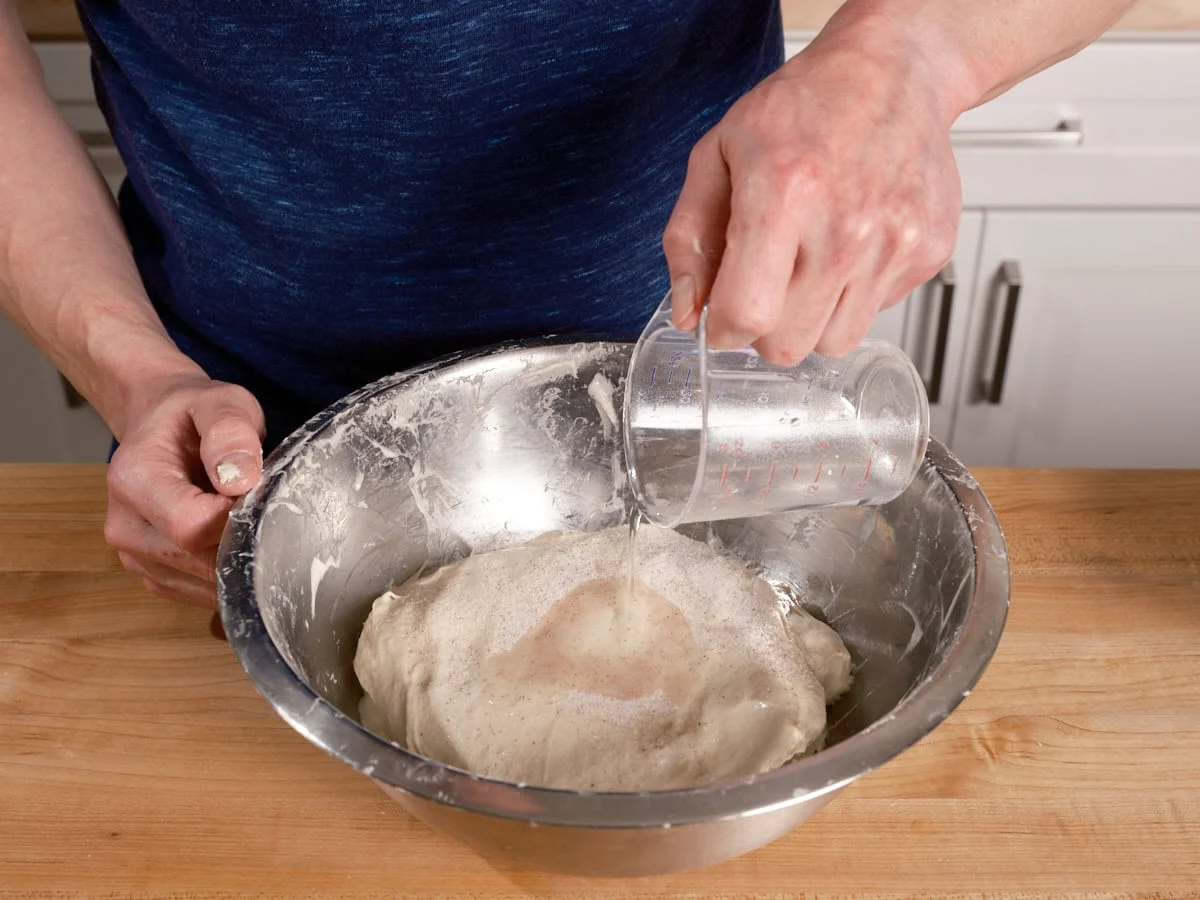
To successfully integrate high volumes of water without overworking the dough or destabilizing the gluten network, many professional bakers utilize a phased mixing technique known as bassinage, or double hydration. Rather than incorporating the total volume of water at the initiation of mixing, the baker holds a designated portion—often 10% to 20%—in reserve.
The process begins by mixing the flour, levain or yeast, and the primary allotment of water (Water 1) to initiate starch hydration and allow the initial gluten scaffolding to form. Once the dough exhibits adequate strength and cohesion, the reserved water (Water 2) is slowly incorporated in stages.
This phased approach offers two distinct operational advantages. First, it prevents the excessive slackness that occurs when a high volume of water is introduced to unhydrated flour, allowing sufficient frictional energy to develop the gluten network efficiently. Second, it provides the baker with a diagnostic window near the end of the initial mix. If the dough has already achieved maximum absorption and appears adequately slack, the reserved water can be omitted entirely, preventing structural failure.
Environmental Influences and Climate Adaptation
Ambient atmospheric conditions exert a measurable influence on dough behavior during commercial production and home baking alike. Relative humidity, barometric pressure, and ambient temperature dictate the rate of moisture evaporation and microbial activity within the fermenting mass.
In arid, high-altitude environments, rapid surface evaporation demands adjusted hydration strategies to prevent premature crusting of the dough during bulk fermentation. Conversely, during periods of high humidity, ambient moisture can be absorbed by stored flour stocks, subtly altering the baseline water requirements of the formula. Professional bakers routinely monitor these environmental fluctuations, adjusting water temperatures and total hydration percentages on a batch-by-batch basis to maintain product consistency.
Practical Implications and Quality Control
Ultimately, successful management of dough hydration relies on the development of sensory intuition—the ability to visually and tactilely assess the physical properties of the dough rather than relying solely on numerical formulas. By maintaining detailed production logs that record ambient weather, flour types, exact water weights, and final loaf characteristics, bakers cultivate the diagnostic skills necessary to navigate the inherent variability of natural ingredients.
Rather than viewing high hydration as an arbitrary marker of baking proficiency, modern artisan baking philosophy prioritizes structural balance. Achieving an optimal loaf requires aligning the hydration percentage with the specific protein profile of the flour, the demands of the fermentation schedule, and the desired structural attributes of the final product.