
The global pursuit of the optimal cup of coffee relies heavily on the nuanced science of extraction, transforming roasted coffee beans into a complex beverage containing hundreds of distinct chemical compounds. While everyday coffee preparation is often treated as a simple culinary routine, it is, in reality, a complex physicochemical process governed by fluid dynamics, thermodynamics, and organic chemistry. Recent analyses by coffee researchers and food scientists continue to illuminate how variables such as water temperature, particle size distribution, and equipment geometry fundamentally alter the chemical composition of the final brew.
Understanding the chemical realities of extraction requires looking beyond the generalized concept of a "good" brew. Roasted coffee is not a uniform or mathematically perfect product; rather, its soluble compounds span multiple orders of magnitude in concentration, each possessing a unique solubility rate and extraction threshold.
The Chemistry of Extraction: Selective Versus Exhaustive Yields
If the objective of coffee brewing were simply to mirror the complete soluble profile of a roasted bean, the ideal methodology would involve ultrafine grinding and prolonged steeping—approaching the extreme extraction techniques seen in Turkish coffee without added sugars or spices. Such methods can yield extraction rates approaching 30 percent, producing an intensely strong beverage, but not necessarily a balanced or pleasant one.
Instead, professional and home baristas typically strive for a selective extraction. From a chemical perspective, an optimal cup relies on an uneven extraction, where different flavor and aromatic compounds are intentionally extracted to varying degrees. This differential extraction is most effectively achieved through percolation, commonly known as the pour-over technique.
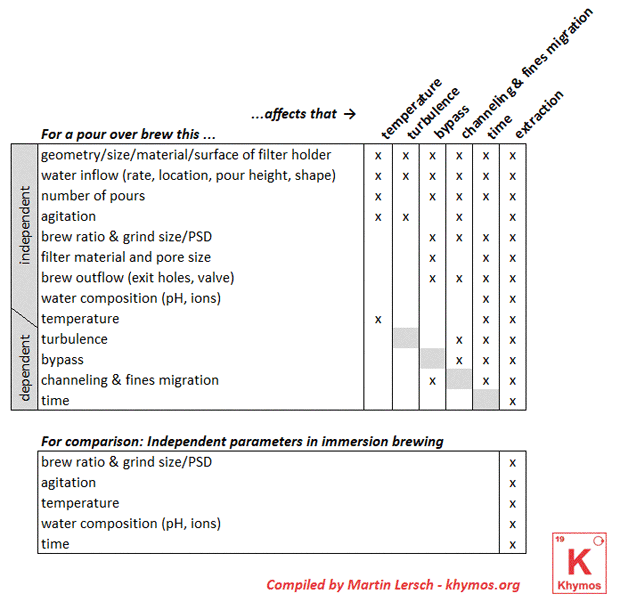
Pour-over brewing appears deceptively simple: hot water is poured over a bed of ground coffee, allowing gravity to pull the liquid through a paper, cloth, or metal filter. However, this simplicity masks an intricate matrix of interdependent variables. Brew ratios, grind size, particle size distribution, water mineral composition, temperature, and filter morphology all exert a profound influence on the final cup.
The Problem of Bypass and Fluid Dynamics
Among the most critical physical challenges in percolation brewing is fluid bypass. Water, obeying the path of least resistance, will frequently flow around the coffee bed rather than through it. This phenomenon is particularly prevalent when using fine grinds that cause partial clogging, leading standing water to seek out shortcuts through the sides of the filter.
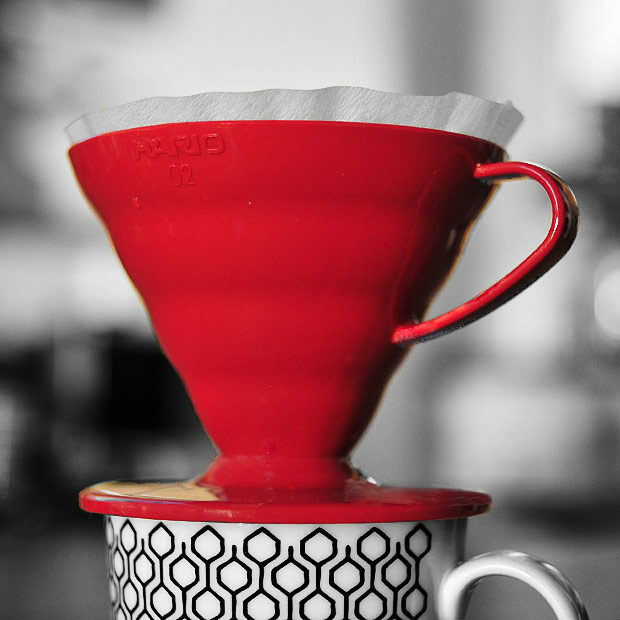
Equipment design heavily dictates the degree of bypass. Traditional conical drippers, flat-bottom brewers, and varying filter paper geometries—such as fluted versus smooth walls—directly impact water flow rates and extraction efficiency. For instance, smooth filter papers that cling flat against the inner walls of a non-ridged brewer effectively eliminate side-wall bypass, whereas structured drippers with prominent ridges encourage fluid movement along the periphery.
To systematically catalog these engineering solutions, researchers have analyzed dozens of commercially available coffee makers, categorizing them by material, thermal mass, side geometry, inner wall structure, filter type, bottom configuration, bypass tendencies, and inflow/outflow control mechanisms. Equipment designers continually attempt to solve these hydrodynamic puzzles through innovations such as vacuum-insulated walls, precision-drilled water distributors like the Melodrip, and variable-flow stop valves seen in immersion-dripper hybrids like the Clever Dripper.
Chronology and Evolution of Coffee Brewing Technology
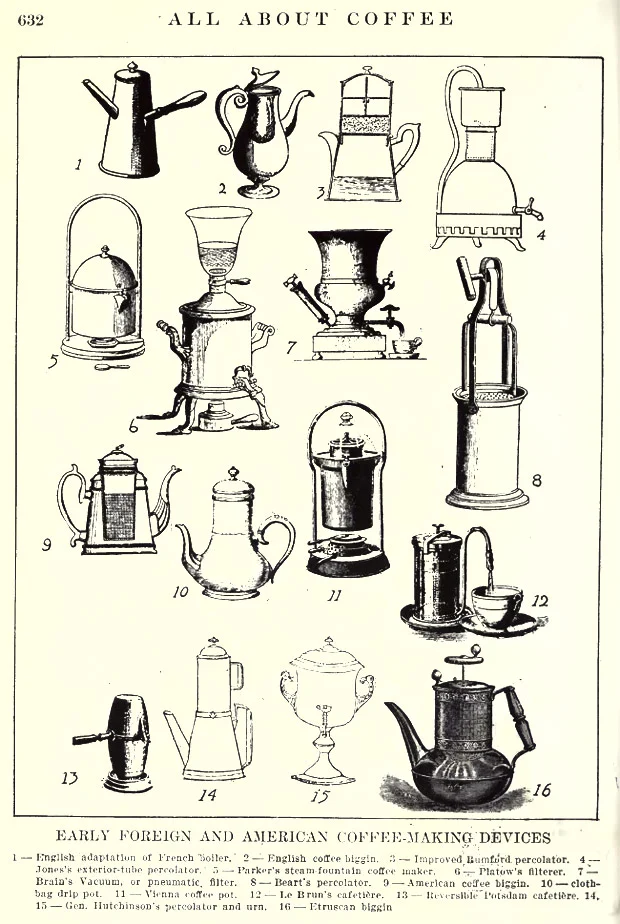
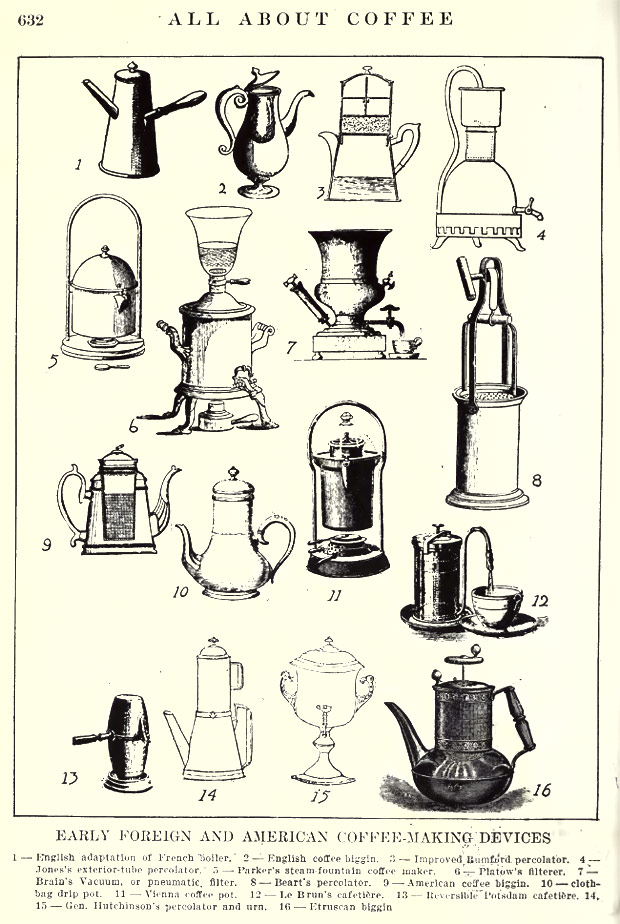
The quest to refine coffee extraction is by no means a modern phenomenon. Historical surveys, such as W. A. Ukers’ exhaustive 1922 publication All about coffee, demonstrate that inventors have spent centuries trying to optimize the extraction process.
In the 19th and early 20th centuries, innovations primarily focused on mechanical separation and thermal retention, leading to the invention of early percolators and gravity-filtration systems. The mid-20th century saw a mass-market explosion of automated electric drip machines and standardized trapezoidal filter holders, such as the ubiquitous Melitta systems popularized in the 1970s.
As specialty coffee emerged in the late 20th and early 21st centuries, the focus shifted toward precision control. The introduction of the Hario V60 in the early 2000s popularized cone-shaped brewing with spiral ridges, sparking a renaissance of manual pour-over devices. Subsequent decades introduced flat-bottom flat-bed brewers like the Kalita Wave, pressure-assisted devices like the Aeropress, and highly specialized laboratory-inspired apparatuses designed to isolate the coffee bed entirely from uncontrolled bypass.
Comparative Analysis: Pour-Over Versus Immersion Brewing
While pour-over methods offer exceptional control over flavor profiles, their complexity introduces a high degree of variability. Subtle, unintended shifts in pouring technique or particle distribution can lead to inconsistencies, fostering numerous preparation myths within the specialty coffee community.
To combat this unpredictability, many baristas turn to immersion brewing methods, such as the French Press or the standard Aeropress technique. In immersion brewing, coffee grounds are steeped entirely in water for a predetermined duration before separation via physical filtration.
From a chemical standpoint, immersion brewing offers superior repeatability. Because the coffee and water reach a near-equilibrium state over time, minor fluctuations in technique have a muted impact on the final extraction. However, immersion methods introduce distinct trade-offs. Traditional metal mesh filters used in French presses allow micro-fines and oils to pass into the cup, adding heavy body and texture while occasionally contributing bitterness and leaving visible sediment. Implementing a secondary paper filtration step can clarify the cup, though it may mute some of the complex aromatics favored by enthusiasts.
Broader Implications and Industry Impact
The continuous dissection of coffee extraction physics carries significant implications for both commercial cafes and home equipment manufacturing. As consumer awareness grows regarding water chemistry, particle size distribution, and thermal stability, manufacturers are under increasing pressure to produce hardware that minimizes user error while maximizing extraction uniformity.
Industry experts and engineering analysts suggest that future advancements in coffee equipment will likely focus on eliminating uncontrolled bypass entirely and providing real-time telemetry on water flow rates and slurry temperatures. By bridging the gap between rigorous laboratory chemistry and accessible kitchen appliances, the coffee industry moves steadily closer to the ideal of absolute repeatability and optimal extraction.