
The global coffee industry has long oscillated between art and analytical science, with enthusiasts and professionals alike continuously seeking to optimize the extraction process. At the heart of this pursuit lies a fundamental chemical reality: a standard cup of coffee contains thousands of distinct chemical compounds spanning nine orders of magnitude in concentration. Each of these compounds possesses a unique solubility profile and extraction rate. Rather than presenting an obstacle to quality, this chemical diversity is the very foundation that allows for creativity, variation, and nuance in brewing.
Roast profiles are rarely uniform, and if every compound within a coffee bean were extracted at an identical rate, the resulting beverage would lack dynamic flavor separation. While a maximum extraction yield—approaching 30%—can be achieved by grinding as finely as possible, boiling the water, and steeping the mixture for an extended period, the outcome resembles an intensely concentrated, unstructured Turkish-style coffee. While bold, this approach fails to achieve the refined balance prized in specialty coffee culture. Instead, master baristas and coffee scientists advocate for selective extraction, strategically targeting an uneven extraction degree where specific compounds are emphasized over others.
The Fluid Dynamics of Pour-Over Brewing
Achieving this selective extraction is most commonly pursued through pour-over percolation techniques. Deceptively simple in execution—hot water is poured over a bed of ground coffee, relying on gravity to filter the liquid—pour-over brewing is, in practice, governed by a complex matrix of interrelated physical and chemical variables.
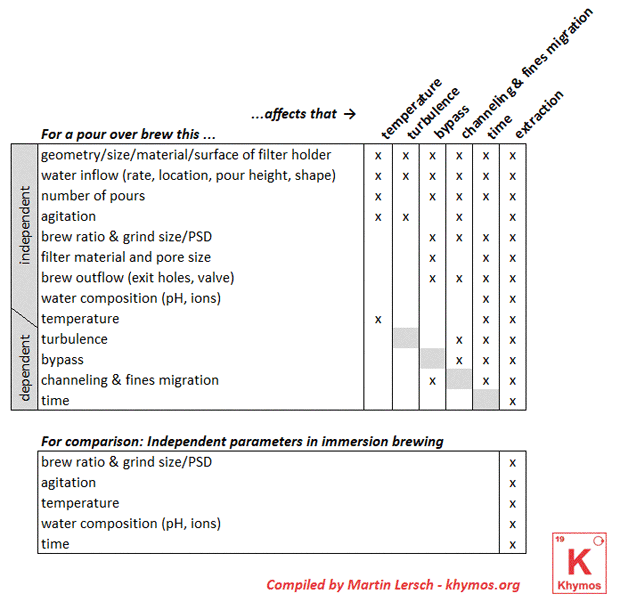
Independent variables controllable by the barista include brew ratio, particle size distribution, water temperature, mineral composition, filter material, pouring technique, and agitation. However, these variables directly influence dependent outcomes such as extraction yield, total dissolved solids (TDS), flow rate, and thermal retention.
Among these factors, particle size distribution (PSD) plays a critical role. Finer grind sizes increase the total surface area available for extraction, accelerating the release of soluble compounds. Simultaneously, however, finer particles compact the coffee bed, slowing down flow rates and increasing contact time. This dynamic introduces the constant risk of filter clogging and fluid channeling.
Water, operating under the path of least resistance, frequently bypasses dense sections of the coffee bed entirely if flow is impeded. This phenomenon, known as "bypass," occurs when liquid flows around the margins of the filter rather than percolating through the grounds. The degree of bypass increases when using fine grinds in filter holders equipped with internal ridges or patterns that lift the paper away from the wall, allowing water to escape without participating in the extraction process. While bypass can dilute an over-extracted brew, it remains an uncontrolled variable that undermines consistency.
A Historical and Engineering Analysis of Brewing Hardware
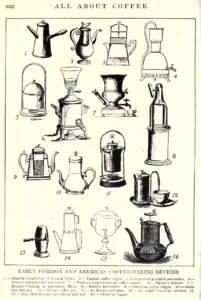
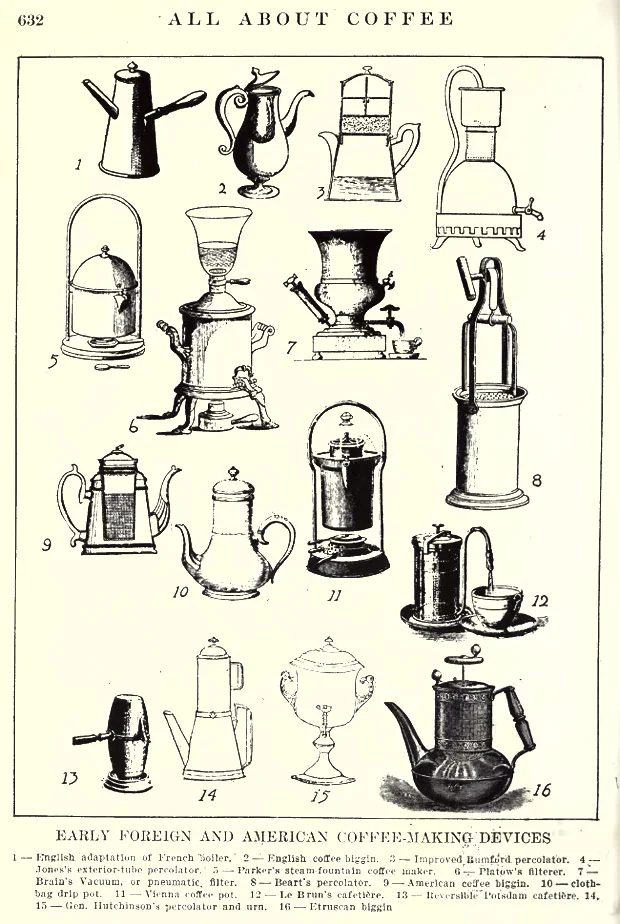
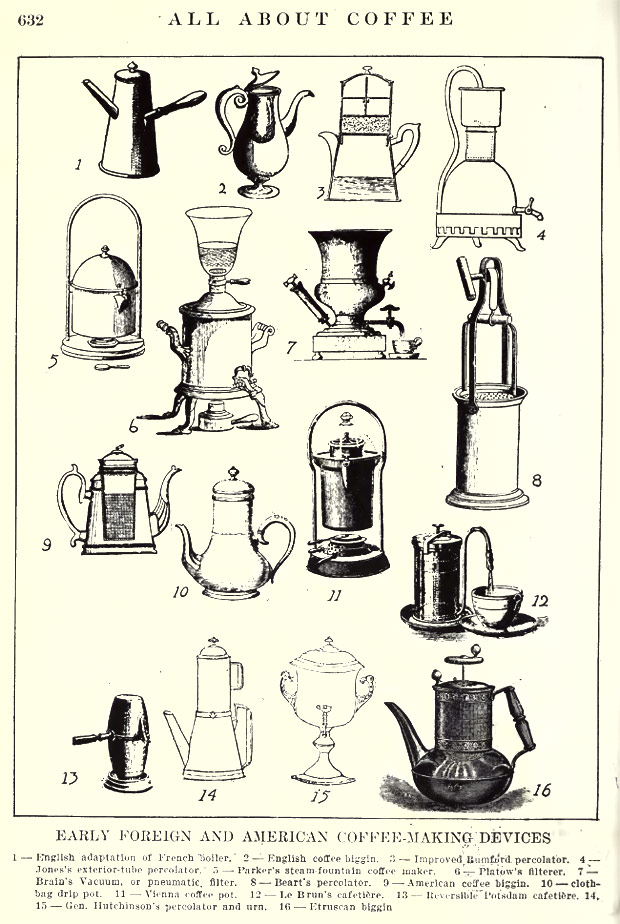
Faced with these persistent fluid-dynamic challenges, inventors and equipment manufacturers have spent over two centuries engineering specialized filter holders to "untie the coffee knot." Historical blueprints, such as those cataloged in W. A. Ukers’ seminal 1922 publication All about coffee, demonstrate that modern innovations are part of a long lineage of mechanical optimization.
Today’s market features dozens of distinct dripper designs, each engineered to address specific thermodynamic and hydrodynamic challenges:
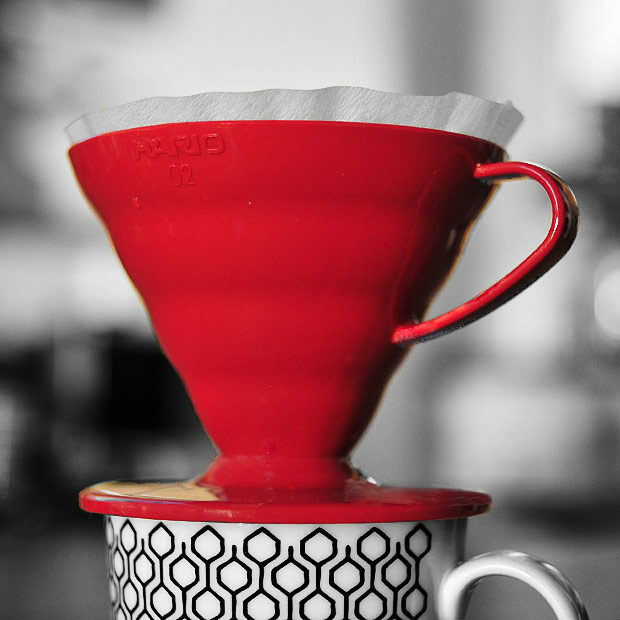
- Material and Thermal Dynamics: Maintaining brewing temperature is critical for optimal extraction. Metal drippers, while durable, are highly conductive and cause rapid heat loss unless vacuum-insulated, as seen in models like the Stagg X/XF. Conversely, glass offers aesthetic appeal but structural fragility. Porous ceramics and food-grade polypropylene (such as the ubiquitous red Hario V60) maintain favorable thermal stability and sturdiness at a lower cost point.
- Geometry and Bed Shape: Drippers generally fall into three geometric categories: trapezoidal (Melitta), conical (Hario V60, Origami), and flat-bottomed (Kalita Wave, April Brewer). Conical beds offer deep water columns that enhance contact time, whereas flat-bottom beds promote uniform extraction across a wider surface, though they remain susceptible to channeling if agitation is mismanaged.
- Internal Walls and Filter Interaction: Smooth-walled drippers, such as the Chemex, force wet filter paper to cling directly to the interior surface. While this eliminates bypass entirely by sealing the periphery, it relies heavily on external design features or paper rigidity to prevent flow blockage. Conversely, ribbed or patterned drippers maintain channels for air and liquid to exit freely.
- Flow Control and Valves: Advanced brewers incorporate mechanical valves (such as the Clever Dripper or Hario Switch) to decouple contact time from grind size. By closing the valve during the initial phase, baristas can introduce a controlled immersion stage before transitioning to percolation, effectively resolving the scaling issues inherent in smaller brew volumes.
Comparative Overview of Coffee Brewing Systems
| Filter Holder | Material Category | Insulation Type | Side Geometry | Internal Structure | Filter Type | Bottom Configuration | Bypass Potential | Inflow Control | Outflow Control Mechanism |
|---|---|---|---|---|---|---|---|---|---|
| Aeropress | Plastic | Material | Straight | None | Plain (Disc) | Perforated (97 holes) | No | No | Pressure / Plunger |
| Chemex | Glass | Material | Tapered | None | Plain | Cone | No | No | Natural gravity |
| Clever Dripper | Plastic | Material | Tapered | Ridged | Plain | Trapezoid (Valve) | Yes | No | Stop valve |
| Hario V60 | Plastic / Ceramic | Material | Tapered | Ridged | Plain | Cone (Open) | Yes | No | Natural gravity |
| Kalita Wave | Metal / Glass / Ceramic | Material | Tapered | None | Folded (W-type) | Flat (3 holes) | Yes | No | Natural gravity |
| Stagg X/XF | Metal | Vacuum | Tapered | None | Folded | Flat (10 holes) | Yes | No | Natural gravity |
| Tricolate | Plastic | Material | Straight | None | Plain | Flat (51 holes) | No | Yes | Natural gravity |
The Alternative: Immersion Brewing and Its Trade-Offs
Given the profound complexity and susceptibility to human error inherent in pour-over methods, many professionals look to immersion brewing as a robust, repeatable alternative. Systems such as the French Press, standard-orientation Aeropress, and vacuum pots rely on steeping coffee grounds in water for a fixed duration.
From a chemical standpoint, immersion brewing offers superior predictability. Because all water is introduced simultaneously and extraction proceeds toward a thermodynamic equilibrium, recipes can be replicated across different operators with minimal variance. Total dissolved solids and extraction yields plateau naturally over time, reducing the impact of micro-variations in pouring technique.
However, immersion brewing introduces its own sensory compromises. Traditional systems like the French Press utilize metal wire-mesh filters, allowing micro-fines and suspended oils to pass into the final cup. While these particulates contribute desirable body, mouthfeel, and texture, they also extend the extraction of bitter compounds from undissolved sediment. Conversely, introducing paper filtration to immersion systems yields a cleaner cup profile at the cost of stripping away complex aromatic oils.
Industry Implications and Future Horizons
The ongoing analysis of coffee extraction mechanics highlights a central tension in modern gastronomy: the trade-off between absolute control and operational simplicity. While pour-over systems provide elite baristas with an expansive array of tunable parameters, this very complexity breeds preparation myths, inter-operator inconsistency, and sensitivity to equipment design flaws.
As specialty coffee continues to mature as both a craft and a food science, the industry is increasingly gravitating toward engineered solutions that minimize unintended variations. Whether through the standardization of flat-bed high-extraction drippers, the adoption of valve-controlled hybrids, or the precise thermal management of commercial immersion systems, the ultimate objective remains unchanged: decoding the chemical complexities of the coffee bean to consistently deliver an optimal sensory experience.