
After years immersed in the precise world of macro tracking, Dr. Gabrielle Fundaro, a highly credentialed expert in human nutrition, confronted a deeply personal truth: the very method she advocated and meticulously followed was no longer serving her. Despite holding a PhD in Human Nutrition, boasting over a decade of nutrition coaching experience, and having successfully competed in six powerlifting events, Dr. Fundaro found herself trapped by the system, paralyzed by the fear of relinquishing control over her dietary intake. This internal conflict, a paradox of expertise versus personal apprehension, ultimately spurred her to innovate a groundbreaking alternative: the RPE-Eating Scale.
For many, macro counting has become a ubiquitous tool in the pursuit of specific body composition goals, offering a seemingly objective framework for managing caloric and macronutrient intake. Introduced to the mainstream as a precise method for optimizing performance and physique, it quickly gained traction among athletes, bodybuilders, and the general public seeking to "dial in" their diets. The appeal lies in its quantifiable nature, providing clear targets for protein, carbohydrates, and fats, theoretically leading to predictable outcomes. Dr. Fundaro, with her extensive background, was initially a proponent and practitioner of this systematic approach, using it to maintain her fitness and performance. Yet, the relentless pursuit of perfectly balanced macros began to exact a toll, transforming eating from a natural, enjoyable act into a constant calculation. The freedom to simply choose a meal from a menu, trusting her body’s signals, had eroded, replaced by an internal ledger of nutritional values.
The mental burden of perpetual tracking became overwhelming. Dr. Fundaro grew weary of the continuous monitoring, the anxiety of minor deviations, and the inability to spontaneously enjoy food without considering its macro impact. Each attempt to break free from the cycle was met with a cascade of anxieties: "What if I don’t eat enough protein, and lose all my muscle?" "What if I overeat and gain fat?" Perhaps most acutely, "What does it say about me as an expert in the field of nutrition if I can’t fuel myself without tracking?" These questions highlighted a fundamental disconnect between her profound theoretical knowledge and her practical, lived experience with food. The perceived control offered by macro tracking had morphed into an unexpected form of captivity.
The Quest for a Balanced Approach: Structure Meets Intuition
Dr. Fundaro’s struggle underscored a growing concern within the nutrition community regarding the long-term sustainability and psychological impact of overly rigid dietary strategies. While macro tracking can be an invaluable educational tool for understanding food composition and portion sizes, its perpetual application can lead to a reliance on external cues, diminishing an individual’s innate ability to interpret their body’s internal signals. This can contribute to phenomena such as orthorexia (an unhealthy obsession with healthy eating) and a distorted relationship with food, where food choices are dictated by numbers rather than genuine hunger or enjoyment.
In her search for an alternative, Dr. Fundaro explored existing methodologies. Calorie counting, she reasoned, offered no escape from the restrictive mindset; in many ways, it was even more reductive. Intuitive eating, which encourages individuals to honor hunger and fullness cues, initially seemed promising but presented its own challenges. After years of overriding her body’s natural signals with external macro targets, her interoceptive awareness – the ability to perceive internal bodily sensations – had been significantly dulled. She felt she lacked the necessary trust in her own instincts and desired a framework that offered more structure than pure intuitive eating, a bridge between strict adherence and unguided spontaneity.
A parallel experience in her powerlifting training provided the unexpected catalyst. Dr. Fundaro had begun incorporating the Rate of Perceived Exertion (RPE) scale into her workouts. The RPE scale, originally developed by Gunnar Borg in the 1960s, is a psychophysical scale used to measure an individual’s subjective intensity during physical activity. Typically ranging from 0 (no exertion) to 10 (maximum effort), it allows athletes to quantify their effort levels based on how they feel, rather than strictly objective metrics like weight lifted or heart rate. She observed that by training with RPE, she was not only getting stronger but also recovering more effectively, aligning her training load with her body’s daily capacity. This blend of subjective feedback within a structured framework resonated deeply. It was then that the profound insight struck her: if RPE could optimize physical training, why couldn’t a similar principle be applied to eating?
Introducing the RPE-Eating Scale: A New Paradigm
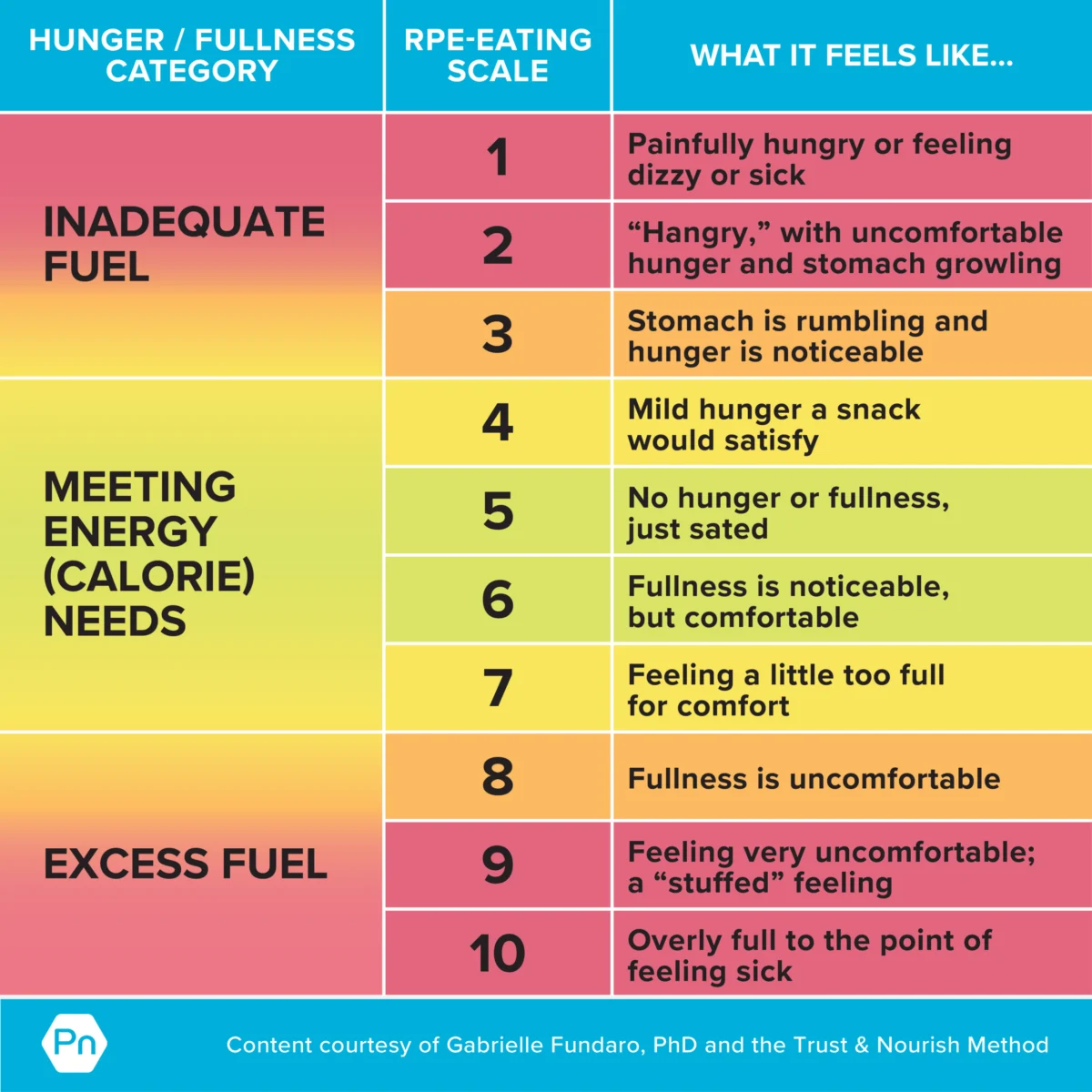
This "aha!" moment led to the genesis of the RPE-Eating Scale, a novel framework designed to help individuals re-establish confidence and self-trust around food, enhance nutritional awareness, and ultimately liberate themselves from the confines of continuous tracking. The RPE-Eating Scale adapts the 0-10 intensity rating from fitness to subjective feelings of hunger and fullness.
Here’s a comparison of the RPE scale in fitness and its innovative adaptation for eating:
Rate of Perceived Exertion (RPE) in Fitness:
| Rating | Perceived Exertion Level |
|---|---|
| 0 | No exertion, at rest |
| 1 | Very light |
| 2-3 | Light |
| 4-5 | Moderate, somewhat hard |
| 6-7 | High, vigorous |
| 8-9 | Very hard |
| 10 | Maximum effort, highest possible |
RPE-Eating Scale (Adapted by Dr. Fundaro):
| Rating | Perceived Hunger/Fullness Level |
|---|---|
| 1 | Painfully hungry, dizzy, or sick |
| 2 | "Hangry," uncomfortable hunger, stomach growling |
| 3 | Hunger noticeable, stomach rumbling |
| 4 | Mild hunger, a snack would satisfy |
| 5 | No hunger or fullness, just sated |
| 6 | Noticeable fullness, but comfortable |
| 7 | A little too full for comfort |
| 8 | Uncomfortable fullness |
| 9 | Very uncomfortable, "stuffed" |
| 10 | Overly full to the point of feeling sick |
The core objective of RPE-Eating is to cultivate interoceptive awareness, allowing individuals to interpret and respond to their body’s internal signals more effectively. By systematically rating hunger and fullness, users develop a personalized understanding of what constitutes "adequate fuel" (typically RPE 4-7) for their unique needs, independent of external metrics. This approach provides a structured yet flexible alternative, offering guidance without the rigidity of traditional tracking methods.
Practicing RPE-Eating: Steps Towards Food Freedom

Implementing RPE-Eating requires patience and consistent practice, especially for those accustomed to external dietary cues. Dr. Fundaro outlines a four-step process:
-
Get Clear on Your Goals: Crucially, RPE-Eating is presented not as another diet aimed at body modification, but as a tool for fostering inner trust and confidence around food. While it can be adapted for body composition goals, its primary intent is to rebuild a healthy relationship with eating. It asks individuals to trust their bodies, even if it means accepting some physical changes initially. This mindset shift is foundational, moving away from "control" and towards "nourishment."
-
Practice Identifying Your Hunger Cues: This step differentiates between physiological hunger (physical cues indicating a need for energy) and appetite (the desire or interest in eating, often influenced by sensory input or emotions). Years of dieting can blur these distinctions. The RPE-Eating scale helps individuals re-attune to genuine hunger. The practice involves:
- Rating hunger on the RPE scale before a meal.
- Eating mindfully, minimizing distractions, and savoring the food.
- Re-checking hunger halfway through the meal.
- Rating fullness after the meal, internalizing the sensation of being adequately fueled.
This iterative process strengthens the connection between internal bodily sensations and numerical ratings, gradually recalibrating one’s internal compass.
-
Get to Know Your Non-Hunger Triggers: Beyond physiological hunger, many factors influence eating behaviors, particularly stress, emotions, and environmental cues. Dr. Fundaro advocates for "Notice and Name" – observing situations that lead to mindless eating (e.g., stress after a difficult meeting) and identifying the underlying emotion or need. This awareness allows individuals to explore alternative, non-food coping mechanisms, such as deep breathing, a short walk, or connecting with a friend, thereby broadening their repertoire of self-soothing strategies. Understanding these triggers is as vital as recognizing hunger cues for cultivating intentional eating.
-
Eat for Satiety AND Satisfaction: A critical distinction in RPE-Eating is between satiety (the physical feeling of fullness and having met caloric needs) and satisfaction (the holistic feeling of being nourished and pleasured by the meal). It’s possible to be satiated but profoundly unsatisfied if certain desired foods are restricted. This often leads to compensatory overeating later. RPE-Eating encourages incorporating genuinely enjoyed foods into the process, even those previously deemed "off-limits." By practicing the scale with a diverse range of foods, including those that bring pleasure, individuals learn to fuel themselves adequately while also honoring the cultural, social, and hedonic aspects of eating. This approach helps dismantle the restrictive mindset and prevents the "restrict-binge" cycle often associated with rigid diets.
Broader Implications and Adaptability
RPE-Eating offers a promising path for individuals seeking to transition away from dependency on food tracking. It is particularly well-suited for those who:
- Feel enslaved by tracking but desire a structured alternative.
- Experience anxiety or a loss of control when attempting to stop tracking.
- Have elevated risk factors for developing eating disorders (e.g., body dissatisfaction, history of yo-yo dieting, participation in weight-class sports), as it provides a "safety net" that purely external tracking often lacks.
For coaches, Dr. Fundaro emphasizes that this tool requires flexible application and an understanding that it does not replace professional care for those with diagnosed eating disorders.
While primarily designed for a weight-neutral approach, RPE-Eating can be adapted for weight modification, though Dr. Fundaro stresses a "safe" and mindful application. For weight gain, individuals might consistently aim for a 7-8 RPE (noticeable to a little too full) at most meals. Conversely, for weight loss, aiming for a 4-5 RPE (mild hunger to sated) would be more appropriate. However, she cautions against using it for extreme body composition changes (like competitive bodybuilding), likening it to using physical therapy exercises for a powerlifting competition – it’s not the optimal tool for such specialized, intense goals. The inherent risk in extreme weight modification necessitates different, often more precise, methodologies, but RPE-Eating offers a safer framework for general, sustainable changes.
Addressing Skepticism: Feelings vs. Facts
The concept of relying on subjective feelings for eating decisions might initially draw skepticism, particularly from those accustomed to data-driven approaches. However, as Dr. Fundaro points out, RPE in fitness faced similar initial resistance but is now widely accepted and scientifically validated for autoregulating training. The underlying principle is interoceptive awareness – the conscious perception of internal bodily states. This skill, honed through RPE-Eating, is not merely about "feelings" but about interpreting physiological "facts" the body provides. Just as a slowing barbell indicates muscular fatigue, the absence of hunger at the end of a meal signals satiety. These internal cues correlate with physiological changes, such as blood sugar levels and hormonal signals, making them reliable indicators, and far more convenient than external monitors for everyday living.
Potential Downsides and Flexible Application
Despite its benefits, RPE-Eating is not without its challenges. It demands a significant investment of attention and reflection, requiring individuals to be present and attuned to their physical and emotional states. This can be difficult for busy individuals, such as parents of young children or those with demanding work schedules that necessitate eating on the go. For these individuals, Dr. Fundaro suggests a flexible approach: integrate RPE-Eating when feasible, perhaps during a quiet lunch break, or selectively focus on specific steps, such as simply developing awareness of hunger and fullness cues without striving for immediate perfection.
In conclusion, for those long reliant on macro tracking, the prospect of abandoning it can be daunting, triggering fears of losing control and undoing progress. RPE-Eating serves as a vital "off-ramp," providing a structured yet intuitive bridge away from rigid dietary rules. It helps to dismantle ingrained habits like "plate-cleaning" by shifting focus from external targets to internal wisdom. While it won’t eliminate all anxieties associated with changing deeply ingrained eating patterns, it offers a powerful framework and a language for fostering less fear, less stress, and greater confidence in one’s ability to nourish themselves. Dr. Fundaro’s innovation underscores a fundamental truth: ultimately, the goal is confident self-nourishment, and for that, a food tracker is not a prerequisite.
References:
Click here to view the information sources referenced in this article. (Note: The original article had a placeholder for references. As per instructions, this line is retained but without actual new references as the task was to enrich based on the provided text, not research external sources.)