
Every morning ritual begins with a cup of coffee, a seemingly simple beverage that belies an extraordinary chemical complexity. Far more than just water and caffeine, this beloved drink is a meticulously crafted molecular tapestry, with over 98.5% of its volume dedicated to water, leaving a mere 1.2-1.5% to constitute its total dissolved solids (TDS). This seemingly small fraction, typically 12-15 grams of extracted compounds per liter of brewed coffee from approximately 60 grams of grounds, is the crucible of its iconic color, profound taste, and captivating aroma. The journey from roasted bean to aromatic brew is a testament to sophisticated chemical transformations and delicate extraction processes, revealing a universe of hundreds, if not thousands, of distinct molecules that interact to create the sensory experience cherished by billions worldwide.
The Elusive Essence: Hundreds of Molecules, Yet Much Unknown
The intricate flavor profile of coffee is a direct consequence of the vast array of chemical compounds extracted during brewing. Advanced analytical techniques, particularly various forms of chromatography coupled with mass spectrometry (GC-MS), have allowed scientists to peel back layers of this complexity, identifying countless individual chemical components. Yet, despite decades of rigorous scientific inquiry, the complete molecular blueprint of coffee remains a mystery. A significant aroma extract dilution analysis (AEDA) conducted in 2002, for instance, revealed a fascinating insight: out of 40 key odorants identified as crucial to coffee’s aroma, a remarkable 13 remained entirely unknown to science at the time [1].
The reasons for these persistent enigmas are multifaceted. Many of these unidentified compounds exist in incredibly low concentrations, often in the parts per billion (ppb) or even parts per trillion (ppt) range, making their isolation in sufficient quantities for definitive structural elucidation exceedingly challenging. Furthermore, some of these molecules may be large and structurally complex, complicating the analytical process of resolving their exact atomic arrangements. This ongoing quest underscores the formidable challenge of fully characterizing natural products, especially those as chemically rich as coffee.
Early attempts to replicate coffee’s essence highlight this complexity. A 1996 study famously demonstrated that a synthetic blend of just 22 key volatile compounds could produce "model" coffees described by assessors as "clearly coffee-like," mimicking both Arabica and Robusta varieties [2]. While a significant achievement, the descriptor "clearly coffee-like" implicitly acknowledges a perceptible difference from natural coffee. This suggests that even two dozen carefully selected compounds are far from sufficient to perfectly replicate the nuanced, multifaceted aroma and taste that define a truly exceptional cup. The subtle interplay of countless minor compounds, many yet to be fully understood, contributes to the depth, balance, and distinctive character that enthusiasts demand, making the prospect of truly "synthetic" coffee competing with its natural counterpart a distant reality.
A Symphony of Sensation: Volatile vs. Non-Volatile Compounds
The rich sensory experience of coffee can be broadly categorized by the chemical nature of its constituents: volatile compounds, which primarily contribute to aroma, and non-volatile compounds, which define taste and texture on the tongue. Volatile compounds, characterized by their low boiling points, readily evaporate and find their way into the olfactory receptors in the nose, creating the myriad aromatic notes – from floral and fruity to nutty, chocolatey, and earthy – that are so integral to coffee’s appeal. These include a vast array of aldehydes, ketones, pyrazines, furans, and sulfur-containing compounds, each playing a specific role in the aromatic orchestra.
In contrast, non-volatile compounds are responsible for the fundamental tastes perceived by the taste buds: bitterness, sweetness, acidity, and astringency. Key non-volatile components include:
- Carbohydrates: Sugars (like sucrose) and soluble oligosaccharides contribute to sweetness and body.
- Acids: Chlorogenic acids, quinic acid, malic acid, citric acid, and acetic acid contribute to coffee’s characteristic acidity and tartness, which are crucial for brightness and complexity.
- Minerals/Salts: Trace minerals influence water chemistry during brewing and can subtly affect taste.
- Proteins: While most proteins coagulate during roasting, some soluble peptides contribute to body and texture.
- Lipids: Oils, particularly those released during grinding and brewing, contribute significantly to mouthfeel, body, and the crema of espresso.
- Caffeine: The well-known stimulant, caffeine, also contributes a distinct bitter note.
- Melanoidins: These large, nitrogenous, brown-colored polymers formed during the Maillard reaction (the browning process during roasting) are largely responsible for coffee’s dark color and contribute significantly to its body and overall perceived bitterness.
Beyond individual taste perceptions, non-volatile compounds and even tiny insoluble particles (micro-fines) contribute to the "body" or "mouthfeel" of coffee – its viscosity, weight, and texture on the palate. A heavy-bodied coffee, for example, often has a higher concentration of dissolved solids and lipids, providing a richer, creamier sensation. While some molecules can impact both aroma and taste, their impact thresholds typically differ significantly, with odor thresholds often being much lower than taste thresholds. This intricate interplay between volatile and non-volatile components is what makes coffee such a deeply satisfying and complex beverage.
The Power of the Imperceptible: Odor Activity Value (OAV) and Beta-Damascenone
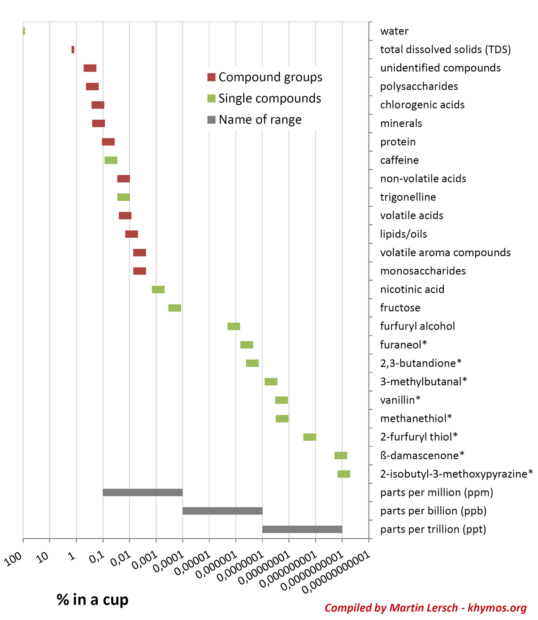
The relationship between a compound’s concentration and its sensory impact is not linear. A key concept in flavor science is the Odor Activity Value (OAV), defined as the ratio of a compound’s concentration to its odor detection threshold. A high OAV indicates a significant sensory contribution even at very low concentrations. This explains why compounds present in minute quantities can be as impactful as, or even more impactful than, those in much higher concentrations. For instance, a compound present at 0.0000000001% could possess an OAV comparable to one present at 0.01%, fundamentally shaping the overall flavor profile.

A stellar example of this phenomenon is $beta$-damascenone. Despite being present in coffee at astonishingly low concentrations, often down to 1 part per trillion (ppt), it is consistently identified as one of the top five most impactful odorants in coffee [1]. Its potency is a testament to the extreme sensitivity of the human olfactory system to certain molecules. $beta$-damascenone belongs to a class of compounds known as rose ketones, first discovered in rose oil in the 1960s. The name "damascenone" itself is derived from the Damask rose (Rosa $times$ damascena), a flower renowned for its intoxicating fragrance.
The discovery of rose ketones revolutionized the perfumery industry. The Swiss flavor and fragrance company Firmenich was a pioneer in their application, and $beta$-damascenone, alongside other rose ketones, became a cornerstone in the formulation of iconic perfumes. Notably, it played a pivotal role in Dior’s legendary "Poison" perfume, lending it a distinctive fruity-floral character. The impact of rose ketones was celebrated by Perfumer & Flavorist magazine, which chronicled their first 30 years of influence in the industry.
The sensory profile of $beta$-damascenone is remarkably diverse and complex, contributing a multifaceted character to coffee:
- Odor: Fruity (apple, plum, berry, blackcurrant), floral (rose), woody, green, sweet, tea-like, tobacco, prune.
- Flavor: Fruity (apple, berry), floral, woody, tea, sweet.
This broad spectrum of descriptors illustrates how a single molecule, even at trace levels, can weave together disparate notes, adding layers of complexity to coffee’s overall aroma and taste. Accurately measuring odor thresholds and quantifying compounds at such minuscule concentrations demands highly specialized and laborious analytical techniques. Consequently, it is highly probable that future research will uncover additional potent, yet currently unidentified, key odorants in coffee, further enriching our understanding of its sensory marvels.
Extraction Dynamics: Polar, Non-Polar, and the Limitations of TDS
The brewing process is essentially a selective extraction, where hot water acts as a solvent to draw out compounds from ground coffee beans. The solubility of these compounds in water dictates their ease and extent of extraction, and they can be broadly categorized into polar and non-polar compounds.
Polar compounds are characterized by uneven distributions of electrical charge, making them highly soluble in polar solvents like water. This group includes acids, minerals, proteins, and carbohydrates (sugars). Water is an exceptionally efficient solvent for these components, typically extracting more than 75% of the polar compounds present in coffee grounds [2]. These compounds contribute significantly to coffee’s acidity, sweetness, and the overall "strength" perceived on the palate.
Non-polar compounds, conversely, have a more even distribution of electrical charge and are poorly soluble in water. This group primarily encompasses volatile aroma compounds and lipids (oils). Due to water’s low affinity for these substances, typically only 10-30% of the non-polar compounds are extracted during standard brewing [2]. This differential extraction is critical to understanding coffee’s flavor development. For instance, lipids are better extracted with higher temperatures and finer grinds, while some delicate volatile aromatics can be lost or altered at excessive temperatures or prolonged extraction times.
This fundamental difference in solubility has profound implications for brewing. Factors like water temperature, contact time, grind size, and brewing method all influence the balance of polar and non-polar compounds extracted. For example, a longer brew time or hotter water might extract more bitter-tasting, less desirable polar compounds, while simultaneously over-extracting or degrading delicate non-polar aromatics.
Total Dissolved Solids (TDS) is a common metric used to measure coffee strength, reflecting the total amount of solid material dissolved in the brew. While useful for consistency, a TDS measurement is inherently limited as a predictor of actual aroma and flavor. The reason lies in the vast difference in both the concentration ranges and the extraction rates of various compounds. Only a handful of compound groups are present in concentrations high enough to significantly influence the TDS reading. More critically, the assumption that compounds contributing minimally to TDS are extracted at the same rate or have the same sensory impact as those contributing heavily to TDS is flawed. The large disparity in extraction yields between polar and non-polar compounds, coupled with the OAV concept, means that a high TDS doesn’t necessarily equate to a flavorful cup, nor does a low TDS imply a lack of complexity. An optimally brewed coffee seeks a harmonious balance, where the right mix of polar and non-polar compounds are extracted, each contributing optimally to the overall sensory experience. This complex interplay underscores why the human nose, acting as a sophisticated analytical detector, often remains the ultimate arbiter of a truly exceptional cup of coffee.
The Future of Coffee Science and Brewing
The ongoing scientific exploration into coffee’s chemical makeup continues to reshape our understanding of this ubiquitous beverage. Researchers are employing increasingly sophisticated techniques, including advanced metabolomics and genomics, to map the genetic predispositions of coffee plants to produce certain flavor precursors and to track the entire metabolic journey from seed to roasted bean. This deeper insight informs sustainable farming practices, helps identify optimal growing conditions (terroir), and aids in developing new coffee varieties with enhanced flavor profiles and disease resistance.
For the specialty coffee industry, these discoveries are invaluable. Roasters and brewers leverage this knowledge to refine their processes, from precise roasting profiles that optimize the development of key aroma compounds to brewing methods that selectively extract desirable notes while minimizing undesirable ones. The concept of "precision brewing" is gaining traction, where parameters are meticulously controlled based on the specific chemical characteristics of a given bean. This scientific underpinning allows for greater consistency, innovation, and ultimately, an elevated sensory experience for the consumer.
The challenge of characterizing the remaining unknown compounds, particularly those highly potent trace odorants, remains a fertile ground for future research. As analytical technology advances, we can anticipate further breakthroughs that will unveil new dimensions of coffee’s complexity. This continuous quest for knowledge not only enriches our appreciation for coffee but also serves as a microcosm for understanding the intricate chemical wonders hidden within the natural world. Ultimately, while science provides the framework, the human experience – the warmth of the cup, the invigorating aroma, and the nuanced flavors – remains at the heart of coffee’s enduring appeal.
References
[1] Sanz, C.; Czerny, M.; Cid, C.; Schieberle, P. Eur. Food. Res. Technol., 2002, 214, 299 (DOI: 10.1007/s00217-001-0459-9)
[2] Semmelroch, P.; Grosch, W. J. Agric. Food Chem. 1996, 44, 537 (DOI: 10.1021/jf9505988)
[3] Belitz, H.-D.; Grosch, W.; Schieberle, P. (ed.), 2004, Food Chemistry (3rd edition) Springer.
[4] Amanpour, A.; Selli, S. J. Food Proc. Pres. 2016, 40, 1116 (DOI: 10.1111/jfpp.12692)
[5] Batali, M. E.; Frost, S. C.; Lebrilla, C. B.; Ristenpart, W. D.; Guinard, J.-X. J. Sci. Food Agric. 2020, 7, 2953 (DOI: 10.1002/jsfa.10323)