
A pervasive sentiment echoes across modern society: "I want to know I’m doing absolutely everything I can to preserve my health for as long as possible." This drive reflects a profound desire not merely to age gracefully but to actively extend both healthspan – the period of life spent in good health – and overall lifespan, often with aspirations of outliving peer groups and conventional age expectancies. The vision of remaining fit, lean, and youthful well into one’s 90s, 100s, and beyond is undeniably compelling, fueling a rapidly expanding longevity industry.
However, this ambitious pursuit often confronts a significant hurdle: much of the popular longevity advice disseminated today appears to demand extraordinary levels of effort, time, financial investment, and intricate adherence. This raises critical questions: Is such extensive commitment truly necessary? Does the benefit justify the cost? And, perhaps most importantly, will these intensive protocols genuinely deliver the promised results? This article delves into these complexities, examining the prevailing myths and realities of health optimization, weighing the benefits against the inherent tradeoffs, and ultimately providing a framework for informed decision-making regarding personal health and well-being.
Demystifying Health Optimization: Challenging the "More is Better" Narrative
The discourse surrounding health and longevity has proliferated across various platforms, from podcasts and best-selling books to social media feeds and casual gym conversations. Influential figures such as Dr. Peter Attia, Dr. Andrew Huberman, Dr. Rhonda Patrick, and biohacker Bryan Johnson have significantly amplified this movement, drawing widespread attention to advanced health protocols. The allure of such content is undeniable; the prospect of a longer, healthier life, coupled with the comforting sense of control derived from meticulously crafted health plans, resonates deeply.

Yet, for many health professionals and organizations working with diverse populations, the concept of "optimal" often proves unrealistic and, more critically, unnecessary for achieving substantial health improvements. Experience derived from coaching hundreds of thousands of individuals reveals a consistent truth: modest, consistent efforts toward fundamental health and well-being frequently yield superior and more sustainable results than intense, highly "optimized" regimens. This counter-intuitive assertion challenges several deeply ingrained myths within the longevity culture.
Myth 1: The Basics Are Insufficient for Longevity
A common misconception posits that achieving exceptional health and extending lifespan beyond the average requires a suite of complex, "cutting-edge" strategies. This perspective often dismisses foundational health practices as inadequate. In reality, evidence overwhelmingly demonstrates the profound efficacy of basic health behaviors. These include regular physical activity, a nutrient-rich diet, adequate sleep, effective stress management, and strong social connections. The primary challenge lies not in the ineffectiveness of these basics, but in the widespread lack of consistent adherence.
The actual impediment to longer, healthier lives for many is not the absence of exotic interventions like ice baths or intravenous vitamin infusions. Instead, it is the inconsistent application of relatively simple, well-established health principles. Individuals who consistently integrate a comprehensive set of health-promoting behaviors into their daily lives, even with an 80-90 percent consistency rate, are often operating at or near their peak potential for health optimization.
Myth 2: The Law of Diminishing Returns in Health Efforts
The premise that "more is better" often leads individuals to believe that perfectly executing and maximizing basic health behaviors will proportionally enhance their well-being. However, health and fitness efforts are subject to the law of diminishing returns. Initial investments in foundational habits yield significant improvements, but as efforts intensify, the incremental benefits begin to plateau.

Furthermore, an overly complex or demanding health and fitness regimen can lead to unintended negative consequences, including increased stress, burnout, reduced adherence over time, and a decreased enjoyment of life. The ultimate goal of extending life should be to live a full, well-rounded, and enjoyable existence. Beyond a certain threshold, additional effort may not translate into significantly better health outcomes and could detract from overall life satisfaction.
Myth 3: Cutting-Edge Strategies Guarantee Significant Benefits
Many advanced, complex strategies promoted within the longevity sphere are presented with an implied promise of substantial benefits. However, a critical examination of the underlying research reveals limitations. Much of the current evidence supporting these longevity optimization tactics is derived from animal studies, observational data, theoretical models, or very small-scale human trials conducted over short durations.
Moreover, numerous fringe methods and supplements advocated by influencers and biohackers lack robust scientific validation and, in some cases, carry potential safety risks. For instance, the long-term effects and interactions of many novel compounds are poorly understood. Health authorities consistently advise prioritizing foundational health behaviors with established, long-term efficacy before considering investments in speculative or unproven interventions.
Myth 4: Health Optimization is an "All or Nothing" Endeavor
The perceived overwhelming nature of health optimization can lead to paralysis, where individuals conclude that if they cannot achieve perfection (e.g., waking at 5 a.m. for 90 minutes of high-intensity cardio), they might as well do nothing. This "all or nothing" mentality is a significant barrier to progress.

Data from extensive coaching programs indicate that measurable results are attainable even with less-than-perfect consistency. For example, clients practicing basic habits less than half of the time still experienced significant improvements, such as weight loss and reductions in girth measurements. This demonstrates that incremental progress, rather than absolute adherence, can still lead to tangible health benefits, dispelling the notion that great health is beyond the capabilities of those unable to commit to extreme protocols.
The Foundational Pillars of Health and Longevity: Evidence-Based Practices
Rather than chasing fleeting trends, a strategic focus on established, fundamental health behaviors offers the most reliable path to extended healthspan and lifespan. These practices, while seemingly simple, are consistently under-implemented by the general population, highlighting a crucial disconnect between knowledge and action.
Data from health surveys consistently show low adherence rates to these fundamental behaviors. For instance, only a small fraction of the population consumes adequate fruits and vegetables, achieves recommended sleep durations, or meets guidelines for both aerobic and resistance exercise. The cumulative effect of neglecting these basics far outweighs any potential benefit from advanced biohacking.
1. Exercise Regularly: Movement as Medicine
The consensus among health experts is unequivocal: regular physical activity is paramount for health and longevity. Beyond contributing to leanness, improved mood, energy, and functional capacity, exercise demonstrably extends life and enhances health quality. Studies, including those tracking Harvard alumni, confirm that any level of physical activity reduces all-cause mortality risk, independent of factors like body weight, blood pressure, smoking status, or genetic predisposition.

Research involving over a quarter-million older adults found that even low amounts of physical activity significantly lowered the risk of death from cancer, cardiovascular disease, and all causes. Steep declines in risk are observed when accumulating at least 7.5 MET-hours (Metabolic Equivalent Hours) of activity per week, with optimal benefits often achieved between 7.5 and 15 MET-hours. While further increases in activity continue to reduce risk, the rate of benefit diminishes. Simple interventions like walking are highly effective; every 1,000 daily step increase has been linked to a 12 percent lower risk of death, with benefits starting at 2,500 steps and continuing up to 17,000. Specifically, for cognitive health, just 3,826 steps daily correlated with a 25 percent reduced risk of dementia, increasing to 50 percent lower risk at 9,826 steps.
Ideally, cardiovascular activity should be complemented by resistance or weight-bearing exercise. Resistance training is crucial for preserving muscle mass, maintaining cognitive sharpness, improving cancer survival odds, supporting metabolic health, and reducing the risk of falls—a leading cause of death among older adults—by enhancing balance, muscle stability, and bone density. Conversely, a sedentary lifestyle is a potent risk factor for cardiovascular disease, diabetes, hypertension, various cancers, and premature death, with two decades of inactivity doubling the risk of early mortality compared to an active lifestyle.
Recommended Dosage: Standard guidelines suggest at least 150 minutes per week of moderate-intensity aerobic activity or 75 minutes of vigorous-intensity aerobic activity, combined with two or more resistance training sessions targeting all major muscle groups. Further benefits accrue up to 300 minutes per week of moderate activity or 150 minutes of vigorous activity, alongside three resistance training sessions.
Public Adherence: Only 24 percent of Americans meet recommendations for both aerobic and resistance exercise, and fewer than 47 percent meet aerobic activity guidelines.

Diminishing Returns: While more exercise is generally better up to a point, excessive training can lead to overtraining syndrome, disrupting hormones, sleep, mood, and increasing fatigue and injury risk. Extreme endurance volumes may even pose detrimental effects on heart health. The benefits of exercise follow a U-shaped curve (the "Extreme Exercise Hypothesis"), where both very low and extremely high levels of activity carry increased health risks, with moderate to high levels offering optimal benefits. Health benefits typically plateau around 7-10 hours of cardio and 3-4 resistance training sessions per week.
2. Eat a Nourishing, Nutrient-Rich Diet
A healthy diet need not be overly complex. Focus on three fundamental nutritional keys:
Nutritional Key 1: Prioritize Whole and Minimally-Processed Foods. These foods are naturally rich in fiber, healthy fats, vitamins, minerals, and phytochemicals, and are less calorie-dense than highly- or ultra-processed foods (UPFs). They contain fewer added sugars, sodium, and trans fats, which are directly linked to increased risks of cardiovascular disease, cancer, diabetes, obesity, and other complications. Diets abundant in whole foods are associated with lower rates of depression, heart disease, type 2 diabetes, cancer, and improved longevity. Conversely, a massive study of nearly 10 million participants linked UPFs to 32 harmful effects, including metabolic and mental health disorders, and all-cause mortality. Higher UPF consumption (four or more servings daily) was associated with a 62 percent increased risk of all-cause mortality.
Recommended Dosage: While no formal guidelines exist, a diet composed of 70 to 80 percent whole or minimally-processed foods often leads to significant health improvements and satisfaction. Even moving from very few to 50 percent minimally processed foods can yield substantial benefits.

Public Adherence: Americans derive only about 28.5 percent of their calories from whole or minimally-processed foods, with 56 percent coming from highly- or ultra-processed items.
Diminishing Returns: Consuming up to 90 percent of calories from minimally-processed foods maximizes benefits, with negligible additional gains beyond this. Some processed foods, like protein powder or certain fortified foods, can complement a healthy diet without adverse effects.
Nutritional Key 2: Consume Five Servings of Fruits and Vegetables Daily. This long-standing recommendation is powerfully supported by evidence. A study of over 1.8 million people demonstrated a significant association between increased fruit and vegetable intake and decreased mortality risk, with benefits plateauing at five servings per day. Individuals consuming five servings daily had a 13 percent lower risk of death from any cause compared to those eating two servings. Fruits and vegetables are also linked to reduced risk of hypertension, coronary heart disease, stroke, and possibly cancer and weight gain.
Recommended Dosage: Aim for five fist-sized servings daily, typically three servings of vegetables and two of fruit. Prioritizing a variety of colors ensures a diverse intake of beneficial phytochemicals.

Public Adherence: Americans average only 2.5 servings of produce daily. Just 12.2 percent meet fruit intake recommendations, and 9.3 percent meet vegetable recommendations, with only 10 percent consuming the full five combined servings.
Diminishing Returns: Life-extending benefits generally plateau at five servings daily, with higher intake not associated with additional disease risk reduction. However, increased fruit and vegetable intake can still support weight management due to their fiber and water content.
Nutritional Key 3: Ensure Adequate Protein Intake. Protein is a crucial macronutrient, particularly for aging populations. Plant protein is specifically linked to a reduced risk of cardiovascular disease and all-cause mortality. While animal protein research is more mixed, minimally processed fish, poultry, and low-fat dairy are generally recommended. Processed red meats (bacon, hot dogs) should be limited due to increased health risks, and even unprocessed red meat consumption should ideally not exceed 18 oz (~4-5 palm-sized portions) per week.
Sufficient protein intake (at least 1.2 g/kg body weight) significantly reduces the risk of sarcopenia (muscle loss), frailty, and neuromuscular decline, especially in older adults. Protein is also vital for muscle maintenance and growth, bone health, immunity, and satiety, aiding in fat loss and body recomposition.

Recommended Dosage: While the USDA recommends 0.8 g/kg body weight, newer research suggests 1.2 g/kg (0.55 g/lb, or 3-5 palm-sized portions) as a better minimum for most adults, particularly older individuals. For muscle growth, retention, or vigorous exercise, 1.6 to 2.2 g/kg (0.75-1 g/lb, or 4-8 palm-sized portions) is optimal, with the higher end maximizing benefits. For individuals on GLP-1 medications, at least 1.2 g/kg, ideally closer to 1.6 g/kg, is critical to mitigate muscle loss.
Public Adherence: Most adults meet the 0.8 g/kg recommendation, but up to 10 percent of young women and 46 percent of older adults do not. The conservative nature of this recommendation means many are likely under-consuming protein for optimal health.
Diminishing Returns: Beyond 1.2 g/kg, additional protein may not offer further benefits for sedentary individuals. For those engaged in intense exercise or managing weight with GLP-1 medications, higher intakes up to 2.2 g/kg are beneficial for specific goals.
Regarding Supplements: Supplements often feature prominently in longevity discussions but play a minor role compared to foundational behaviors. While multivitamins and doctor-recommended supplements (e.g., Vitamin D, iron) can correct deficiencies, and others like protein powder or creatine have proven benefits for specific needs, many buzzy, trendy supplements lack definitive evidence. Ingredients like curcumin, spirulina, and NAD+ show promise in early research (often animal models), but human data is minimal or inconclusive. Some herbal supplements can even cause harm. Reputable third-party certifications (e.g., NSF) and independent databases (e.g., Examine.com) are crucial resources, and consultation with a healthcare provider is always recommended.

3. Get Adequate Sleep: The Cornerstone of Recovery
Sleep is a fundamental pillar of health, with profound implications for longevity. Studies show that men getting adequate quality sleep live nearly five years longer, and women two and a half years longer, than their sleep-deprived counterparts. Sleep is as vital for heart health as exercise, diet, and weight management. A one-hour decrease from seven hours of sleep per day is associated with an 11 percent increased risk of cardiovascular disease and a 9 percent increased risk of type 2 diabetes. For older adults, less than six hours of sleep nightly correlates with a higher risk of dementia and cognitive decline, as deep sleep is critical for clearing neurotoxins like beta-amyloid plaques.
Recommended Dosage: Sleep experts generally recommend 7 to 9 hours of sleep per night for most adults, with at least seven hours on most nights. The ideal amount is highly individualized, marked by feeling refreshed upon waking and sustained energy throughout the day.
Public Adherence: Approximately one-third of U.S. adults do not meet the recommended 7 to 9 hours of sleep per night.
Diminishing Returns: While insufficient sleep is detrimental, sleeping excessively (over nine hours per night) is also associated with increased risks of cardiovascular disease, type 2 diabetes, and overall mortality. However, this correlation may be due to underlying health issues (e.g., depression, sleep apnea, heavy alcohol use) that lead to both longer sleep and higher health risks, rather than the sleep itself being causative.

4. Manage Stress Effectively: Cultivating Resilience
Chronic, unmanaged stress, sustained over months or years without adequate recovery, profoundly impacts nearly every physiological system. It elevates heart rate, blood pressure, and inflammation, increasing the risk of cardiovascular disease. Long-term stress also worsens mental and emotional health, contributing to anxiety and depression, and can lead to unhealthy coping mechanisms like increased alcohol consumption.
However, stress itself is a natural and even beneficial part of life, providing motivation, purpose, and engagement. The goal is not to eliminate stress but to cultivate resilience through healthy coping mechanisms and appropriate recovery strategies. Effective stress management encompasses simple mindset shifts, such as practicing self-compassion, adopting a growth mindset, and reframing stress as a normal part of life. Developing self-regulation skills—noticing and naming emotions, controlling actions, and utilizing diverse coping strategies—is crucial for processing emotions and recovering from stressful events.
Recommended Dosage: Stress management should be proportional to life’s demands. Just as stressors deplete one’s "energy tank," recovery practices replenish it. Even short bursts of purposeful recovery (3-5 minutes of deep breathing, journaling, gentle stretching, or nature exposure) can be highly effective.
Public Adherence: Over a quarter of people in the U.S. and Canada report being so stressed they cannot function on most days, and over a third admit they don’t know where to begin with stress management.

Diminishing Returns: The aim is to find a personal "stress sweet spot," where one feels energized and engaged rather than bored or overwhelmed. Excessive dedication to stress reduction techniques, when stress levels are already balanced, can paradoxically add another burden, detracting from overall well-being.
5. Stay Socially Connected: The Power of Relationships
Social connection is a vital, often underestimated, health imperative. Strong social and emotional support not only improves well-being but is also robustly associated with a reduced risk of premature death. Individuals with strong relationships have a 50 percent higher likelihood of survival at any given time. The Harvard Study of Adult Development, one of the longest-running studies on human well-being, identified strong relationships as the most significant predictor of both life satisfaction and longevity, surpassing factors like social class, wealth, IQ, or genetics.
Conversely, social isolation and loneliness are major public health concerns, increasing the risk of heart disease, stroke, type 2 diabetes, depression, anxiety, dementia, and earlier mortality. The profound impact of social isolation on mortality is comparable to smoking 15 cigarettes per day, exceeding the risks associated with obesity and physical inactivity.
Recommended Dosage: Research suggests that having three to five close friends with whom one regularly interacts (1-3 times per week, in-person or via phone) offers optimal social benefits. A smaller, deeper network often provides more value than a large network of acquaintances. Individual needs vary, and the most important aspect is an authentic sense of connection, belonging, and social fulfillment.

Public Adherence: Approximately one in three adults report feeling lonely, and one in four lack social and emotional support. Eight percent report having no close friends, while 53 percent have 1-4, and 38 percent have five or more.
Diminishing Returns: Excessive social engagement (daily or multiple times daily) may actually increase mortality risk, possibly due to increased mental, emotional, and physical fatigue, and potential association with risky behaviors like heavy alcohol consumption. It can also divert time and energy from other essential health-promoting activities.
6. Minimize Known Harms: Protecting Against Detrimental Practices
Actively minimizing exposure to known harmful substances and behaviors is a cornerstone of long-term health, though often overlooked due to ingrained habits or desires. The two most prominent culprits are smoking and excessive alcohol consumption.
Harm Avoidance 1: Avoid Smoking. The detrimental effects of smoking are well-established. Despite widespread awareness, smoking remains prevalent globally. The World Health Organization (WHO) estimates over 8 million premature deaths annually from tobacco use (including chewing tobacco), making it a leading risk factor for premature death and all-cause mortality. Smoking is a direct cause of numerous chronic conditions, including coronary heart disease, stroke, emphysema, and various cancers, accounting for about a quarter of global cancer deaths.

Harm Avoidance 2: Limit Alcohol Consumption. Mounting research conclusively demonstrates the negative implications of alcohol for health, especially with regular and heavy use. Alcohol plays a causal role in over 200 diseases, including liver diseases, heart diseases, at least seven types of cancer, depression, anxiety, alcohol use disorders, and dementia. In 2019, alcohol consumption was responsible for 2.6 million deaths worldwide. For individuals aged 15-49, alcohol is the leading risk factor for death, contributing to 3.8 percent of female deaths and 12.2 percent of male deaths.
Recommended Dosage: U.S. guidelines suggest moderate intake: up to one drink per day for women and up to two drinks per day for men. A standard drink contains 14 grams of pure ethanol, equivalent to 12 oz of regular beer, 5 oz of wine, or 1.5 oz of 80-proof distilled spirits. The WHO, in 2023, controversially stated that no amount of alcohol is "safe," sparking ongoing debate among health experts. While an abstinence-only policy may be impractical for many, it is clear that heavy drinking significantly escalates health risks. Heavy drinking is defined as 4+ drinks on any day or 8+ drinks per week for women, and 5+ drinks on any day or 15+ drinks per week for men.
Public Adherence: Americans generally exceed recommended alcohol guidelines, with average consumption estimated at over 10 standard drinks per week, a figure likely underestimated due to underreporting. Heavy episodic drinking (binge drinking) is common, particularly among young adults.
Diminishing Returns: While alcohol is a known carcinogen, health risks do not rise linearly with intake; small doses are unlikely to have a significant impact, but risks increase exponentially with heavy consumption. The decision to drink, and how much, ultimately involves a personal assessment of acceptable risk versus perceived benefits. General recommendations include limiting consumption to no more than 3-4 drinks per week, avoiding binge drinking, and abstaining on most days.

7. Practice Basic Preventive Health Measures: The Unsung Heroes
Amidst the excitement of longevity optimization, the importance of mundane but crucial preventive health measures can be easily overlooked. These foundational practices safeguard health throughout life. They include regular medical check-ups, appropriate cancer screenings (e.g., mammograms, colonoscopies), routine dental care (brushing, flossing), eye exams, vaccinations, and adherence to basic safety protocols such as wearing seatbelts and helmets.
It is important to acknowledge that access to these preventive measures is not uniform. Social determinants of health, including poverty, racism, homophobia, disability accommodations, and displacement, create systemic barriers for many individuals, making consistent engagement with these protective behaviors challenging or even impossible. This reality underscores the need for both individual effort and broader societal support for health equity.
Recommended Dosage: Consistency is key. Daily oral hygiene, consistent use of safety equipment (seatbelts, helmets), regular sunscreen application, and proactive attention to any unusual symptoms (e.g., moles, persistent pain) are paramount. Addressing lingering health concerns, such as overdue bloodwork or specialist consultations, should be prioritized. Protecting hearing, a modifiable risk factor for dementia, involves adhering to guidelines like the "60/60 rule" for headphones (60% volume for 60 minutes, then a break) and using earplugs in noisy environments.
Public Adherence: While seatbelt usage is high (around 92 percent), flossing rates are significantly lower (only 32 percent daily). Helmet use among cyclists and motorcyclists is around 50 percent, and even lower for other recreational activities. These disparities highlight areas where basic protective measures could be substantially improved.

Diminishing Returns: While reasonable efforts to protect health are vital, becoming obsessive about eliminating all conceivable risks at every turn is counterproductive. The aim is a sensible, balanced approach to risk mitigation that does not detract from quality of life.
Bonus Pillar: Foster a Sense of Purpose and Meaning
Research consistently demonstrates that having a strong sense of purpose and meaning in life significantly improves health, overall well-being, and longevity. This factor appears to have a unique benefit distinct from general happiness, making individuals more likely to engage in health-promoting behaviors like adequate sleep and fruit/vegetable consumption. Purpose also correlates with improved mental health; one study indicated a 43 percent reduced risk of depression among individuals with the strongest sense of purpose. Ultimately, purpose may simply foster a desire to live longer, healthier lives to fulfill that purpose. This can manifest in various ways, from career ambitions and family responsibilities to creative pursuits, community service, or personal growth.
The Tradeoffs of Hyper-Optimization: Beyond Diminishing Returns
While foundational health habits offer substantial benefits, pushing into the realm of hyper-optimization introduces significant tradeoffs that warrant careful consideration. The incremental gains achieved through extreme protocols often come at an exponential cost in time, money, and personal well-being.
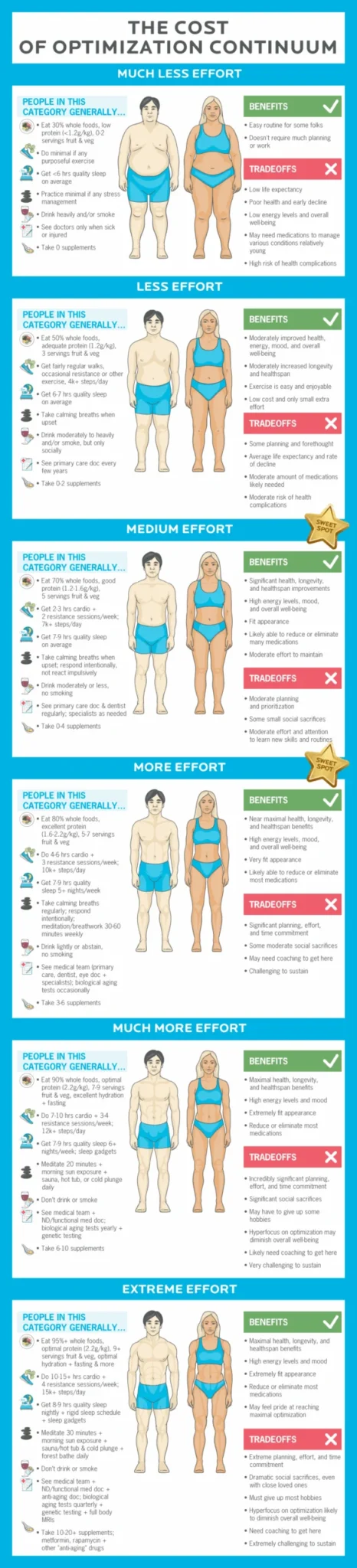
Consider a comparison between an individual consistently meeting foundational health recommendations ("healthy lifestyle") versus an "optimizer" who maximizes these behaviors and integrates numerous fringe recommendations. The "optimizer" might spend three to four times more time and money weekly on exercise, nutrition, and self-care. This does not even account for less frequent but costly interventions like specialized diagnostic tests (e.g., whole-body MRIs, advanced genetic sequencing), experimental therapies (e.g., stem cell treatments, specific hormone therapies), or cutting-edge gadgets (e.g., advanced recovery devices, red light therapy). These additional measures could easily incur tens of thousands of dollars annually. While this magnified effort might yield marginal extra benefits, the "healthy lifestyle" typically delivers at least 80 percent of desired improvements in lifespan, healthspan, and quality of life for a fraction of the investment.

Furthermore, an excessive focus on health and longevity can detrimentally impact overall well-being and quality of life. Highly restrictive or demanding regimens often lead to burnout and increased risk of abandoning foundational habits. More critically, an overemphasis on physical health can neglect other crucial aspects of "deep health," including relational, existential, mental, and emotional well-being. This can sometimes escalate into unhealthy fixations, such as disordered eating (orthorexia) or other mental health conditions, where the pursuit of health becomes an unhealthy obsession. The core principle should be that enjoying life is not separate from good health; it is an intrinsic component. While initial health efforts significantly boost life satisfaction, hyper-optimization can lead to a plateau or even a decline in overall well-being as the sacrifices outweigh the marginal gains.
Strategic Steps for Personalized Longevity
Navigating the complex landscape of health and longevity requires a personalized and pragmatic approach. Individuals are encouraged to:
- Clarify Personal Goals: Step back and honestly assess what truly matters most. What kind of life is desired? How does maximizing healthspan and lifespan align with other life priorities, such as relationships, career, personal passions, and financial security?
- Evaluate Tradeoffs Realistically: Given personal goals and available resources, determine what is realistically achievable. How much time, money, and effort is genuinely sustainable? What sacrifices are acceptable, and which are non-negotiable?
- Prioritize Foundational Behaviors: Review the seven foundational health behaviors outlined in this article. Identify areas where consistency can be improved. For the vast majority, enhancing adherence to these proven basics will yield substantial and tangible results, negating the need to pursue faddish or unproven "super-optimal" interventions. Individuals already consistently practicing most basics are in an elite category.
- Filter External Noise: Recognize that external voices, whether from podcasts or social media, do not hold all the answers for individual lives. Personal agency and self-awareness are paramount. Decisions about health should be authentically aligned with one’s own values and priorities, rather than driven by external pressures or idealized standards.
Ultimately, the journey to a longer, healthier life is deeply personal. By focusing on sustainable, evidence-based practices and making intentional choices aligned with individual values, one can achieve significant health benefits without succumbing to the allure and potential pitfalls of hyper-optimization